

TL;DR:
- Effective sustainable packaging requires a structured workflow from audit to pilot validation.
- Material choice depends on lifecycle impact, performance, compliance, and infrastructure compatibility.
- Continuous improvement and compliance awareness are key to balancing sustainability and market requirements.
Packaging claims that don’t hold up in the real world are a fast way to lose customer trust. A bag labeled “eco-friendly” that falls apart at the seam, or a compostable container that ends up in a landfill because local facilities don’t accept it, can do more damage to your brand than no sustainability effort at all. That gap between intention and execution is exactly where most North American retail and foodservice brands get stuck. This guide walks you through a proven, step-by-step workflow to close that gap, so your packaging delivers on its environmental promise and strengthens the brand equity you’ve worked hard to build.
Table of Contents
- Understand the drivers and requirements for sustainable packaging
- Audit current packaging and map requirements
- Select materials and suppliers for sustainable impact
- Pilot, test, and validate your packaging workflow
- Navigate trade-offs and regulatory challenges
- Why the ‘perfect’ sustainable packaging doesn’t exist—and what to do instead
- Take your sustainable packaging workflow further with Gather Packaging
- Frequently asked questions
Key Takeaways
| Point | Details |
|---|---|
| Structure matters | A step-by-step workflow ensures your sustainable packaging strategy actually delivers both environmental results and brand value. |
| Functional sustainability first | The right packaging always protects the product from waste before maximizing recyclability or compostability. |
| Navigate trade-offs wisely | There is no perfect material; every sustainable choice requires balancing regulations, infrastructure, and real-world performance. |
| Continuous improvement | Regularly pilot and validate your workflow to adapt to new rules and shifting consumer expectations. |
| Build loyalty, not just green claims | Authentic, effective packaging drives stronger customer retention and brand differentiation than eco-labeling alone. |
Understand the drivers and requirements for sustainable packaging
Let’s start by framing why a structured workflow is vital for North American retail and foodservice brands. Sustainability in packaging isn’t just a trend you can address with a quick material swap. It’s a business requirement shaped by consumer expectations, regulatory pressure, and operational realities that are all moving at once.
Consumer demand is real and measurable. 80% of consumers pay more for eco-friendly packaging, 70% actively prefer it, and brands that deliver on sustainability see up to a 25% increase in customer loyalty. But there’s a well-documented gap between what consumers say they want and what they actually choose at checkout. Price, convenience, and habit still drive decisions. That means your packaging has to be genuinely functional and visually compelling, not just green on paper.
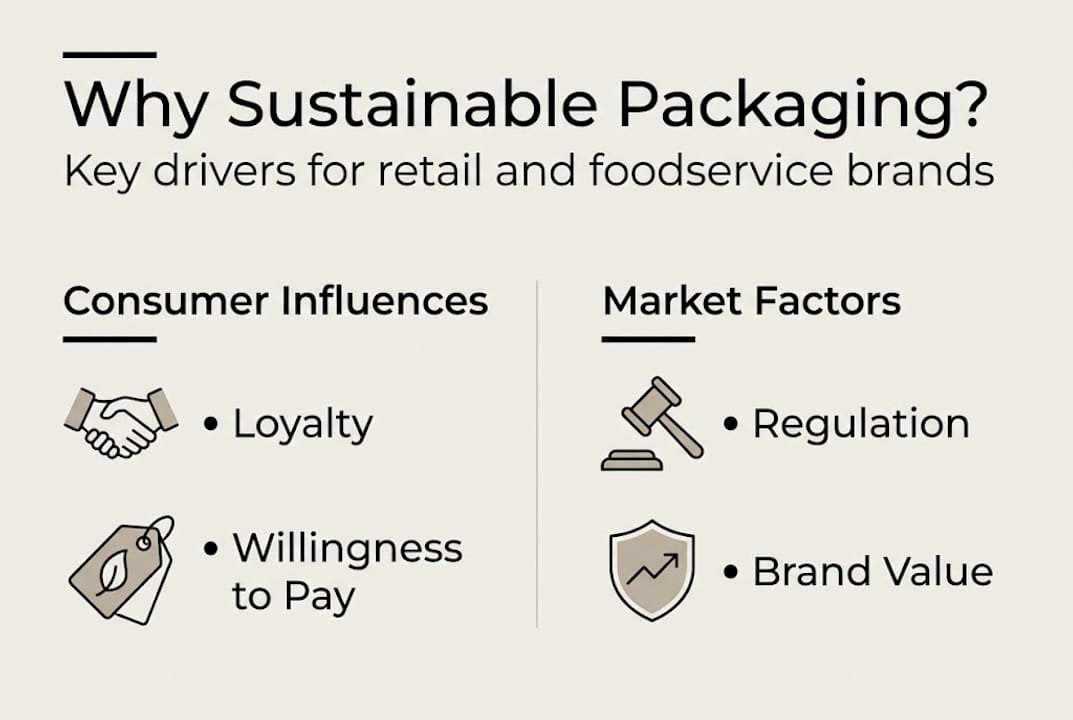
Regulatory pressure is accelerating. Extended Producer Responsibility (EPR) programs, which require brands to fund the end-of-life management of their packaging, are expanding across North American states and provinces. Recyclability standards, material restrictions, and labeling rules vary by jurisdiction. What passes compliance in one state may trigger a fine in another.
The sustainable packaging essentials you need to know go beyond choosing recycled content. A sustainable packaging workflow follows a structured methodology that emphasizes assessment, functional sustainability, and compliance from the start. Functional sustainability means protection comes first. Packaging that fails to protect your product creates waste upstream, which can offset any material-level environmental gains.
Here’s a quick look at the key drivers shaping sustainable packaging decisions in 2026:
| Driver | What it means for your brand |
|---|---|
| Consumer demand | 70-80% prefer eco options; loyalty rewards brands that deliver |
| EPR regulations | Fees and compliance rules tied to material recyclability |
| Brand differentiation | Sustainability signals quality and values to buyers |
| Functional performance | Product protection reduces waste across the supply chain |
| Market access | Some retailers now require sustainability credentials from suppliers |
Understanding green packaging and brand value as interconnected, rather than separate goals, is the first mindset shift that separates brands that succeed from those that just add a recycling symbol to their existing bag.
Audit current packaging and map requirements
Understanding the drivers is only useful if you have a clear picture of where you stand today. The next step is a structured audit.
Auditing and mapping involve lifecycle assessment, compliance review, and an honest view of material performance across your full packaging range. Start by collecting data on every packaging SKU you use: material type, supplier, cost per unit, performance history, and any known compliance issues.
Here’s a numbered process to follow:
- List every packaging SKU with material specs, weight, and current supplier.
- Score each SKU on protection performance, cost, and compliance status.
- Identify product groupings based on fragility and perishability (robust, resilient, delicate, highly perishable).
- Apply SMART design criteria: Systems thinking, Manufactured responsibly, Accessible to recycling or composting, Reusable or recyclable, and Targeted to product needs.
- Map gaps between your current state and your sustainability and compliance targets.
The comparison below shows how a typical audit reveals the distance between where most brands start and where they need to go:
| Packaging attribute | Current state | Target state |
|---|---|---|
| Material | Virgin paperboard | FSC-certified or recycled content |
| End-of-life | Landfill | Curbside recyclable |
| Compliance | Partial EPR alignment | Full EPR and How2Recycle certified |
| Performance | Adequate | Tested and validated |
| Cost per unit | Baseline | Within 10-15% of baseline |
This is also where your eco-friendly packaging workflow takes shape as a living document rather than a one-time checklist. Use it to track decisions, flag trade-offs, and set measurable targets for each phase.
Pro Tip: Don’t skip the compliance column in your audit. Many brands discover mid-project that their current packaging already violates emerging EPR rules in key markets. Catching this early saves significant rework costs. Reviewing retail packaging specs before you finalize your audit template can help you build in the right checkpoints from day one.
For brands in apparel, sustainable solutions for apparel packaging add another layer of complexity around presentation and protection that your audit should account for.
Select materials and suppliers for sustainable impact
With your packaging gaps mapped, you’re ready to decide on materials and partners that will deliver true sustainability gains.

Material selection is where brands most often get tripped up. The instinct is to chase the most eco-sounding option, whether that’s compostable, biodegradable, or plant-based. But fiber-based, PCR plastics, and molded fiber all carry different trade-offs in shelf life, cost, and actual environmental impact depending on your supply chain and end market.
Use a decision matrix to evaluate every material candidate across these criteria:
- Budget: Total cost including sourcing, logistics, and any EPR fees
- Performance: Moisture resistance, tear strength, load capacity
- Sustainability: Lifecycle impact, recycled content percentage, certifications
- Branding: Print quality, surface finish, visual appeal
- Operations: Compatibility with your fill lines and storage conditions
- Scalability: Can your supplier meet peak demand without quality drops?
- Compliance: Does the material meet current and projected EPR and labeling rules?
A decision matrix covering budget, performance, sustainability, branding, operations, scalability, and compliance gives you an objective score for each option rather than a gut-feel choice.
Paper-based packaging, including FSC-certified Kraft paper bags, scores well across most of these criteria for retail and foodservice. It’s curbside recyclable in most North American markets, printable with water-based inks, and compatible with EPR programs. Molded fiber is gaining ground for foodservice applications. PCR plastics remain relevant for applications where moisture resistance is non-negotiable.
Pro Tip: Ask every supplier for a transparency scorecard before signing a contract. Request their recycled content percentage, certifications (FSC, SFI, How2Recycle), and their own EPR compliance status. Suppliers who can’t answer these questions clearly are a liability in a regulated market.
Learning from Canadian packaging suppliers who manufacture domestically can also reduce your carbon footprint from shipping while shortening lead times. Thoughtful retail packaging design at this stage ensures your material choices support both brand impact and waste reduction goals. Explore foodservice packaging options to benchmark what leading operators are choosing in your category.
Pilot, test, and validate your packaging workflow
Choosing the right solution is just the beginning. Piloting and verification reveal if your sustainable packaging really delivers on its promise.
A structured pilot prevents costly full-scale rollouts of packaging that looks great on paper but fails in the field. Set up your pilot with clear, measurable goals tied to cost, greenhouse gas (GHG) impact, and product protection. Define your “kill criteria” before you start: for example, if costs rise more than 15%, or if product damage rates increase, the pilot stops and you return to the decision matrix.
Here’s a phased pilot structure:
- Phase 1: Small-batch production run with new material. Assess print quality, structural integrity, and fill-line compatibility.
- Phase 2: Limited market test with real customers. Collect feedback on appearance, durability, and unboxing experience.
- Phase 3: Lifecycle Assessment (LCA) to quantify actual GHG reduction versus your baseline.
- Phase 4: Compliance review. Confirm How2Recycle label accuracy and EPR fee projections.
- Phase 5: Scale decision. Go, iterate, or stop based on data from phases 1 through 4.
Empirical benchmarks show that paper and fiber-based packaging consistently delivers lower GHG emissions than reusable plastic crates (RPCs) across most product categories when full lifecycle data is applied. That’s a strong baseline for brands already leaning toward paper.
“Gated pilots ensure materials meet claims and operational realities before scaling.”
| Pilot checkpoint | Success metric | Kill criterion |
|---|---|---|
| Cost per unit | Within 10% of baseline | Greater than 15% above baseline |
| Product damage rate | Equal to or below current rate | Any increase above 2% |
| GHG reduction | Minimum 10% vs. baseline | No measurable reduction |
| Compliance status | Full How2Recycle alignment | Any labeling non-compliance |
Review how automated bag manufacturing affects consistency and quality at scale. Also check packaging compliance tips to make sure your pilot includes the right regulatory checkpoints. The full SPC Trends Report is a useful benchmark for comparing your pilot results against industry standards.
Navigate trade-offs and regulatory challenges
Even with a proven workflow, real-world execution demands continuous navigation of evolving rules and market trade-offs.
Every sustainable packaging format involves real trade-offs. Compostable packaging sounds ideal, but compostables are only ideal for soiled items and depend on local composting infrastructure that simply doesn’t exist in most North American markets. Recyclable packaging is more broadly supported, but material contamination and collection gaps still limit real-world recovery rates. Reusable packaging works in closed-loop systems but adds logistics complexity and cost.
Regional fragmentation makes this harder. A packaging format that meets California’s EPR requirements may not satisfy rules in Ontario or New York. Trade-offs persist across shelf life, price sensitivity, and regulatory confusion in ways that no single material or label can resolve.
“Regulations and infrastructure are shifting quickly. Brands that build review cycles into their workflow stay ahead; brands that don’t get caught flat-footed by rule changes.”
Here’s a checklist of what to review at least annually:
- EPR program updates in every state and province where you sell
- How2Recycle label accuracy for your current materials and local infrastructure
- Supplier certifications (FSC, SFI, recycled content claims)
- Consumer preference shifts tracked through sales data and returns
- Competitor benchmarking to stay aligned with category norms
- New material options from your supplier network
Staying current on packaging compliance and sustainability rules is not a one-time task. Review retail compliance considerations regularly to catch rule changes before they become violations. The FPI survey results are worth bookmarking as an annual benchmark for where the industry stands on these trade-offs.
Why the ‘perfect’ sustainable packaging doesn’t exist—and what to do instead
Having examined practical steps and roadblocks, let’s shift to a candid take on ‘perfection’ in sustainable packaging.
After working through audits, material matrices, and pilot programs, the most important thing we can tell you is this: there is no universally best sustainable packaging material. Every choice carries trade-offs. Paper excels on recyclability but has moisture limitations. Compostables score on end-of-life but fail on infrastructure. PCR plastics reduce virgin material use but face labeling scrutiny.
Chasing the “greenest” label often leads brands into expensive pivots that don’t actually reduce environmental impact. What works is a continuous workflow improvement mindset: set a baseline, measure against it, iterate, and improve. Brands that commit to this process consistently outperform those that make one big sustainability announcement and then stall.
The loyalty gains from genuine, documented progress far outpace any short-term price premium you might absorb. Customers reward honesty and momentum, not perfection.
Take your sustainable packaging workflow further with Gather Packaging
Ready to make your workflow a reality?
At Gather Packaging, we’ve built our entire process around the same principles this guide covers: audit, design, pilot, validate, and scale with compliance built in from day one. Our Toronto-based manufacturing delivers eco-friendly bag solutions that meet FSC certification, recycled content standards, and How2Recycle requirements without sacrificing print quality or structural performance.
Explore our Canadian-made packaging options for faster turnaround and lower logistics costs compared to overseas suppliers. Our custom Kraft paper bags are available in multiple styles with 8-color flexo printing, so your brand shows up exactly as intended. Connect with our team to start mapping your packaging workflow today.
Frequently asked questions
What are the key steps in a sustainable packaging workflow?
The main steps are auditing current packaging, mapping needs, choosing materials, vetting suppliers, piloting solutions, and validating results with LCAs and compliance checks.
How do I choose the best sustainable material for my brand?
Use a decision matrix accounting for budget, performance, branding, compliance, and total lifecycle ROI rather than just cost or material label.
Do compostable or recyclable packages always make sense?
Not always; compostables work best for soiled items if local facilities exist, while recyclables suit dry items—fit and infrastructure matter more than labels.
What’s the impact of EPR and new regulations on packaging choices?
EPR and state rules in North America increasingly favor easily recyclable or compostable packaging, making compliance a core business requirement rather than a nice-to-have.
How does sustainable packaging affect customer loyalty and revenue?
Eco-friendly packaging can boost customer loyalty by up to 25% and increase willingness to pay, according to North American market data from leading foodservice research.
Share:
Packaging specs: Drive eco-friendly retail success
Packaging Quality Assurance Checklist for Sustainable Solutions