

TL;DR:
- A single packaging failure can cost over ten million dollars in damages.
- Clear standards for appearance, integrity, and eco-compliance are essential for effective QA.
- Continuous tracking of defects and testing results drives process improvements and sustainability credibility.
A single packaging failure can trigger a recall that costs your business an average of $10M or more in direct and indirect losses. For retail and foodservice operators sourcing sustainable packaging, that risk is compounded by the added complexity of eco-friendly materials that must meet both performance and environmental standards. Quality assurance is not a nice-to-have. It is the operational backbone that keeps your brand protected, your customers satisfied, and your sustainability commitments credible. This guide walks you through a practical, step-by-step quality assurance checklist built specifically for business owners managing sustainable packaging in North American retail and foodservice environments.
Table of Contents
- Set your quality standards: criteria for sustainable packaging
- Inspection checklist: how to spot defects and prevent failures
- Testing protocols: how to validate packaging performance
- Continuous improvement: tracking defects and optimizing your process
- What most checklists miss: integrating sustainability and real-world risk
- Explore sustainable packaging solutions and quality assurance with Gather Packaging
- Frequently asked questions
Key Takeaways
| Point | Details |
|---|---|
| Set clear quality criteria | Define packaging standards covering defects, sustainability, and regulatory compliance for reliable results. |
| Use standard inspection checklists | Follow established checklists and defect categorization to systematically spot issues before they reach customers. |
| Validate with industry testing protocols | Testing according to ASTM and ISTA standards ensures packaging performs and protects during real-world handling. |
| Continuously track and improve | Monitor defect metrics and feedback to adapt processes and avoid costly recalls as your business scales. |
| Integrate sustainability in QA | Sustainable criteria and continuous improvement together deliver long-term value and safer packaging for your customers. |
Set your quality standards: criteria for sustainable packaging
Before you inspect a single bag or run a single test, you need to define what “good” looks like. Without clear standards, inspections are subjective and inconsistent, which means defects slip through and your quality program loses credibility fast.
Strong packaging quality standards cover three dimensions: appearance, structural integrity, and eco-compliance. Appearance includes print registration, color consistency, and surface finish. Integrity covers seam strength, handle attachment, load capacity, and moisture resistance. Eco-compliance means verifying that materials meet the certifications and specs you have committed to, whether that is FSC® certification, recycled content percentages, or compostability ratings.
The USDA uses a clear three-tier defect classification system that is worth adopting directly:
- Critical defects: Contamination, mold, foreign materials, or any condition that creates a health or safety risk. Zero tolerance for critical defects is the standard.
- Major defects: Structural failures like broken handles, torn seams, or missing components that make the packaging non-functional.
- Minor defects: Cosmetic issues such as slight color variation or minor surface scuffs that do not affect function.
For sustainable packaging specifically, your standards should also address:
- Recyclability verification (material type labeling, contamination-free surfaces)
- Compostability certification status (BPI or equivalent)
- Mechanical robustness under real-world load and humidity conditions
- Ink and adhesive compliance with water-based or food-safe requirements
Statistic: Packaging defects that reach distribution cost businesses significantly more to address than defects caught at the source. Catching issues before shipment is always the lower-cost option.
Pro Tip: When you define your eco-friendly packaging specs, document them in a formal spec sheet that travels with every order. This gives your supplier, your QA team, and your receiving staff a shared reference point, eliminating the “I thought it was supposed to look like this” conversations that waste time and money.
Once your standards are written down and agreed upon, you have the foundation for every inspection and test that follows.
Inspection checklist: how to spot defects and prevent failures
With your standards defined, you need a repeatable inspection process. Inconsistent inspections are almost as dangerous as no inspections at all. Here is a practical step-by-step approach:
- Pull your sample set. Use the QAD 617A worksheet sampling method to determine how many units to inspect per lot. Sampling size scales with lot size, and the worksheet provides exact guidance.
- Conduct a visual inspection. Check each sampled unit for surface defects: mold, stains, tears, dents, print misalignment, and color inconsistency.
- Test structural integrity. Physically load each bag to its rated capacity. Check handle attachment points, seam bonds, and bottom gussets under stress.
- Verify eco-compliance markings. Confirm certification labels, recycled content statements, and material type codes are present and legible.
- Document every finding. Record defect type, severity, and unit count. Categorize each defect as critical, major, or minor.
- Make a disposition decision. Based on your findings, accept the lot, place it on hold for re-inspection, or reject it entirely.
Here is how defect handling differs by category:
| Defect type | Examples | Acceptable rate | Action |
|---|---|---|---|
| Critical | Mold, contamination, foreign material | Zero tolerance | Reject entire lot |
| Major | Broken handles, torn seams, missing components | Very low (AQL 1.0) | Hold and re-inspect |
| Minor | Surface scuffs, slight color variation | Low (AQL 4.0) | Accept with documentation |
The most commonly missed defects in sustainable paper packaging are moisture-related. Paper bags exposed to humidity during storage or transit can develop soft spots, weakened seams, and mold growth before they ever reach a retail shelf. Build a humidity check into your receiving process, especially for packaging recalls prevention during high-humidity seasons.
“A defect found at receiving costs a fraction of a defect found by your customer.”
Regular sampling of packaging quality across multiple lots over time also reveals supplier trends. If one supplier consistently produces minor defects in a specific area, that pattern is worth addressing before it escalates.
Testing protocols: how to validate packaging performance
Visual inspection catches surface and structural issues, but it does not tell you how your packaging performs under the real conditions of shipping, stacking, and handling. That requires standardized testing.
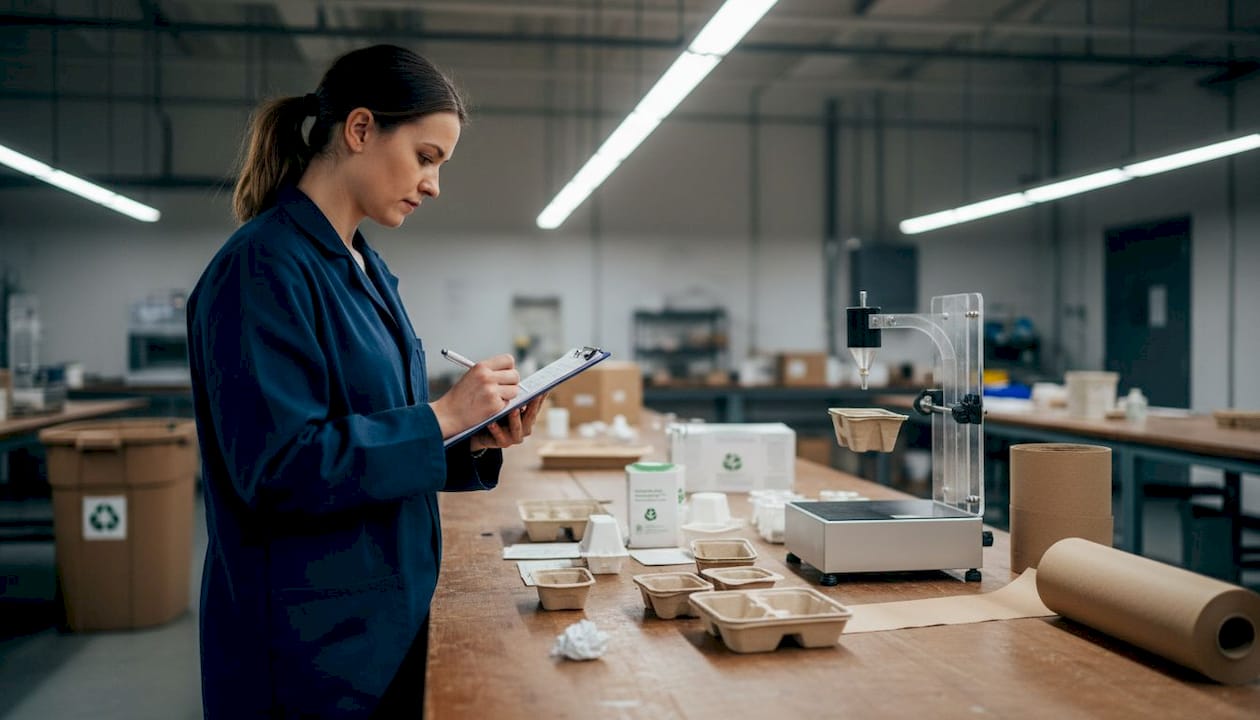
Two industry benchmarks dominate North American packaging testing. ASTM D4169 simulates distribution cycles including vibration, drop, compression, and climate exposure, and the FDA recognizes it as a valid performance standard. ISTA 3A covers similar ground with a focus on parcel shipment environments. Both are relevant depending on whether your packaging moves through retail supply chains or direct-to-consumer fulfillment.
Here is a practical testing reference for retail and foodservice packaging:
| Test type | Standard | Frequency | Application |
|---|---|---|---|
| Drop test | ASTM D4169 | Every new design or material change | Retail and foodservice |
| Vibration test | ISTA 3A | Every new supplier or batch change | Retail distribution |
| Compression test | ASTM D4169 | Quarterly or after stacking complaints | Stacked storage |
| Leak detection | ASTM D3078 | Every food-contact packaging run | Foodservice |
| Grease resistance | TAPPI T559 | Every foodservice bag batch | Foodservice |
For foodservice operators, leak integrity is non-negotiable. Bubble emission testing using ASTM D3078 can detect leaks as small as 250 microns, which is well below the threshold visible to the naked eye. This matters enormously when your bags carry hot food, sauces, or oily items.
Key tests to prioritize for sustainable paper bags:
- Drop testing at multiple orientations to simulate real handling
- Vibration testing to replicate transit conditions
- Compression testing to validate stacking strength in storage
- Leak detection for any food-contact application
Pro Tip: If your foodservice bags handle high-grease items, run the TAPPI T559 Kit 8 or higher grease resistance test on every batch. A bag that passes visual inspection but fails grease resistance will leak on your customer’s hands, not in your warehouse. That is the worst possible place to find a defect.
Aligning your testing program with a sustainable packaging workflow means scheduling tests at defined production milestones, not just when something looks wrong. Build testing into your standard operating procedures and review compliance in packaging testing requirements annually as standards update.
Continuous improvement: tracking defects and optimizing your process
Testing and inspection catch problems. Tracking and analysis prevent them from recurring. This is where most small and mid-size businesses leave significant value on the table.
Two metrics form the core of any packaging quality improvement program:
- Defects Per Million (DPM): The number of defective units per million produced or received. Lower is better. Use this to compare supplier performance over time.
- First Pass Yield (FPY): The percentage of units that pass inspection without rework or rejection on the first attempt. Higher is better. A strong FPY signals a stable, well-controlled production process.
Tracking these metrics across batches and suppliers gives you data to act on, not just problems to react to. Industry benchmarks for DPM and FPY vary by industry, but the goal is always a consistent trend toward improvement.
Actions that drive real improvement when your tracking data shows problems:
- Review and tighten spec sheets with your supplier when DPM rises
- Increase sampling frequency temporarily after a batch rejection
- Conduct a root cause analysis on any critical defect before resuming orders
- Adjust storage and handling procedures if defects cluster around receiving rather than production
- Benchmark your FPY quarterly and set improvement targets for the next period
The branding impact of quality is real and measurable. Customers notice when bags tear, leak, or look inconsistent. Each defect that reaches your customer is a brand impression you cannot take back.
Building a simple tracking spreadsheet is enough to start. Log every inspection, every defect, every test result. After three to six months, patterns emerge that tell you exactly where to focus. Pair this with a commitment to reducing waste in packaging and you create a quality program that also supports your sustainability goals.
What most checklists miss: integrating sustainability and real-world risk
Here is something worth saying plainly: most packaging quality checklists are built for conventional materials and conventional risks. They check boxes for structural integrity and contamination, but they rarely ask the harder questions that sustainable packaging demands.
Eco-friendly materials behave differently. Recycled paper stock has more variability than virgin fiber. Compostable coatings respond differently to humidity. Water-based inks can react unpredictably with certain surface treatments. A checklist that was designed for conventional packaging will miss these failure modes entirely.
The other gap we see consistently is the absence of continuous improvement thinking. A checklist is a point-in-time tool. It tells you whether this batch passed or failed. It does not tell you whether your quality is getting better or worse over time, and it does not connect defect data to process decisions.
For North American business owners, the practical fix is to integrate eco-material-specific criteria directly into your standards and inspection steps, and to treat your defect data as a management tool, not just a compliance record. Choosing Canadian packaging partners who already operate with rigorous QA processes built around sustainable materials shortens this learning curve considerably. You inherit their experience instead of building it from scratch.
Explore sustainable packaging solutions and quality assurance with Gather Packaging
If you are ready to move from reactive quality checks to a proactive, sustainability-integrated QA program, Gather Packaging is built to support that transition.
We manufacture FSC®-certified, eco-friendly paper bags in Toronto with quality assurance built into every stage of production. From prototyping to final delivery, our process is designed to give you confidence in every order. Explore our full range of sustainable packaging options and browse custom kraft paper bags designed for retail and foodservice. When you are ready to dig into the details of our QA process, our quality assurance resources are available to walk you through exactly how we maintain consistency at scale.
Frequently asked questions
What are the most critical packaging defects to check for?
Critical defects like mold, foreign materials, and contamination carry a zero-tolerance standard and require immediate lot rejection to protect product safety and brand integrity.
How often should packaging be tested for quality?
Test every batch as a baseline, and run additional testing after any material, supplier, or design change, following ASTM D4169 or ISTA 3A protocols to stay consistent with industry standards.
What tools help detect leaks or integrity issues?
Bubble emission testing using ASTM D3078 identifies leaks as small as 250 microns, making it the recommended method for any food-contact or foodservice packaging application.
Which metrics should be tracked for packaging quality improvement?
Monitor Defects Per Million and FPY consistently across batches and suppliers to identify trends, benchmark performance, and drive targeted process improvements over time.
Share:
Build a Sustainable Packaging Workflow to Elevate Your Brand
Packaging mockups: faster, smarter custom designs