

TL;DR:
- Rising supply chain issues make domestic packaging more reliable than overseas options.
- Local manufacturing enhances quality control, compliance, and traceability, especially for food safety.
- Sourcing domestically supports sustainability, brand recognition, faster response, and operational flexibility.
Most retail and foodservice operators assume overseas packaging automatically means lower costs. That assumption made sense a decade ago, but the math has changed. Supply chain disruptions, rising freight rates, customs delays, and quality inconsistencies have quietly eroded the savings that once made offshore sourcing attractive. Meanwhile, your packaging is doing something far more important than just holding a product: it is telling your customers who you are. For North American brands that care about consistency, compliance, and growth, the case for domestic packaging manufacturers has never been stronger.
Table of Contents
- Understanding the true costs of overseas packaging
- Quality, compliance, and food safety: Why local matters
- Sustainability and local impact: Strengthening your brand
- Faster, flexible, and custom: The competitive edge of domestic packaging
- Our take: Why domestic packaging is a branding investment, not just a cost
- Ready to elevate your packaging? Partner with local experts
- Frequently asked questions
Key Takeaways
| Point | Details |
|---|---|
| Hidden costs add up | Overseas packaging’s apparent savings often disappear due to shipping, delays, and quality risks. |
| Local control boosts quality | Domestic manufacturers let you manage quality, compliance, and safety more closely. |
| Sustainability enhances brand | Eco-conscious, locally made packaging strengthens your business’s responsible image. |
| Custom options drive growth | Responsive customization from domestic suppliers helps you keep up with market needs and stand out. |
Understanding the true costs of overseas packaging
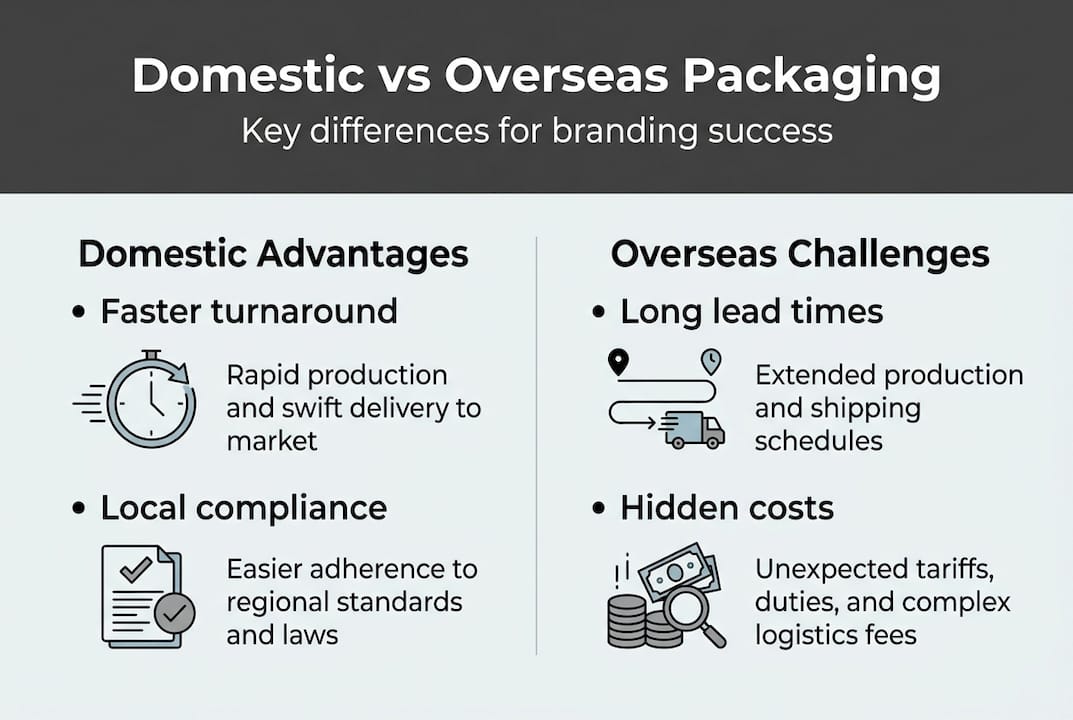
The sticker price on overseas packaging looks appealing until you start counting everything else. Shipping lead times of 8 to 16 weeks mean you need to carry heavy safety stock, which ties up capital and warehouse space. Customs clearance adds unpredictable delays. When a shipment arrives with the wrong color, a printing defect, or substandard materials, your options are limited: accept the flawed product, wait months for a replacement, or scramble for an emergency local order at premium prices.
These are not rare edge cases. Many brands switch manufacturers precisely because overseas quality problems compound over time. A single bad batch can trigger customer complaints, damage your reputation, and force costly product recalls.
The broader market is already shifting in response. The North America foodservice packaging market is projected at USD 26.69 billion in 2026 and growing to 30.37 billion by 2031, with a 2.62% CAGR, and a clear trend toward domestic supply for operational resilience. Businesses are recognizing that reliability is worth paying for.
Consider what packaging inconsistency actually costs you in brand equity:
- Customers notice when your bags look different from order to order
- Foodservice operators risk compliance violations from unapproved materials
- Retail brands lose shelf impact when colors shift between production runs
- Emergency reorders destroy margin and create operational chaos
“The real cost of cheap packaging is not measured at the point of purchase. It shows up in customer churn, operational firefighting, and brand dilution over months and years.”
For a deeper look at why businesses are rethinking their sourcing strategy, Canadian manufacturers in 2026 offer a compelling alternative that addresses these pain points directly. The shift is not just about cost. It is about building a supply chain that actually supports your business goals.
Quality, compliance, and food safety: Why local matters
When your packaging touches food, the stakes are higher than aesthetics. Domestic manufacturers operate under the same regulatory environment you do, which makes compliance verification straightforward rather than a guessing game. Understanding packaging compliance matters is not optional for foodservice operators: the wrong material can trigger a health inspection failure or a liability issue.
4 trends driving foodservice packaging confirms that domestic production supports superior quality control, regulatory compliance, and traceability, which are crucial for foodservice safety standards. When something goes wrong, you can call your manufacturer and get a real answer the same day, not wait for a time-zone-delayed email chain.
Here is how domestic and overseas packaging compare on key quality metrics:
| Factor | Domestic manufacturer | Overseas manufacturer |
|---|---|---|
| Lead time | 2 to 4 weeks | 8 to 16 weeks |
| Quality audit access | Direct, in-person | Limited, third-party |
| Regulatory alignment | Built-in | Requires verification |
| Rapid prototyping | Yes | Rarely |
| Traceability | Full chain visibility | Often limited |
For businesses that want to get their quality assurance process right, here is a practical approach:
- Request material certifications upfront, including FSC® status and food-safe ink documentation
- Schedule a facility audit or request a virtual walkthrough before committing to a production run
- Order a prototype batch and test it in real operating conditions before scaling
- Establish a clear defect reporting process so issues get resolved in the same production cycle
- Review compliance documentation annually as regulations evolve
Pro Tip: Ask your manufacturer for a sample of their food-safe packaging guide documentation. A supplier who cannot produce clear material safety data quickly is a supplier who will slow you down when it matters most.
For foodservice operations in particular, Canadian-made bags give you direct access to the production team, meaning traceability is not a buzzword but an actual operational reality. That kind of traceability and supply chain visibility is what separates businesses that manage risk from those that react to it.
Sustainability and local impact: Strengthening your brand
Sustainability is no longer a nice-to-have feature on a packaging brief. It is a purchase driver. Consumers are paying attention to how brands source and produce their materials, and packaging is one of the most visible signals a business sends. Choosing a domestic manufacturer with certified sustainable materials is one of the fastest ways to make that signal credible.
Shorter transport distances mean lower carbon emissions per unit. When you source packaging from a Toronto-based manufacturer rather than overseas, you are cutting thousands of miles from the supply chain. That reduction is measurable, reportable, and increasingly important to retail buyers and foodservice procurement teams who have their own sustainability targets to meet.
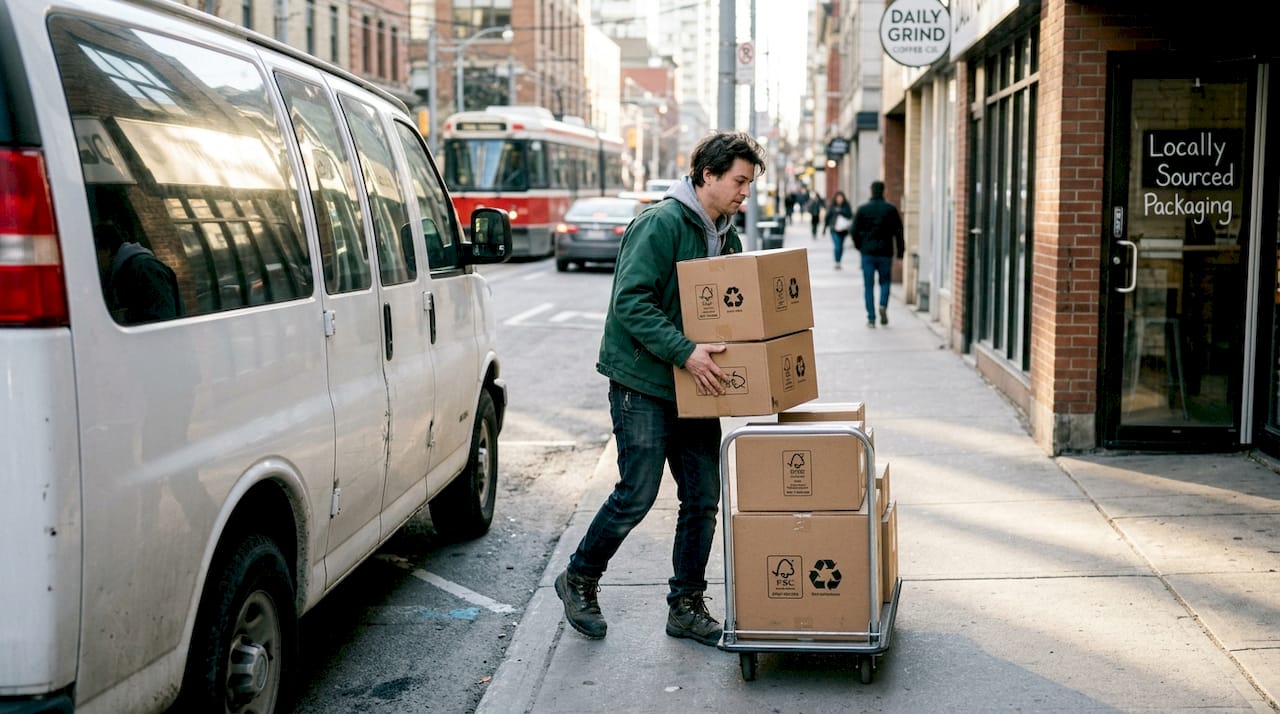
Here is a comparison of sustainability outcomes by sourcing approach:
| Sustainability factor | Domestic sourcing | Overseas sourcing |
|---|---|---|
| Transport emissions | Low | High |
| Material certification visibility | Easy to verify | Harder to confirm |
| Biodegradable options | Readily available | Variable |
| Community economic impact | Local jobs supported | Minimal local benefit |
| Packaging waste from defects | Lower | Higher |
The brand benefits are equally tangible. Custom domestic packaging enhances brand visibility and has been linked to 30% faster service in case studies, turning packaging into a direct marketing tool. That is not a trivial number for a foodservice operator trying to improve throughput.
Building a strong marketing strategy with packaging means treating every bag as a brand touchpoint. A well-designed, locally produced bag with your logo, your colors, and your message creates a consistent customer experience from the moment someone picks up their order.
- FSC®-certified paper signals environmental responsibility without extra explanation
- Water-based inks reduce chemical exposure and support recycling
- Biodegradable options give customers a reason to feel good about choosing your brand
- Consistent color matching across runs builds visual brand recognition
For a practical framework on making sustainability part of your brand story, the sustainable branding guide walks through how packaging choices connect to long-term brand equity. And if you want to explore the full range of eco-friendly bags available from a domestic source, the options are broader than most businesses expect.
Faster, flexible, and custom: The competitive edge of domestic packaging
Speed is a competitive advantage that overseas sourcing simply cannot match. When your domestic manufacturer is a two-hour drive away instead of an ocean crossing, your ability to respond to market changes is fundamentally different. That responsiveness translates directly into business outcomes.
Just-in-time inventory becomes a real possibility rather than a wishful thinking exercise. You can order smaller quantities more frequently, reduce warehousing costs, and avoid the cash flow hit of carrying six months of stock. When a seasonal promotion comes up or a product line changes, you can adapt your packaging in weeks rather than quarters.
Custom domestic packaging has demonstrated measurable impact on service efficiency, with case studies showing 30% faster service when packaging is purpose-built for the operation. That kind of operational fit is only possible when your manufacturer understands your workflow and can iterate quickly with you.
Here is how to take full advantage of domestic manufacturing flexibility:
- Plan for short-run promotional packaging tied to seasonal events or product launches
- Use rapid prototyping to test new bag formats before committing to a full production run
- Coordinate with your manufacturer on inventory forecasting to smooth out demand spikes
- Leverage 8-color flexo printing capabilities to create packaging that genuinely stands out on the shelf
- Build a direct relationship with the production team so last-minute changes get handled as a priority
Pro Tip: Think about customer experience and loyalty when briefing your packaging supplier. Customers remember the unboxing moment. A bag that feels premium, looks consistent, and carries your brand clearly is doing marketing work you are not paying extra for.
For retail businesses looking to cut waste and boost sales, domestic flexibility also means you can right-size your packaging more precisely, reducing material waste and per-unit cost simultaneously. Exploring the full range of custom paper bags available domestically will show you how much design freedom you actually have. And for businesses ready to scale your brand, domestic partnerships grow with you in ways overseas suppliers rarely can.
Our take: Why domestic packaging is a branding investment, not just a cost
Most business leaders treat packaging as a line item to minimize. We think that is the wrong frame entirely. Packaging is the last physical touchpoint between your brand and your customer, and it is doing active work every single time someone carries your bag out the door.
The businesses we see winning on packaging are not the ones who found the cheapest overseas option. They are the ones who recognized that consistency, quality, and brand alignment compound over time. Every customer who carries a well-made, well-branded bag is advertising for you. Every customer who gets a flimsy, inconsistent bag is forming a quiet negative impression.
Domestic manufacturers eliminate the headaches that imports create: the delayed shipments, the quality surprises, the compliance uncertainty. More importantly, they give you a real partner who can help you build something. For insights on what makes domestic manufacturing insights genuinely different, the operational and brand advantages go well beyond what most cost analyses capture. Treat your packaging budget as a brand investment and you will start making decisions that pay off for years.
Ready to elevate your packaging? Partner with local experts
If the hidden costs of overseas sourcing and the brand upside of domestic manufacturing have you thinking differently about your packaging strategy, Gather Packaging is built exactly for this moment.
We manufacture bags made in Canada with FSC®-certified materials, water-based inks, and up to 8-color flexo printing, all from our Toronto facility. Whether you need custom kraft paper bags for a retail launch or eco packaging options for a foodservice operation, we offer fast turnaround, full design support, and the kind of quality assurance that only comes from working with a manufacturer you can actually visit. Let’s build packaging that works as hard as your brand does.
Frequently asked questions
What are the main advantages of using domestic packaging manufacturers?
Domestic manufacturers offer better quality control, faster turnaround, and easier compliance with North American food safety regulations. Domestic production also provides full supply chain traceability, which is critical for foodservice operators managing risk.
How does domestic packaging benefit sustainability goals?
Local production means shorter transport distances and lower carbon emissions per unit, while also making it easier to verify eco-friendly material certifications. Custom domestic packaging has been shown to enhance brand visibility and operational efficiency simultaneously.
Is custom branding easier with domestic packaging suppliers?
Yes, domestic manufacturers enable faster and more flexible customization, including short runs, last-minute changes, and special promotions. Custom packaging visibility improvements like 30% faster service show how purpose-built packaging directly supports operations.
Do domestic packaging suppliers cost more?
While unit costs can be slightly higher, reduced shipping fees, fewer customs delays, and better quality control often make the total cost comparable or lower when you factor in emergency reorders and quality failures avoided.
Share:
Green packaging explained: boost sustainability and brand value
How to order custom bags for retail & foodservice branding