
TL;DR:
- Custom eco-friendly paper bags enhance brand visibility and meet sustainability standards.
- Proper preparation and clear communication streamline the ordering process and prevent costly errors.
- Working with knowledgeable suppliers as strategic partners results in better branding and product quality.
Generic bags are quietly working against you. When a customer walks out of your store or restaurant with a plain, non-branded bag made from mystery materials, you lose a branding moment and risk falling behind tightening plastic bag regulations sweeping North America. Custom, eco-friendly paper bags solve both problems at once: they carry your logo, tell your story, and meet the sustainability standards your customers increasingly expect. This guide walks you through everything, from gathering your specs and choosing the right materials to approving proofs, avoiding costly mistakes, and rolling out your new bags with maximum impact.
Table of Contents
- What you need before ordering custom bags
- Step-by-step guide: How to order custom bags
- Common mistakes when ordering custom bags (and how to avoid them)
- What to expect: Lead times, delivery, and final results
- What most brands get wrong about custom bag ordering
- Order custom eco-friendly bags with Gather Packaging
- Frequently asked questions
Key Takeaways
| Point | Details |
|---|---|
| Prep your requirements | Gather logos, specs, and compliance details before starting your order. |
| Follow each ordering step | Move methodically from quote to proof approval to avoid costly errors. |
| Avoid common mistakes | Double-check artwork quality and compliance needs to prevent production delays. |
| Anticipate realistic timelines | Expect 3-6 weeks for delivery of most custom eco-friendly bag orders. |
| Sustainability adds value | Opting for eco-friendly bags boosts brand image and meets client and regulatory expectations. |
What you need before ordering custom bags
Before you contact a single supplier, get your house in order. Brands that show up to the quoting process unprepared waste weeks going back and forth, and sometimes end up with bags that don’t reflect their identity or meet local compliance rules. Pulling the right information together upfront is the single fastest way to get better bags, faster.
Start with these essentials:
- Logo files in vector format (AI or EPS preferred). Raster images like JPGs will not print cleanly at bag scale.
- Brand color codes in Pantone, CMYK, or RGB. Consistency matters more than you think when ink meets paper.
- Target order quantity. Most manufacturers work in runs of 1,000 to 5,000 units minimum, so know your volume before asking for a quote.
- Hard deadline. Production and shipping take time. Work backward from your launch or seasonal event.
- Preferred bag style. Turn top, serrated top, and tamper-resistant are common options for retail and foodservice respectively.
Material selection is where sustainability meets strategy. Eco-friendly materials like recycled and compostable options are standard in 2026, and your choice here signals your brand values before a customer even opens the bag. Kraft paper is durable and biodegradable. Recycled content bags reduce raw material demand. Compostable options are ideal for food-to-go applications where the bag may contact organic waste.
| Material type | Best use case | Sustainability benefit |
|---|---|---|
| Virgin kraft | Premium retail, apparel | Strong, printable, biodegradable |
| Recycled kraft | Everyday retail, grocery | Reduces raw material use |
| Compostable paper | Foodservice, to-go | Breaks down in compost systems |
| FSC-certified paper | Any industry | Verified responsible sourcing |
Branding requirements go beyond slapping a logo on the front panel. Think about logo placement on multiple panels, tagline inclusion, handle color, and whether you want inside printing for an upscale unboxing feel. Explore your printing options for branding early so you know what’s possible before locking in a design direction.
Sizing is often underestimated. A bag that’s too small for your product damages the customer experience. A bag that’s too large looks sloppy and wastes material. Review your design guide for retail to match dimensions to your actual product range.
Pro Tip: If you operate in California, New York, or other jurisdictions with active bag legislation, confirm your chosen material meets local compliance standards before finalizing your order. Asking your supplier upfront saves you from a costly reorder.
Step-by-step guide: How to order custom bags
Once you’ve gathered your specs, the ordering process is more straightforward than most brands expect. Here’s how it typically flows from first contact to final delivery.
- Submit a quote request. Send your specs, logo files, quantity, deadline, and material preferences to your chosen manufacturer. The more detail you include, the more accurate your quote will be.
- Review the digital proof. Your supplier will generate a mockup showing your design on the actual bag template. Check every element: logo size, placement, color, and text.
- Request a physical sample if needed. For large orders or premium products, a physical prototype lets you feel the paper weight, handle quality, and print finish before committing to bulk production. Custom bag manufacturers typically provide proofs and samples before bulk production.
- Confirm all specs in writing. Once you’re satisfied with the proof, confirm dimensions, quantity, material, and print colors in a written approval. This protects both parties.
- Submit your purchase order. After written approval, the manufacturer moves your job into the production queue.
- Track production and shipping. Ask for a confirmed production start date and estimated ship date so you can plan your inventory and launch.
Direct vs. distributor ordering: which is right for you?
| Factor | Direct manufacturer | Distributor |
|---|---|---|
| Price | Lower per unit | Markup applied |
| Lead time | Faster, fewer handoffs | May add time |
| Customization | Full control | Limited by distributor catalog |
| Communication | Direct with production team | Intermediary involved |
| Minimum order | Higher typical minimums | Sometimes lower |
Understanding the full bag manufacturing process helps you ask smarter questions and set realistic expectations. Knowing what happens between proof approval and shipping means you won’t be caught off guard by production timelines.

Pro Tip: Always get your proof approval done within 48 hours of receiving it. Delays at the proof stage are the number one reason orders miss their target delivery dates.
Common mistakes when ordering custom bags (and how to avoid them)
Even experienced buyers make avoidable errors. These are the mistakes that cost brands time, money, and credibility, along with how to sidestep each one.
Supplying low-resolution artwork. Sending a logo pulled from your website almost always results in a blurry print. Always supply vector files. If your design team only has raster files, ask your bag supplier if they offer artwork preparation services before the project kicks off.
Missing proof approval deadlines. Production slots fill up fast, especially around Q4 and seasonal peaks. When you delay approving a proof, your order gets pushed back in the queue. Treat proof approval like a hard business deadline.
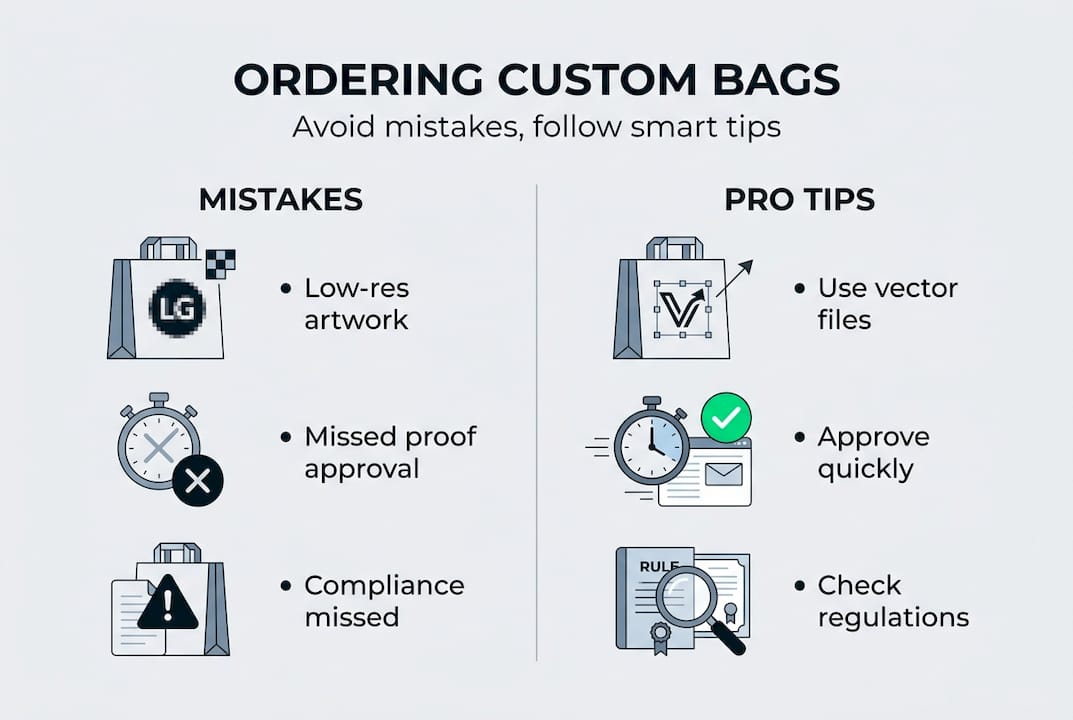
Skipping compliance details. Omitting compliance information can result in non-compliant bags that cannot be used in some regions. If you need compostable certification, recycled content percentages, or FSC labeling, state this clearly in your initial quote request.
Ordering the wrong quantity. Running out of bags mid-season forces a rush reorder at premium cost. Ordering too many ties up cash in inventory. Use your sales history or projected volume to land on a realistic number, and ask your supplier about reorder lead times so you can plan ahead.
Forgetting special requirements. Custom handles, inside printing, tissue paper compatibility, or specific handle lengths all need to be communicated before production starts. Changes after proof approval can reset your timeline entirely.
“The brands that get the best results are the ones who treat the briefing stage like a creative project, not a checkbox exercise. Every detail you communicate upfront is a detail you don’t have to fix later.”
Review design tips for sustainability to make sure your design choices align with both your aesthetic goals and your environmental commitments. A bag that looks great and meets eco standards is not a compromise. It’s the standard.
Pro Tip: Create a one-page brief template for every custom bag order. Include logo files, color codes, dimensions, quantity, deadline, compliance needs, and special requirements. Sharing this with your supplier at the first touchpoint eliminates most back-and-forth.
What to expect: Lead times, delivery, and final results
Approving your proof is not the finish line. It’s the starting gun for production. Setting accurate expectations for what comes next protects your launch timeline and your sanity.
Typical lead times by order type:
| Order type | Estimated lead time |
|---|---|
| Stock bags with basic imprint | 1 to 2 weeks |
| Semi-custom (standard size, custom print) | 3 to 4 weeks |
| Fully custom (size, style, print) | 5 to 7 weeks |
| Rush orders (when available) | 1 to 2 weeks with premium |
Once your bags arrive, don’t just sign the delivery receipt and move on. A thorough receiving inspection protects you if there are issues.
What to check upon delivery:
- Print quality. Compare printed bags to your approved proof. Colors should match, text should be sharp, and logo placement should be consistent across the run.
- Order accuracy. Count a sample of the shipment to verify quantity. Check that the bag style, size, and handle type match your purchase order.
- Eco certifications. If you ordered FSC-certified or compostable bags, verify that the certification markings appear correctly on the bag or on the accompanying documentation.
- Structural integrity. Pull handles, check seams, and load a bag with your heaviest product to confirm durability before putting bags into circulation.
For rollout, consider a phased deployment. Introduce your new branded bags in your flagship location or busiest channel first, gather feedback, then scale. This approach catches any real-world issues before they affect your entire customer base.
Switching to custom eco-friendly bags is also a measurable sustainability win. Eco-friendly custom bags can reduce your company’s carbon emissions by over 60% compared to plastic bags. That’s a number worth sharing in your marketing, on your website, and in your packaging itself. Review your branding guide for retail to make the most of your new packaging as a brand asset.
What most brands get wrong about custom bag ordering
After working with retail and foodservice brands across North America, one pattern stands out: most teams treat custom bag ordering as a procurement task rather than a brand-building opportunity. They focus on price per unit and basic logo placement, then wonder why their packaging feels forgettable.
The brands that stand out use every inch of the bag intentionally. They think about the handle color, the inside panel, the tagline, and whether their sustainability story is visible to the customer. They also ask their supplier what’s possible instead of just submitting a brief and waiting.
Supplier expertise is an underused resource. Manufacturers who specialize in eco-friendly paper bags have seen hundreds of projects. They know which materials photograph well, which handle styles hold up under heavy loads, and which sustainable printing options deliver the best color fidelity on kraft paper. Brands that treat their bag supplier as a strategic partner, not just a vendor, consistently get better results at lower cost. That shift in mindset is what separates good packaging from packaging people actually remember.
Order custom eco-friendly bags with Gather Packaging
If you’re ready to move from generic to genuinely branded, Gather Packaging makes that transition straightforward for North American retail and foodservice operators.
With over a century of combined manufacturing experience and domestic production in Toronto, Canada, we deliver fast turnaround, lower costs, and bags built to your exact specifications. Our sustainable bag solutions include FSC-certified, recycled, and compostable options printed with water-based inks using 8-color flexo technology. Browse our full range of custom kraft bag options or learn more about our Canadian kraft bag manufacturing process. Request a quote today and let our team help you build packaging that works as hard as your brand does.
Frequently asked questions
How long does it typically take to receive custom bags after ordering?
Most custom orders are delivered within 3 to 6 weeks after proof approval, depending on complexity and quantity. Production and delivery times for custom bags depend on design and volume.
Can I order compostable or recycled custom bags?
Yes, many manufacturers including Gather Packaging offer compostable and recycled paper bag options to meet sustainability goals. Gather Packaging offers compostable and recycled options by default in 2026.
What file types are best for custom bag artwork?
Vector files such as AI or EPS ensure the highest print quality and prevent production errors. Vector files provide optimal results for printed bags.
Do I need special certifications for compostable paper bags?
For some jurisdictions and food applications, certifications may be required, so always check local regulations and ask your manufacturer. Regulatory requirements for compostable bags can vary by region and application.
Is there a minimum order quantity for custom bags?
Most manufacturers have minimums ranging from 1,000 to 5,000 units, and low-quantity runs may be available for some standard sizes.
Share:
Why domestic packaging manufacturers boost branding in 2026
Packaging compliance explained: stay legal, lead in sustainability