

Designing custom paper bags for retail or foodservice isn’t just about picking a color and printing a logo. You’re balancing material strength, structural integrity, eco-friendliness, and cost, all while ensuring the bag survives real-world use. Get one element wrong and you face torn handles, customer complaints, or wasted materials. This guide walks you through every design decision, from selecting kraft paper grades to testing prototypes, so you can create bags that perform reliably and reflect your brand’s commitment to sustainability.
Table of Contents
- Understanding Paper Bag Materials And Specifications
- Designing Paper Bag Geometry And Structural Components
- Reinforcements, Coatings, And Handling Special Requirements
- Testing, Quality Control, And Common Mistakes To Avoid
- Partner With Gather Packaging For Custom Paper Bag Solutions
- Frequently Asked Questions
Key takeaways
| Point | Details |
|---|---|
| Material choice impacts bag strength and eco-friendliness | Selecting the right kraft paper GSM and burst factor ensures durability without over-specifying materials. |
| Design geometry and folding techniques ensure functionality | Panel dimensions, bottom formation, and handle attachment determine bag capacity and usability. |
| Reinforcements protect against common failure points | Adding reinforcements at handles and bottoms prevents tears under load and extends bag lifespan. |
| Testing prototypes prevents costly production errors | Prototype testing with real loads and machine compatibility checks identifies design flaws before mass production. |
| Quality control maintains consistent bag performance | Batch testing for tensile strength, burst resistance, and drop tests ensures zero-failure production runs. |
Understanding paper bag materials and specifications
Choosing the right kraft paper grade is the foundation of a successful paper bag design. Kraft paper GSM ranges from 80 to 200, with retail bags typically using 100 to 150 gsm for adequate strength. However, GSM alone doesn’t tell the full story. Burst factor, which measures how much pressure paper can withstand before rupturing, is a more reliable predictor of bag strength than weight alone.
Virgin kraft paper delivers better tensile strength compared to recycled options, making it ideal for heavy-load applications. Recycled kraft paper works well for lighter items and appeals to eco-conscious customers, but you’ll need to test thoroughly to ensure it meets your load requirements. If your bags will carry moisture-heavy items like fresh produce or greasy takeout, you’ll need PE liners or coatings to prevent leaks and maintain structural integrity.
Pro Tip: Over-specifying paper weight wastes resources and increases costs unnecessarily. Under-specifying leads to bag failures, torn handles, and frustrated customers. Test your actual use case before committing to a specification.
Here’s a quick reference for matching paper grades to common retail and foodservice applications:
| Application | Recommended GSM | Key Features | | — | — | | Lightweight retail (apparel, gifts) | 80-100 gsm | Cost-effective, adequate for items under 5 lbs | | Standard retail bags | 100-150 gsm | Balanced strength and cost for most retail use | | Heavy-duty retail or foodservice | 150-200 gsm | High burst strength for heavier loads or moisture exposure |
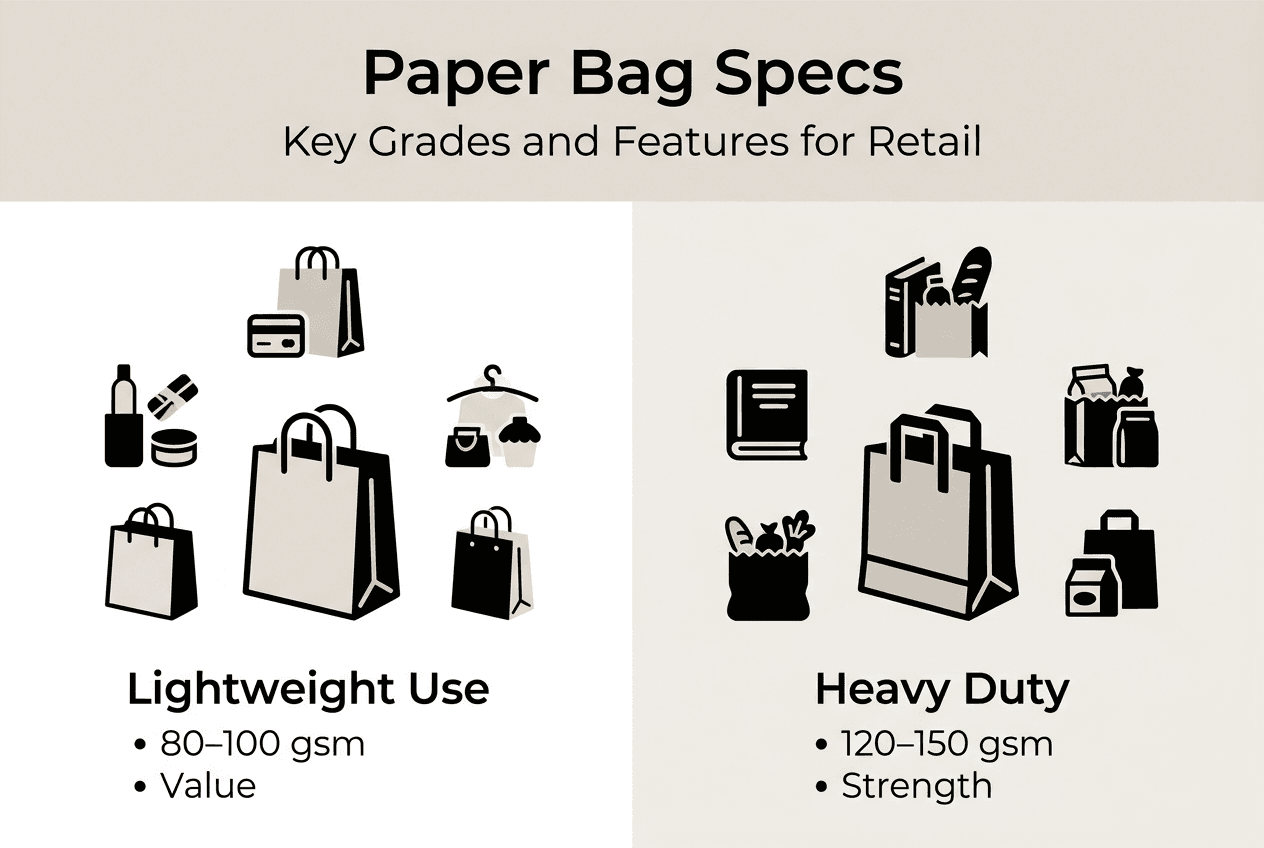
When choosing the right paper bags for your business, consider both the typical load weight and environmental conditions. A bag carrying dry goods in a climate-controlled store has different requirements than one holding hot food in humid weather. Work with your manufacturer to match paper specifications to your real-world conditions, and always request samples before placing large orders.
Understanding the relationship between paper weight, burst factor, and real-world performance helps you specify materials that deliver reliability without unnecessary expense. The next step is translating those material choices into a functional bag structure that meets your capacity and branding needs.
Designing paper bag geometry and structural components
Paper bag geometry starts with three critical measurements: Width x Gusset x Height, commonly abbreviated as WxGxH. Width determines how much the bag can hold side to side, gusset defines how much it expands outward, and height sets the vertical capacity. These dimensions must align with your product size and desired bag volume while accounting for manufacturing constraints.
Paper bag design involves WxGxH panel geometry, folding, and gluing to form the tube body. The manufacturing process begins by cutting kraft paper to size, then folding and gluing the edges to create a tube. This tube becomes the bag’s body, and its dimensions directly affect how much weight the bag can carry and how it looks when filled.
Bottom formation offers two primary options. Diamond fold bottoms provide excellent stability and load distribution, making them ideal for heavier items. Gusset bottoms allow for design variation and can create a more distinctive bag shape, but they may not distribute weight as evenly. Your choice depends on whether you prioritize maximum strength or unique aesthetics.
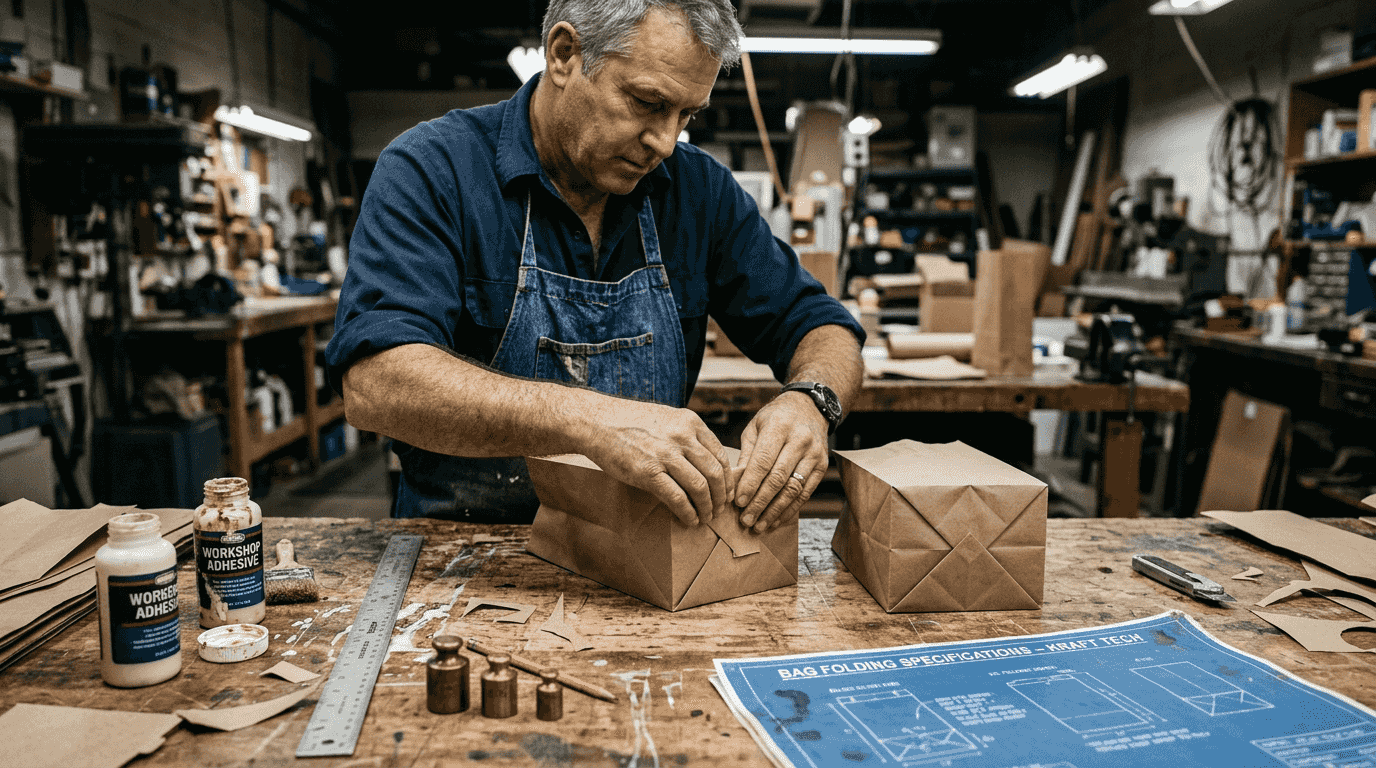
Handle attachment is where many bags fail under stress. Paper twisted handles are economical and work well for lighter loads. Flat paper handles offer more surface area for branding but require reinforcement for heavier items. Reinforced handles with additional layers or rope inserts provide the highest strength but increase material costs. Match your handle type to your expected load weight, and always add reinforcements at attachment points.
Pro Tip: The weakest points in any paper bag are where handles attach and where the bottom meets the sides. Adding reinforcement patches at these stress points dramatically increases bag durability without significantly raising material costs.
Here’s how different bag components affect performance:
- Panel dimensions determine capacity and shape, but oversized bags waste material and increase shipping costs.
- Folding precision affects how cleanly the bag opens and how well it stands when filled.
- Gluing quality determines whether seams hold under stress or separate during use.
- Bottom formation impacts weight distribution and how stable the bag sits when set down.
- Handle design and reinforcement determine maximum safe load capacity.
When working with kraft paper bags manufacturing partners, provide detailed specifications for all these components. Request prototypes that you can test with actual products before committing to production. A bag that looks perfect empty might collapse when filled, so real-world testing is essential.
The geometry and structural components you choose create the foundation for a functional bag. Next, you’ll need to address special requirements like moisture resistance and heavy-load reinforcements to ensure your bags perform in challenging conditions.
Reinforcements, coatings, and handling special requirements
Standard kraft paper bags work well for dry goods in controlled environments, but real-world retail and foodservice applications often demand additional protection. Moisture or grease exposure requires PE liners or coatings between 20 and 80 micrometers thick. These barriers prevent liquids from weakening paper fibers and causing structural failure.
PE coatings come in different thicknesses for different protection levels. A 20 micrometer coating handles light moisture exposure like condensation or brief contact with damp items. Heavy-duty foodservice applications with hot, greasy foods require 60 to 80 micrometer coatings for reliable protection. Choose coating thickness based on expected exposure duration and liquid type, not just as a precaution.
Heavy loads demand strategic reinforcements beyond standard construction. Handle reinforcements typically involve additional layers of kraft paper or cardboard patches at attachment points. Bottom reinforcements can include extra paper layers, cardboard inserts, or specialized folding techniques that distribute weight more evenly. These additions increase material costs but dramatically reduce failure rates.
The specification balance matters more than you might think. Over-specification wastes materials, increases production costs, and raises your environmental footprint without improving performance. Under-specification leads to bag failures during use, creating customer dissatisfaction and increasing logistics costs when you need to replace failed bags or deal with damaged products. Finding the right balance requires testing with actual use cases, not guessing based on similar products.
“The difference between a bag that barely meets requirements and one that’s properly specified often comes down to a few cents per unit. The difference in customer experience and brand perception is enormous. Test thoroughly, specify accurately, and your bags will perform reliably while controlling costs.”
Quality assurance for reinforced and coated bags involves specific testing protocols:
- Top load testing measures how much weight the bag can support when carried by handles without tearing or deforming.
- Drop resistance testing simulates bags being set down quickly or dropped from typical carrying height.
- Moisture penetration testing for coated bags ensures liquids don’t seep through over expected use duration.
- Handle pull testing applies force to handles until failure to establish safe load limits.
Work with domestic paper shopping bags manufacturers who understand these testing requirements and can provide documentation of test results. Reliable manufacturers test samples from each production run, not just initial prototypes, ensuring consistent quality across all your orders.
Special requirements like moisture resistance and heavy-load capacity need thoughtful specification and testing. Once you’ve designed reinforcements and coatings into your bags, the final step is systematic testing and quality control to ensure every bag performs as designed.
Testing, quality control, and common mistakes to avoid
Prototype testing separates successful bag designs from expensive failures. Start by testing prototypes with your actual products at realistic weights. Fill bags to typical capacity, carry them by handles, set them down repeatedly, and simulate the full customer journey from checkout to car to home. If bags will go through automated packaging equipment, test machine compatibility to ensure they feed correctly and don’t jam.
Quality control relies on tension stability and batch testing including tensile, burst, and drop tests. Tension stability during manufacturing prevents print registration issues and folding defects that compromise bag integrity. Manufacturers should test samples from each production batch, not just approve an initial prototype and assume consistency.
Batch testing protocols should include:
- Tensile strength testing to measure how much force paper can withstand before tearing.
- Burst strength testing to determine resistance to pressure from inside the bag.
- Drop testing from typical carrying height with full load to simulate real-world use.
- Handle pull testing to establish safe weight limits and identify weak attachment points.
- Visual inspection for print quality, fold precision, and gluing consistency.
Common design mistakes cost businesses thousands in wasted materials and lost customer confidence. Ignoring burst factor in favor of GSM alone leads to bags that look sturdy but fail under load. Poor reinforcements at handles and bottoms create predictable failure points. Skipping prototype testing with real products means discovering problems only after production runs complete.
Pro Tip: Request samples from multiple points in a production run, not just the first bags off the line. Quality can drift as equipment warms up or operators change, so mid-run and end-run samples give you a complete picture of consistency.
Balancing specifications requires understanding the relationship between cost, performance, and environmental impact. A bag that’s 10% stronger than necessary might cost 15% more and use 20% more material. A bag that’s 10% weaker than needed will fail 50% of the time under peak loads. The sweet spot comes from testing actual use cases and specifying exactly what you need, no more and no less.
Manufacturing process control affects final bag quality as much as design specifications. Proper tension prevents print defects and fold issues during high-speed production. Consistent glue application ensures seams hold under stress. Temperature and humidity control in the production facility affects how paper behaves during folding and forming.
When evaluating quality control for paper bags, look for manufacturers who document their testing protocols and share results transparently. Ask about their process control measures, inspection frequency, and how they handle bags that don’t meet specifications. Reliable partners catch problems during production, not after bags reach your facility.
Systematic testing and quality control transform paper bag design from guesswork into a predictable process. With proper testing protocols and attention to common mistakes, you can produce bags that perform reliably while controlling costs and maintaining your sustainability commitments.
Partner with Gather Packaging for custom paper bag solutions
Designing paper bags that balance strength, sustainability, and brand appeal requires expertise and manufacturing capability. Gather Packaging specializes in custom printed kraft paper bags manufactured domestically in Toronto, Canada. Their team brings over a century of combined experience to help retail and foodservice businesses create bags that perform reliably while reflecting environmental values.
Working with a Canadian made paper bags manufacturer offers quick turnaround times, lower shipping costs, and direct communication throughout the design and production process. Gather Packaging provides comprehensive design assistance, prototyping services, and quality assurance testing to ensure your bags meet specifications before full production runs. Their 8-color flexo printing capabilities deliver vibrant branding on FSC-certified materials with water-based inks, combining visual impact with sustainability.
Frequently asked questions
What gsm paper is best for retail paper bags?
Retail paper bags commonly use 100 to 150 gsm kraft paper for a balance of strength and cost. This range handles most retail items up to 10 pounds reliably. Thicker paper between 150 and 200 gsm may be required for heavier loads, moisture exposure, or specialty uses where extra durability justifies the increased material cost.
How do I make my paper bags moisture resistant?
Apply PE liners or coatings between 20 and 80 micrometers thick to provide moisture and grease resistance. Light moisture exposure requires 20 to 40 micrometer coatings, while heavy-duty foodservice applications with hot, greasy foods need 60 to 80 micrometer protection. Choose coating thickness based on expected exposure duration and liquid type, and always test with your actual products before committing to production specifications.
What are common mistakes in paper bag design to avoid?
Avoid over-specification which wastes materials and increases costs, and under-specification which causes failures and customer dissatisfaction. Failing to reinforce handle and bottom weak points reduces bag durability and creates predictable failure points under normal use. Skipping prototype testing with real products and actual loads can lead to costly production errors that only become apparent after manufacturing runs complete. Always test thoroughly with your specific use case before approving final specifications.
How do I test paper bag prototypes effectively?
Fill prototypes with your actual products at realistic weights and simulate the complete customer journey from checkout to transport to final use. Test handle strength by carrying bags at full capacity, drop bags from typical carrying height onto hard surfaces, and if using automated packaging equipment, verify bags feed correctly without jamming. Request samples from multiple points in production runs to ensure quality remains consistent, not just initial prototypes that may not reflect final manufacturing conditions.
Share:
Elevate your marketing strategy with packaging in 2026
Paper bags in retail: sustainable branding guide 2026