

TL;DR:
- Packaging specs are technical blueprints that determine a bag’s sustainability and recyclability.
- Well-defined specs help reduce waste, ensure quality, and build consumer trust.
- Accurate, documented specs give brands a competitive edge and verify their environmental claims.
Most retail brands and foodservice operators invest in eco-friendly paper packaging with the best intentions, yet a surprising number never see the real environmental or business payoff. The reason is almost always the same: the specs behind the bag don’t match the sustainability promise on the front of it. 52–68% of North American consumers actively prefer paper packaging for sustainability reasons, but consumer preference alone doesn’t make a bag recyclable, compostable, or cost-effective. The details buried in your packaging specifications do. This guide breaks those details down so you can make choices that actually deliver.
Table of Contents
- What are packaging specs—and why do they matter?
- Sustainability benchmarks: How specs deliver eco results
- From product fit to waste reduction: Getting specs right
- Specs and your brand: The hidden driver of customer trust
- Why specs—not slogans—make or break sustainability
- Advance your sustainability with custom packaging solutions
- Frequently asked questions
Key Takeaways
| Point | Details |
|---|---|
| Specs define success | Clear, eco-focused specs are the foundation for effective sustainable packaging. |
| Sustainability is spec-driven | Paper packaging’s eco impact depends on precise specs, not just material choice. |
| Fit reduces waste | Well-matched specs minimize material use, costs, and excess waste in retail and foodservice. |
| Trust needs proof | Brand sustainability claims are only credible when supported by detailed, documented specs. |
What are packaging specs—and why do they matter?
Packaging specifications are the technical blueprint behind every bag you order. They define what a package is made of, how it performs, and whether it meets your sustainability goals. Think of specs as the difference between a bag that looks eco-friendly and one that is eco-friendly.
A complete spec sheet typically covers:
- Material type: Kraft paper, recycled content paper, coated or uncoated stock
- Thickness (basis weight): Measured in grams per square meter (GSM) or pounds, this determines durability
- Size and dimensions: Length, width, and gusset depth matched to your actual product
- Print method and ink type: Water-based inks vs. solvent-based, number of colors, coverage
- Certifications: FSC®, PEFC, post-consumer waste (PCW) percentage, compostability standards
- Barrier properties: Grease resistance, moisture resistance, and whether coatings are recyclable
Well-crafted specs do three things simultaneously: they keep your costs predictable, they ensure consistent quality across every production run, and they determine whether your bag actually qualifies for recycling or composting in your local market.
Here’s where many brands go wrong. They invest in custom design, beautiful branding, and green messaging, but they leave the spec decisions entirely to a supplier without clear direction. The result? A bag that looks great but may contain a plastic laminate that disqualifies it from curbside recycling, or a compostable claim that only applies in industrial facilities, not the bins your customers use.
“A custom design is not the same as a sustainable package. Sustainability is built into the spec sheet, not the artwork.”
The sustainable packaging basics that matter most to your bottom line and your brand reputation all trace back to documented, verified specs. When specs are clear, you reduce material waste, avoid costly reprints, and give your supply chain team something concrete to audit. When they’re vague, you’re essentially hoping for the best, and in 2026’s regulatory environment, hope is not a compliance strategy.
High consumer preference for paper creates real market opportunity, but only brands with the right specs behind their products can actually capture it.
Sustainability benchmarks: How specs deliver eco results
Specs are the mechanism that connects your sustainability goals to real-world outcomes. Let’s look at the numbers and what they mean for your decisions.
Paper recycling rates exceed 60% in the US and top 80% in Canada, and the North American paper packaging market is growing at a 4.27% CAGR. Those are strong tailwinds, but they only benefit your brand if your packaging is actually designed to enter that recycling stream.
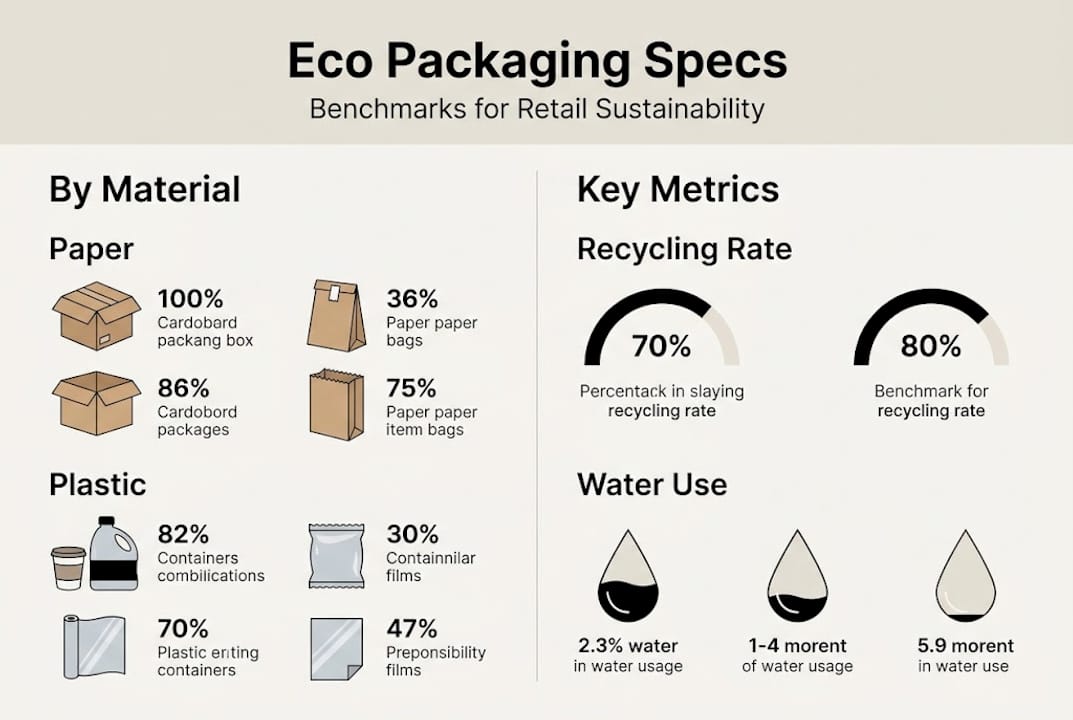
Not all paper packaging qualifies. A bag with a polyethylene moisture barrier, for example, is technically paper but is rejected by most recycling facilities. A bag printed with solvent-based inks may carry VOC concerns that undercut your eco-story. The spec is what separates a recyclable bag from a landfill-bound one.
Here’s a quick comparison of environmental trade-offs across common packaging materials:
| Material | Greenhouse gas | Energy use | Water use | Recyclability |
|---|---|---|---|---|
| Paper (uncoated) | Lower | Moderate | Higher | High (60–80%+) |
| Plastic (LDPE) | Higher | Lower | Lower | Low (under 10%) |
| Paper with barrier | Lower | Moderate | Higher | Varies by barrier |
Paper often wins on greenhouse gas and energy metrics, but can lag behind plastics in water use and acidification depending on the production process. That’s why barrier innovation, such as water-based coatings and fiber-based grease barriers, is the most important frontier in sustainable paper packaging right now.
For North American compliance and credibility, your spec sheet should include:
- FSC® or PEFC certification for responsible fiber sourcing
- PCW percentage (post-consumer waste recycled content)
- Recyclability claim verified against local municipal guidelines
- Compostability standard if applicable (BPI, ASTM D6400, or EN 13432)
- Ink type confirmed as water-based or vegetable-based
Explore recycling and market growth trends to understand how these specs align with where the market is heading. You can also review eco-friendly bag options that already meet these benchmarks.
Pro Tip: Partner with manufacturers who are actively investing in barrier alternatives and eco-ink adaptation. A supplier who can document their innovation roadmap is a supplier who will keep your specs current as regulations tighten.
From product fit to waste reduction: Getting specs right
If sustainability depends on the right specs, how do you actually choose and apply them for your products? The answer starts with fit, literally.
Right-sized packaging is one of the most underrated waste reduction tools available to retail and foodservice operators. A bag that’s too large wastes material, increases shipping weight, and often ends up crumpled or double-bagged. A bag that’s too small risks product damage and customer complaints. Neither outcome serves your brand or your sustainability goals.

Here’s a practical sizing reference for common North American applications:
| Product type | Recommended bag size range | Key spec priority |
|---|---|---|
| Dry goods (1–4 items) | Small to medium flat bag | Basis weight 60–80 GSM |
| Burgers and sandwiches (5–7 items) | Medium gusseted bag | Grease-resistant barrier |
| Fried or delivery orders (8–12 items) | Large gusseted or serrated top | Heat retention, grease barrier |
| Retail apparel (folded) | Medium to large with handles | Strength, print quality |
Proper fit prevents unnecessary waste, and correct bag sizing by product is one of the clearest empirical benchmarks for reducing excess material across a supply chain.
Here’s a step-by-step process to get your specs right:
- Conduct a product audit. Measure your actual items, including packaging inserts, tissue paper, or food containers that go inside the bag.
- Build a spec checklist. Include material, size, GSM, print colors, certifications, and any barrier requirements.
- Request samples and test them. Load bags with real products and simulate real handling conditions.
- Benchmark against your sustainability targets. Confirm recycled content percentage, certification status, and end-of-life pathway.
- Document everything. Share the finalized spec sheet with your supplier and keep a copy for compliance and marketing use.
The custom packaging workflow at Gather Packaging follows this exact logic, and cutting packaging waste starts with getting these fundamentals locked in before you go to print.
Pro Tip: Always pilot test your specs with an actual production run before committing to full volume. A small batch test reveals fit issues, print registration problems, and structural weaknesses that a sample alone won’t catch.
Specs and your brand: The hidden driver of customer trust
Specs aren’t just a technical exercise. They are the foundation of every sustainability claim your brand makes in public, and customers are paying closer attention than most operators realize.
Paper packaging achieves a 49–57% higher sustainability perception versus plastic among consumers. That’s a significant brand advantage, but it evaporates fast if your claims can’t be backed up. Greenwashing, even unintentional, is one of the fastest ways to lose customer trust in 2026.
When your specs are documented and communicated, you unlock real brand benefits:
- Transparency: You can tell customers exactly what’s in their bag and where it came from
- Regulatory readiness: Documented specs help you stay ahead of evolving extended producer responsibility (EPR) laws across North American states and provinces
- Repeat business: Shoppers who trust your eco-claims come back, and they tell others
- Competitive differentiation: Most competitors are still leading with slogans; you lead with proof
- Retail and foodservice alignment: Major retail partners increasingly require spec documentation as part of supplier onboarding
For foodservice operators, this matters at the counter. A customer who sees “FSC-certified, 30% post-consumer recycled content, recyclable” printed on their bag walks away with a stronger impression than one who sees a generic leaf logo. For retail brands, paper bag branding built on verified specs becomes a storytelling asset, not just a container.
If you’re in apparel, the same principle applies. Packaging for apparel that carries certified, documented eco-attributes supports your brand values at the point of unboxing, which is a moment customers increasingly share publicly.
The bottom line: eco-claims rooted in documented specs build trust. Claims that aren’t backed by specs are a liability.
Why specs—not slogans—make or break sustainability
Here’s an uncomfortable truth most packaging conversations avoid: the majority of brands that call themselves sustainable are leading with marketing, not with data. We’ve seen this pattern play out repeatedly across the North American market, and it’s worth naming directly.
A slogan costs nothing to print. A verified FSC® certification, a documented PCW percentage, a confirmed recyclability pathway, those take real work. But they’re also what Canadian manufacturers’ quality standards are increasingly built around, and what forward-thinking buyers now demand before signing a supply agreement.
The brands that win long-term are the ones who treat their spec sheet as a communication tool, not just an internal document. They share it with retail partners, reference it in customer-facing content, and update it whenever regulations shift. That discipline is what separates authentic sustainability from a green coat of paint. In a market moving toward stricter EPR enforcement and buyer scrutiny, specs are your competitive edge.
Advance your sustainability with custom packaging solutions
Ready to ensure your packaging drives both sustainability and customer loyalty? At Gather Packaging, every order starts with a documented spec conversation, not a catalog selection. We build eco-friendly paper bags around your actual product dimensions, your brand standards, and your sustainability commitments, with FSC®-certified materials, water-based inks, and verified recycled content options built in from the start.
Whether you need sustainable packaging for a foodservice rollout, fully branded custom paper packaging for retail, or made-in-Canada bags with fast turnaround and lower logistics costs, we have the manufacturing depth and spec expertise to deliver. Let’s build packaging that earns trust at every touchpoint.
Frequently asked questions
What are the key components of packaging specs?
Packaging specs cover performance and sustainability requirements including material type, thickness, size, finish, certifications, and eco attributes like recycled content or compostability. Every element on that list affects both function and environmental outcome.
How do packaging specs affect recycling and composting?
Specs determine whether packaging meets local recycling and composting criteria, directly influencing end-of-life outcomes. Paper recycling rates are 60%+ in the US and 80%+ in Canada, but only bags designed for recyclability actually enter that stream.
Why do brands need documented specs for sustainability claims?
Documented specs ensure your sustainability claims are accurate and verifiable, building trust and meeting increasing regulatory demands. Consumer perception of sustainability is driven by credible, clear specs, not just marketing language.
Can the right specs really reduce packaging waste?
Yes. Right-sized and properly spec’d packaging cuts material use, shipping costs, and landfill waste. Correct bag sizing by product type is one of the clearest empirical benchmarks for minimizing excess material across a supply chain.
How often should packaging specs be reviewed or updated?
Specs should be revisited at least annually or whenever a major product change, supplier shift, or regulatory update occurs. Staying current with your specs keeps your sustainability claims accurate and your operations aligned with evolving North American compliance requirements.
Share:
Automated Bag Manufacturing: The Smart Solution for Sustainable Packaging
Build a Sustainable Packaging Workflow to Elevate Your Brand