

TL;DR:
- Automated bag manufacturing reduces labor costs by up to 80 and minimizes material waste.
- It offers high-speed, consistent production with extensive customization options for branding and design.
- Automation enhances sustainability, scalability, and creative flexibility for brands of all sizes.
Automated bag manufacturing cuts labor by 60-80% and slashes material waste dramatically, yet many retail and foodservice operators still assume automation means generic, cookie-cutter packaging or prohibitive upfront costs. That assumption is costing them money, time, and competitive ground. This guide breaks down exactly how automated bag manufacturing works, what happens at each stage of production, and why the technology is now the most practical path to sustainable, customizable paper bags. Whether you run a boutique retail shop or a high-volume foodservice operation, understanding this process will sharpen your packaging strategy and your bottom line.
Table of Contents
- Understanding automated bag manufacturing
- From paper roll to finished bag: The complete process explained
- Sustainability and ROI advantages of automated bag production
- Customization and branding: Unlocking new packaging potential
- A fresh perspective: Why automation is the true key to packaging innovation
- Take your packaging further with automated bag manufacturing
- Frequently asked questions
Key Takeaways
| Point | Details |
|---|---|
| True automation benefits | Automated bag manufacturing drastically increases speed and consistency while reducing waste and labor costs. |
| Sustainable packaging edge | Automation enables the use of recycled materials and accomplishes significant eco benchmarks for modern brands. |
| Flexible customization | Advanced machines allow for quick design changes, supporting custom branding without extra waste. |
| ROI for all sizes | Both small and large businesses gain from automation through lower costs and faster adaptation to market needs. |
Understanding automated bag manufacturing
Automated bag manufacturing is the process of producing paper bags using integrated machinery that handles every production stage with minimal human intervention. Instead of workers cutting, folding, and gluing by hand, purpose-built machines perform each task in a continuous, high-speed sequence. The result is consistent quality, predictable output, and dramatically lower per-unit costs.
The core machinery in a modern bag production line typically includes an unwinder, a tube-forming unit, a cutting station, a bottom-forming press, a handle attachment module, and a stacking or counting system. Each unit feeds directly into the next, creating a seamless production flow. Understanding making paper bags step-by-step helps clarify why this sequencing matters so much for quality control.
Here are the major steps in a standard automated bag production run:
- Unwinding: Large rolls of kraft or recycled paper are fed into the machine at a controlled tension.
- Tube forming: The paper is shaped into a continuous tube around a forming mandrel.
- Side gluing: Adhesive is applied to seal the tube’s longitudinal seam.
- Cutting: The tube is cut to the correct bag length with precision blades.
- Bottom forming: The cut tube receives a folded and glued bottom panel.
- Handle attachment: Twisted paper, flat ribbon, or die-cut handles are attached automatically.
- Stacking and counting: Finished bags are counted, grouped, and stacked for packaging.
As automated machines process rolls of paper through unwinding, cutting, folding, gluing, and stacking, every stage is governed by sensors and servo motors that maintain tight tolerances. The term tube forming refers to shaping flat paper into a hollow cylinder before the bag structure is completed. Unwinding simply means feeding paper from a large roll at a consistent speed and tension.
| Production factor | Manual process | Automated process |
|---|---|---|
| Labor required | 4-8 workers per shift | 1-2 operators per line |
| Output speed | 10-30 bags per minute | 60-200 bags per minute |
| Consistency | Variable | Highly consistent |
| Setup time | Low | Moderate (once configured) |
| Error rate | Higher | Near zero |
This comparison alone explains why brands that have switched to automated production rarely go back. The efficiency gap is simply too wide to ignore.
From paper roll to finished bag: The complete process explained
Once you see the full sequence laid out, the elegance of automated bag production becomes obvious. Every stage is designed to eliminate human error and maximize throughput without sacrificing quality.
Here is the complete process from raw material to finished, stackable bag:
- Paper feeding: A large roll of kraft, recycled, or FSC-certified paper is mounted on the unwinder. Tension control systems keep the paper moving at a steady rate.
- Tube forming: The flat paper passes over a forming shoulder, which wraps it into a continuous tube shape around a mandrel.
- Side seam gluing: A glue application unit applies a precise bead of water-based adhesive along the overlapping edge, sealing the tube.
- Cutting: Rotary or guillotine blades cut the tube into individual bag blanks at the programmed length.
- Bottom forming: The blank is transferred to a folding station where the bottom is creased, folded, and glued to create a flat or square bottom.
- Handle attachment: Depending on the bag style, twisted paper handles, flat ribbon handles, or die-cut openings are added automatically.
- Counting and stacking: Sensors count each finished bag, and mechanical stackers group them into bundles ready for wrapping or boxing.
Specialized machinery handles every stage, from paper alignment to optional handle attachment and final counting and stacking, with optical sensors catching misfeeds or glue failures in real time. This is critical because a single misaligned sheet at the feeding stage can cascade into dozens of defective bags if not caught immediately.
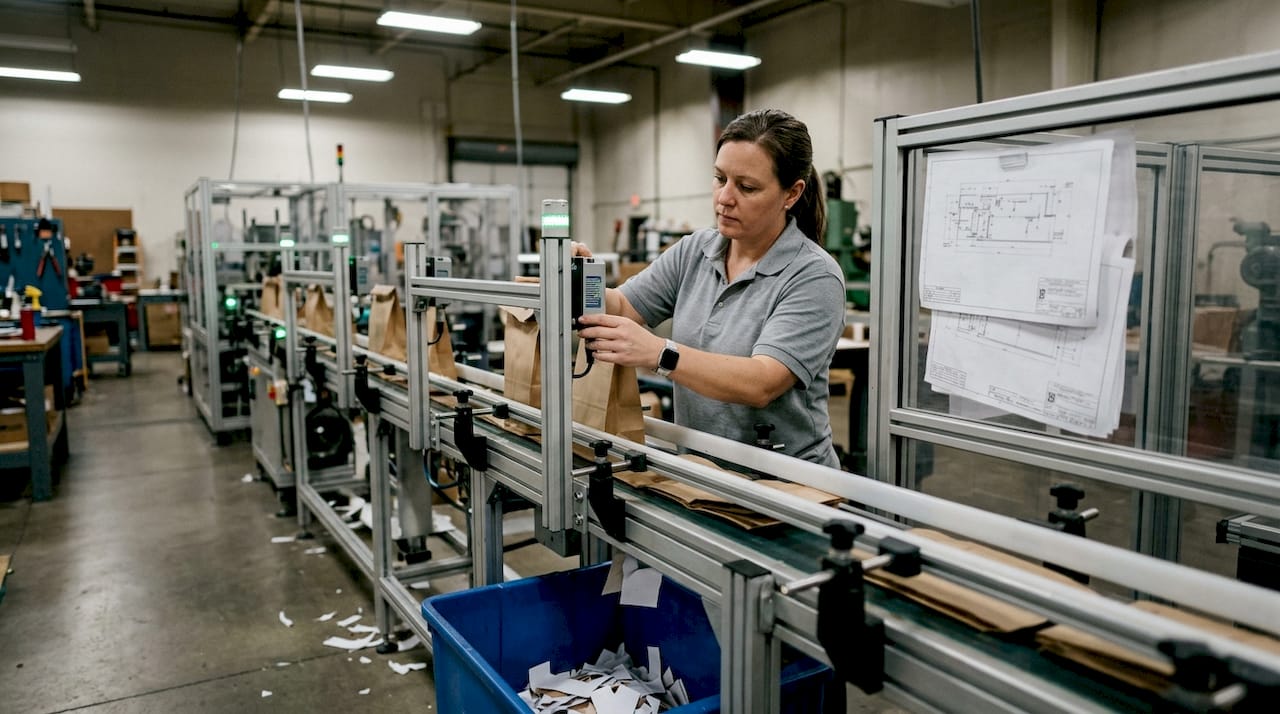
The role of sensors throughout the line cannot be overstated. Optical sensors verify paper alignment. Glue sensors confirm adhesive is applied at the right volume. Counting sensors ensure bundle accuracy. Together, they replace the quality-check role that multiple workers would fill in a manual operation.
For brands, understanding retail bag making steps at this level of detail helps you ask better questions when evaluating suppliers. You can also use this knowledge when reviewing designing retail paper bags to ensure your artwork and structural specs are compatible with automated production.
Pro Tip: Automated lines can run short test batches at a fraction of the waste generated by manual sampling. If you want to trial a new size or color scheme, a short automated run gives you real production samples without committing to a large inventory.
Sustainability and ROI advantages of automated bag production
Automation is not just a productivity story. It is one of the most powerful levers available for brands serious about reducing their environmental footprint while protecting margins.
Here are the core environmental advantages automation delivers:
- Reduced paper waste: Precision cutting and feeding keep waste at just 2-3% of total material input.
- Energy efficiency: Continuous-run machines use energy more efficiently per bag than start-stop manual processes.
- Recycled material compatibility: Automated lines handle recycled kraft and FSC-certified paper without sacrificing speed or quality.
- Consistent output quality: Fewer defects mean fewer bags discarded, which directly reduces total material consumption.
Stat callout: A single automated production run can eliminate 400-650 kg of paper waste compared to equivalent manual production volumes. Over a full year, that adds up to a measurable reduction in raw material consumption and disposal costs.
The financial case is equally compelling. Automated machines reduce labor costs by 60-80%, keep waste to just 2-3%, enable use of recycled kraft, and support output growth of 30-40% year over year for scaling brands.
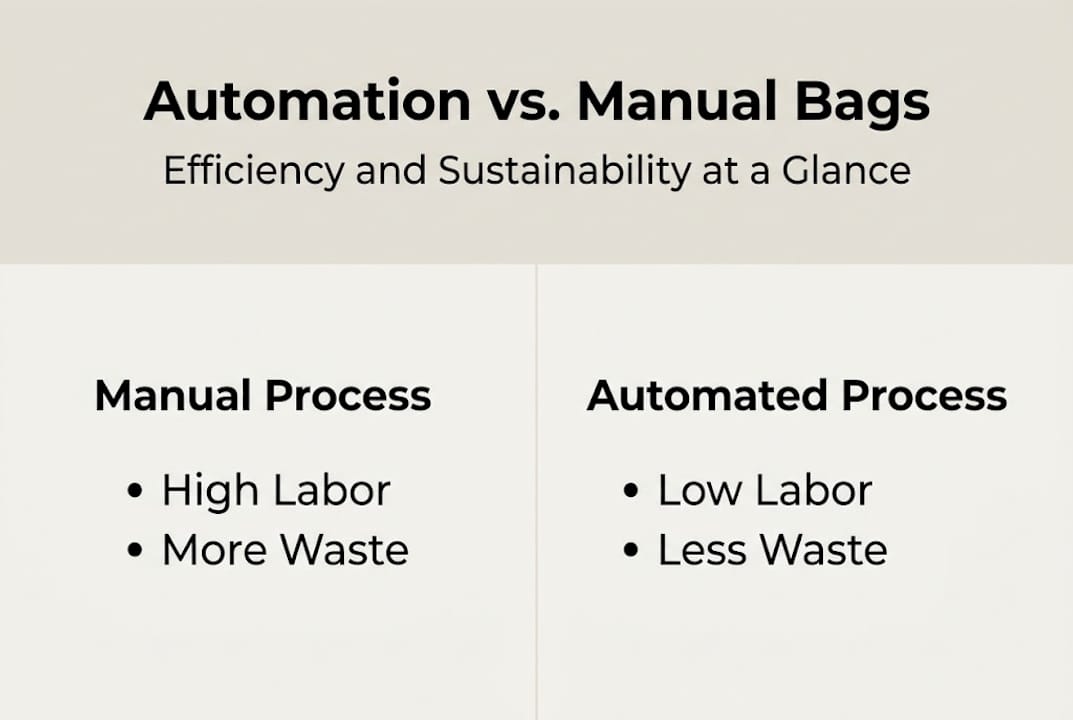
| Metric | Manual production | Automated production |
|---|---|---|
| Labor cost per 1,000 bags | High | 60-80% lower |
| Material waste | 8-15% | 2-3% |
| Gross margin potential | Lower | Significantly higher |
| Annual output growth | Limited by headcount | 30-40% YoY scalable |
Eco-conscious brands are adopting automation because it aligns financial performance with environmental responsibility. You do not have to choose between profitability and sustainability. Reviewing sustainable bag design tips alongside your production strategy helps you maximize both. For a broader view of how packaging choices communicate brand values, explore sustainable branding with paper bags to see how leading retailers are making this work.
The bottom line is straightforward. Automation reduces cost, reduces waste, and scales cleanly. For any brand planning growth in 2026 and beyond, it is the most rational production choice available.
Customization and branding: Unlocking new packaging potential
One of the most persistent myths about automated bag manufacturing is that it forces brands into a narrow range of generic options. The opposite is true. Modern automated lines are built for flexibility, and they make customization faster and more affordable than ever.
Automation enables on-demand design changes, seasonal promotions, and rapid rebranding without the long lead times associated with traditional tooling changes. Because machine parameters are digitally controlled, switching between bag sizes, handle styles, or print configurations takes minutes rather than days.
Here are the most popular customizable features available through automated production:
- Bag size and gusset depth: Configure width, height, and gusset to match your specific product dimensions.
- Handle type: Choose from twisted paper, flat ribbon, or die-cut handles depending on your brand aesthetic and load requirements.
- Custom printing: Up to 8-color flexo printing allows vibrant logos, patterns, and seasonal artwork.
- Recycled and certified materials: Specify recycled kraft, FSC-certified paper, or biodegradable options without changing the production line.
- Finish and texture: Matte, gloss, or natural kraft finishes are all achievable within the same automated system.
Automated printing and configuration allow for custom sizes, logos, and handle styles with minimal setup time, meeting both branding and sustainability needs simultaneously. This is a significant advantage for foodservice operators who need seasonal packaging for holidays or limited-time menu items.
Pro Tip: Use short automated production runs to test a new logo or color palette before committing to a full order. You get real-world samples at production quality with minimal inventory risk, which is far more reliable than digital mockups alone.
For deeper guidance on print options and ink choices, sustainable custom bag printing covers the practical decisions that affect both visual impact and environmental credentials. You can also browse eco-friendly custom bags to see the range of options available for retail and foodservice applications.
Automation does not flatten your brand. It gives you the tools to express it faster, more consistently, and with less waste at every step.
A fresh perspective: Why automation is the true key to packaging innovation
Here is something the industry does not say often enough: automation is not a cost-cutting tool for giant corporations. It is a creative advantage for any brand willing to use it strategically.
We have seen brands of every size assume that customization requires handcrafted production or that going green means accepting slower output. Neither is true. The brands making the most interesting packaging decisions right now are the ones treating automated lines as a design platform, not just a manufacturing commodity.
The real competitive edge automation offers is speed of experimentation. When you can test a new bag format or seasonal print run without generating significant waste or committing to a massive order, you move faster than competitors who are locked into long manual production cycles. That agility compounds over time.
Exploring eco packaging options through an automated production partner gives you the freedom to iterate, improve, and differentiate without the financial penalty that manual production imposes. The brands that recognize this early will set the standard that others scramble to follow.
Take your packaging further with automated bag manufacturing
If this guide has clarified what automated bag manufacturing can do for your brand, the next step is finding a production partner who can deliver on all of it: speed, sustainability, and genuine customization.
Gather Packaging manufactures bags made in Canada with full automation, FSC-certified materials, and up to 8-color flexo printing, giving retail and foodservice brands a reliable North American supplier with fast turnaround and lower logistics costs. From custom kraft paper bags to fully branded seasonal packaging, every order is backed by design assistance and quality assurance. Explore our sustainable paper bags to see how we can support your packaging goals with production that is as responsible as it is efficient.
Frequently asked questions
How fast are automated bag machines compared to manual production?
Fully automatic machines produce 60-200 bags per minute, a rate that manual production cannot come close to matching at comparable quality levels.
Can automated bag manufacturing handle custom designs and printing?
Yes. Automated lines support rapid switching between custom logos, sizes, and eco-friendly printing options with minimal setup time between runs.
How does automation make paper bags more sustainable?
Automation reduces waste to just 2-3% of total material input, supports the use of recycled kraft paper, and uses energy more efficiently than manual methods across equivalent production volumes.
Is automated bag manufacturing only for large brands?
No. Automated systems handle short production runs efficiently, making it practical for small and mid-sized brands to test new designs with low waste and minimal financial commitment.
Share:
Paper packaging in wholesale: 3.8% CAGR growth explained
Packaging specs: Drive eco-friendly retail success