

TL;DR:
- Sustainable packaging decisions depend on specific compliance, recyclability, and compostability criteria.
- Paper remains a practical choice, offering high recyclability and strong brand visual impact.
- Testing, lifecycle assessments, and understanding customer return behavior are essential for effective packaging.
Choosing the right packaging is one of the most consequential decisions a retail or foodservice business owner makes today. Your bags and boxes carry your brand into the world, sit on shelves, and end up in customers’ hands. The problem is that “good packaging” now means satisfying several competing demands at once: meeting increasingly strict eco-regulations, controlling costs, maintaining product performance, and telling a brand story that resonates. This article walks you through a practical framework covering criteria, materials, design, and the single-use versus reusable question, so you can make decisions with confidence rather than guesswork.
Table of Contents
- Define your sustainable packaging criteria
- Choose materials: From paper to flexible plastics
- Design choices that boost brand and eco value
- Reusable vs. single-use: Making the right choice
- A smarter approach to packaging design: Lessons learned from sustainability experiments
- Explore custom, sustainable packaging solutions for your brand
- Frequently asked questions
Key Takeaways
| Point | Details |
|---|---|
| Sustainability starts with criteria | Define compliance, recyclability, and branding goals before selecting packaging materials. |
| Paper and plastics lead | Paper and flexible plastics are popular for North American businesses seeking eco-friendly packaging options. |
| Design drives perception | Smart graphics and sustainability claims on packaging enhance your brand image and connect with customers. |
| Reusable only works with high returns | Only choose reusable if you can ensure products cycle enough times to outweigh single-use impacts. |
| Test and refine | Continuous improvement through testing and feedback delivers both sustainability and performance over time. |
Define your sustainable packaging criteria
Before you compare materials or design concepts, you need to get clear on what sustainability actually means for your specific operation. A coffee shop in Ontario has very different compliance requirements than an apparel retailer in California. Without a defined set of criteria, you will waste time evaluating options that were never right for you to begin with.
Start with compliance. Extended producer responsibility (EPR) regulations, which place the cost of end-of-life packaging management on the producer rather than the municipality, are expanding fast across North America. Knowing which EPR programs apply to your business is the single most useful first step you can take. For deeper guidance on navigating these rules, explore these packaging compliance tips before locking in any supplier decisions.
Next, clarify your recyclability and compostability goals. These two terms are not interchangeable. Recyclable means a product can be collected and reprocessed into a new material. Compostable means it breaks down into organic matter under specific conditions, usually industrial composting facilities. Claiming “100% compostable” on a bag that your customers will throw in a recycling bin creates confusion and potential legal risk. Get the definitions right before you put any claims on your packaging.
Here are the most common sustainable packaging requirements businesses should evaluate:
- Recycled content: Does the packaging contain post-consumer recycled (PCR) material? PCR content comes from materials that consumers have already used and returned to the waste stream.
- Recyclability at end of life: Can your customers actually recycle this in their curbside bins, or does it require a special drop-off?
- Compostability certification: Is the packaging certified by the Biodegradable Products Institute (BPI) or a comparable body?
- Lightweighting: Reducing the weight of packaging lowers material use and transportation emissions.
- Mono-material construction: Packaging made from a single material type is far easier to recycle than multi-layer laminates.
- FSC certification: The Forest Stewardship Council (FSC) label on paper products signals responsible forest management.
Lightweight and PCR content are key for EPR compliance in North America, and brands that start mapping their criteria to these two factors early will be ahead of regulatory changes rather than scrambling to react.
Pro Tip: Start with your local EPR regulations and work backward. If your municipality or state has specific recycled-content thresholds or material bans, those constraints immediately narrow your material options and save you from researching solutions that will not pass compliance review. You can also review helpful sustainable packaging definitions to sharpen your vocabulary before talking to suppliers.
Choose materials: From paper to flexible plastics
With your criteria defined, the next step is matching those criteria to material options. The packaging industry offers a wide range of choices, and each has a different performance profile, cost structure, and sustainability story. Understanding the tradeoffs, rather than chasing a single “best” material, is what separates smart buyers from frustrated ones.
Paper and flexible plastics are gaining share in North America as retailers and foodservice operators respond to sustainability trends and consumer expectations. Paper, in particular, is a strong option for brands that want immediate visual impact, a natural look and feel, and strong end-of-life performance in recycling streams. The paper packaging growth trend reflects real market demand, not just a passing preference.
Here is a comparison of the three most common material types you are likely to evaluate:
| Material | Sustainability | Performance | Cost | Recyclability |
|---|---|---|---|---|
| Paper (kraft, coated) | High: renewable, often FSC certified | Good for dry goods; limited moisture resistance | Low to moderate | High: widely accepted in curbside |
| Flexible plastics | Moderate: lightweight, lower transport emissions | High: moisture and puncture resistant | Low | Low: requires special drop-off |
| Mono-material plastic | Moderate: recyclable if pure | High: durable, versatile | Moderate | Moderate: easier than multi-layer but still limited |
Key strengths and limitations to keep in mind:
- Paper: Strong brand aesthetic, widely recyclable, great for custom printing. Less resistant to grease and moisture without barrier coatings, which can complicate recyclability.
- Flexible plastics: Excellent product protection and shelf life extension, especially for food. However, recyclable mono-materials may require thicker gauges and increased material use, which can undermine the environmental savings from switching away from multi-layer structures.
- Mono-material plastic: Better for recycling infrastructure than mixed-material bags. However, thicker gauges needed for strength can offset the lightweighting benefits you were expecting.
For most retail and foodservice brands, paper remains the most practical entry point into sustainable packaging. It scores high on consumer perception, has a well-established recycling infrastructure, and allows for vivid, detailed branding through multi-color printing. Review these paper bag tips to understand how material choice and design decisions interact.
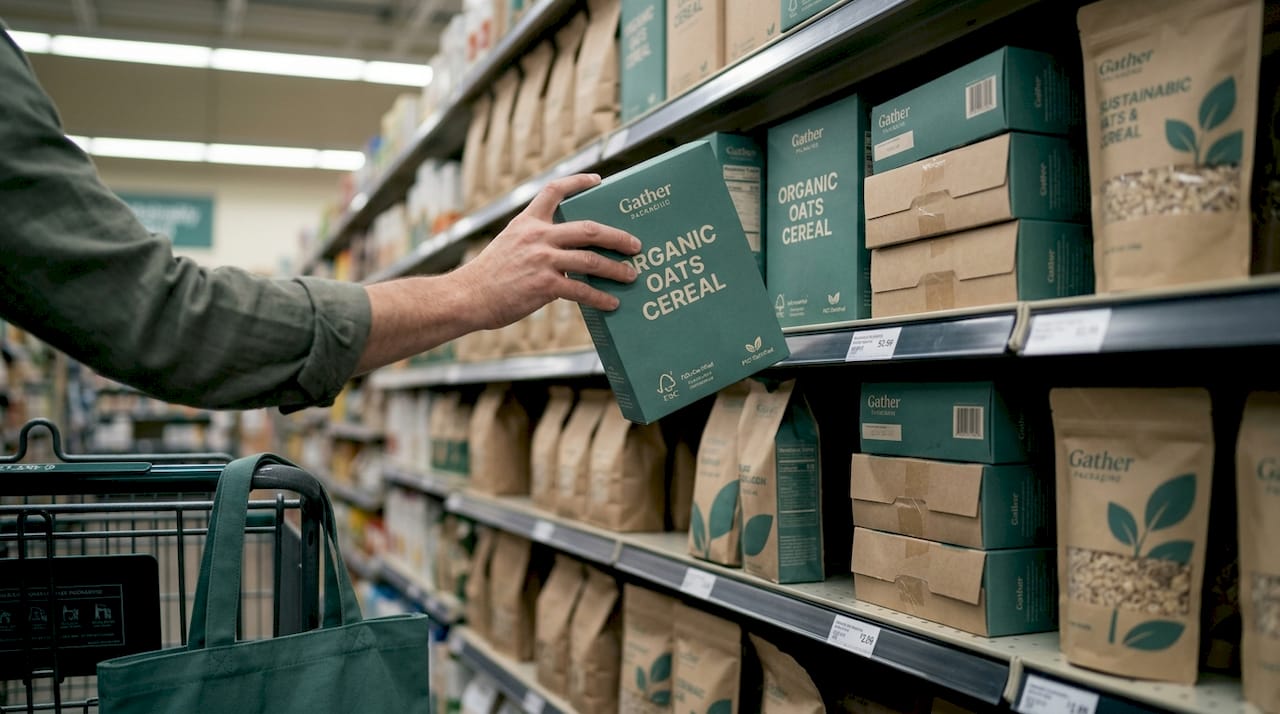
One nuance worth flagging: adding a barrier coating to paper to resist moisture or grease may make the bag function better but could disqualify it from standard paper recycling streams. If compostability or recyclability is a core claim for your brand, confirm with your supplier that the coatings or adhesives used are compatible. For a broader view of how paper bags are performing in retail markets right now, the paper bags in retail landscape provides useful context.
Design choices that boost brand and eco value
Once you have selected your material, design choices become the main lever for brand differentiation and sustainability storytelling. The visual and structural elements of your packaging are what customers notice first. Done well, packaging design communicates your brand values before a single word is read.
Key design elements worth investing in include:
- Custom colors and logo placement: Consistent, recognizable branding builds trust and repeat purchase behavior.
- Sustainability claims printed on the bag: Phrases like “made from recycled materials” or “FSC certified” serve dual purposes. They tell customers your brand cares, and they create accountability that reinforces supplier selection discipline.
- Die-cut handles and window cutouts: These add function and visual interest without adding material waste when designed efficiently.
- QR codes: A small but powerful addition that links customers directly to your sustainability reports, sourcing stories, or recycling instructions.
- Minimalist design: Reducing ink coverage and simplifying graphics can lower costs and improve end-of-life recyclability when water-based inks are used.
“Sustainable packaging enhances brand image via storytelling but must balance with performance to avoid returns and food waste.” This insight from foodservice packaging trends is one that too many brands overlook. A beautiful bag that falls apart under the weight of a takeout order destroys trust faster than any eco claim can rebuild it.
Pro Tip: Use a QR code on your bag to link customers to your sustainability story page. This approach costs almost nothing to implement and transforms a functional object into a brand touchpoint. It also gives you data on customer engagement that static packaging cannot provide.
The design process works best when sustainability goals are set before the creative brief is written, not after. If you decide midway through design that you want to switch to water-based inks or reduce ink coverage to improve recyclability, you may be redesigning from scratch. Map your sustainability criteria first, then hand them to your design team. For a structured approach, see how a packaging workflow for branding can keep design and sustainability goals aligned throughout production. For businesses creating packaging from scratch, a custom eco design workflow lays out a smart sequence to follow.
Reusable vs. single-use: Making the right choice
Beyond materials and design, one of the most consequential operational decisions you face is whether to go with single-use or reusable packaging. This debate generates a lot of heat in the sustainability community, but the practical answer depends heavily on your business model, customer behavior, and whether you can actually make a reusable system work at the scale you operate.
| Factor | Single-use | Reusable |
|---|---|---|
| Environmental impact | Lower if responsibly sourced and recyclable | Lower only with high return rates (10-50+ cycles) |
| Operational complexity | Low: no collection or washing logistics needed | High: requires return infrastructure, cleaning, storage |
| Customer behavior dependency | Low | Very high |
| Cost per unit | Low upfront | High upfront, potentially lower over many cycles |
| Brand story potential | Moderate | High if system actually works |
The data is clear and a little humbling: reusable systems need 10 to 50+ cycles to outperform single-use packaging on environmental metrics. Poor return rates can make a reusable system worse for the planet than a well-managed single-use program.
When should you choose each option?
- Choose single-use if your customers consume on the go and there is no practical mechanism for returns. A food truck, a pop-up retail event, or a delivery-heavy restaurant model almost always fits better with high-quality single-use packaging that is responsibly sourced.
- Choose single-use if you are in early-growth mode and cannot manage the logistics of a return and cleaning system without it degrading customer experience.
- Choose reusable if you have a high-frequency, loyal customer base with consistent return behavior, such as a subscription meal kit, a zero-waste grocery, or a corporate cafeteria.
- Choose reusable if you can control the full end-to-end journey of the package, from sale to return to cleaning to reuse. Closed-loop environments such as office buildings or university campuses are the strongest use cases.
- Consider a hybrid model if your operation includes both dine-in and takeout. Reusables for on-premise consumption and well-designed single-use for takeout can maximize sustainability without sacrificing operational reliability.
Pro Tip: For foodservice operators, track your actual return rates during a pilot before committing to a full reusable rollout. Many programs that look great on paper fail because return rates sit well below the 50% threshold needed to deliver real environmental benefit. A brief pilot with 20 to 30 loyal customers will give you real data fast. For guidance on designing packaging that reduces waste from the start, look at waste-cutting packaging design principles, and review packaging specs for retail to make sure your specs support the operational model you are building.
A smarter approach to packaging design: Lessons learned from sustainability experiments
Here is something we see again and again: brands put enormous effort into sourcing sustainable materials and crafting eco-friendly messaging, then launch a packaging line without ever running a real-world performance test. The bag looks beautiful. The sustainability claims are accurate. But it tears in the rain, collapses under the weight of a candle set, or gets returned because the handle snaps on the way from the store to the car.
The uncomfortable truth is that sustainability and performance are not automatically compatible. Every successful packaging upgrade we have seen is the result of a testing cycle, not a one-time decision. You define criteria, prototype, test under real-use conditions, measure what actually happens, and refine. That cycle rarely ends after one pass.
Most brands overemphasize the sustainability claims on the bag and underinvest in the quality assurance for sustainable packaging process that determines whether those claims hold up in the real world. A lifecycle assessment (LCA) conducted before and after a packaging change gives you objective data that internal preference never can.
Pro Tip: Always run a lifecycle assessment before introducing a new packaging product. An LCA will reveal whether the environmental savings you expect from switching materials are real, or whether transport emissions, processing energy, or low return rates are canceling them out. The brands that succeed at sustainable packaging are the ones that keep asking “is this actually working?” long after launch.
Explore custom, sustainable packaging solutions for your brand
If you are ready to move from planning to sourcing, the criteria, materials, and design strategies in this article are most powerful when paired with a manufacturer who can actually execute them.
At Gather Packaging, we manufacture eco-friendly packaging options right here in Canada, using FSC-certified materials, water-based inks, and recycled content. Our custom printed kraft bags are available in multiple styles and sizes with up to 8-color flexo printing so your sustainability story and your brand identity come through clearly. For businesses that want the speed and reliability of domestic sourcing, our Canadian-made paper bags mean faster turnaround, lower shipping costs, and easier quality oversight. Talk to our team about your specific criteria and let us help you build a packaging solution that performs on every level.
Frequently asked questions
What is the best material for sustainable packaging?
Paper and flexible plastics are currently the leading choices, and both are gaining share due to sustainability trends, but the right material depends on your compliance requirements, performance needs, and brand goals.
How can businesses balance sustainability and food or product safety in packaging?
Choose packaging that tells a credible sustainability story while also meeting real-use performance standards, because sustainable packaging must balance with performance to prevent product returns or food waste.
Is reusable packaging always better than single-use?
No. Reusable systems only deliver better environmental outcomes when return rates support 10 to 50+ cycles, and poorly managed programs can actually perform worse than responsibly sourced single-use options.
What is PCR content and why does it matter?
PCR stands for post-consumer recycled content, meaning material reclaimed from the waste stream after consumer use. Lightweight and PCR content are key factors for meeting EPR compliance standards across North America.
Share:
Best types of custom shopping bags for sustainable retail
Types of retail packaging for eco-friendly branding success