

TL;DR:
- Packaging regulations now influence material choice, printing, and branding for custom shopping bags.
- Recycled kraft paper bags are widely used, eco-friendly, and suitable for most retail needs.
- Quality, compliance, and design flexibility are key to turning bags into powerful branding assets.
Choosing the right custom shopping bag used to be simple. Pick a size, add a logo, done. But packaging regulations are tightening across North America, with new rules around recycled content, material sourcing, and food safety compliance reshaping what brands can and cannot use. At the same time, customers are paying closer attention to the bags they carry out of your store. The bag you choose is now a branding statement, a compliance decision, and a signal of your values all at once. This guide breaks down the main bag types, how to compare them, and how to make a confident choice for your retail or foodservice operation.
Table of Contents
- Sustainability and branding criteria for custom shopping bags
- Recycled kraft paper bags: The sustainability standard
- Virgin and blended paper bags: When strength matters most
- Custom printing and food-safe specialty bags
- Our take: Why bag selection is your best branding opportunity in 2026
- Upgrade your custom bags with sustainable, brand-boosting options
- Frequently asked questions
Key Takeaways
| Point | Details |
|---|---|
| Follow compliance standards | Choose bags with required post-consumer recycled content to meet 2026 regulations and avoid penalties. |
| Match bag to application | Use recycled kraft for everyday branding and consider blends or virgin paper for heavy loads. |
| Leverage custom printing | Enhance your brand’s impact with approved CMYK or foil custom printing on compliant bag materials. |
| Prioritize food safety | For foodservice, specify food-grade or grease-resistant paper and test for ink compliance. |
| Branding and sustainability go together | Thoughtful bag selection can boost both your eco-credibility and customer experience. |
Sustainability and branding criteria for custom shopping bags
Before you compare bag types, you need a clear scorecard. Not all eco-friendly bags are created equal, and what works for a boutique clothing retailer may not work for a fast-casual restaurant. Here are the core criteria to evaluate.
Key criteria to review:
- Material type: Kraft paper, white paper, recycled fiber, or virgin pulp each have different environmental profiles and visual results.
- Post-consumer recycled (PCR) content: The EPA’s procurement guidelines recommend 40% to 100% PCR depending on bag type, with California moving to 50% minimum in 2026.
- FSC certification: Forest Stewardship Council certification confirms responsible sourcing and is increasingly required by retail sustainability programs.
- Durability (GSM): Grams per square meter measures paper weight and tear resistance. A 120gsm bag handles everyday retail loads. Heavier products need more.
- Food safety: Foodservice operators must confirm paper is food-grade and free from harmful coatings or PFAS chemicals.
- Printing flexibility: Your bag is a moving billboard. Choosing a material that supports high-resolution CMYK or foil printing is essential for retail branding impact.
On the compliance side, brands operating in California, Washington, and other progressive states need to act now. Choosing bags for compliance is no longer optional, since penalties for non-compliant packaging are increasing and enforcement is catching up.
“Eco-friendly packaging is not a compromise. When you match the right material to the right printing technique, you get a bag that’s both responsible and memorable.”
Pro Tip: Request ISO or ASTM test data from your supplier to verify durability claims and material composition before committing to a large order.
The best brands treat these criteria as a creative framework, not a checklist. Every constraint is also a creative prompt.
Recycled kraft paper bags: The sustainability standard
Recycled kraft bags are the most widely used option in North American retail and foodservice, and for good reason. They meet current regulatory thresholds, handle standard branding techniques well, and carry a clear environmental story customers recognize.
These bags use at least 40% post-consumer fibers, which is the baseline requirement across most U.S. states and Canadian provinces. Many suppliers, including domestic manufacturers, offer options at 60% to 80% PCR content for brands that want to go further.
Why recycled kraft works for most brands:
- Natural brown tone communicates eco-consciousness without extra messaging.
- Surface accepts flexo printing, CMYK color, and foil accents cleanly.
- Twisted paper handles and flat handles are both widely available and easy to brand.
- Common for boutique retail, fast-casual restaurants, and branded event giveaways.
- 120gsm kraft is the reliable benchmark for everyday retail use without over-engineering.
For foodservice, a recycled kraft bag with a food-safe liner or coating is often the most practical and compliant option. The bag performs well in dry goods applications, and its natural look reinforces a clean brand story.
Pro Tip: Foil stamping on recycled kraft creates a striking contrast that elevates perceived value. You get the eco story AND the premium feel, which is exactly what customers at boutique and specialty retail respond to.
Learning what makes a durable bag before you order saves you from expensive reprints and returns. Weight, handle attachment method, and seam construction all matter as much as the fiber content. And if you want your design to perform as well as the bag itself, reviewing bag design best practices before submitting artwork pays off every time.
Virgin and blended paper bags: When strength matters most
Recycled kraft is the right default for most situations. But when you are packaging wine bottles, heavy groceries, or luxury goods that demand a pristine white surface, you need more. That’s where virgin and blended paper bags come in.
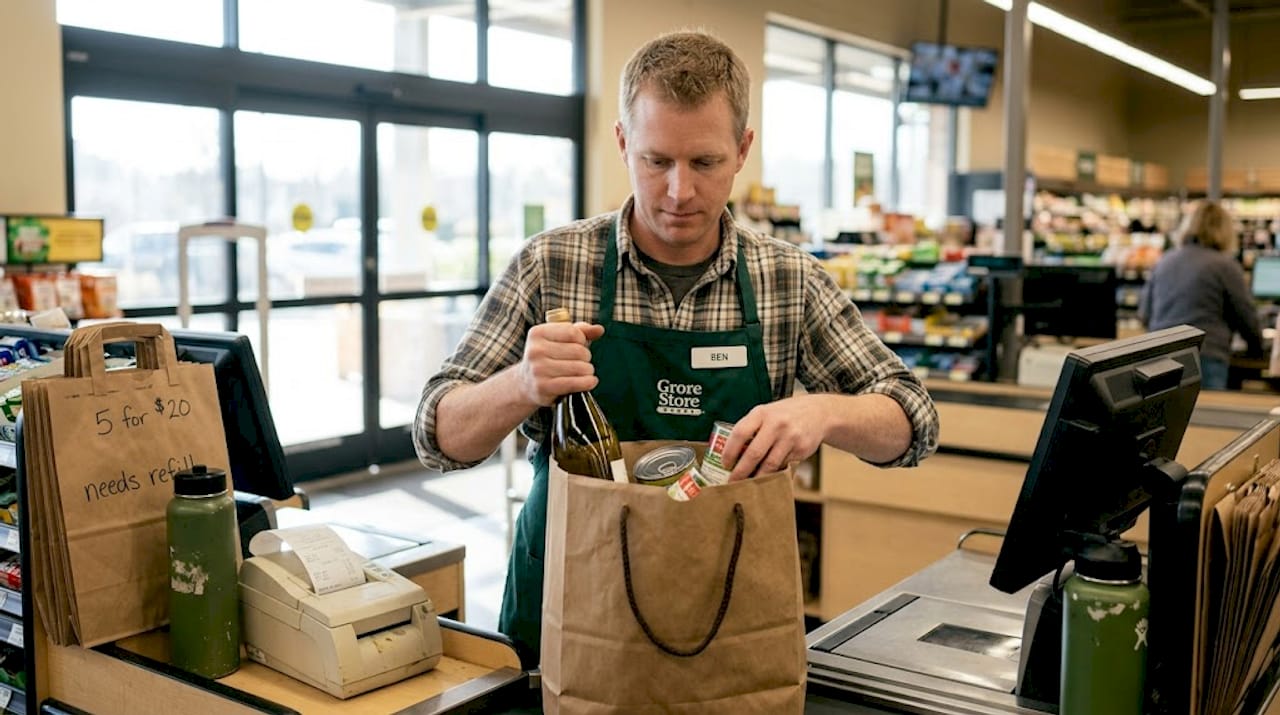
Virgin paper offers consistent fiber strength because the cellulose has not been broken down through previous recycling cycles. This makes it more reliable for heavy or moisture-adjacent applications. Blended bags combine recycled and virgin fibers to balance eco performance with load capacity.
When to consider virgin or blended bags:
- Grocery pickup orders with heavy or mixed items.
- Upscale retail where a bright white surface is part of the brand presentation.
- Wine, spirits, and specialty food gifting where the bag doubles as part of the gift.
- Any application where the bag will be reused and must hold up over multiple uses.
Rope handles are the preferred choice here. They signal premium quality, distribute weight more evenly than twisted paper handles, and photograph well for brand imagery.
| Feature | Recycled kraft | Blended | Virgin paper |
|---|---|---|---|
| Strength | Moderate | High | Highest |
| Eco score | Best | Good | Lower |
| Cost | Lowest | Mid-range | Highest |
| Print surface | Natural/textured | Smooth | Very smooth |
| Best for | Boutique, events | General retail | Luxury, grocery |
For bag selection tips that match your product weight and brand tier, it helps to map your use case before you specify materials. And if you want the look to hold up as well as the structure, designing for durability from the start prevents costly revisions.
Custom printing and food-safe specialty bags
Customization is where your bag stops being a commodity and starts being a brand asset. The printing method you choose shapes how your bag looks, how much it costs, and whether it meets food safety requirements.
How to plan a branded, compliant food-safe bag:
- Confirm the paper is food-grade or grease-resistant if the bag will contact food directly. PFAS-free coatings are now required or strongly recommended in most jurisdictions.
- Choose your printing method. Flexo is cost-effective at scale. CMYK offers photographic detail. Foil adds a metallic accent for premium positioning.
- Select a finish. Matte laminate, gloss, or uncoated each create a different brand feel and affect recyclability.
- Request a printed proof before full production. Colors shift between screen and paper, and catching a mismatch early saves significant cost.
- Verify that custom printing inks are water-based and food-safe when the bag will be used in a foodservice context.
| Feature | Standard paper bag | Specialty bag |
|---|---|---|
| Printing | Basic 1-2 color | Full CMYK, foil, spot color |
| Food safe | Optional | Required for foodservice |
| Finish options | Uncoated | Matte, gloss, soft-touch |
| Brand impact | Functional | High recall and differentiation |
| Cost | Lower | Higher, offset by brand return |
For full guidance on printing options and what each technique delivers, it helps to see examples side by side before committing. And reviewing design tips for impact before you finalize artwork ensures the design works at bag scale, not just on screen.
Pro Tip: Always test a physical printed proof in real lighting before approving production. Foil and matte finishes look dramatically different under store lighting versus office lighting, and that difference is what your customer actually sees.
Our take: Why bag selection is your best branding opportunity in 2026
Most brands approach bag selection as a procurement task. Order something compliant, keep costs down, move on. We think that’s a missed opportunity, and one that compounds over time.
Every bag that leaves your store is seen by the person carrying it, the people they pass, and everyone in the spaces they move through. That’s earned media you are already paying for. The only question is whether the bag is doing creative work or just carrying weight.
The brands we see winning on branding with paper bags are the ones treating compliance as the starting point, not the finish line. Regulations give you a floor. Your design choices determine the ceiling. When you combine FSC certification, a strong recycled content story, and a bag that genuinely looks like it belongs with your brand, you are not just avoiding penalties. You are building recognition.
Greenwashing is the real risk here. Vague claims like “eco-friendly” or “sustainable” without material data are drawing regulatory scrutiny. The smarter move is letting your certifications and recycled content percentages speak for themselves, and letting your design do the emotional heavy lifting.
Upgrade your custom bags with sustainable, brand-boosting options
If this guide has clarified what to look for, the next step is finding a supplier that can actually deliver on all of it. Compliance, quality, branding flexibility, and fast turnaround rarely come together in one place.
Gather Packaging manufactures Canadian-made paper bags domestically in Toronto, which means shorter lead times, lower shipping costs, and easier quality control. Our eco-friendly bag options include FSC-certified materials, water-based inks, and biodegradable constructions that meet current and upcoming North American regulations. Whether you need a boutique retail bag with foil accents or a food-safe kraft bag for your restaurant, explore our full range of custom printed paper bags to find the right fit for your brand and budget.
Frequently asked questions
What recycled content is required for custom paper bags in North America?
Most states require at least 40% post-consumer recycled content, with California rising to 50% in 2026. Always verify the rules in your specific state or province before placing an order.
Are custom-printed paper bags food safe?
Yes, if you specify food-grade or grease-resistant paper and confirm that printing inks and coatings are water-based and PFAS-free. Ask your supplier for documentation before production.
What handle styles are best for retail vs. grocery bags?
Twisted or flat handles suit most retail applications, while rope handles and heavier paper weights are the better choice for grocery or heavy-duty loads. Match the handle to the expected weight and use case.
Is custom printing allowed on eco-friendly bags?
Yes. Most sustainable paper bags support CMYK and foil printing that meets both branding goals and regulatory requirements, as long as water-based inks are used and the base material maintains its recycled content certification.
Share:
Reduce Your Packaging Carbon Footprint: Strategies & Insights
Packaging design tips for sustainable branding success