
TL;DR:
- Custom die-cut bags serve as effective branding tools by providing high visual impact and versatile design options. They are sustainable, customizable, and can be produced quickly and affordably, especially with modern manufacturing. Using these bags enhances brand recognition, encourages social sharing, and aligns with environmental responsibility.
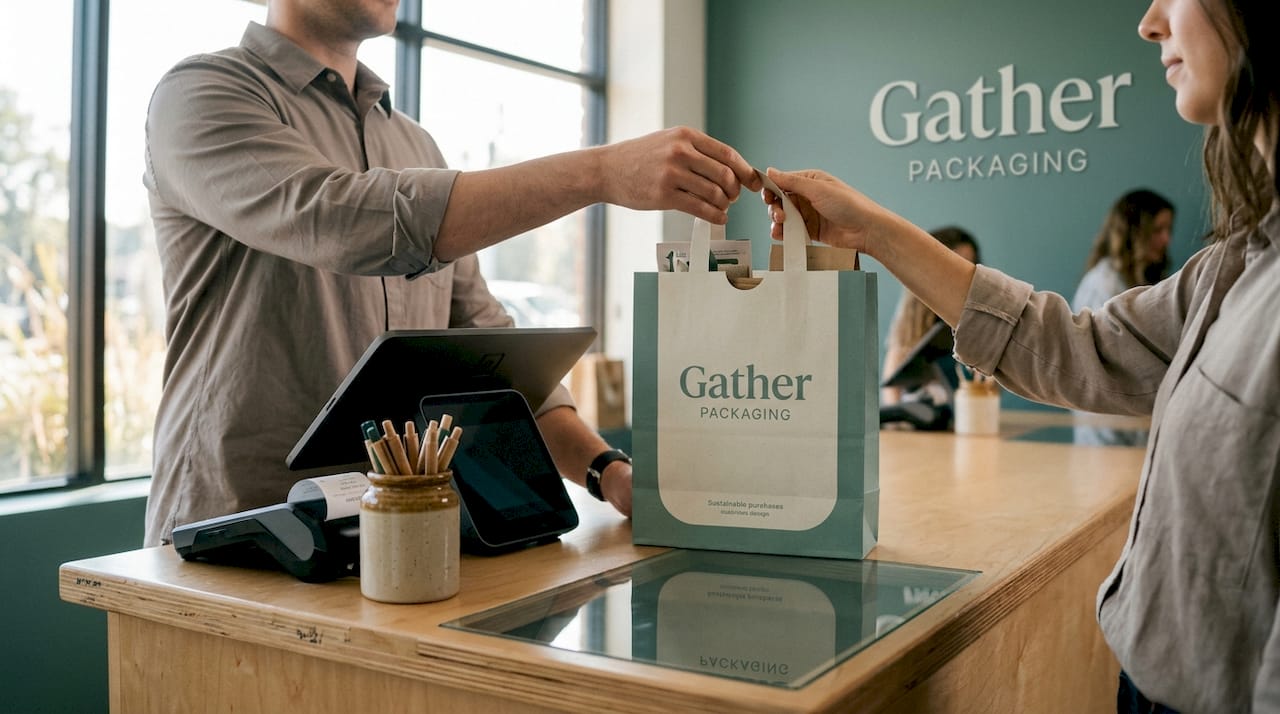
Your shopping bag is not neutral. The moment a customer walks out your door carrying your packaging, it becomes a moving advertisement, a brand statement, and a direct signal about your values. Yet most retail and foodservice operators still treat bags as a commodity purchase, grabbing whatever is cheapest and most generic. That thinking leaves serious branding and sustainability value sitting on the table. Custom die-cut bags change that equation completely, giving you a packaging tool that works as hard for your business as everything else in your marketing mix.
Table of Contents
- Custom die-cut bags: What makes them different?
- Branding advantages: Turning bags into billboards
- Eco-friendly impact: Sustainability and customer perception
- How to order and design the most effective custom die-cut bags
- What most brands get wrong about custom die-cut bags
- Ready to boost your brand with eco-friendly custom bags?
- Frequently asked questions
Key Takeaways
| Point | Details |
|---|---|
| Branding power | Custom die-cut bags help your business stand out and turn every customer interaction into a brand-building opportunity. |
| Eco-friendly choice | Switching to custom die-cut paper bags drastically lowers your environmental impact compared to plastic. |
| Design flexibility | You can tailor die-cut bags in size, shape, and color to fit your marketing goals perfectly. |
| Customer perception | Well-designed, eco-friendly bags boost customer loyalty by showing your commitment to sustainability. |
| Accessible solutions | Modern manufacturing makes custom die-cut bags an option for business owners of any size. |
Custom die-cut bags: What makes them different?
Not all paper bags are built the same. A custom die-cut bag uses a precision cutting process to create a handle that is stamped or punched directly into the bag material, rather than adding a separate twisted paper cord or flat ribbon handle. The result is a sleek, integrated look that feels intentional and premium without adding bulk or extra components.
The distinction goes deeper than handle style. When you choose a die-cut bag, you’re also deciding on the paper weight, structural shape, print coverage, and finish. Those variables combine into a bag that feels custom built because it is. You’re not just picking a size off a shelf.
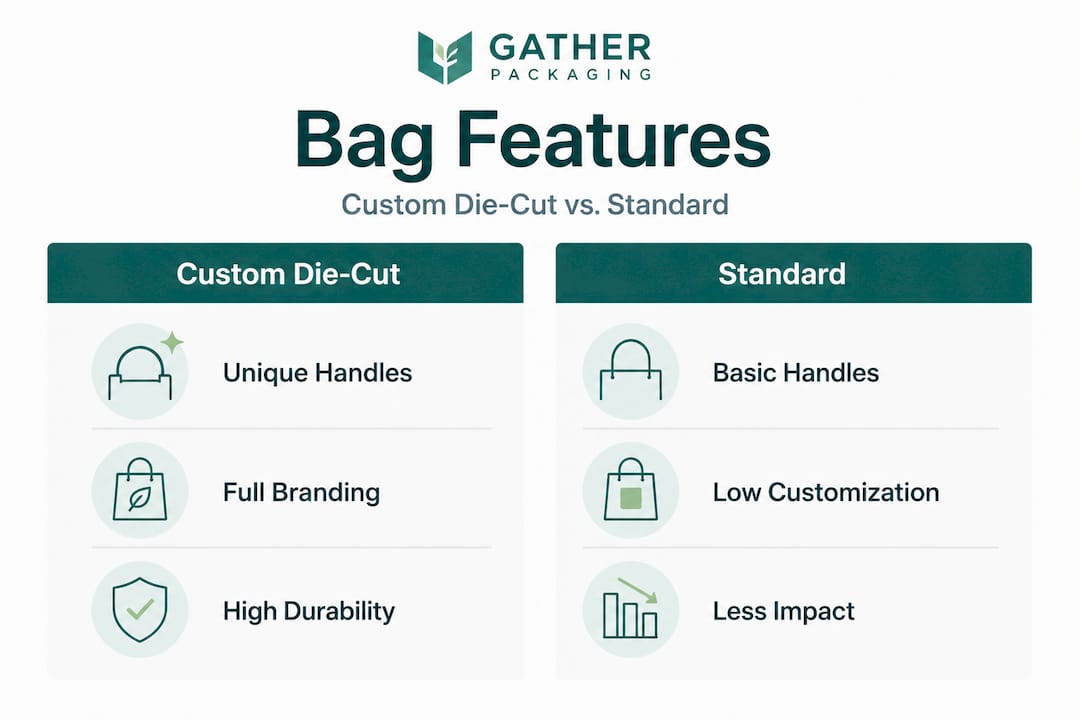
Here’s how die-cut bags stack up against other common bag formats:
| Bag type | Handle style | Visual impact | Durability | Customization potential |
|---|---|---|---|---|
| Die-cut paper bag | Integrated cut-out | High | High | Very high |
| Twisted handle paper | Separate twisted cord | Moderate | Moderate | Moderate |
| Flat handle paper | Separate ribbon | Moderate | Moderate | Moderate |
| Rope handle paper | Separate rope | Premium | High | Moderate |
| Plain paper bag | No handle | Low | Variable | Low |
One common misconception is that custom die-cut bags are automatically more expensive or difficult to order than standard bags. In practice, modern manufacturing and printing options for custom bags have made custom production far more accessible than most operators expect. Another misconception is that die-cut bags lack strength. In fact, well-constructed die-cut bags with reinforced handles hold weight comfortably and outperform many twisted-handle options in day-to-day use.
Common myths worth dismissing:
- “Custom means a long lead time.” Domestic manufacturers can significantly cut production timelines compared to overseas sourcing.
- “The handle opening isn’t comfortable.” Die-cut openings are shaped ergonomically and can be customized to any width.
- “You need a huge minimum order.” Many manufacturers offer flexible minimum order quantities for growing businesses.
- “You can’t get full-color printing on die-cut bags.” Modern 8-color flexo printing delivers vibrant, accurate results.
When you start designing paper bags with the die-cut format in mind, the range of creative possibilities expands considerably. You control every visual element, from the handle cutout shape to the surface finish, and every choice reinforces your brand.
Branding advantages: Turning bags into billboards
A customer who leaves your store holding a beautifully designed die-cut bag doesn’t just carry your product home. They carry your brand through parking lots, into offices, onto public transit, and into other stores. That’s earned media you don’t pay a media buyer for.
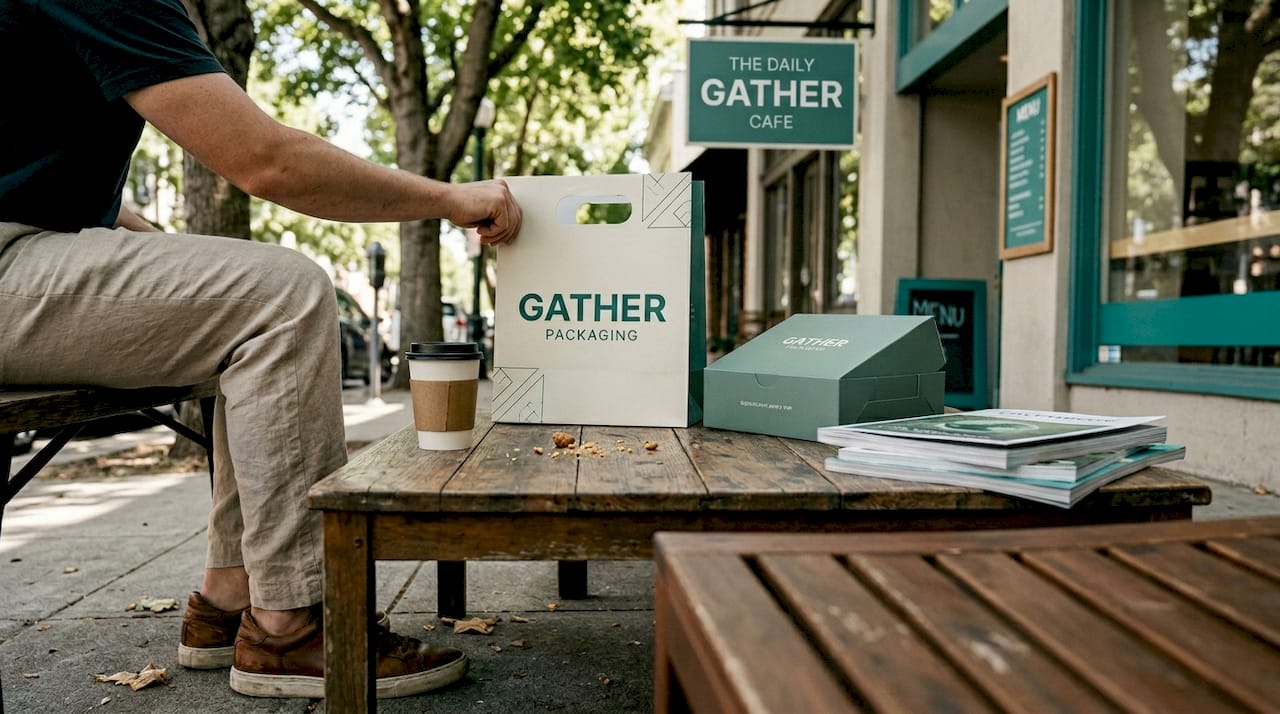
The reason die-cut bags work so well as branding tools comes down to surface area and design flexibility. A standard kraft bag with a stamp gives you limited real estate. A fully printed die-cut bag gives you a structured, shaped canvas on every panel. You can run a bold logo across the front, wrap a brand story around the side, add a QR code to drive digital engagement, or print seasonal artwork that makes the bag collectible.
Here’s a quick look at how feature-rich die-cut bags compare to basic bag formats:
| Branding feature | Custom die-cut bag | Standard bag |
|---|---|---|
| Full-color logo printing | Yes, up to 8 colors | Limited |
| Custom shape and size | Yes | Standard sizes only |
| Matte/gloss/soft-touch finish | Available | Rarely available |
| QR code placement | Yes | Uncommon |
| Brand messaging on all panels | Yes | Limited to front |
| Seasonal/limited-edition designs | Easy to update | Difficult |
The step-by-step paper bag design guide shows how building your bag design around your full brand identity, not just slapping a logo on, creates a far more powerful impression. Smart packaging design also supports word-of-mouth marketing. Customers share distinctive bags on social media, especially when the design is sharp enough to feel worth showing off.
How memorable packaging drives business results:
- Repeat purchases: A positive unboxing or carry experience reinforces the reason customers came to you in the first place.
- Social sharing: Visually striking bags get photographed and posted, generating organic reach at zero cost.
- Referral behavior: Customers carrying your bag in public introduce your brand to people who’ve never heard of you.
- Perceived quality: Packaging quality directly affects how customers judge your product, even before they open it.
Checking out paper bag branding tips can help you prioritize which design elements deliver the most impact for your specific category.
Pro Tip: Before finalizing your bag design, hold a physical prototype next to your other branded materials, your in-store signage, your menu, your apparel tags. If the bag doesn’t feel like it belongs in the same family, revise. Consistency across touchpoints is what makes a brand feel credible and established.
Eco-friendly impact: Sustainability and customer perception
Sustainability is no longer a differentiator. It’s table stakes. Customers in 2026 actively research the brands they support, and packaging is one of the most visible signals of where a business stands on environmental responsibility.
The data is clear: paper bags emit 61% less greenhouse gas over their lifecycle compared to plastic bags. That’s not a marginal improvement. It’s a fundamental shift in environmental impact, and choosing custom paper die-cut bags is one of the most direct ways a retail or foodservice brand can act on its sustainability commitments.
But not all paper bags carry the same environmental credentials. The material choices and certifications behind your bag matter as much as the format. Responsible custom shopping bag sourcing means looking at the full picture, from fiber sourcing to printing inks to end-of-life biodegradability.
Top eco-friendly material and certification choices for die-cut bags:
- FSC®-certified paper: Ensures fibers come from responsibly managed forests with verified chain of custody.
- Recycled content paper: Uses post-consumer or post-industrial fiber to reduce demand for virgin materials.
- Water-based inks: Eliminate solvent-based VOC emissions during printing and make the bag easier to recycle.
- Biodegradable coatings: Replace plastic laminates with coatings that break down naturally, keeping the bag compostable.
- Unbleached kraft paper: A naturally brown, minimally processed option that signals authenticity and earns immediate trust.
Choosing any combination of these options makes a real environmental difference. It also gives you something concrete to communicate to customers. Bags printed with an FSC® logo or a “made with recycled content” message tell a story at the point of purchase, when a customer is most receptive to brand messaging.
For foodservice eco-friendly bag programs specifically, material selection becomes even more important because bags often go directly into recycling streams or compost bins. Choosing the right materials upfront avoids problems later.
Sustainability also drives loyalty. Studies consistently show that customers who feel aligned with a brand’s values spend more over time and are less sensitive to price increases. Your bag is one of the lowest-cost, highest-visibility ways to communicate that alignment.
Pro Tip: Add a small eco-label or certification mark to your bag’s design, something like “Printed with water-based inks” or an FSC® certification badge. Customers notice these details, and they reinforce that your sustainability commitment is real, not just marketing language.
How to order and design the most effective custom die-cut bags
Moving from the idea of custom die-cut bags to holding a finished product in your hands is simpler than most operators assume. The key is knowing the steps and working with a manufacturer who can guide you through each one.
Here’s how the process typically works:
- Define your goals. Decide what the bag needs to accomplish. Is it primarily a branding tool? A foodservice carry bag? A seasonal gift bag? Your goals shape every downstream decision.
- Set your specs. Choose the bag size, paper weight, handle cutout shape, and number of print colors. This is also when you confirm whether you need a matte finish, gloss coating, or a natural kraft look.
- Submit your artwork. Work with your designer or use the manufacturer’s design assistance to prepare print-ready files. Confirm color matching and bleed requirements before finalizing.
- Review a prototype. A physical prototype lets you check how the bag actually looks and feels before committing to a full production run. This step saves you from costly surprises.
- Approve and produce. Once the prototype is approved, production begins. Domestic manufacturing in North America means significantly shorter lead times than overseas sourcing.
- Receive and deploy. Bags are delivered to your location or warehouse, ready to use immediately.
Key considerations before placing your order:
- Minimum order quantities (MOQ): Know your volume needs so you’re not over-ordering or under-ordering.
- Lead times: Factor in design review, prototype production, and shipping when planning around seasonal campaigns.
- Approved materials: Confirm that the paper, inks, and coatings meet your sustainability requirements and any regulatory standards in your region.
- Print file specifications: Ask for exact file requirements upfront so artwork revisions don’t delay your timeline.
The ordering custom bags process is much smoother when you arrive with clear answers to these questions. Manufacturers who use automated bag manufacturing technology can process orders with greater precision and consistency, reducing defects and ensuring every bag in your run meets the same quality standard.
Pro Tip: Work with manufacturers who offer both quality printing capability and verified environmental standards. A bag that looks stunning but uses low-grade inks or uncertified paper undermines the brand story you’re trying to tell.
What most brands get wrong about custom die-cut bags
Here’s something we see repeatedly: brands spend enormous time and money on logos, fonts, in-store displays, and social media content, then ship their customers out the door with a generic white bag. It’s one of the most overlooked brand consistency gaps in retail and foodservice.
The assumption is that “going custom” requires a big budget and a complicated process. But that’s outdated thinking. Affordable custom design options are available because modern automated manufacturing has fundamentally changed the cost structure of custom bag production. What once required massive minimum orders and long offshore timelines is now accessible to mid-size retailers and growing foodservice operators.
The real value of a well-designed die-cut bag isn’t the bag itself. It’s the compounding effect of every customer who carries it. Think about the exposure math: if 200 customers per day leave your location with your bag, that’s 200 brand impressions per customer trip, before any social sharing or second-hand visibility. Over a week, a month, a season, that’s significant reach with no ongoing media cost.
We’d also push back on the idea that you need a complete packaging system from day one. Starting with one strong, signature bag style and getting it exactly right creates far more value than spreading your budget across several mediocre options. A single great bag, consistent and well-printed, builds recognition faster than a rotating mix of formats that never quite cohere.
The brands that extract the most from custom die-cut packaging are the ones who treat the bag as a creative and strategic investment, not a line item to minimize. Get the design right, choose materials that match your values, and order with intention.
Ready to boost your brand with eco-friendly custom bags?
Gathering the right packaging partner makes all the difference between bags that get the job done and bags that actually grow your brand.
At Gather Packaging, we help retail brands and foodservice operators across North America create custom die-cut bags that combine serious branding power with genuine environmental responsibility. From FSC®-certified paper to water-based inks and biodegradable options, every detail is designed to reflect your values and delight your customers. Explore Gather Packaging’s eco-friendly options to understand the full scope of sustainable choices available, or browse our custom paper bag products to find the right format for your business. Our team is ready to guide you from concept to finished product, fast and without the complexity.
Frequently asked questions
What is a die-cut handle on a bag?
A die-cut handle is a handle integrated directly into the bag, typically as a shaped cut-out near the bag’s top edge for comfortable carrying, eliminating the need for attached cords or ribbons. Learn more about bag handle design options and how they affect overall bag feel and function.
Are custom paper die-cut bags really better for the environment than plastic?
Yes. Custom paper die-cut bags can reduce emissions by 61% compared to plastic bags when made from responsibly sourced materials, making them a clear winner for environmentally conscious brands.
Can I use custom die-cut bags for both retail and foodservice?
Absolutely. Die-cut bags are highly versatile and can be customized for both industries, supporting branding and sustainable packaging needs across very different operating environments. See how ordering custom bags works for both retail and foodservice contexts.
What are the main design options for custom die-cut bags?
You can choose from a wide range of custom sizes, handle shapes, paper weights, print colors up to 8-color flexo, and surface finishes to align your bag with your brand identity. The full range of custom bag printing options covers everything from matte coatings to vibrant full-panel artwork.
Share:
Top 4 ocat.ca Alternatives 2026
Modular packaging: Boost sustainability and efficiency