

TL;DR:
- Eco-friendly bags reinforce brand values and enhance customer experience.
- Material selection impacts durability, sustainability, and regulatory compliance significantly.
- Proper prototype testing and design alignment are key to successful, sustainable packaging.
A plain brown bag with no logo, no message, and no soul leaves your restaurant the moment a customer walks out the door. It carries your food but does nothing for your brand. Worse, if it ends up in a landfill, it quietly works against the sustainability story you’re trying to tell. The good news is that a well-designed, eco-friendly foodservice bag can do the opposite: it can reinforce your values, delight your customers, and turn every takeout order into a brand impression. This guide walks you through every step, from material selection to prototype testing, so you can design bags that work as hard as your team does.
Table of Contents
- Essential considerations before you start
- Selecting the right materials and eco credentials
- Bringing your brand to life: Custom design essentials
- From prototype to mass production: Functionality and quality checks
- Why sustainable bag design is your secret brand weapon
- Ready to create your signature eco-friendly foodservice bag?
- Frequently asked questions
Key Takeaways
| Point | Details |
|---|---|
| Material matters | Choosing compostable or recycled paper boosts durability and eco marketing. |
| Brand integration | Design integrates logos, colors, and messages to enhance customer recognition. |
| Test before you buy | Always prototype and check functionality to avoid surprises in mass production. |
| Eco labels build trust | Printing certifications on bags helps validate your sustainability claims. |
| Bags as marketing | Sustainably designed bags are low-cost brand assets that drive loyalty. |
Essential considerations before you start
Before you sketch a single logo placement or pick a paper weight, you need to get clear on what your bags actually need to do. That sounds obvious, but it’s the step most operators skip. They jump straight to aesthetics and end up with beautiful bags that tear under a heavy order or fail a local composting requirement.
Start by mapping your real operational needs. Ask yourself:
- What are you carrying? Hot containers, cold drinks, and dry goods each put different stress on a bag.
- What sizes do you need? A bag that’s too large wastes material; one that’s too small damages your product.
- How are bags handled? Counter pickup, delivery drivers, and curbside all create different durability demands.
- What are your local regulations? Some municipalities now restrict certain materials or require recyclable or compostable options.
Choosing paper bag materials is one of the most consequential decisions you’ll make because material selection impacts bag durability, food safety, and sustainability compliance all at once. Pair that with a clear understanding of packaging sustainability compliance requirements in your region, and you’ll avoid costly redesigns later.
Customer expectations matter too. Diners increasingly notice packaging. A bag that looks cheap or wasteful sends a signal about your brand values, even if the food inside is exceptional. Think of your bag as part of the dining experience, not just a container.
Here’s a quick summary of the top requirements to evaluate before you move forward:
| Requirement | Why it matters | Key question to ask |
|---|---|---|
| Durability | Prevents spills and tears in transit | Can it hold your heaviest order? |
| Food safety compliance | Protects customers and your license | Is the material food-contact safe? |
| Green certifications | Builds credibility with eco-aware diners | Does it carry FSC or compostable labels? |
| Custom print options | Enables branding and messaging | Can it support multi-color printing? |
| Cost per unit | Affects margins at scale | Does the ROI justify the investment? |
Also review the qualities of durable foodservice bags before finalizing your spec sheet.
Pro Tip: Before finalizing any spec, ask two or three staff members and a handful of loyal customers what they find frustrating about your current bags. You’ll uncover real-world problems that no design brief would catch.
Selecting the right materials and eco credentials
Armed with your requirements, your next choice is the material that best balances performance with eco credibility. Not all eco-friendly bags are created equal, and the differences matter both operationally and reputationally.
The three most common options for foodservice are kraft paper, recycled content paper, and compostable paper. Each has real trade-offs:
| Material | Durability | Eco credentials | Cost | Best for |
|---|---|---|---|---|
| Virgin kraft paper | High | Moderate (FSC-certifiable) | Low to mid | Heavy loads, premium look |
| Recycled content paper | Moderate to high | Strong (post-consumer waste) | Mid | Everyday takeout, delivery |
| Compostable paper | Moderate | Highest (certified compostable) | Higher | Eco-forward brands, urban markets |
Sustainable bag materials reduce environmental impact and can strengthen your brand message at the same time. That’s a rare win-win in foodservice packaging. Meanwhile, compostable and recyclable options are increasingly in demand across North American foodservice as cities tighten disposal rules and customers grow more informed.
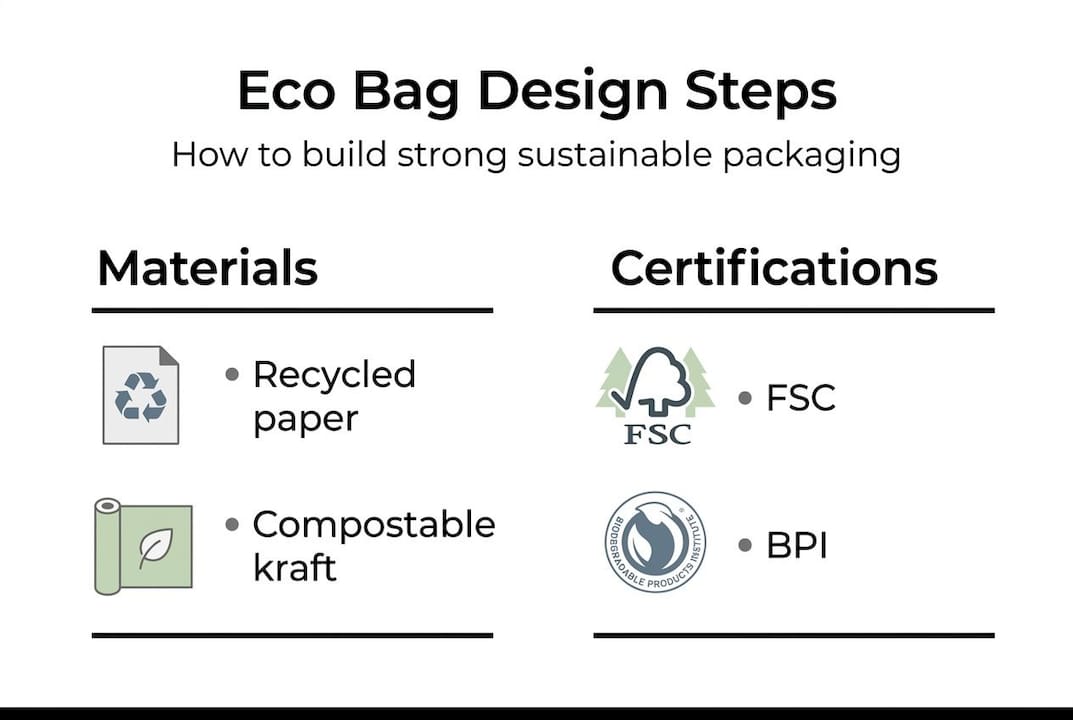
For certifications, here’s what actually carries weight with consumers and regulators:
- FSC® Certified: Confirms wood fiber comes from responsibly managed forests.
- BPI Compostable: Verifies the bag will break down in a commercial composting facility.
- Post-Consumer Recycled (PCR) Content: Shows the bag incorporates material diverted from landfills.
- Water-based inks: Reduces toxic runoff compared to solvent-based alternatives.
For a real-world example of how brands communicate eco values through packaging, see these eco-friendly packaging examples from the coffee industry. The principles translate directly to foodservice.
A quick note on cost: compostable bags typically run 15 to 30 percent more per unit than standard kraft. But when you factor in the brand perception lift and the ability to market your sustainability credentials, many operators find the investment pays off within a season.
Pro Tip: Print your certifications directly on the bag. A small FSC or BPI logo on the side panel tells customers your eco claims are verified, not just marketing copy. That transparency builds trust fast.
Bringing your brand to life: Custom design essentials
With sustainable materials chosen, now it’s time to turn your eco goals into powerful, on-brand bag designs. This is where most operators either get it right and create a bag people actually notice, or get it wrong and produce something forgettable.
Follow these steps to build a design that works:
- Define your concept. What do you want customers to feel when they see the bag? Warmth, sophistication, playfulness? Your concept drives every decision that follows.
- Choose your bag shape and size. The silhouette affects how your design reads. A tall, narrow bag displays a vertical logo better than a wide, flat one.
- Map your branding elements. Place your logo where it’s visible when the bag is held, typically the center panel. Add your tagline, website, or social handle in a secondary position.
- Write your messaging. One clear line about your sustainability commitment, like “100% compostable” or “Made with recycled materials,” adds credibility without cluttering the design.
- Select your finish. Matte finishes feel premium and natural. Gloss finishes pop in bright light. Spot color printing lets you highlight key elements without a full-bleed cost.
Custom bag printing can strengthen your sustainability narrative and genuinely delight customers when the design aligns with your brand values. For deeper guidance, review these bag design tips before you finalize your artwork.
“Sustainable design is more than eco-materials. It’s about communicating your values at every touch point.”
Before you send files to production, run through this checklist:
- Logo is in vector format and prints cleanly at bag size
- Colors are specified in Pantone or CMYK, not RGB
- Text is legible at actual print size, not just on screen
- Certification marks are included and properly licensed
- Handle placement doesn’t obscure key design elements
- Bag dimensions match your product’s actual footprint
For a full walkthrough of the ordering process, the guide on ordering custom bags covers everything from file prep to delivery timelines.
From prototype to mass production: Functionality and quality checks
No great design is complete without real-world testing and careful quality assurance. A bag that looks perfect on screen can still fail in the field if it wasn’t tested under actual use conditions.
Here’s how to move from design to a production-ready bag:
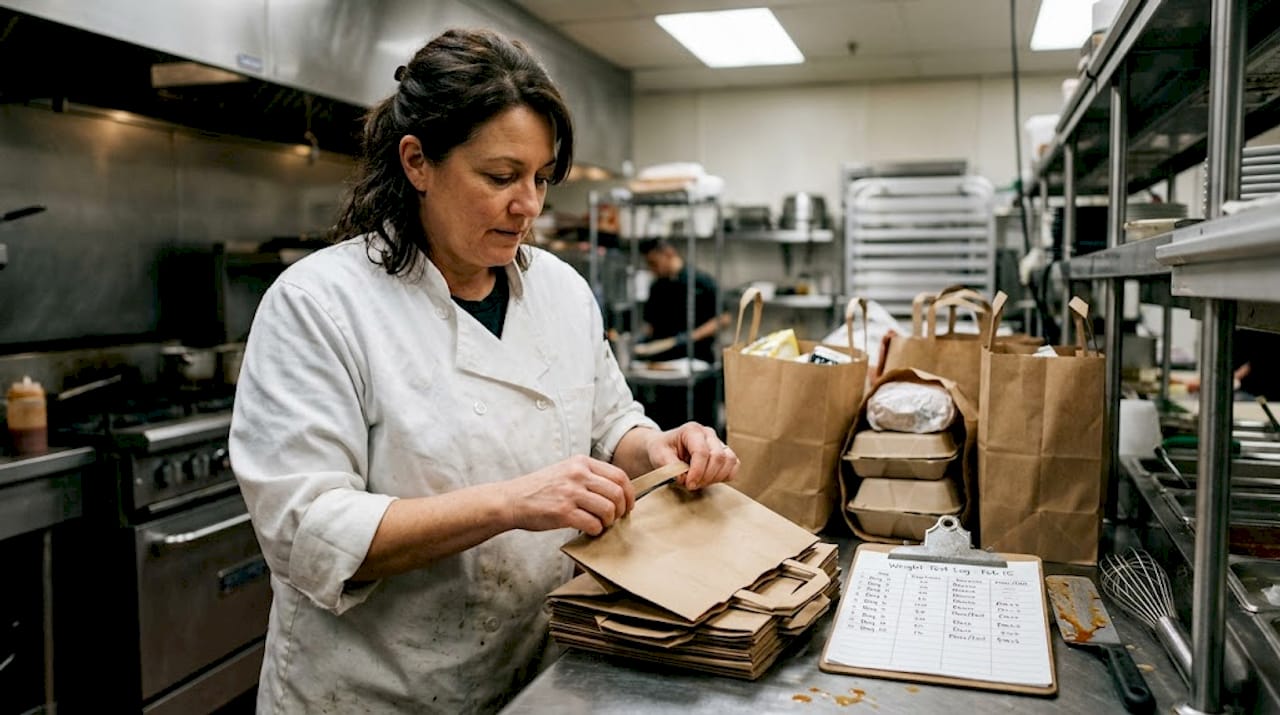
- Request a physical prototype. Never approve a design based solely on digital mockups. Paper weight, texture, and handle feel only reveal themselves in your hands.
- Test with real loads. Fill the bag to its intended capacity and carry it for a realistic distance. Check for handle stress, bottom integrity, and seam strength.
- Assess print durability. Rub the printed surface with a damp cloth. Ink that smears or transfers will embarrass your brand the moment it gets wet.
- Verify food safety compliance. Confirm the inner surface is food-contact safe, especially if the bag will hold hot items or greasy containers.
- Check closure performance. For turn-top or tamper-resistant styles, test the closure mechanism under delivery conditions.
Testing paper bag prototypes is essential for successful mass production because problems caught at the prototype stage cost a fraction of what they cost after a full run. Review the available custom kraft paper bag options to understand which styles are best suited for prototype testing.
For food safety standards relevant to packaging materials, current food safety practices provide useful context on material requirements.
Here are the most common failure points and how to catch them early:
| Failure point | What to test | How to catch it |
|---|---|---|
| Handle tear | Load weight, carry duration | Fill and carry test |
| Bottom blowout | Load weight, moisture exposure | Wet load test |
| Ink transfer | Surface abrasion, moisture | Rub test with damp cloth |
| Seam separation | Stress at corners | Drop test from counter height |
| Print color shift | Compare proof to production sample | Side-by-side color check |
Pro Tip: Order a small batch of 50 to 100 units before committing to full-scale production. Use them in your actual operation for a week. Your staff will surface problems that no lab test would catch.
Why sustainable bag design is your secret brand weapon
Most restaurants spend thousands on signage, social media, and loyalty programs while completely ignoring the one marketing asset that leaves the building with every single customer. Your bag travels to homes, offices, parks, and public transit. It gets seen by people who never visited your location. That’s earned media, and it costs you nothing extra once the design is done.
Here’s the contrarian truth: eco-friendly bags aren’t just a compliance checkbox or a feel-good gesture. They’re one of the highest-ROI brand investments available to a foodservice operator in 2026. A customer who receives a well-designed, certified compostable bag doesn’t just feel good about your brand. They talk about it. They post it. They come back because your values match theirs.
The brands winning loyalty right now are the ones boosting sustainable brand image through every detail, including packaging. The operators who treat bags as an afterthought are leaving real brand equity on the table. Don’t be one of them.
Ready to create your signature eco-friendly foodservice bag?
You now have a clear framework: assess your needs, choose certified materials, design with purpose, and test before you scale. The difference between a forgettable bag and a brand-building one comes down to intention and execution.
At Gather Packaging, we manufacture custom printed eco-friendly bags right here in North America, with FSC-certified materials, water-based inks, and up to 8-color flexo printing. Whether you’re starting from scratch or upgrading an existing design, our team provides design assistance, prototyping, and quality assurance from first concept to final delivery. Explore our sustainable bag solutions or shop paper bag solutions to find the right fit for your operation. Reach out today and let’s build something worth carrying.
Frequently asked questions
What is the best material for foodservice bags?
Compostable and recyclable materials are the leading choices for sustainable bags in foodservice. Compostable kraft paper and recycled content paper both offer strong durability and verifiable eco credentials.
How do I design a bag that’s both functional and branded?
Start with your logo and core message, then choose a layout and materials that highlight your brand while meeting durability and food safety needs. Bag design should balance branding with functional requirements from the very first draft.
What are common mistakes when ordering custom foodservice bags?
Skipping prototype testing and failing to verify eco-certifications are the two most costly errors operators make. Testing prototypes catches problems before large production runs, saving both money and reputation.
Can sustainable bags really influence customer loyalty?
Absolutely. Sustainable packaging contributes to a positive brand image and consumer loyalty, especially as diners in 2026 actively seek out brands that align with their environmental values.
Share:
Packaging mockups: faster, smarter custom designs
Unlock the value of custom packaging for restaurants