
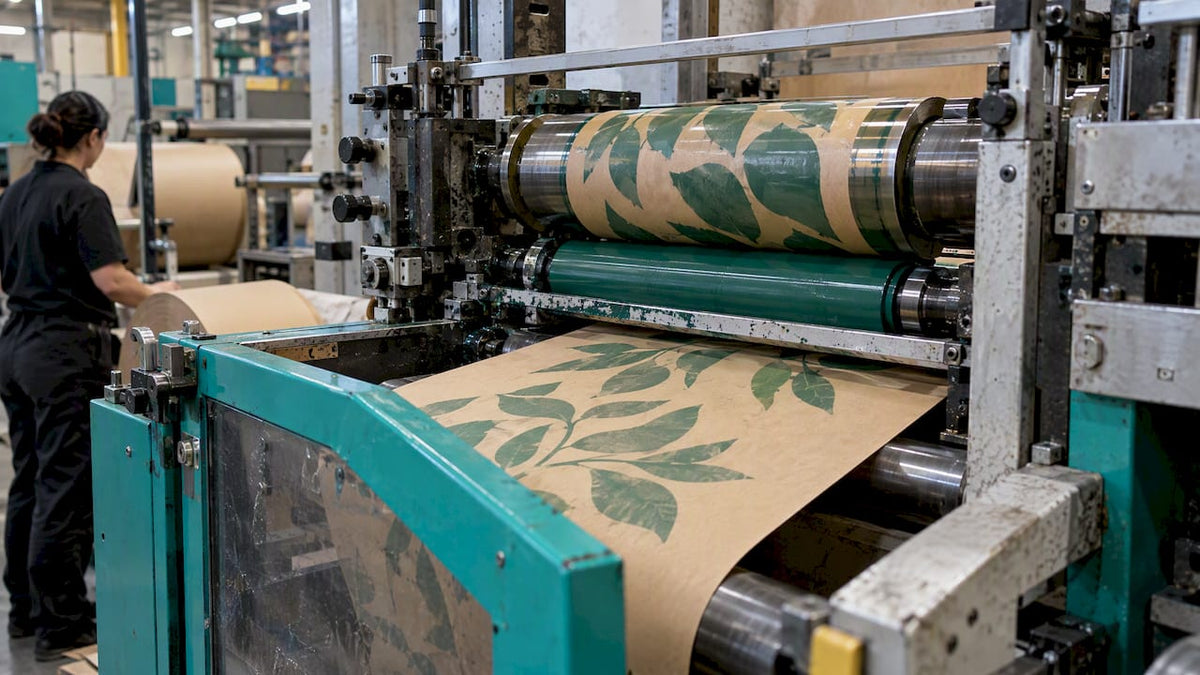
Water-based ink printing is the standard way to print paper shopping bags, and it is a good one: the inks keep volatile organic compounds (VOCs) out of the pressroom and sit well on absorbent kraft. The catch is that water-based ink is harder to run than it looks. Drying, pH and viscosity decide whether your logo comes out crisp and rub-resistant or blurred and tacky. This guide covers what a packaging buyer should know, and what to ask a converter before approving a run.
TL;DR
- Water-based inks are the industry standard for absorbent media such as paper shopping bags, because they do not release VOCs into the pressroom.
- The challenge has moved from emissions to process control: drying, pH, viscosity and ink-paper interaction.
- “Food-safe ink” is not a certificate you can buy. In Canada, the finished package and its use are what count, which matters for takeout bags.
- Ask any bag supplier how they cure, test and stack printed bags. Their answers tell you more than a sample does.
- We print paper shopping bags with water-based inks and 8-color flexo at our Toronto plant. Contact us to talk through your artwork.
Table of Contents
- What water-based ink actually is
- Water-based vs solvent-based ink on bags
- Why the hard part is now drying and control
- What this means for print quality on kraft
- Takeout bags: ink and food contact in Canada
- Greener inks: what “eco-friendly” can and cannot mean
- Our view: why we print this way, and where
- How to evaluate a water-based bag printer
- Work with us on your bag order
- FAQ
- Sources
What water-based ink actually is
Water-based ink uses water as the main carrier for pigment, with resins that bind the color to the sheet. As the water leaves, by absorption into the paper and by evaporation, the resin film locks the pigment in place. Solvent-based systems do the same job with organic solvents, which evaporate quickly but emit VOCs.
That difference explains why the two families ended up on different materials. Solvent-based inks were historically preferred for non-porous films because they evaporate fast and adhere well to them. Paper is the opposite case. It is porous and absorbent, so water-based ink suits it. Advances in resin technology now let water-based inks work on a wider range of substrates than before, but for kraft and other paper bags it has long been the default choice.
The Flexographic Technical Association also notes that water-based inks are used on wide-web flexo presses for paper packaging, overwraps and bags. If you want the wider picture of how flexo compares with other methods, our guide to flexo vs offset printing goes through it for packaging buyers.
Water-based vs solvent-based ink on bags
For paper bags the comparison comes down to a few practical points.
| Factor | Water-based ink | Solvent-based ink |
|---|---|---|
| Typical home | Paper, kraft, cardboard, napkins | Non-porous films |
| VOCs in the pressroom | Not released | Released during drying |
| Drying | Slower, needs heat and airflow | Fast evaporation |
| Press control | pH and viscosity need regular checks | Less sensitive to pH |
| Fit for paper shopping bags | Standard choice | Rarely the right tool |
The honest summary: water-based ink gives up some drying speed in exchange for a cleaner pressroom and a better match with paper. A converter who knows the process loses nothing in print quality. A converter who does not will show it in the stack.
Why the hard part is now drying and control
Industry experts point out that water-based inks removed the main VOC concern but shifted the technical challenge to drying and substrate compatibility. For a buyer, that is the useful way to think about it: the ink is rarely the problem, the process around it is.
Drying and cure
Water evaporates more slowly than solvents, so press speed may need to come down unless the press has high-velocity impinged air drying. Even after a bag looks dry, the ink is not finished. Water-based ink typically needs about 24 hours to reach full cure, adhesion and durability.
Rush that, and you get blocking: printed bags that stick together in the stack because they were packed too tightly or piled too high straight off the press. Residual moisture is also the leading cause of poor water resistance and poor adhesion, according to the same source. So airflow and moisture management are quality steps, not afterthoughts. We cover the oven side in more detail in our piece on water-based ink drying for buyers.
pH and viscosity
Water-based flexo inks are stable in a narrow window. A technical white paper puts the ideal pH between 8.5 and 9.5, and drift outside it can cause blurred dots or edge diffusion. The reason is that amine stabilizers, which keep the resin in solution, evaporate during printing. The pH falls, viscosity rises, and the ink becomes harder to re-dissolve. That can plug plates or anilox cells, which shows up as missing print or broken dots.

The same paper says pH and viscosity should be checked consistently, often every four hours during a run, and that a closed ink circulation system reduces the swing by limiting exposure to air. If a supplier cannot tell you how they monitor these two numbers, treat that as a warning sign.
Cleaning and plates
Dried water-based ink is stubborn. The white paper notes that traditional cleaning may not fully remove it from anilox rolls, and that an ultrasonic cleaner is often needed. Plate choice and press settings, including oven temperature and air volume, also matter on difficult surfaces. None of this is visible on a finished bag, and all of it affects whether the 5,000th bag matches the first.
This kind of discipline is not unique to bags. Any printer running water-based systems needs the same habits, and production considerations for consistent water-based printing are worth a look if you want to see how another print discipline approaches repeatability.
What this means for print quality on kraft
Buyers usually judge print on three things: color, fine detail and rub resistance.
Color. Kraft is brown and absorbent, so colors read differently than on coated white stock. Solid brand colors on natural kraft often look deeper and more earthy. A white underlayer, a lighter bag stock or a spot color choice changes the result. Ask for a printed proof on the actual bag stock, not a screen render.

Fine detail. Blurred dots and edge diffusion trace back to pH and viscosity drift, as above. Tight small type and fine lines are where a poorly controlled press shows itself first. Our guide to how bag printing works, step by step shows where artwork, plates and press setup meet.
Rub resistance. A bag that scuffs in a customer’s hand undermines the brand. Rub testing is a routine quality check for printed paper bags. We have put together an ink rub resistance checklist that references ASTM D5264 and TAPPI T830, and it is a good template for what to request from any supplier.
Takeout bags: ink and food contact in Canada
This is where buyers most often get misled. A supplier says “food-safe ink,” and the buyer assumes a certification exists. It does not work that way.
In Canada, there is no mandatory pre-market approval from Health Canada for food packaging when direct food contact is not intended. Packaging must still be safe and suitable for its intended use under the Food and Drugs Act. The Canadian Printing Ink Manufacturers’ Association statement adds two practical points for printed packaging without direct contact: there should be a functional barrier between the food and the printed ink film, and the ink must be fully cured so nothing sets off or marks during handling or storage.
Brands can voluntarily request a Letter of Non-objection from Health Canada for sensitive applications, but the same document says that process can take from six months to more than two years. And a letter does not remove the packager’s responsibility: safety rests with the manufacturer and converter, who must design the package so ink components do not migrate into food. Regulators look at the finished package and how it is used, not the ink alone. If your situation involves direct food contact or an unusual product, confirm requirements with Health Canada or a regulatory specialist before you finalize the design. A legal overview of food-contact materials in Canada, updated in September 2026, is a useful starting read for your own counsel.
For takeout and delivery bags, then, your questions to a supplier are about cure, barrier and migration, not about a badge. Our articles on water-based inks and migration risk and what to demand on safety: SDS, migration tests and ventilation list the documents worth asking for.
Greener inks: what “eco-friendly” can and cannot mean
Terms like eco-friendly, sustainable and environmentally friendly are not defined by the ink alone. Water-based inks help because they avoid VOC emissions in the pressroom. Beyond that, the claims worth checking are about what is in the ink and what is in the bag.
There is real movement on the ink side. Siegwerk’s Paul Pain describes the industry moving beyond renewable binders toward bio-renewable colorants, including pigments derived from coffee-roasting side streams, in water-based formulations for paper bags. That is a direction of travel, not a spec you will find on every quote.
For your own claims, keep them narrow and provable. “Printed with water-based inks on FSC®-certified paper” is checkable. A vague green slogan on the bag is not. If you are looking at compostability or biodegradability claims for printed food packaging, read our note on biodegradable inks in food packaging first.
Our view: why we print this way, and where
We make paper shopping bags in Toronto, and water-based ink printing is part of how we do it. Here is what we have learned matters most.
Process beats ink brand. Most print complaints we hear about on bags are not about the ink. They are about a cure that was cut short, a stack that was too heavy, or a color that was approved on a different stock. We treat drying and stacking as steps with their own checks.
Proof on the real bag. That is why pre-press proofing and pre-production prototyping are part of our service. A prototype on your actual paper and style shows you how the artwork will behave before the run, and it is far cheaper to fix there.
Close to the buyer. Because we manufacture domestically, in Toronto, you can talk to the people running your job, and a reprint or adjustment does not wait on an ocean crossing. For buyers working to a launch date, that proximity matters more than a slightly lower unit quote from far away.
Print capability that fits brands. Our flexo presses handle up to 8 colors, so brand palettes, gradients and solid fields are possible without compromise. We also work with FSC®-certified and recycled content, and our water-based inks pair naturally with both.
In short, we view a converter as a technical partner, not a commodity vendor. That is also how industry experts describe it: the best results come from a domestic manufacturer with advanced drying systems and paper-ink expertise.
— Taylor
How to evaluate a water-based bag printer
Use this short list when you compare quotes or visit a plant.
- Ask how they dry and cure. Do they use heat and airflow, and how long do they hold bags before packing? A converter that cannot explain this is guessing.
- Ask how often they check pH and viscosity. Every few hours during a run is a reasonable benchmark from the technical literature.
- Ask about stacking and carton limits. Overpacked fresh bags block.
- Request a printed prototype on your stock. Not a digital mock-up.
- Request rub-resistance test results. Agree on a method before the order.
- For takeout bags, ask about barrier and migration. Request the SDS and documentation described above, and have your own compliance lead review it.
- Get lead times in writing. Include proofing, production and cure time, not just press time.
Work with us on your bag order
If you buy custom paper shopping bags in Canada, we can take you from die-line and graphic layout through proofing, prototyping, printing and warehousing and logistics. We make turn top, serrated top and tamper-resistant serrated top bags, all customizable in size and design. See the range of paper bags, read about our Canadian-made paper shopping bags, or contact Gather Packaging to discuss your paper shopping bag or retail packaging needs. If you are still weighing print methods and finishes, our overview of custom bag printing options for sustainable branding is a good place to start.
FAQ
Is water-based ink permanent on paper bags?
Once fully cured, yes, it forms a durable film on paper. Full cure, adhesion and durability typically take about 24 hours, so bags handled or stacked too early can scuff or stick. Rub testing confirms how a given job performs.
What are the downsides of water-based ink?
It dries more slowly than solvent ink, so it needs good airflow, heat or slower press speeds. It is also sensitive to pH and viscosity, which must be monitored during a run. These are process issues a skilled converter manages routinely.
Are water-based inks safe for takeout bags?
Safety depends on the finished package and its use, not the ink alone. In Canada, packaging without intended direct food contact should have a functional barrier and fully cured ink. Confirm your specific case with Health Canada or a regulatory specialist.
Do water-based inks work on kraft paper?
Yes. Paper and kraft are absorbent, which is why water-based ink is the standard for them. Expect colors to look deeper on natural kraft than on white stock, and approve a proof on the real bag.
Sources
- The Growth of Water-Based Inks in Flexible Packaging, Flexographic Technical Association
- The Basics of Flexo Ink Chemistries, Manufacturing and On-Press Maintenance, Flexographic Technical Association
- Important Considerations for Water-Based and UV Energy-Curable Inks, Flexographic Technical Association
- White Paper on Flexographic Water-based Ink Technology
- From Coffee Side Stream to Ink to Flexo Print on Paper Bags, Flexographic Technical Association
- Canadian Printing Ink Manufacturers Association statement on printing inks and food packaging
- Regulation of Food-Contact Materials in Canada, Steptoe
Share:
Block Bottom Paper Bags: A Canadian Buyer's Guide