
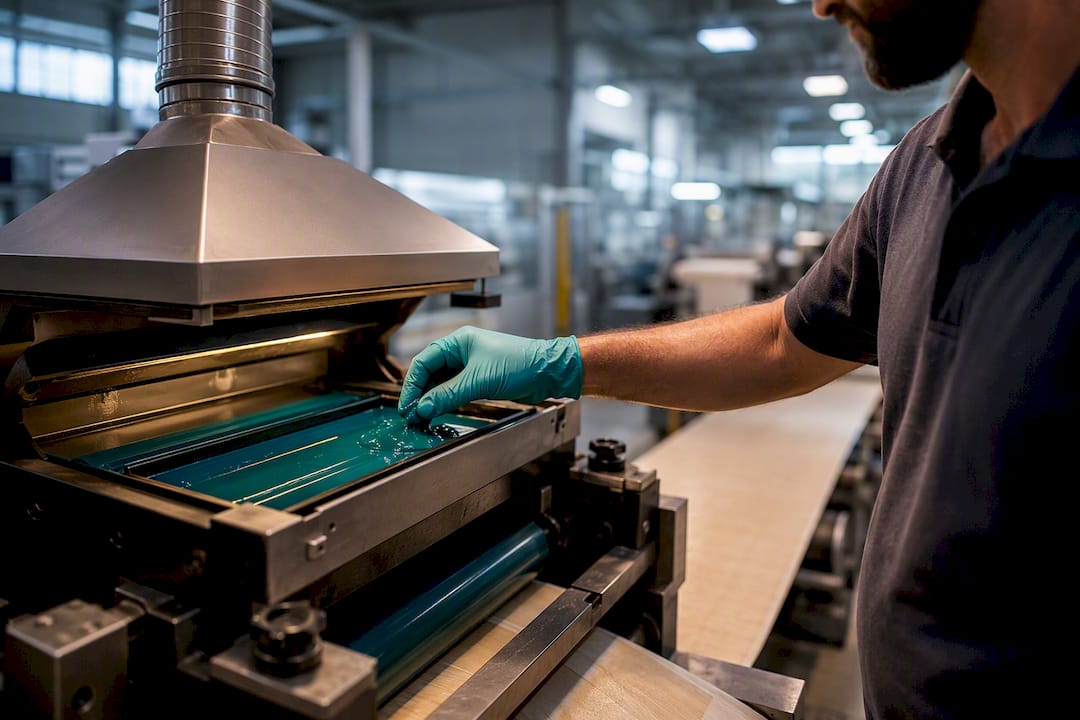
Water-based inks are generally safer and lower in volatile organic compounds than solvent-based inks, but they are not automatically risk-free. Before approving any printed run, request the safety data sheet, confirm migration testing for anything touching food, and verify the printer has working ventilation and PPE protocols. Gather Packaging, which prints paper shopping bags with water-based flexo inks, treats those three checks as standard practice rather than optional extras.
TL;DR:
- Water-based inks emit fewer VOCs overall, but additives during printing can still introduce hazardous chemicals, requiring individual SDS review.
- Slower drying and adhesion issues on non-porous substrates are common, but primers and IR dryers can mitigate these limitations.
- Handling risks mainly involve skin contact and inhalation from misting, so using PPE and adequate ventilation remains essential despite lower VOC content.
- Food packaging safety depends on direct contact; migration testing and official documentation are necessary for bags that touch food directly.
- Suppliers must provide current SDS, proper labeling, and documented controls, with full approval of prototypes before scaling production.
Table of Contents
- Is Water-Based Ink Safety a Given, or Does It Depend on the Formula?
- What Health Risks Should Pressroom Operators Actually Worry About?
- Do Water-Based Inks Actually Lower Environmental Risk?
- What Controls and PPE Should Suppliers Have in Place?
- Can Water-Based Ink Touch Food Packaging Safely?
- Where Do Water-Based Inks Fall Short, and How Do Shops Work Around It?
- How Gather Packaging Applies These Standards to Paper Bag Production
- What Should Procurement Require Before Approving a Print Job?
- Ready to Print Your Next Run With Water-Based Inks?
- Sources
- FAQ
Is Water-Based Ink Safety a Given, or Does It Depend on the Formula?
Water-based ink uses water as its carrier instead of a petroleum solvent. Pigments or dyes suspended in that water are held together by binders and resins, with coalescents, preservatives, or defoamers added to control drying and shelf stability.
That base formula is genuinely different from solvent or UV-cured systems, and it usually behaves differently on press too:
- Drying takes longer, since water has to evaporate rather than flash off a solvent.
- Gloss tends to run lower than solvent or UV inks, which matters for certain retail branding jobs.
- Adhesion on coated or nonporous substrates can be inconsistent without primer or press adjustments.
Here’s the part buyers miss: the base ink isn’t the whole story. Press-side additives, like defoamers or slip agents added during a run, can raise VOC content even in a system marketed as water-based. The EPA’s evaluation of flexographic inks found exactly this. Water-based systems came out ahead of solvent systems on VOC emissions and energy use overall, but some water-based formulations still contained chemicals of concern once you looked at what was actually going into the mix.
What Health Risks Should Pressroom Operators Actually Worry About?
Two exposure routes matter most: skin contact and inhalation. Direct contact with wet ink can irritate skin or, with repeated exposure, trigger sensitization in some workers. That’s a reason to standardize on nitrile or butyl gloves rather than whatever’s on hand, and to build in hand-washing breaks between shifts.

Inhalation risk comes mostly from misting during high-speed printing and from VOCs released by additives, not from the water carrier itself. Shops running faster presses or enclosed spaces should consider local exhaust ventilation (LEV) or respirators, and document those controls in writing with the supplier.
The safety data sheet is the actual authority here, not the ink’s marketing label. Research from the EPA noted that some water-based formulations included amides, glycols, or other additives tied to worker exposure concerns that a generic “water-based” label won’t reveal. Two sections matter most on any SDS:
- Section 2 (hazard identification): look for hazard statements and signal words.
- Section 8 (exposure controls): check recommended PPE and any listed exposure limits.
A generic assumption that “water-based means safe” is unreliable on its own. Every formulation needs its own SDS review, ink by ink.
Do Water-Based Inks Actually Lower Environmental Risk?
Yes, on balance, but the win isn’t unconditional. The EPA’s flexographic ink comparison found water-based systems generally produced lower VOC emissions and lower energy use than solvent-based lines. That’s a real environmental advantage, and it’s the main reason brand owners push suppliers toward water-based conversion in the first place.
The trade-off is in the waste stream, not the air. Switching away from solvent systems cuts hazardous liquid waste, but shops end up managing more contaminated solids instead, things like ink-soaked wipes, filters, and press cleanup materials. Pollution-prevention guidance for printers is direct on this point: conversion shifts the waste problem rather than eliminating it, and shops need new housekeeping habits to handle that shift.
Practical rules that keep this manageable:
- Never rinse or drain ink into sewer systems, even water-based ink.
- Capture and label press returns separately from general waste.
- Segregate contaminated solids from clean packaging waste for proper disposal.
- Use a licensed waste handler for anything that can’t go through standard recycling.
Pro Tip: Some experienced shops reclaim press-return ink with a colorimeter to match color batches, cutting virgin ink purchases. This only works with the ink supplier’s approval and dedicated storage to avoid cross-contamination.
What Controls and PPE Should Suppliers Have in Place?
Procurement and safety officers should treat this as a checklist before signing off on any supplier, not a courtesy question during a plant tour.
- Confirm engineering controls: local exhaust ventilation, appropriately sized dryers, and some form of room ventilation monitoring.
- Confirm administrative controls: SDS retained and current, staff trained on the specific ink in use, and GHS/CLP-compliant labeling supplied with every shipment.
- Confirm PPE protocols: correct glove material for the ink chemistry, eye protection where splash risk exists, and respirators where misting or VOC levels warrant them.
GHS and CLP labeling isn’t a nice-to-have. Legislation coverage from Labels & Labeling points out that compliant labeling and complete SDS documentation, especially the exposure-control section, are what converters are legally required to maintain. A supplier who can’t produce a current SDS on request is a red flag regardless of what the ink is made from.
Basic PPE inspection habits round this out:
- Check gloves for tears or chemical breakthrough before each shift.
- Replace respirator cartridges on the schedule the manufacturer specifies, not by guesswork.
- Keep eyewash stations accessible near mixing and cleanup areas.
Can Water-Based Ink Touch Food Packaging Safely?
It depends entirely on whether the ink makes direct contact with food or sits on the exterior of the packaging. Regulatory expectations differ sharply between the two. Ink printed on the outside of a takeout bag faces lighter scrutiny than ink anywhere near a direct food-contact surface.
For anything closer to that line, ask suppliers for actual documentation, not a verbal assurance:
- Migration test reports showing what, if anything, transfers from ink to substrate under realistic conditions.
- Declarations of compliance tied to the specific substrate and end use.
- Third-party lab certificates rather than the supplier’s internal test data alone.
A supplier can reasonably self-certify packaging with no direct food contact, like the exterior of a retail shopping bag. Foodservice takeout and delivery bags are a different case: if there’s any chance of direct contact, insist on migration evidence before running production. Water-based inks generally reduce migration risk compared with solvent-based alternatives, but “generally lower risk” isn’t the same as “cleared for food contact.” Get the paperwork.
Where Do Water-Based Inks Fall Short, and How Do Shops Work Around It?
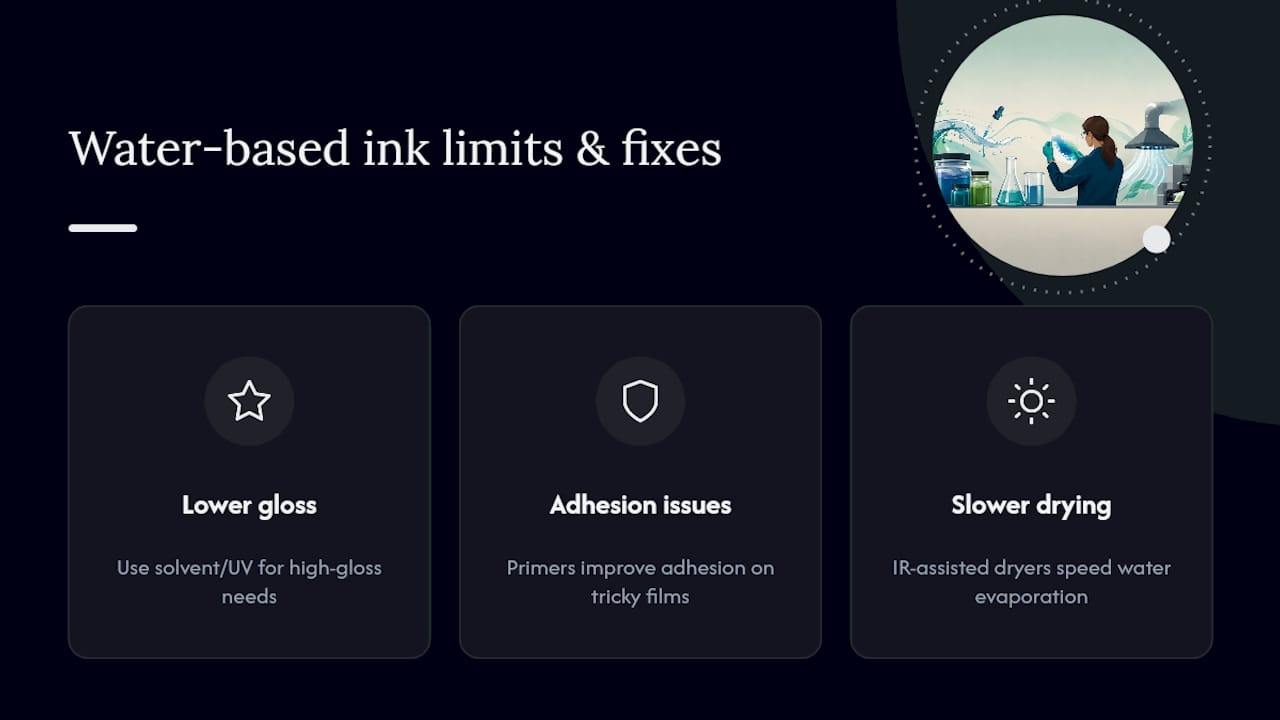
The honest limitations: lower gloss than solvent or UV inks, adhesion problems on non-porous films, and slower drying that can bottleneck a press schedule.
Standard fixes exist for each. Primers improve adhesion on tricky substrates. IR-assisted dryers speed up water evaporation without reworking the whole press line. Pilot runs before full production catch adhesion or drying issues while they’re still cheap to fix, not after a full order is printed.
Retraining matters too, since operators used to solvent systems often need to relearn press tension and drying settings. Solvent or UV systems still have a place for certain substrates or speed requirements. If a shop uses them, the same ventilation, PPE, and SDS discipline applies, just with tighter margins for error given the higher VOC content involved.
How Gather Packaging Applies These Standards to Paper Bag Production
Gather Packaging prints with water-based inks across its 8-color flexo setup, and pre-press proofing and prototyping happen before any full production run, catching color and adhesion issues early rather than after a bulk order ships.
Packaging buyers evaluating any supplier, Gather Packaging included, should ask for the same QA steps: proofed color separations before production, a current SDS for the ink formulation in use, migration documentation when the bag will touch food, and a documented production run check confirming print quality holds across the full order.
What Should Procurement Require Before Approving a Print Job?
Before signing off, require the SDS, migration evidence for food-contact runs, confirmation of working ventilation, and an approved production sample. Run a pilot batch and get written sign-off before scaling to full volume.
— Taylor
Ready to Print Your Next Run With Water-Based Inks?
Gather Packaging manufactures custom paper shopping bags domestically in Toronto, which means proofs and revisions move faster than they would with an overseas supplier juggling multiple time zones and shipping delays. Every bag runs through 8-color flexo printing with water-based inks, backed by pre-press proofing and prototyping before a full production run ever starts.
If you need FSC-certified stock, recycled content, or documentation to support a food-adjacent takeout bag order, that’s a conversation worth having before you commit to volume, not after. Browse Turn Top, Serrated Top, and Tamper-Resistant paper bag styles to see what’s available, or reach out through Gather Packaging’s consultation page to request a proof, ask about migration testing for your specific application, and get a quote based on your order volume and timeline.
Sources
- Evaluation of Flexographic Inks on Wide-Web Film Summary Booklet
- Impact of legislation on ink manufacture and usage — Labels & Labeling
- Pollution Prevention for Printers
FAQ
What Are the Downsides of Using Water-Based Ink?
Slower drying, lower gloss compared to solvent or UV inks, and adhesion challenges on nonporous substrates are the main trade-offs, usually manageable with primers or press adjustments.
What Pen or Printing Ink Is Truly Non-Toxic?
No ink is universally “non-toxic.” Even water-based formulations can contain additives of concern, so the SDS for that specific formulation, not the water-based label, tells you what’s actually in it.
Are Water-Based Inks Hazardous to Handle?
They carry lower VOC exposure risk than solvent-based inks, but skin contact and inhalation from misting or additives still warrant gloves, ventilation, and SDS review before a job runs.
Do Water-Based Inks Wash Off or Transfer Easily?
Water-based inks dry into the substrate and resist casual smudging once cured, but they generally show lower rub resistance than solvent or UV inks on non-porous materials without a topcoat or primer.
How Do I Verify a Supplier’s Water-Based Ink Safety Claims?
Request the current SDS, confirm GHS/CLP-compliant labeling, and ask for migration test documentation if the packaging will contact food, as Gather Packaging provides for its printed paper bag orders.
Share:
5 Supplier Non Negotiables Buyers Must Require for Paper Bags in Canada
Canadian Buyers: Avoid 25–50% Surtax on Paper Bag Imports, Sept 8, 2026