
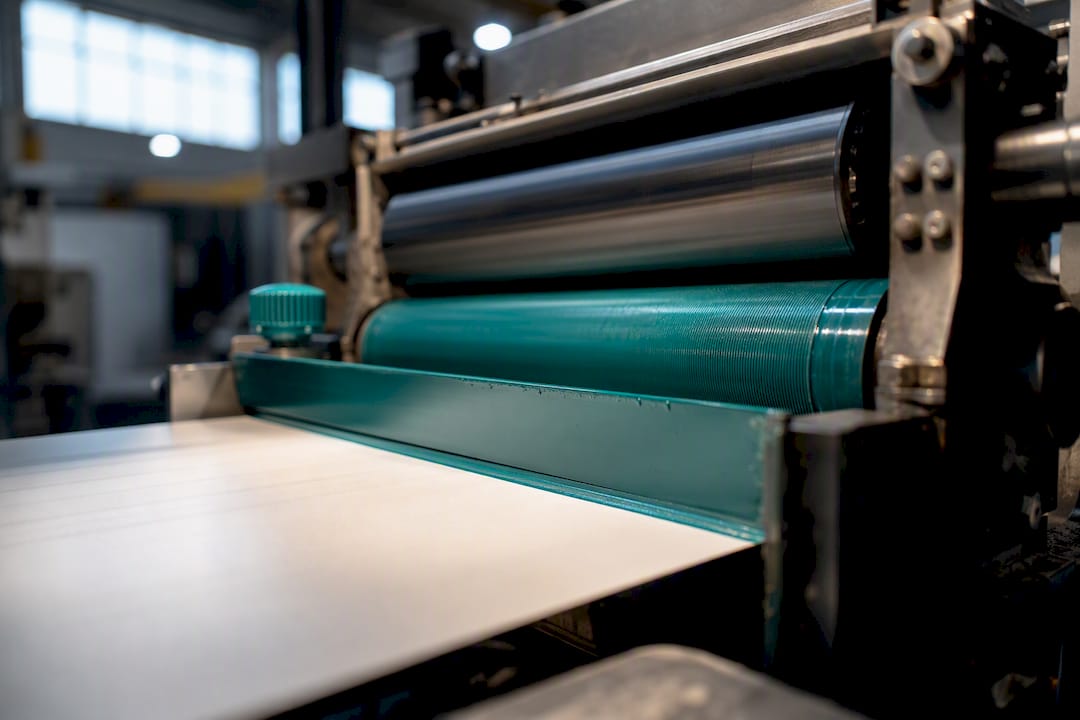
Water-based inks are the practical choice for most paper and board packaging, including retail shopping bags, and they hold up well against sustainability and safety goals. The main caveats: non-absorbent films need specialized low-migration formulations, and anything touching food directly requires finished-pack testing rather than a supplier’s word alone. Some domestic manufacturers print paper shopping bags with water-based inks, which can give procurement teams a shorter path to both compliance documentation and delivery.
TL;DR:
- Water-based inks are best suited for paper and board packaging due to their quick absorption and strong adhesion, reducing the need for special surface treatment.
- They emit significantly fewer VOCs than solvent-based inks, lowering environmental impact, safety costs, and facility requirements for storage and ventilation.
- Switching to water-based inks often requires dryer upgrades, diligent pH and viscosity monitoring, and trial runs tailored to specific substrates to prevent issues like dry-in or poor adhesion.
- Food-contact applications demand comprehensive migration testing on the finished pack, and suppliers should provide actual test results and safety documentation before production.
- Domestic manufacturers like Gather Packaging offer faster turnarounds and direct QA access, making them a strong choice for testing, samples, and transitioning to water-based ink systems.
Table of Contents
- What Are Water-Based Inks and How Do They Work?
- Benefits of Water-Based Inks for Packaging
- Which Substrates Work Best with Water-Based Inks?
- What Changes on Press When You Switch to Water-Based Ink?
- What Regulatory and Food-Contact Rules Apply?
- How Do You Choose Ink Suppliers for Paper Shopping Bags?
- How Gather Packaging Approaches Water-Based Ink Printing
- How Do You Test Ink Durability on Packaging?
- What Certifications and Standards Apply to Water-Based Inks?
- How Should You Store Water-Based Inks?
- What’s the Total Cost of Switching to Water-Based Inks?
- What Should Procurement Teams Do Next?
- Get Custom Paper Shopping Bags Printed with Water-Based Inks
- Sources
What Are Water-Based Inks and How Do They Work?
Water-based ink is built from four parts: a pigment for color, a binder (usually an acrylic or polymer resin) that holds the pigment to the substrate, water as the carrying solvent, and a handful of additives, including wetting agents, defoamers, and sometimes crosslinkers to improve rub resistance. That’s a simpler formula than solvent-based systems, which rely on organic solvents to carry the resin, or UV/EB inks, which cure instantly under light rather than drying through evaporation.
The tradeoff shows up in resolubility. Water-based polymers need to stay dissolved and workable in the ink tray, on the anilox roll, and on the plate. If the pH drifts or the ink dries too fast on press components, the polymer can lose resolubility and harden in place, a problem known as dry-in. That’s why pH and viscosity monitoring during a run isn’t optional maintenance. It’s the difference between consistent color from the first sheet to the last and a shift that shows up mid-run and forces a stop.
Color strength on water-based systems has closed the gap with solvent inks substantially over the past decade, largely because resin chemistry has improved. But getting there on press still depends on running the ink within its designed pH and viscosity window, not just buying the right formulation.
Benefits of Water-Based Inks for Packaging
The sustainability case for water-based ink starts with volatile organic compound (VOC) output. Water-based systems emit far less VOC than solvent-based inks, which cuts workplace exposure risk and reduces the fire and ventilation infrastructure a plant needs to run solvent inks safely. BASF’s technical overview of water-based ink benefits points to lower VOC emissions and reduced environmental and safety costs as the core advantage, alongside print quality that’s now competitive with solvent systems across many packaging applications.
That lower VOC profile carries operational side benefits most procurement teams don’t think about until they price them out, such as sustainable waste solutions using bulka bags that help reduce environmental impact:
- Reduced fire-code and ventilation requirements compared to solvent ink storage
- Lower insurance and handling costs tied to flammable-solvent storage
- Fewer workplace air-quality controls needed on the pressroom floor
- Easier cleanup, since water-based inks rinse rather than requiring solvent washdown
Pro Tip: Ask any prospective ink supplier for their VOC content by weight, not just a “low VOC” claim. Canadian facilities operating near VOC concentration thresholds under federal regulation need the actual number, not a marketing label.
Print quality is close enough to solvent-based output on paper and board that most retail buyers won’t see a visible difference on shelf. Solvent and UV systems still hold an edge on certain high-gloss film applications and extreme scuff resistance, but for paper shopping bags, that gap rarely matters in practice.
Which Substrates Work Best with Water-Based Inks?
Paper and board are the strongest match for water-based ink, and it’s not close. The absorbent fiber structure pulls water out of the ink quickly, which supports fast drying and strong adhesion without extra chemistry. That’s exactly why water-based ink is the standard choice for printed paper shopping bags and most retail packaging.
- Paper shopping bags and retail packaging: Best-case substrate. Fast absorption, strong adhesion, vibrant color on kraft or bleached stock.
- Corrugated (pre-print and post-print): Common application, particularly for flexo pre-print on linerboard, though board caliper and coating affect ink lay-down.
- Flexible films and laminates: The hardest case. Non-porous surfaces don’t absorb water, so drying depends entirely on dryer capacity and airflow, and adhesion often needs corona treatment or a primer coat.
Growth in water-based ink adoption for flexible packaging has been driven by better resin formulations and dryer technology, but film substrates still demand more engineering than paper does. If your product line is mostly paper bags with some flexible pouches mixed in, expect the paper side to be straightforward and the film side to need a real conversation with your ink supplier about primers and drying margin.
What Changes on Press When You Switch to Water-Based Ink?
Converting a press to water-based ink, or running a new SKU on one, means planning around drying, chemistry stability, and surface wetting before the first sheet runs.
- Confirm dryer capacity first. Water-based inks need more thermal energy to flash off water than solvent inks need to evaporate solvent, so press speed sometimes has to drop, or dryer output has to go up, to hit the same throughput.
- Set a pH and viscosity monitoring routine. Check both at defined intervals during the run, not just at startup. Drift in either one is usually the earliest warning sign of trouble.
- Watch for dry-in on anilox cells and plates. Loss of resolubility is what causes ink to harden where it shouldn’t, and it shows up as spotty color or missing detail long before anyone traces it to chemistry.
- Plan adhesion fixes for non-absorbent stock. Corona treatment, primers, or an ink reformulated for the specific film are the standard fixes when wetting is poor.
- Build in a real trial run. A short press trial on the actual substrate construction, not a generic test sheet, catches problems before a full production run does.
Pro Tip: Keep a running pH and viscosity log for every job, not just problem jobs. When something goes wrong three weeks later, that log is what tells you whether it’s a chemistry issue or a mechanical one.
Operator training matters more with water-based systems than people expect, mostly because the failure modes are chemistry-driven rather than mechanical. A pH monitoring routine that catches drift early prevents the downtime that erases whatever cost savings switched you to water-based ink in the first place.
What Regulatory and Food-Contact Rules Apply?
Migration risk is the central compliance question for any packaging that touches food, even indirectly. Ink components can transfer to food through direct contact or through set-off, where ink from one sheet transfers to the back of the sheet stacked against it during storage. Because migration depends on the entire finished construction, not the ink alone, testing has to happen on the final converted pack, including any barrier layers and the way the product is stored and palletized.
No single global standard governs food-contact inks. Internationally, converters commonly work within voluntary frameworks like the Swiss Ordinance on food-contact materials or Nestlé’s ink guidance list. In Canada, Health Canada’s packaging materials guidance places responsibility on the packer or brand owner to ensure the finished packaging is safe, rather than issuing formal ink acceptance letters the way some other regulators do.
Before awarding a job that touches food, even for a takeout bag liner, ask suppliers for:
- Migration test results on the actual finished construction, not a generic ink data sheet
- A Safety Data Sheet (SDS) covering the ink formulation
- A written statement of Good Manufacturing Practice (GMP) adherence
- Evidence of compliance with recognized industry frameworks like EuPIA guidelines
Facilities running significant ink volumes should also check Ontario’s environmental reporting thresholds for printing operations, since provincial rules can trigger registration requirements tied to monthly usage.
How Do You Choose Ink Suppliers for Paper Shopping Bags?
Substrate fit comes first. A supplier who can show consistent results on kraft paper and board, not just a general capabilities list, is the one worth trialing. From there, the evaluation gets specific fast.
- Ask for low-migration evidence if there’s any food adjacency, including takeout bags, even when the ink doesn’t touch food directly.
- Confirm press capability matches your color and volume needs. Multi-color flexo printing (six, eight colors) handles most retail branding without compromise.
- Check sustainability credentials, including FSC® chain-of-custody certification for the paper stock itself, not just the ink.
- Request QA documentation, including press trial results and color-matching protocols, before committing to a full run.
- Confirm lead time and logistics fit your reorder cycle, especially if you’re used to importing and want to compare it against domestic turnaround.
Red flags include vague answers about migration testing, no willingness to run a sample before a full order, and pricing that seems disconnected from the volume or complexity of the job. Good suppliers show you actual sample bags, not just spec sheets, and they’re specific about what they can and can’t verify.
How Gather Packaging Approaches Water-Based Ink Printing
Gather Packaging manufactures paper shopping bags domestically in Toronto, with 8-color flexo printing that handles detailed branding on FSC®-certified and recycled paper stock. Water-based ink is part of the standard product offering, built around the same paper substrate advantages covered above: strong absorption, reliable adhesion, and vibrant color without the VOC load of solvent systems.
Collaboration typically runs through design and prototyping first, then a press trial to confirm color and print quality on the actual bag construction, followed by quality assurance checks before the full run ships. Because manufacturing happens domestically, turnaround on samples and adjustments moves faster than working with an overseas supplier on a multi-week shipping cycle. If your team needs migration-test coordination for a takeout bag line or just wants to see a printed sample before committing, that conversation starts with a direct request to the team.
How Do You Test Ink Durability on Packaging?
Print longevity testing depends on how the bag or box actually gets used, not on a single lab number. Rub and scuff resistance testing, usually done with a crockmeter or similar abrasion device, tells you whether printed color survives handling during fulfillment, retail display, and customer carry. For shopping bags specifically, that means testing the printed surface after repeated flexing at the fold lines, since cracking at a fold is a far more common failure than fading.
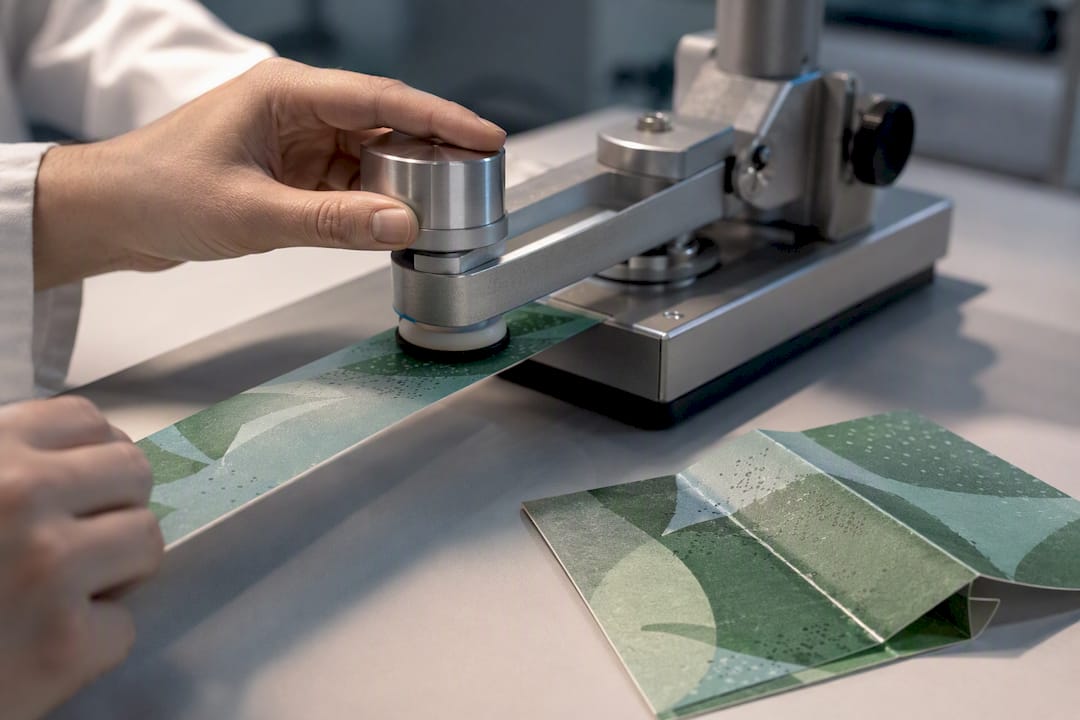
Wet rub resistance matters separately from dry rub resistance. A bag that survives dry handling can still lose ink when it picks up moisture from a humid stockroom or a spilled drink, so testing both conditions catches failures a single test would miss.
Light exposure testing (accelerated weathering under controlled UV) matters for anything displayed near a storefront window or shipped in a way that exposes it to sunlight for extended periods. Water-based inks generally hold color under moderate light exposure on paper substrates, though extreme or prolonged UV exposure will fade any ink system eventually.
Adhesion testing, often a simple tape-pull test, confirms the ink bonded properly to the substrate rather than sitting loosely on top of it. This matters more on coated or laminated board than on raw kraft paper, where absorption does most of the adhesion work automatically.
The most reliable approach combines these methods on a small trial batch before a full production run, rather than relying only on a supplier’s general spec sheet. A trial run on your actual bag construction, with your actual paper stock and fold pattern, catches problems a generic lab test on a flat sheet never will.
What Certifications and Standards Apply to Water-Based Inks?
No universal certification exists that stamps an ink as “food safe” the way a UL mark certifies electrical safety. Instead, compliance runs through a mix of regional regulations and voluntary industry frameworks that converters and brand owners have to assemble themselves.
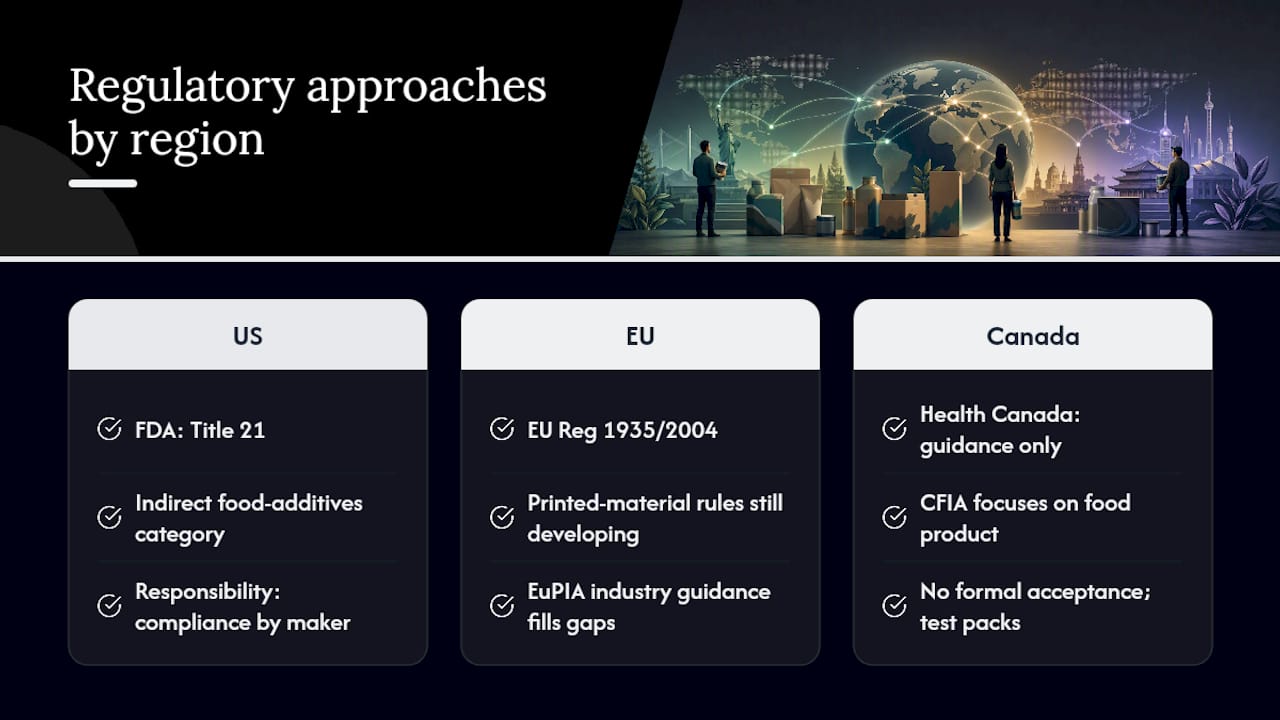
In the United States, FDA regulations under Title 21 of the Code of Federal Regulations govern indirect food additives, which is the category most packaging inks fall under when there’s any chance of contact. The European Union runs its own food-contact material framework under EU Regulation 1935/2004, with specific rules for printed materials still under development in some member states, which is part of why industry associations like EuPIA (European Printing Ink Association) publish their own guidance to fill the gap.
In Canada, there’s no equivalent formal acceptance process. Health Canada provides guidance rather than a certification list, and CFIA (Canadian Food Inspection Agency) oversight focuses more on the food product than the packaging ink itself. That leaves the packer or brand owner holding responsibility for proving their finished pack is safe, typically through migration testing rather than a certificate.
FSC® certification, while not a food-safety standard, is the credential procurement teams should verify separately when sustainability claims matter, since it confirms the paper stock’s chain of custody rather than anything about the ink. The two credentials answer different questions, and treating one as a substitute for the other is a common buyer mistake.
How Should You Store Water-Based Inks?
Shelf life on water-based ink runs shorter than most buyers expect, generally in the range of six months to a year unopened, depending on the formulation and storage conditions. Temperature swings are the main enemy. Freezing can permanently break the polymer emulsion, and excessive heat accelerates evaporation and skinning even in a sealed container.
Store ink at a stable room temperature, away from direct sunlight, and keep containers sealed tightly between uses. Once a container is opened, skinning at the surface is the first sign of trouble. A thin film forming on top usually means air exposure has started drying that layer, and it needs to be removed rather than mixed back into the batch.
Rotation matters as much as temperature. Older stock should get used first, and any ink sitting unused for more than a few months needs a viscosity and pH check before it goes back on press. Ink that’s drifted outside its working range will cause the same dry-in and adhesion problems covered earlier, even though the container looks fine from the outside.
Buyers who order in bulk to save on per-unit ink cost should weigh that against shelf-life risk. A large drum sitting untouched for eight months isn’t a bargain if a third of it has to be discarded for chemistry drift by the time it’s used.
What’s the Total Cost of Switching to Water-Based Inks?
The sticker price on water-based ink itself is often close to solvent-based ink, so the real cost conversation lives in the pressroom, not the purchase order. Dryer upgrades are the biggest line item for converters running older equipment built around solvent evaporation rather than water flash-off. Retrofitting or replacing dryers to handle higher thermal loads is a real capital cost, though one that’s typically absorbed by print manufacturers rather than passed directly to packaging buyers on a per-order basis.
Operating costs shift in a favorable direction after the switch. Lower VOC emissions mean reduced ventilation and fire-suppression infrastructure, along with lower insurance costs tied to flammable-solvent storage, both of which savings tend to show up in a converter’s overhead rather than a line item a buyer sees directly. Cleanup costs drop too, since water rinses replace solvent washdown procedures.
For the packaging buyer specifically, the practical cost question is simpler: does the supplier’s water-based ink program add cost to your paper shopping bag or der versus a comparable solvent-printed run? On paper substrates, where water-based ink is the natural fit rather than a forced conversion, pricing is typically competitive because the supplier isn’t fighting the substrate to make the ink work. The costs to watch for are the ones tied to non-standard requests: rush low-migration testing, custom color matching outside a standard palette, or small run sizes that don’t spread tooling costs efficiently.
What Should Procurement Teams Do Next?
Run a small trial before committing to a full order, request the actual migration and QA documentation rather than a general spec sheet, and get specific with any supplier about their press capability on your exact paper stock. Those three steps catch most of the problems that show up later as delays or rejected shipments.
— Taylor
Get Custom Paper Shopping Bags Printed with Water-Based Inks
Gather Packaging manufactures paper shopping bags domestically in Toronto with 8-color flexo printing on FSC®-certified and recycled stock, using water-based inks as a standard option across the product line.
Working with a domestic Canadian manufacturer means shorter sample turnaround and direct access to press trial results and QA documentation, instead of waiting weeks on an overseas supplier to answer a testing question. Whether you’re converting an existing bag program to water-based ink or specifying a new line of kraft paper bags for a retail launch, the process starts with a sample. Contact Gather Packaging to request a quote, discuss migration-test coordination for any food-adjacent SKUs, and get a printed sample in hand before you commit to a full run.
Share:
Avoid Costly Reprints with White Ink on Kraft for Packaging Buyers
Packaging Buyers: 8 Color Flexo with CMYK plus Four Spot Stations