
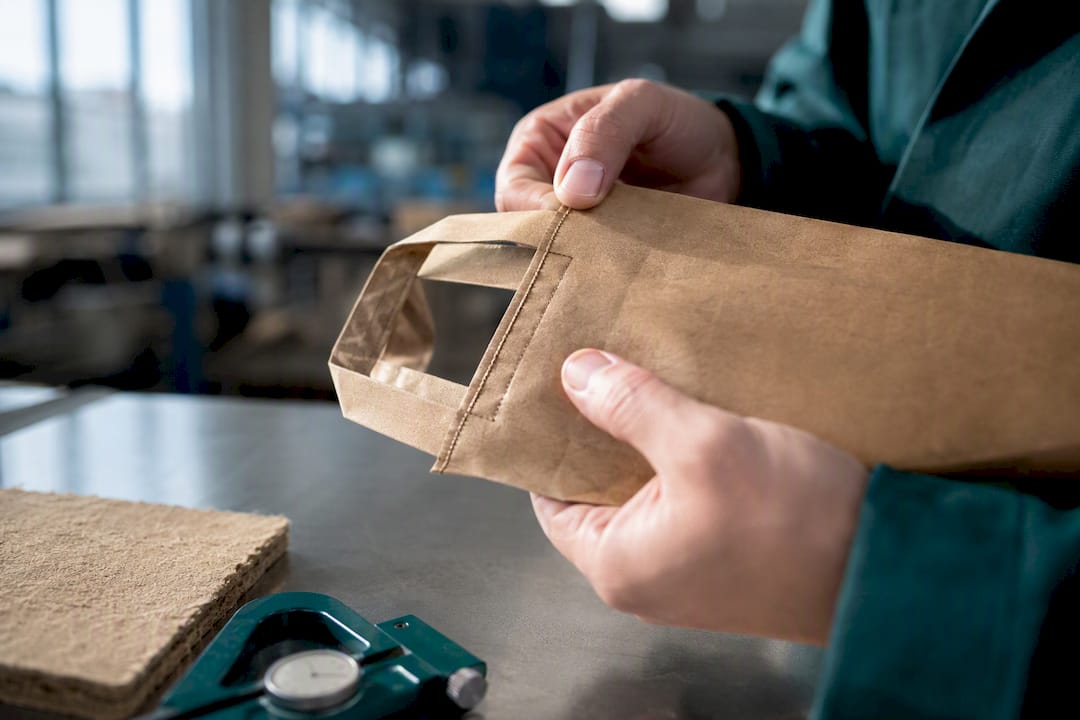
Any supplier that can’t produce FSC Chain of Custody documentation, water-based ink confirmation, and a physical pre-production sample on request isn’t ready for a Canadian retail RFQ. The five non-negotiables are material and certification proof, handle and strength specifications, printing and ink compliance, mandatory labeling, and a documented sample and QA process. A domestic manufacturer is built around meeting exactly this checklist. The sections below break down each requirement and the paperwork that should back it up.
TL;DR:
- Suppliers must provide FSC Chain of Custody documentation, water-based ink confirmation, and a physical pre-production sample before quoting.
- Acceptable bag strength standards align with EN13590, requiring carriers to withstand at least six kilograms and support multiple reuse cycles.
- Domestic Canadian manufacturers can reduce lead times and improve quality control through in-person QA checks and shorter production cycles.
- Recyclability claims depend on coatings and inks, so specify avoidance of plastic-based coatings and verify construction matches local curbside recycling standards.
- Procurement should request detailed documentation for certification, lot traceability, and compliance to avoid liability and facilitate traceability if issues arise.
Table of Contents
- Supplier Specification Checklist For RFQs And Purchase Orders
- What Do Tensile Strength And Bursting Strength Actually Mean?
- How Should Procurement Test And Approve A Bag Before Full Production?
- What Lead Times And Order Minimums Should You Expect?
- Canadian Rules Buyers Should Build Into Supplier Contracts
- What Labeling And Paperwork Should Suppliers Provide?
- How Does Bag Disposal Affect What You Should Specify?
- A Manufacturer’s View On Meeting These Requirements
- Get A Sample, A Quote, And Straight Answers From Gather Packaging
- Sources
- FAQ
Supplier Specification Checklist For RFQs And Purchase Orders
Vague RFQ language gets vague quotes back. If your spec sheet says “eco-friendly kraft bag,” you’ll get five bids that mean five different things. Spell out the actual numbers and phrases you want written into the supplier’s proposal.
Material and certification language. State the paper type (bleached white kraft or natural kraft), a GSM range appropriate to load (most retail carrier bags run between 80 and 150 GSM depending on bag size and handle style), and whether you require post-consumer recycled content. If sustainability claims matter to your brand, require the exact phrase “FSC Chain of Custody certified” and ask for the certificate number, not just a logo on a proof. Requesting FSC documentation up front avoids a certification dispute after the purchase order is signed.
Handle construction. Specify handle type (twisted paper, flat paper, or die-cut) and attachment method (glued patch, reinforced eyelet, or rope-through). Ask the supplier to confirm minimum pull-strength testing on the handle assembly, not just the paper stock. A bag with excellent tear resistance in the body can still fail at a weak glue joint.
Printing and inks. Require water-based inks in writing, since some overseas suppliers default to solvent-based systems that cost more to convert. Ask for Pantone matching on brand colors rather than “close match” CMYK approximation, and confirm flexo press capability if your order needs more than four colors.
Labeling requirements. Your PO should state what needs to print on the bag: a recycled-content percentage statement if applicable, “recyclable” wording only where your municipality’s recycling stream actually accepts the bag, and any bilingual labeling your retail category requires.
Documents to request alongside the quote:
- A physical pre-production sample, not a digital rendering
- Mill certificates confirming fiber source
- FSC Chain of Custody paperwork with certificate number
- A food-contact statement, if the bag will carry takeout or food-delivery items
Nail these down before the quote comes back and you cut out a full round of revisions later.
What Do Tensile Strength And Bursting Strength Actually Mean?
Lab jargon on a spec sheet is useless if nobody on your team can translate it into “will this bag survive a Saturday grocery run.” Four terms show up in most technical documents, and each answers a different practical question.
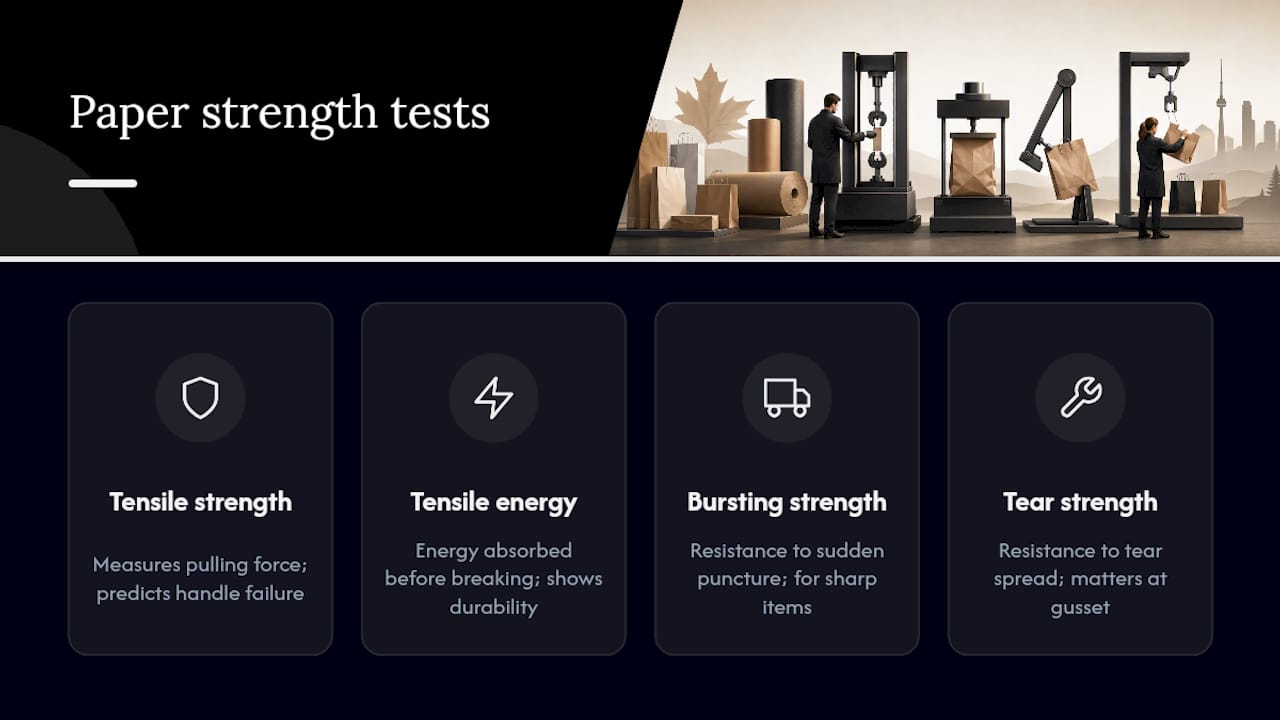
Tensile strength measures how much pulling force the paper withstands before it tears, which is the number that predicts handle failure. Tensile energy absorption (TEA) measures how much energy the paper absorbs before breaking, a better predictor of real-world durability than tensile strength alone because it accounts for stretch, not just peak force. Bursting strength tests resistance to a sudden puncture, relevant if your bags carry anything with sharp edges or corners. Tear strength measures resistance to a tear spreading once it starts, which matters most at stress points like the bottom gusset.
Industry guidance from CEPI Eurokraft recommends paper carrier bags be able to carry at least 6 kilograms and remain reusable up to five times for the same purpose, and it points to EN13590 as a reference test standard for validating that durability. That figure gives procurement teams a usable benchmark: a bag built for a boutique clothing order with light contents doesn’t need the same GSM as a bag meant to carry bottles or hardware.
For adhesives, insist on water-based glue systems rather than solvent-based ones, both for handle attachment and bottom-seam construction. Water-based glue holds up under Canadian humidity swings better than lower-grade alternatives and avoids the off-gassing concerns some retail buyers flag for in-store use.
On test reports: a supplier’s own internal test data is fine for a repeat order with an established track record. For a new supplier relationship or a high-volume first order, ask whether they can supply results referencing recognized methods like EN13590, and reserve independent third-party lab testing for orders where bag failure carries real brand or safety risk.
How Should Procurement Test And Approve A Bag Before Full Production?
Skipping a sampling step is how procurement teams end up with a warehouse full of bags whose handles separate from the bag on day one. A disciplined approval sequence catches that before it becomes a 10,000-unit problem.
- Digital mockup. Confirm dimensions, color layout, and print placement before any physical material gets cut.
- Physical sample with full print run. This is the artifact that matters most. A single production-ready sample with complete printing and finished handles reveals far more than three partial mockups, and it’s what supplier-evaluation guidance recommends procurement teams treat as the acceptance benchmark.
- Sample testing. Run a handle pull test, a drop test with representative weight, a Pantone color check against your approved swatch, and a seam strength check on the bottom gusset. Record the pass/fail criteria in writing before testing starts, not after.
- Production sample or pilot run. Before committing to the full order, request a short pilot batch and pre-production photos so you can catch drift in color or print registration.
- Nonconformance handling. Agree in advance on what happens if a lot fails inspection: rework, discount, or rejection with replacement timeline.
Pro Tip: Ask your supplier for in-line photos during the actual production run, not just a sample pulled before the press starts. Print registration and color can drift over a long run, and photos from hour six of production tell you something a pre-approved sample never will.
Keep mill certificates, lot traceability records, and FSC Chain of Custody paperwork on file for every order. If a bag fails in the field, that paperwork is what lets you trace the problem back to a specific production run instead of guessing.
What Lead Times And Order Minimums Should You Expect?
Lead time on a custom paper bag order isn’t one number. It’s the sum of artwork approval, plate-making for flexo printing, the print run itself, finishing (handle attachment, bottom gluing), quality inspection, and delivery. Each stage adds days, and a rushed artwork approval on your end can push the entire schedule back by a week.
A Toronto-based manufacturer changes the math on several of those stages. Domestic production can compress lead times by removing cross-border shipping and customs clearance from the timeline entirely, and it means your team can request an in-person or virtual pre-production check without waiting on international freight schedules. Landed-cost calculations also get simpler: a domestic order avoids the currency conversion and duty guesswork that comes with an overseas DDP or EXW quote.
Speaking of terms, spell out DDP (delivered duty paid) versus EXW (ex works) explicitly in your purchase order. An EXW quote that looks cheaper on paper can end up costing more once you add freight, insurance, and customs handling yourself. Build rework and rejected-lot clauses into your contract too. If a production run fails your acceptance criteria, the PO should state whether the supplier covers reprint costs or issues a credit, and by what deadline. For rush orders or seasonal launches, ask whether the supplier offers staged deliveries or short-term warehousing so you’re not forced to take the full order in one shipment.
Canadian Rules Buyers Should Build Into Supplier Contracts
Several provinces and municipalities have restricted single-use plastic checkout bags, which has pushed retail buyers toward paper alternatives as the default carrier bag. That shift means procurement teams now need to treat paper bag sourcing with the same rigor they’d apply to any regulated packaging category, even though paper bags themselves aren’t subject to the same bans plastic bags face.
Extended producer responsibility (EPR) programs, which now operate in several Canadian provinces, put reporting obligations on the businesses that put packaging into the marketplace, not on the bag manufacturer. That means your procurement contract should require suppliers to provide the material composition and weight data you need for your own EPR filings. Ask for this in writing at the quoting stage rather than after the packaging is already in circulation. Gatherpackaging covers the mechanics of these extended producer responsibility obligations in more detail, including the kind of documentation kraft bag suppliers should be able to hand over.
Public sector procurement also offers a useful template even for private retail buyers. Federal procurement policy uses standard contract language requiring environmentally preferable packaging and verification that packaging is accepted by local recycling programs at the delivery location. Adapting similar language into your own vendor contracts, requiring suppliers to confirm recyclability claims match what your local municipality actually accepts, closes a gap that a lot of retail procurement teams miss. A bag printed with “recyclable” doesn’t mean much if the ink coverage or coating on that specific bag makes it unwelcome in a curbside stream. For background on how the broader plastic bag policy shift affects paper bag sourcing timelines, see Gatherpackaging’s rundown on Canada’s plastic bag ban.
What Labeling And Paperwork Should Suppliers Provide?
A compliant-looking bag with no paperwork behind it is a liability, not an asset. When a supplier makes a recycled-content or FSC claim on the bag itself, your contract should require the certificate that backs it up, not just a printed logo.
At minimum, ask suppliers to provide: the FSC Chain of Custody certificate number if the bag carries FSC labeling, a written recycled-content percentage if that claim appears on the bag, mill certification confirming fiber origin, and a food-contact safety statement for any bag used in takeout or food-delivery applications. If your retail category involves bilingual packaging requirements, confirm the supplier’s print process can accommodate both English and French text without compromising legibility or print quality.
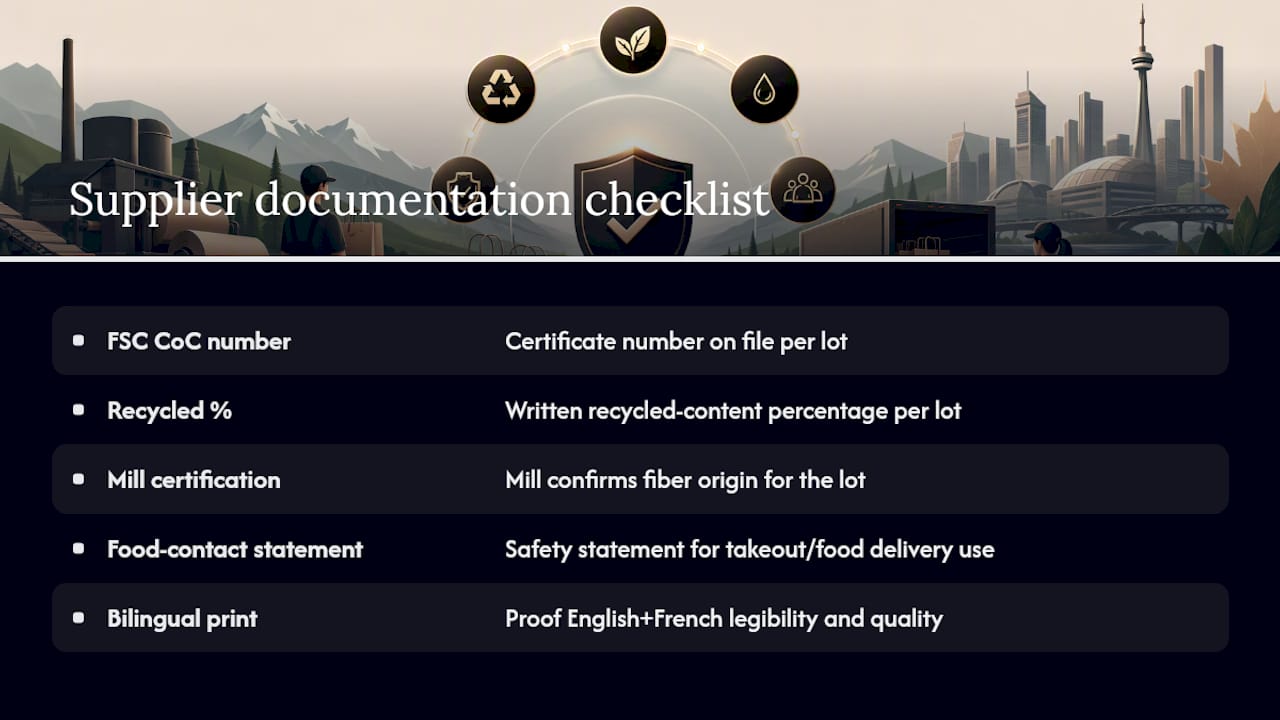
Keep this documentation on file per production lot, not just per supplier relationship. If a claim on a bag gets questioned by a retail partner, a customer, or a regulator, lot-level traceability is what lets you respond with specifics instead of a general assurance. Gatherpackaging’s rundown of eco-friendly bag certifications walks through which certificates carry real weight and which are closer to marketing language.
One practical note: some suppliers publish brochure-style documentation showing chain-of-custody claims and manufacturing process details as part of their standard sales materials. That format is worth asking for explicitly, since a supplier that already has this documentation prepared is usually further along in its own compliance process than one that has to assemble it on request.
How Does Bag Disposal Affect What You Should Specify?
What happens to the bag after checkout should shape what you put in the RFQ, not just what it looks like on the shelf. Paper bags are widely accepted in curbside recycling programs across Canada, but coatings, laminates, and heavy ink coverage can push a bag out of the recyclable category even when the base material is kraft paper.
If your brand wants to print “recyclable” on the bag, specify that the supplier avoid plastic-based coatings or laminates that would contaminate a paper recycling stream; consider recyclable materials for eco-friendly candle packaging to guide your choice of sustainable packaging. Water-based inks help here too, since heavy solvent-based ink coverage can affect how a recycling facility processes the material. If your bags will carry food or grease (a common issue for takeout bags), be aware that heavily soiled paper often isn’t accepted in standard residential recycling and may need to be composted or landfilled depending on local rules, so don’t overstate recyclability claims on bags meant for greasy food use.
Municipal programs vary enough across Canada that a bag accepted curbside in one city might not be accepted the same way in another. Build a line into your supplier contract requiring confirmation that the bag’s specific construction, coatings included, aligns with standard Canadian curbside paper recycling streams rather than assuming “it’s paper, so it’s fine.”
A Manufacturer’s View On Meeting These Requirements
Most of the compliance headaches procurement teams describe come down to one thing: a supplier that treats documentation as an afterthought instead of building it into the production process from day one. At Gatherpackaging, design assistance and prototyping happen before a single sheet goes on press, which means the pre-production sample a buyer receives already reflects the actual handle construction, ink system, and material the final order will use.
Manufacturing from Toronto with FSC-certified material options, water-based inks, and 8-color flexo printing means QA inspection and troubleshooting happen close to home instead of across a border. If your procurement team wants a second set of eyes on an existing RFQ checklist or a sample with full handles and print, that’s a conversation worth having before the purchase order goes out.
— Taylor
Get A Sample, A Quote, And Straight Answers From Gather Packaging
Gatherpackaging is the domestic alternative to sourcing overseas: Toronto manufacturing means shorter lead times, easier in-person QA access, and no cross-border shipping delays sitting between your artwork approval and your delivery date. For a procurement team weighing supplier risk, that local access to pilot runs and pre-production photos is the difference between catching a problem in week two versus finding out after 10,000 units land at the warehouse.
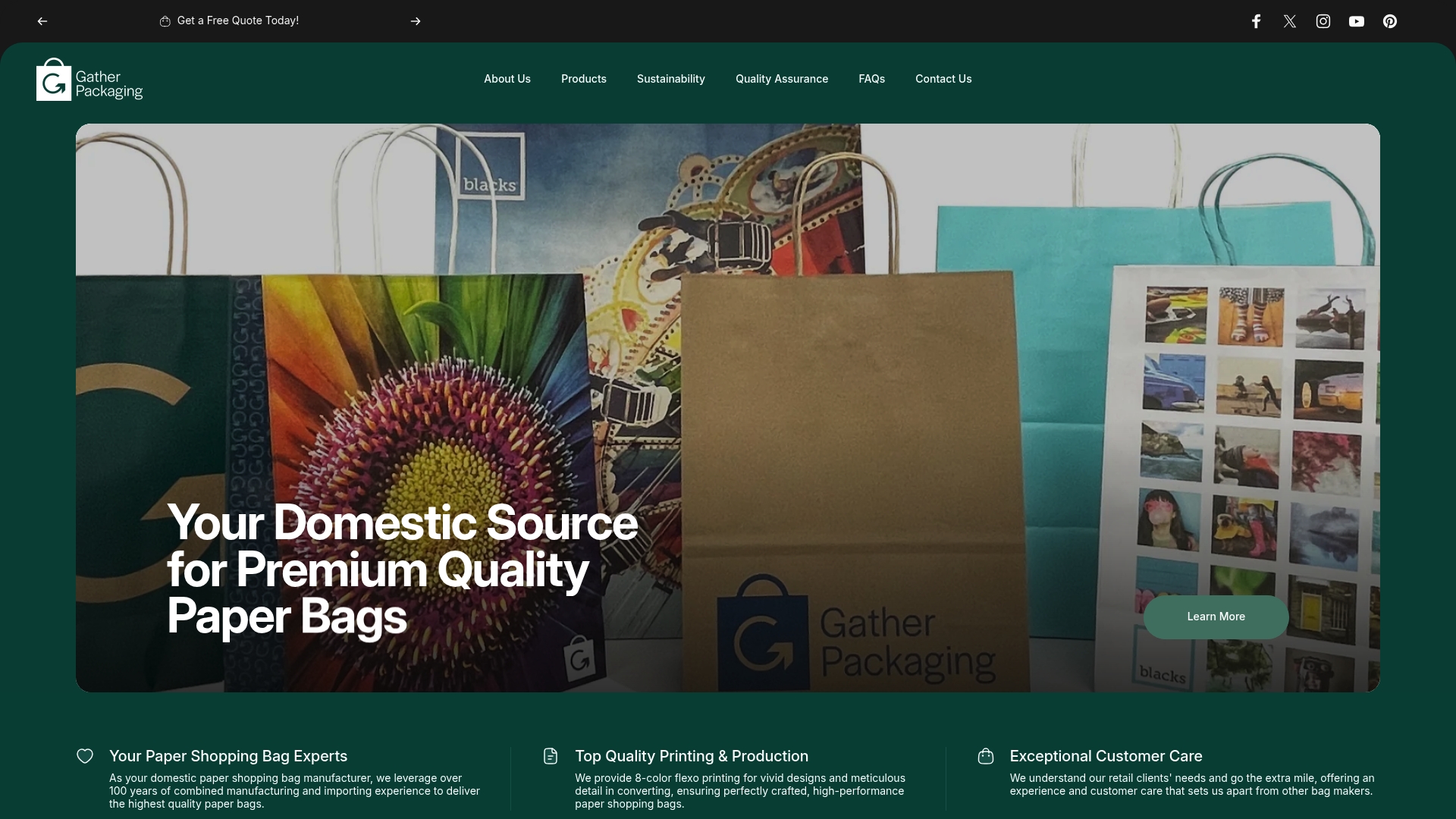
The manufacturer produces custom kraft, turn top, serrated top, and tamper-resistant bags with FSC-certified material options, water-based inks, and 8-color flexo printing, supported by design assistance and prototyping before production starts. When you reach out, request a physical sample with full handles attached, mill and FSC certificates, a realistic lead time estimate for your volume, and an itemized cost breakdown covering material, plate-making, and finishing. Visit the Gather Packaging homepage to start that conversation, or explore the made-in-Canada product line to see current bag styles and material options before you send your next RFQ.
Sources
FAQ
What should a paper bag RFQ require from every supplier?
At minimum, require GSM and material specifications, FSC Chain of Custody documentation, water-based ink confirmation, a physical pre-production sample, and mill certificates before the purchase order is finalized.
What test standard applies to paper carrier bag strength?
EN13590 is the reference test standard cited by CEPI Eurokraft’s industry guidelines for validating tensile, tear, and bursting strength in paper carrier bags.
How much weight should a standard paper shopping bag hold?
Industry guidance recommends carrier bags be able to hold a typical supermarket load and remain reusable multiple times for the same purpose, though heavier retail applications may need higher GSM stock.
Should procurement accept a supplier’s own test reports?
Supplier-provided reports are acceptable for repeat orders with an established supplier, but new relationships or high-volume first orders warrant requesting results referencing recognized methods like EN13590.
Does Gather Packaging manufacture paper bags domestically in Canada?
Yes, Gather Packaging manufactures paper bags from a Toronto facility with FSC-certified material options, water-based inks, and 8-color flexo printing, along with design and QA support.
Are all paper bags accepted in Canadian curbside recycling?
Not automatically. Coatings, laminates, and heavy grease contamination can make an otherwise recyclable kraft bag unsuitable for standard curbside programs, so procurement should confirm construction details against local rules.
Share:
Buyers: Win Sustainable Packaging RFPs With 3 Mandatory Evidence Packs
Water Based Ink Safety: Demand SDS, Migration Tests, Ventilation