

A sustainable packaging RFP has one job: force bidders to prove their environmental claims with documents that hold up under audit, not marketing language. The essential evidence includes a Recyclability Evidence Dossier, a contractual Declaration of Conformity, and an operational readiness pack. Skipping any of the three means you’re buying a claim, not a packaging solution. Everything below builds out that checklist section by section.
TL;DR:
- Bidders must submit a complete Recyclability Evidence Dossier, a signed Declaration of Conformity, and an Operational Readiness Pack to avoid disqualification.
- Verification of recyclability claims requires proof of collection access, sortation feasibility, reprocessing capability, and end-market LOIs, not just marketing statements.
- Certificates such as FSC and recycled content must be checked against public registries, with continuous re-verification of claims during the contract period to manage supply and compliance risks.
- Domestic manufacturing, like Gather Packaging in Toronto, can often supply verification documents quickly, supporting thorough evaluation and reducing supply chain disruption concerns.
Table of Contents
- Building a Sustainable Packaging RFP: Structure and Required Attachments
- What Recyclability Evidence Should Bidders Submit?
- How Do You Verify a Supplier Is Production-Ready?
- Building a Weighted Scoring Matrix for Sustainable Packaging Bids
- Standardizing the Procurement Document Pack
- How Long Should a Sustainable Packaging RFP Process Take?
- How Gather Packaging Supports a Sustainable Packaging RFP
- Making Compliance Evidence a Contractual Obligation, Not a Formality
- Sample RFP Language for Sustainable Packaging Requirements
- Managing Supply Chain and Sustainability Claims Risk
- Sustainability Certifications and Eco-Labels Beyond Recyclability
- Supplier Diversity and Ethical Sourcing in Packaging RFPs
- Managing Suppliers After the Sustainable Packaging RFP Is Awarded
- Author Perspective: Procurement Lessons From Live RFPs
- Get an RFP-Ready Capability Pack From Gather Packaging
- Sources
- FAQ
Building a Sustainable Packaging RFP: Structure and Required Attachments
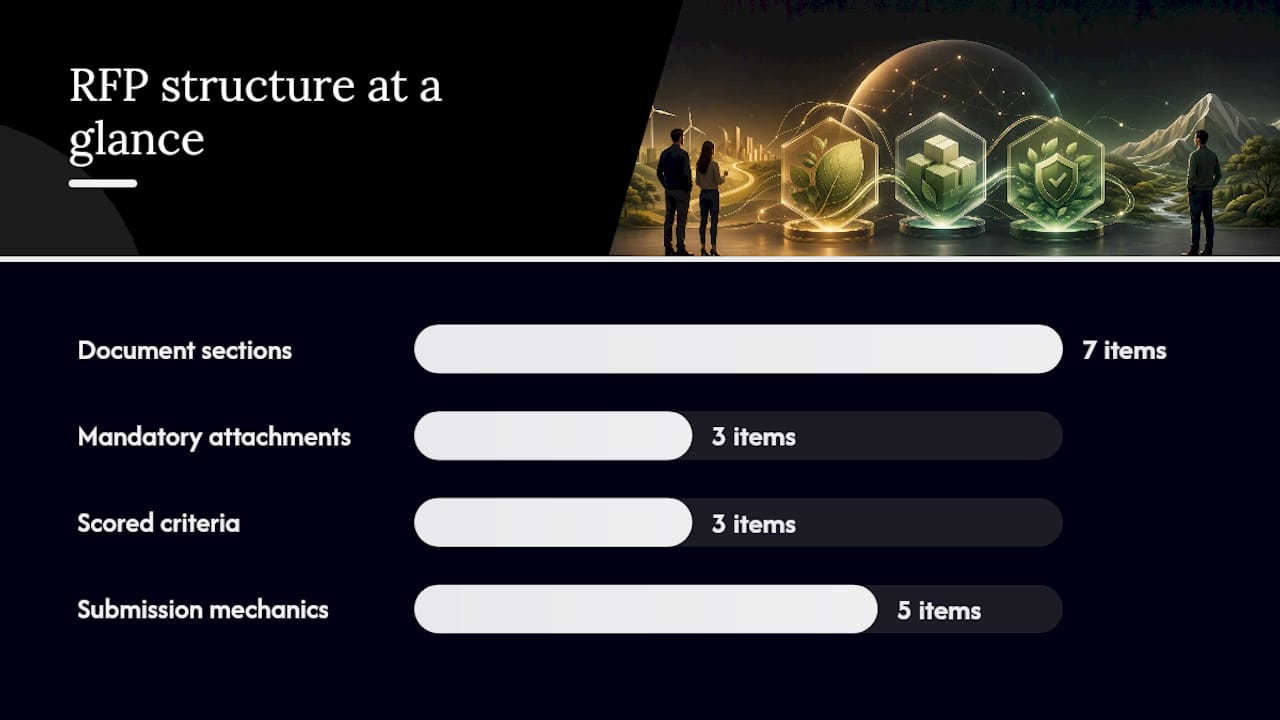
A sustainable packaging RFP works best when it’s built like a contract, not a wish list. Bidders should be able to open the document, understand exactly what’s mandatory versus what earns points, and submit without back-and-forth emails asking what you actually meant.
Here’s the section order that keeps evaluators and bidders aligned from day one:
- Project summary and background — current packaging spec, why you’re changing it, and the timeline you’re working against.
- Scope and volumes — annual unit counts, SKU count, seasonal spikes, and any regional split (private label versus branded, retail versus takeout delivery bags).
- Technical specifications — dimensions, print method, handle style, load capacity, and any existing die lines or artwork files bidders need.
- Sustainability requirements — this is where you name the Recyclability Evidence Dossier, DoC requirement, and any certification thresholds (FSC chain of custody, recycled content percentage floors).
- Pricing template — a locked spreadsheet format so every bidder quotes the same units (cost per thousand, tooling fees, freight terms) instead of burying assumptions in a PDF.
- Lead times and capacity commitments — standard production lead time, rush capability, and minimum order quantities by SKU.
- KPIs and penalty clauses — on-time delivery thresholds, defect rate ceilings, and what happens contractually if a supplier misses either.
The best packaging RFPs draw a hard line between mandatory documentation and scored award criteria, according to Packaura’s procurement guidance. Mandatory items disqualify a bid outright if missing: a signed DoC, proof of production capacity, and a completed pricing template. Scored items differentiate otherwise-qualified bidders: dossier completeness, certification breadth, sample lead time.
Submission mechanics matter more than most procurement teams admit. Require a single consolidated PDF, not a folder of loose attachments. Set a filename convention (CompanyName_RFP2026_SustainablePackaging.pdf) so your evaluation team isn’t renaming files at 11 PM before a scoring deadline. Name one point of contact for bidder questions, publish a Q&A window with a hard cutoff, and post consolidated answers to all bidders simultaneously. That last step protects you from a disqualification challenge later. If your RFP touches reverse logistics or a takeback component, borrow the stakeholder-mapping approach used in postal-sector RFPs for reverse value chains and require bidders to name every party in the recovery chain, not just the manufacturer.
What Recyclability Evidence Should Bidders Submit?
A “recyclable” claim without documentation is a liability, not a feature. Under emerging packaging regulation, an unsubstantiated claim can bar a product from market access entirely, according to Packa’s 2026 procurement analysis of PPWR and Green Claims Directive requirements. That’s why the Recyclability Evidence Dossier has to be a mandatory attachment, not a nice-to-have.
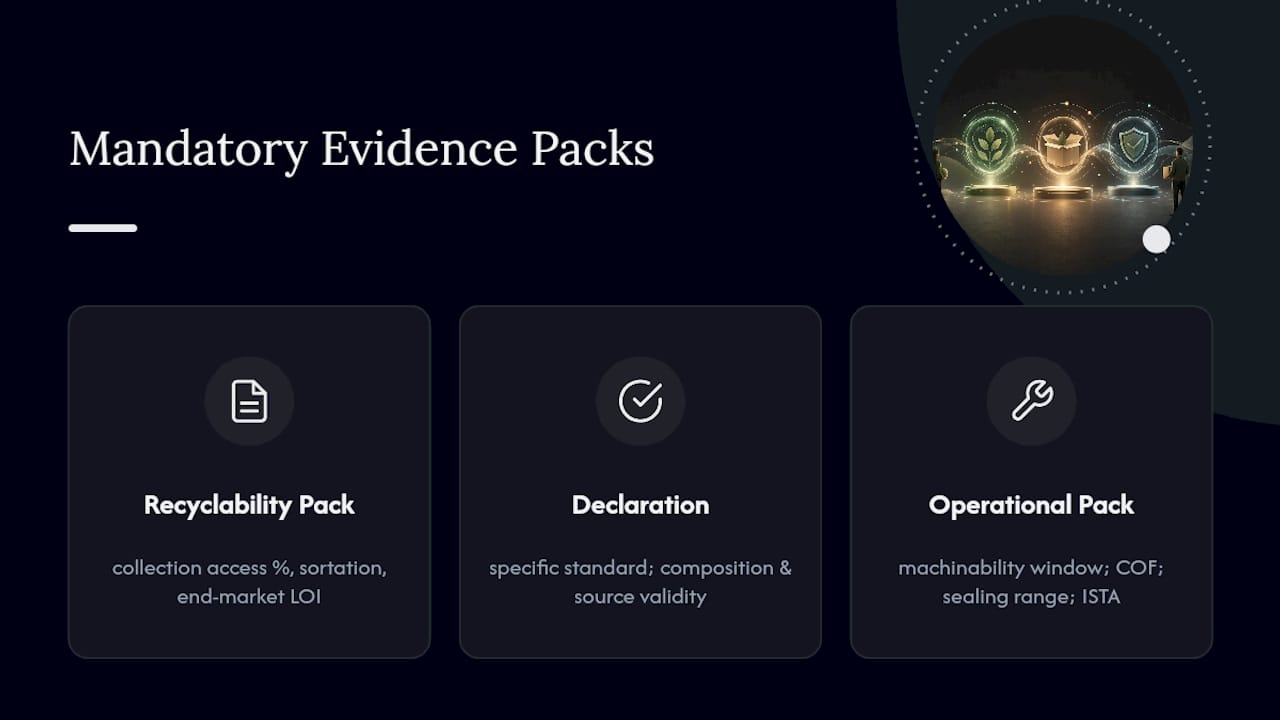
A complete dossier includes:
- Collection access data showing the material is accepted in curbside or drop-off programs covering a defined share of the target market.
- Sortation feasibility evidence confirming the material is correctly identified and separated by standard material recovery facility (MRF) equipment.
- Reprocessing compatibility documentation proving the material can actually be reprocessed into new products at commercial scale, not just theoretically.
- End-market letters of intent (LOIs) from reclaimers or mills willing to buy the recovered material.
- Third-party test or certification proof, referencing bodies like APR, AF&PA, or Western Michigan University (WMU) packaging labs where applicable to the material category.
Recyclability claims without collection, sortation, and end-market evidence are treated as unsubstantiated under the frameworks driving 2026 packaging procurement, and an increasing share of retail RFPs now require dossier-level proof before a claim can appear on-shelf, according to the SPC Retailer Forum brief on R&D submissions.
The Declaration of Conformity deserves its own line item, separate from the dossier. Require it whenever a bidder claims compliance with a specific standard, whether that’s recycled content percentage, FSC chain of custody, or a regulatory threshold like PFAS-free status. Treat the DoC as a contractual deliverable due before contract execution, not something you chase down after the purchase order ships. For claims tied to responsibly sourced fiber, verify certificate scope and expiration directly against the FSC certification requirements buyers should check rather than accepting a logo on a spec sheet at face value.
How Do You Verify a Supplier Is Production-Ready?
Recyclability on paper means nothing if the bag jams your fulfillment line or fails in transit. An Operational Readiness Pack closes that gap, and it should be mandatory for any bidder advancing past initial screening.
The pack needs to answer five practical questions:
- What’s the machinability window? Bidders should state the equipment speeds and settings their packaging has been validated against, not just “compatible with standard equipment.”
- What’s the coefficient of friction (COF)? Relevant for any bag moving through automated filling or conveyor systems.
- What’s the sealing range? Temperature and dwell-time tolerances for any adhesive or heat-seal closures.
- What are the OTR and MVTR figures? Oxygen transmission rate and moisture vapor transmission rate matter most for foodservice takeout applications where product freshness is on the line.
- What’s the line-speed delta versus the current packaging? A material that forces a 15 percent slowdown on your filling line has a real cost that pricing alone won’t show you.
Requests for R&D submissions in the packaging sector routinely require exactly this kind of operational readiness pack, along with ISTA transit testing aligned to the shipping channel in question, according to SPC’s brief for film suppliers. Match your ISTA protocol to how the product actually ships. A retail shelf-ready case doesn’t need the same drop-test rigor as an e-commerce parcel that passes through three sortation hubs.
Pro Tip: Ask bidders for MRF or bench sortation test footage, not just a written claim. A thirty-second video of a bag moving through an optical sorter tells you more than a paragraph of assurances.
Building a Weighted Scoring Matrix for Sustainable Packaging Bids
Objective scoring keeps procurement decisions defensible when a bidder challenges the outcome. A weighted matrix built around five neutral categories works for most retail and foodservice packaging categories:
- Recyclability evidence (25 to 30 percent): dossier completeness, LOI strength, and certification scope.
- Operational fit (20 to 25 percent): machinability results, line-speed delta, and transit test pass rate.
- Regulatory readiness (15 to 20 percent): DoC completeness, PFAS attestation, and claims substantiation.
- Scalability and lead time (15 to 20 percent): standard lead time, surge capacity, and geographic proximity to your distribution network.
- Cost (15 to 20 percent): total landed cost, not just unit price, including tooling and freight.
Set a minimum pass threshold on regulatory readiness and recyclability evidence specifically. A bidder can be cheap and fast but still fail outright if the DoC is missing or the dossier has no end-market LOI. Don’t average a weak compliance score against a strong price score and call it a passing bid. That’s how procurement teams end up defending an unsubstantiated claim to a retail partner or regulator months later.
When critical evidence is missing rather than deficient, give the bidder one clarification window with a hard deadline rather than disqualifying immediately. Document every clarification request and response in writing. If the evidence still doesn’t arrive, disqualify and move on. Holding a slot open for a bidder who can’t produce a DoC just delays the whole process for everyone else at the table.
Standardizing the Procurement Document Pack
Comparing bids becomes nearly impossible when one supplier reports weight in grams per bag and another reports total case weight. A standardized procurement document pack solves that by forcing every bidder into the same fields, which is the core recommendation in PaperPackLog’s document pack framework for FSC, EPR, and PPWR compliance data.
| Field | What to require | Why it matters |
|---|---|---|
| Material-level weight | Weight per component (bag, handle, reinforcement) in grams, stated per unit | Enables accurate EPR fee calculation |
| Total packaging weight | Sum of all components per finished unit | Cross-check against material-level entries |
| Separability | Yes/no plus method (adhesive-free handles, mono-material construction) | Determines real-world recyclability |
| Certificate copies | FSC, recycled-content, and any compostability certificates | Verifies claims against registry records |
| Change history | Log of any material or supplier changes since certification | Confirms certificate still covers current production |
Verify certificates against the issuing body’s public registry rather than trusting the PDF a bidder emails you. A certificate number that doesn’t resolve on the FSC database, for instance, is a bigger red flag than a missing attachment. This same document pack also surfaces your EPR fee exposure early, which matters if you’re sourcing into a jurisdiction with per-kilogram packaging fees tied to material type, as outlined in Gatherpackaging’s breakdown of Canadian EPR fee changes.
How Long Should a Sustainable Packaging RFP Process Take?
Skipping market dialogue is the fastest way to write an RFP nobody can actually fulfill. A short RFI phase before the formal RFP prevents over-specified requirements and flags where a pilot run is necessary before full award, a pattern confirmed in circular procurement checklists for packaging.
A realistic sequence looks like this:
- RFI (2 to 3 weeks): Ask suppliers what recyclability evidence they currently hold, what their standard lead times are, and whether they’ve completed ISTA testing on comparable products. Their answers tell you what’s realistic to require in the formal RFP.
- RFP issuance and Q&A window (4 to 6 weeks): Publish the document, hold a fixed Q&A period, and answer all bidders at once.
- Evaluation and scoring (2 to 3 weeks): Score against your weighted matrix, request clarifications where needed.
- Pilot run (4 to 8 weeks): Shortlisted bidders produce a limited run for line trials and transit testing before full award.
- Award and contract start: Lock in DoC delivery deadlines and KPI reporting cadence as part of the signed agreement.
Build buffer time around the pilot phase specifically. It’s the stage most often compressed under deadline pressure, and it’s the one stage that actually proves a bidder’s claims match their production reality.
How Gather Packaging Supports a Sustainable Packaging RFP
Gather Packaging manufactures custom paper shopping bags domestically in Toronto, using FSC-certified and recycled materials, water-based inks, and 8-color flexo printing across turn top, serrated top, and tamper-resistant styles. That combination lets procurement teams request evidence and get answers without waiting on an overseas supplier’s compliance team.
For a sustainable packaging RFP, Gather Packaging can typically provide:
- Material specification sheets showing fiber content, recycled percentage, and weight per unit.
- FSC chain-of-custody certificate copies for verification against the public registry.
- Sample-run notes documenting print quality, handle strength, and dimensional accuracy.
- Production quality assurance protocols covering the checks applied before a batch ships.
- Prototyping support so your team can validate machinability and sealing before committing to a full production order.
Procurement teams writing scoring language should reward domestic, auditable supply without writing bidders out of contention arbitrarily. A fair approach: award points for shorter, verifiable supply chains and faster document turnaround, rather than mandating domestic-only sourcing outright. That keeps the evaluation defensible while still recognizing the real advantage of a supplier who can produce a DoC or sample run in days instead of weeks.
Making Compliance Evidence a Contractual Obligation, Not a Formality
A Declaration of Conformity collected during evaluation and forgotten after award protects nobody. The evidence has to survive into the contract itself, with specific obligations attached to it.
Write the DoC requirement into the contract as a standing obligation, not a one-time submission. That means specifying what happens if a supplier changes a material input, a mill source, or a certification status mid-contract. Require written notice within a defined window (30 days is typical) and re-certification before the changed material ships. Treating green claims and compliance declarations as binding contract terms, rather than something requested only after the fact, closes the gap that lets outdated or inaccurate claims slip through, according to Packa’s analysis of 2026 procurement rules.
Include an audit clause giving your team, or a third party you designate, the right to request supporting documentation on short notice. Set the audit response window explicitly, commonly 10 to 15 business days, and attach a defined remedy if a supplier can’t produce the evidence: a corrective action plan, a price holdback, or in serious cases, contract termination for cause.
Also specify who owns liability if a claim turns out to be false. Standard boilerplate often leaves this vague. A sustainability-specific indemnification clause, naming the supplier as responsible for costs arising from a substantiated false claim, gives procurement real leverage rather than just paperwork. Review this clause alongside your legal team, since indemnification language needs to match your organization’s actual risk tolerance and jurisdiction.
Sample RFP Language for Sustainable Packaging Requirements
Specific language in the RFP document itself prevents ambiguity that leads to weak bids. Here’s example wording procurement teams can adapt directly into the sustainability requirements section:
“Bidder shall submit a Recyclability Evidence Dossier for each proposed packaging item, including documented collection access covering no less than [X]% of the target market, sortation feasibility testing results, and at least one end-market letter of intent. Failure to submit a complete dossier will result in disqualification from award consideration for that item.”
“Bidder shall submit a signed Declaration of Conformity confirming compliance with [specific standard, e.g., recycled content minimum, PFAS-free status]. The DoC shall be treated as a contractual deliverable and remains valid only for the material composition and source specified therein. Any change to material composition or source requires written notice and re-certification within 30 days.”
“Bidder shall provide an Operational Readiness Pack including machinability window, coefficient of friction, sealing range, and ISTA [specify protocol, e.g., 3A or 6-Amazon] transit test results for the proposed packaging format.”
Adapt the percentage thresholds and specific standards to your category and jurisdiction. A takeout delivery bag RFP will lean harder on moisture and grease resistance data, while a retail shopping bag RFP will weigh print quality and handle strength more heavily. Keep the structure but swap the technical specifics to match what actually matters for your product.
Managing Supply Chain and Sustainability Claims Risk
The biggest risk in a sustainable packaging RFP isn’t a bidder submitting a bad bid. It’s a bidder submitting a good-looking bid backed by evidence that doesn’t hold up six months into the contract.
Build risk mitigation into the RFP structure itself rather than treating it as a post-award concern. Require a single-source risk disclosure: ask bidders to state whether any material input comes from a sole supplier, and what their contingency plan is if that supplier has a disruption. A recycled-content claim tied to one reclaimer’s output is fragile if that reclaimer closes or changes specifications.
Ask for a claims-substantiation refresh schedule as part of the bid. Recyclability and certification status can change when a material recovery facility updates its sortation equipment or a mill changes its accepted feedstock. A bidder who commits to re-verifying claims annually, and states that commitment in writing, is lower risk than one who submitted a dossier once and never revisited it.
Geographic concentration is a quieter risk worth flagging in the RFP itself. A supplier whose entire production runs through one facility carries more disruption risk than one with distributed capacity, even if their per-unit pricing looks identical on paper. Weight this factor into your scalability criteria rather than treating it as a footnote.
Sustainability Certifications and Eco-Labels Beyond Recyclability
Recyclability is the headline claim in most sustainable packaging RFPs, but it’s not the only credential worth requesting. Compostability and carbon footprint data matter for specific product categories and increasingly for retailer-level sustainability reporting.
For compostable claims, request certification against a recognized composting standard and ask the bidder to specify whether the claim applies to industrial composting facilities, home composting, or both. Those are meaningfully different, and a bag certified for industrial composting will fail if your end customer has no access to that infrastructure.
Carbon footprint data is harder to standardize across bidders because methodologies vary. Rather than requiring a single carbon number, ask bidders to disclose their calculation methodology and scope (cradle-to-gate versus cradle-to-grave) so your team can compare on a like-for-like basis, or at minimum understand where the numbers diverge. Recycled content percentage is a reasonable proxy when full lifecycle data isn’t available, since it correlates with lower virgin material extraction.
Don’t let a compostability or carbon claim substitute for the recyclability dossier if recyclability is your primary requirement. Treat each certification category as its own evidence line in the scoring matrix rather than assuming one green credential implies the others.
Supplier Diversity and Ethical Sourcing in Packaging RFPs
Many procurement organizations now carry supplier diversity targets alongside sustainability goals, and a packaging RFP is a reasonable place to request that information without letting it override technical and compliance requirements.
Ask bidders to self-disclose certified diverse business status where applicable (minority-owned, women-owned, veteran-owned, or equivalent regional certifications) as a scored criterion rather than a mandatory gate. Pairing it with ethical sourcing questions strengthens the section: request documentation on labor practices at the fiber source, any third-party labor audits conducted at converting facilities, and whether the bidder can trace raw material origin beyond the immediate supplier tier.
Fiber traceability connects directly back to your certification requirements. A bidder claiming FSC chain of custody should already have the sourcing documentation needed to answer ethical sourcing questions, since FSC certification requires tracking material from forest to finished product. Use that overlap to avoid asking bidders for duplicate paperwork under two different section headings.
Keep supplier diversity and ethical sourcing criteria weighted modestly relative to recyclability evidence and operational readiness. They matter, but a diverse supplier who can’t produce a DoC or pass a transit test still fails your core packaging requirements.
Managing Suppliers After the Sustainable Packaging RFP Is Awarded
Award is the start of the compliance relationship, not the end of it. Build a post-award monitoring cadence into the contract before you sign it, not as an afterthought once shipments start.
Set a quarterly reporting requirement covering the metrics that matter most: on-time delivery rate, defect rate, and any change to material sourcing or certification status. Tie these back to the KPIs and penalty clauses you defined in the original RFP so there’s no ambiguity about what triggers a corrective action conversation versus a contract review.
Schedule an annual re-verification of all sustainability claims and certificates, not just at contract renewal. Certificates expire, mills change feedstock, and a recyclability claim that was accurate at award can go stale within eighteen months if a key MRF changes its sortation criteria. Build the re-verification deadline into your supplier management calendar so it doesn’t get missed during a busy season.
Keep a standing file of every DoC, certificate, and audit response tied to the contract. If a retail partner or regulator asks for proof of a claim two years into the relationship, you want that document ready in minutes, not chasing a supplier who may have changed contacts since the original bid.
Author Perspective: Procurement Lessons From Live RFPs
The bidders who fail sustainable packaging RFPs almost always fail the same way: no DoC, a recyclability claim with no end-market evidence, or a pilot run that reveals the packaging can’t handle actual line speeds. The fix isn’t more scrutiny at evaluation. It’s treating compliance evidence as a contractual obligation from day one, so there’s no ambiguity later about who’s responsible when a claim doesn’t hold up. That protects your negotiation position without putting supply continuity at risk.
— Taylor
Get an RFP-Ready Capability Pack From Gather Packaging
If your sustainable packaging RFP requires a domestic manufacturer who can produce FSC certificate copies, sample-run documentation, and production QA protocols without a six-week wait, Gather Packaging is built for exactly that scope. Every bag ships from our Toronto facility with the material specs and compliance paperwork procurement teams need to score a bid confidently, whether it’s a turn top retail bag or a tamper-resistant format for specialty retail.
Request a capability pack, a sample run, or a formal quote through Gather Packaging’s site and get the documentation your evaluation team needs before your submission deadline. If domestic sourcing is a scored criterion in your RFP, our Canadian manufacturing details are ready to attach directly to your procurement document pack.
Sources
For further reading: the SPC Retailer Forum brief covers dossier structure, Packa’s compliance analysis explains DoC requirements, Packaura’s RFP guide offers structural best practices, and PaperPackLog’s document pack framework provides the weight-table model. For recycling compatibility background, see this guide on plastics to avoid in recycling streams.
- Packaging procurement in 2026: PPWR, EUDR and the Green Claims Directive — Packa
- 10 Powerful RFP best practices for packaging procurement — Packaura
- Procurement document pack for FSC, PEFC, EPR and PPWR claims — PaperPackLog
FAQ
What Must a Sustainable Packaging RFP Require From Bidders?
At minimum, a Recyclability Evidence Dossier, a signed Declaration of Conformity, and an Operational Readiness Pack covering machinability and transit testing. Missing any of the three should disqualify a bid outright.
How Is a Sustainable Packaging RFP Different From a Standard Packaging RFQ?
An RFQ for sustainable packaging typically compares price against a fixed spec, while an RFP scores bidders across weighted criteria including recyclability evidence, regulatory readiness, and operational fit, not price alone.
What Certifications Should Procurement Verify Before Awarding a Contract?
Verify FSC chain-of-custody status, recycled content documentation, and any compostability certification directly against the issuing body’s public registry rather than accepting a certificate copy at face value.
Can Gather Packaging Supply the Evidence Needed for a Sustainable Packaging RFP?
Yes. Gather Packaging can provide FSC certificate copies, material specification sheets, sample-run notes, and production QA protocols to support a bidder response, manufactured domestically in Toronto.
How Long Should Procurement Budget for a Sustainable Packaging RFP Process?
A realistic sequence looks like this: a 2 to 3 week RFI, a 4 to 6 week RFP and Q&A window, and 2 to 3 weeks of evaluation, plus a 4 to 8 week pilot run before final award.
Share:
5 Steps to Switch to Paper Bags for Canadian Retailers
5 Supplier Non Negotiables Buyers Must Require for Paper Bags in Canada