
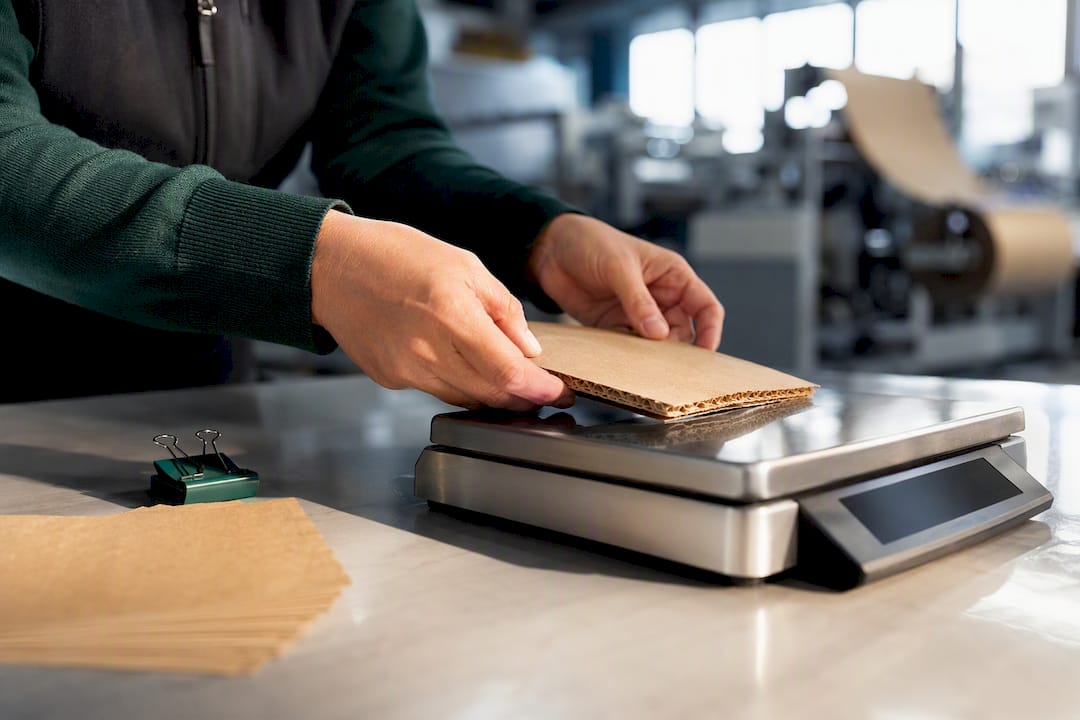
Packaging EPR in Canada runs province by province, not as a single federal system. If you place packaging into any Canadian province with a live program, you must register with that province’s producer responsibility organization, report the materials and volumes you put on the market, and pay eco-modulated fees based on what those materials are. Most provinces set an annual reporting deadline of May 31, 2026, for the prior year’s data, and some plastic packaging may also require separate federal reporting.
TL;DR:
- Producers must register and report packaging materials separately in each province where they operate, with deadlines mostly set for May 31, 2026.
- Canadian provinces have distinct regulations and thresholds, requiring companies to manage multiple compliance relationships rather than a single unified system.
- Plastic packaging with complex laminates or foil linings will face higher eco-modulation fees, encouraging mono-material, recyclable designs.
- Retailers and importers often become the producer of record if no upstream brand owner has Canadian obligations, necessitating careful supply chain documentation.
- Building SKU-specific records and designing packaging with clear material specs in advance can significantly reduce compliance costs and minimize late penalties.
Table of Contents
- Which Provinces Have Live Packaging EPR Programs?
- Who Counts as an Obligated Producer?
- How to Get Compliance-Ready Before May 2026
- Why Eco-Modulation Changes What Your Packaging Costs
- What the Federal Plastics Registry Adds on Top of Provincial Reporting
- What Happens if You Miss a Deadline or Misclassify Materials
- Gatherpackaging’s Take on Reporting-Ready Bag Design
- How Are Consumers Learning About Packaging EPR?
- What Successful EPR Implementation Looks Like in Practice
- Where Is Packaging EPR in Canada Headed Next?
- What Do Retailers and Importers Have to Do Under EPR?
- How EPR Reshapes Supply Chain and Procurement Choices
- Sources
Which Provinces Have Live Packaging EPR Programs?
British Columbia, Ontario, Quebec, Alberta, Manitoba, Saskatchewan, New Brunswick, Nova Scotia, and Yukon all now run some form of packaging extended producer responsibility. Each province sets its own regulations, material lists, and thresholds, which means a producer selling in five provinces manages five separate compliance relationships, not one.
The producer responsibility organizations differ by jurisdiction:
- British Columbia: Recycle BC administers residential packaging and paper collection under provincial oversight.
- Ontario: Circular Materials and other registered PROs coordinate reporting to the Resource Productivity & Recovery Authority (RPRA).
- Quebec: Éco Entreprises Québec (EEQ) manages fee schedules, reporting, and eco-modulation for packaging producers.
- Alberta and Manitoba: Circular Materials handles much of the producer registration and reporting load as those programs mature.
- Saskatchewan: SK Recycles oversees the provincial stewardship program.
- New Brunswick and Nova Scotia: Divert NS and related bodies manage packaging and paper stewardship reporting.
- Yukon: runs its own program with reporting dates that sometimes fall earlier than the rest of the country.
Most of these programs converge on a May 31, 2026 deadline for 2025 volume data, though Yukon and a few smaller programs may set different windows. Manitoba and Saskatchewan are still finishing their transition to full producer-pay models, so if you sell there, confirm current obligations directly with the provincial authority rather than assuming last year’s rules still apply. Coverage gaps remain in some territories, which is exactly why checking each province individually before you build a compliance plan matters more than relying on a national summary.
Who Counts as an Obligated Producer?
An obligated producer is typically the brand owner on the package, the first business to import it into Canada, or the manufacturer that puts packaging into the Canadian market. When none of those parties has a Canadian presence, responsibility can shift down the chain to an importer or, in some cases, a retailer selling under its own private label.
That cascading rule is where a lot of businesses get caught off guard. A retailer that imports store-brand shopping bags directly, without a Canadian brand owner upstream, may find itself classified as the producer of record.
A few things to check before you assume you’re exempt:
- Who legally owns the brand on your packaging, and where are they registered?
- Do your import records show you as the first entity bringing the packaging into Canada?
- Does the specific province you sell into define “producer” the same way as its neighbors? Definitions and thresholds vary by jurisdiction, so a company obligated in Ontario may fall under a small-producer exemption in another province.
How to Get Compliance-Ready Before May 2026
Getting ahead of the reporting window comes down to four moves, done roughly in this order.
- Confirm provincial scope. List every province where you sell or ship packaged goods, then check each program’s current thresholds and registration rules.
- Register with the right authority. Sign up with the provincial regulator or the PRO it designates, such as Circular Materials, Recycle BC, or EEQ, before you attempt to file anything.
- Build SKU-level records. For every packaging SKU, capture material type, weight in kilograms, whether it’s sold filled or unfilled, resin type for any plastic components, and province-by-province sales volumes.
- File and retain. Submit your reports to each PRO and, where your plastic packaging falls under federal scope, to Environment and Climate Change Canada as well. Keep your underlying calculations on file, since regulators can audit them later.
Pro Tip: Assign one internal owner for EPR reporting now, even if it’s a part-time responsibility. Programs that split data collection across marketing, procurement, and finance almost always miss fields when the May deadline arrives.
Why Eco-Modulation Changes What Your Packaging Costs
Eco-modulated fees mean the material and design of your packaging directly set your bill, not just its weight. A simple, recyclable format costs less to report and less to pay for than a complex one, even at the same size.
Quebec’s EEQ program is a useful reference point here. Its published fee schedule places kraft paper and corrugated cardboard in different bands than plastic laminates, because laminated materials are harder and more expensive to sort and recycle at end of life. A non-laminated kraft paper shopping bag typically clears a lower fee category than a plastic-film or foil-laminated bag of similar size, since laminates carry higher management costs across most provincial fee models.
Three design habits keep fee exposure down:
- Stick to mono-material construction wherever the application allows it.
- Skip plastic laminates and foil linings unless the product genuinely requires them.
- Use recycled content where the provincial fee schedule offers a credit for it.
EEQ and other provincial programs also offer flat-fee options for smaller producers, so check thresholds before assuming you owe full invoicing.
What the Federal Plastics Registry Adds on Top of Provincial Reporting
The Federal Plastics Registry, run by Environment and Climate Change Canada, layers a separate obligation on top of your provincial filings. Phase 1 covers plastic packaging, certain resins, and single-use plastic products, with its own required data fields and calculation methods.
Filing with your provincial PRO does not automatically satisfy the FPR. The two systems track different things for different purposes, though producers can authorize their PRO to report on their behalf in some cases.
- Check whether any of your plastic packaging SKUs fall under Phase 1 scope.
- If they do, follow ECCC’s guidance directly rather than assuming provincial paperwork covers it.
- Confirm with your PRO whether they offer authorized federal reporting as part of your registration.
What Happens if You Miss a Deadline or Misclassify Materials
Enforcement has picked up noticeably. RPRA and other provincial authorities have moved from warning letters to active compliance orders and administrative monetary penalties as programs mature past their startup grace periods.
The most common failures are avoidable: misclassifying single-use or problematic plastic items, skipping registration in a province you didn’t realize applied, submitting incomplete SKU data, or simply missing the May deadline. Run a SKU audit each year, document exactly how you calculated weights and material splits, and name one person accountable for filing. That last step alone cuts down most late-filing risk that catches growing businesses off guard.
Gatherpackaging’s Take on Reporting-Ready Bag Design
Mono-material kraft paper shopping bags simplify EPR reporting because there’s no laminate layer to break out separately, and they tend to land in lower fee categories across most provincial schedules. That’s one reason choosing a Canadian manufacturer pays off beyond lead time.
Producing in Toronto also means faster prototyping and more precise weight documentation, since specs don’t travel through overseas freight paperwork before they reach your compliance file.
- FSC-certified and recycled-content kraft paper options
- Documented weight and material specs for each SKU
- 8-color flexo printing without laminate coatings
- Quality assurance records that support your own reporting file
How Are Consumers Learning About Packaging EPR?
Most Canadian consumers still connect EPR with curbside recycling bins, not with the fees producers pay behind the scenes. That gap matters for retailers, because provincial programs increasingly fund public education campaigns using the fees producers contribute.
Recycle BC, for instance, runs consumer-facing guidance on what belongs in residential recycling streams, which shapes how shoppers judge a brand’s packaging at the shelf. When a retailer’s packaging is genuinely easy to recycle, that message can reinforce what the PRO is already telling consumers, rather than fighting it.
Provincial authorities also publish sorting guides and “what goes where” tools tied to their EPR programs, and some retailers now reference these directly on product pages or in-store signage. The practical takeaway for procurement teams: packaging that matches what your province’s PRO is already telling consumers to expect avoids friction at checkout and in customer service. A kraft paper bag with no plastic window or foil lining is simple to explain and simple to recycle, which keeps your brand out of consumer confusion that a laminated alternative can create.
What Successful EPR Implementation Looks Like in Practice
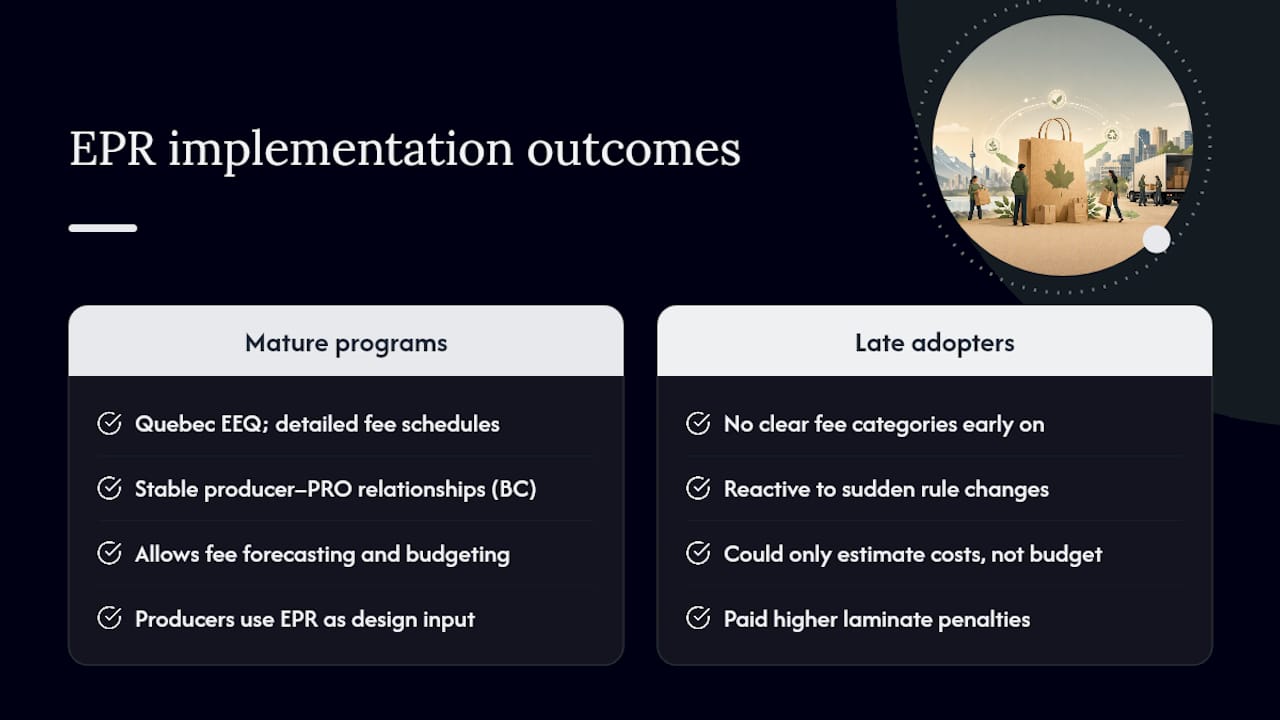
Quebec’s EEQ program is often cited as one of the more mature packaging EPR systems in Canada because it has run long enough to publish detailed, material-specific fee schedules that producers can actually plan around. That maturity gives procurement teams a real budgeting tool instead of a rough estimate.
British Columbia’s Recycle BC program offers a similar lesson from the residential collection side: a stable, long-running PRO relationship lets producers forecast fees and adjust packaging design over multiple cycles rather than reacting to sudden rule changes. Producers who shifted early toward mono-material formats in that province had more time to adjust before eco-modulation penalties tightened around laminated materials.
The common thread across the provinces furthest along isn’t a single regulatory trick. It’s producers treating EPR as a design input from the start rather than a compliance bill to absorb after the fact. Companies that waited to see how fee schedules shook out before adjusting their packaging tend to be the ones now paying the highest laminate penalties, simply because their SKUs were locked into multi-year print runs before the fee categories became clear.
Where Is Packaging EPR in Canada Headed Next?
Provincial programs are not fully harmonized yet, and that’s likely to remain true for a few more reporting cycles. National alignment efforts are underway among major PROs, but producers still need to manage province-specific pathways today rather than wait for a unified national system.
Expect three trends to keep shaping the compliance landscape. Fee schedules will likely tighten further around hard-to-recycle laminates as provinces gain more data on actual recycling costs. Newer programs in Manitoba and Saskatchewan will probably move from transitional rules toward the full producer-pay models that BC and Quebec already run. And federal Phase 1 reporting under the Plastics Registry may expand its scope to cover more product categories beyond the current plastic packaging and single-use items.
None of that changes what to do right now: register where you’re obligated, report accurately, and treat any tightening of eco-modulation as a reason to simplify materials sooner rather than later.
What Do Retailers and Importers Have to Do Under EPR?
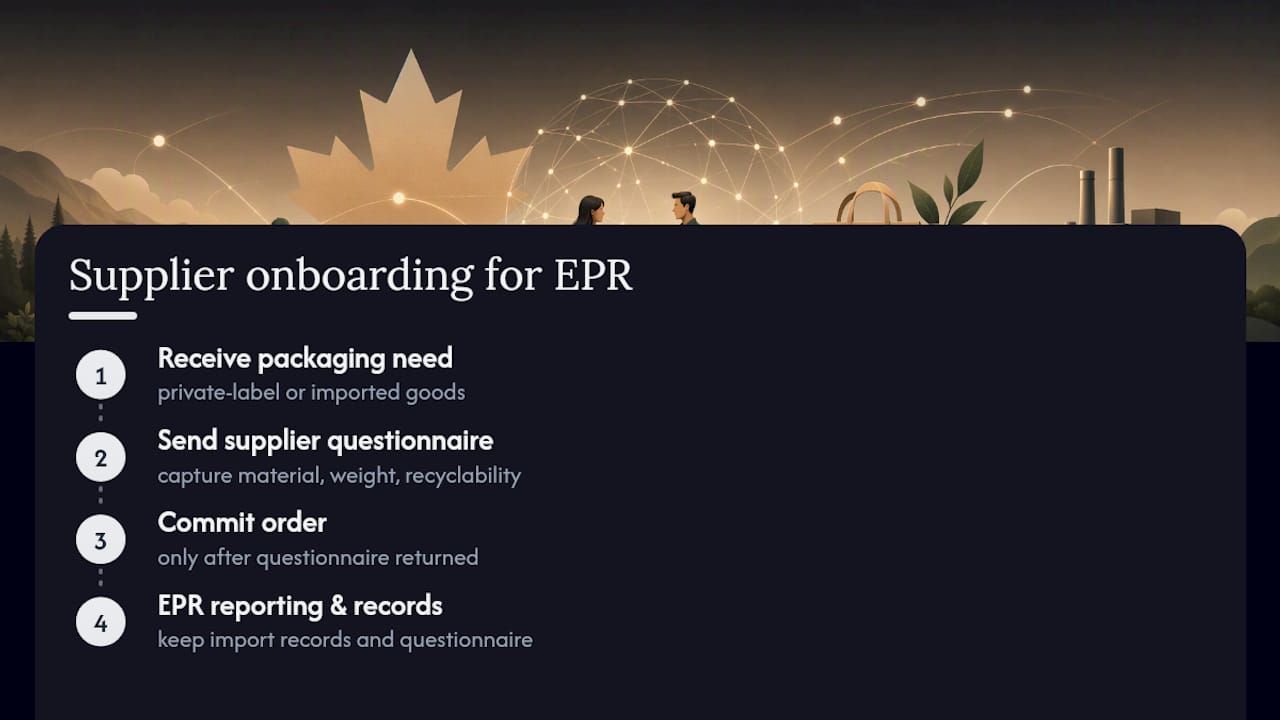
Retailers and importers don’t get a pass just because they didn’t manufacture the packaging. When a retailer imports private-label goods and no upstream brand owner has Canadian obligations, that retailer often becomes the producer of record by default.
Importers face a similar exposure. If you’re the first business bringing packaged goods into Canada, most provincial definitions place the reporting burden on you, regardless of where the packaging itself was designed or printed. That makes import records, not just brand ownership documents, a core piece of your compliance file.
The practical response for both groups is the same: build a supplier questionnaire into your onboarding process that captures material composition, weight, and recyclability before you commit to a packaging order. Waiting until the reporting deadline to ask your supplier what your bags are actually made of is the single most common source of last-minute scrambling procurement teams run into.
How EPR Reshapes Supply Chain and Procurement Choices
EPR fees turn packaging specification into a line item that finance actually watches, which changes how procurement teams evaluate suppliers. A slightly higher unit cost for a mono-material bag can be cheaper overall once you factor in the eco-modulated fee difference against a laminated alternative.
That shift also rewards suppliers who can document their materials precisely. A supplier that hands over exact weight and material composition data per SKU saves procurement teams from having to reverse-engineer that information later under deadline pressure. Designing packaging to reduce waste at the spec stage, rather than retrofitting it after a fee increase, keeps both procurement and sustainability teams working from the same numbers.
Domestic sourcing adds a second layer of benefit here. Shorter supply chains mean fewer handoffs where weight and material specs can get lost or mistranslated, which matters when your compliance file depends on accurate per-SKU records. Working with Canadian packaging manufacturers also shortens the feedback loop when a fee schedule change makes it worth reengineering a bag design mid-year.
A note from Gather Packaging on procurement and EPR
Procurement teams should demand a material breakdown and per-SKU weight from every supplier before signing off on a packaging order, not after a reporting deadline forces the question. If your current supplier can’t hand you that documentation, Gatherpackaging can build kraft paper bags designed with your EPR reporting in mind from the start.
— Taylor
Custom Kraft Paper Bags Built With EPR Fee Exposure in Mind
Gatherpackaging manufactures paper shopping bags domestically in Toronto, using FSC-certified and recycled kraft paper, water-based inks, and 8-color flexo printing, with full weight and material documentation for every order. That combination matters for procurement teams because a mono-material kraft bag, built without plastic laminates, typically clears a lower eco-modulated fee category than a laminated alternative while giving your compliance team exact specs to file with.
Beyond materials, Gatherpackaging handles prototyping and quality assurance in house, which means your team gets accurate per-SKU weight data before the bags ever ship, not after a reporting deadline forces a scramble. If you’re specifying turn top, serrated top, or tamper-resistant bags and want fee-conscious materials built in from the design stage, browse the custom kraft paper bag options or review the sustainability materials available. Contact Gatherpackaging directly to discuss your paper shopping bag specs, volumes, and timeline for your next order.
Where to Verify Current EPR Rules and Deadlines
Check ECCC’s Federal Plastics Registry guidance, EEQ’s fee schedule, and your province’s regulator directly, since deadlines and thresholds change between reporting years.
Sources
- EPR Programs in Canada: Regulations, Reporting & Compliance - RWDI
- Federal Plastics Registry guidance — ECCC
- Fee Schedule to help with your report | Éco Entreprises Québec
- Canada Packaging EPR — 9 Provincial Programs, May 2026 Deadlines | Currogate
- Canada Packaging EPR: May 31 Reporting and Compliance Steps - Reverse Logistics Group (RLG) / Rev-Log
Share:
Prevent Reprints: Flexo Plate Thickness Specs for Packaging Buyers
Overprint vs Knockout: 6 Preflight Checks to Prevent Reprints on Packaging Files