
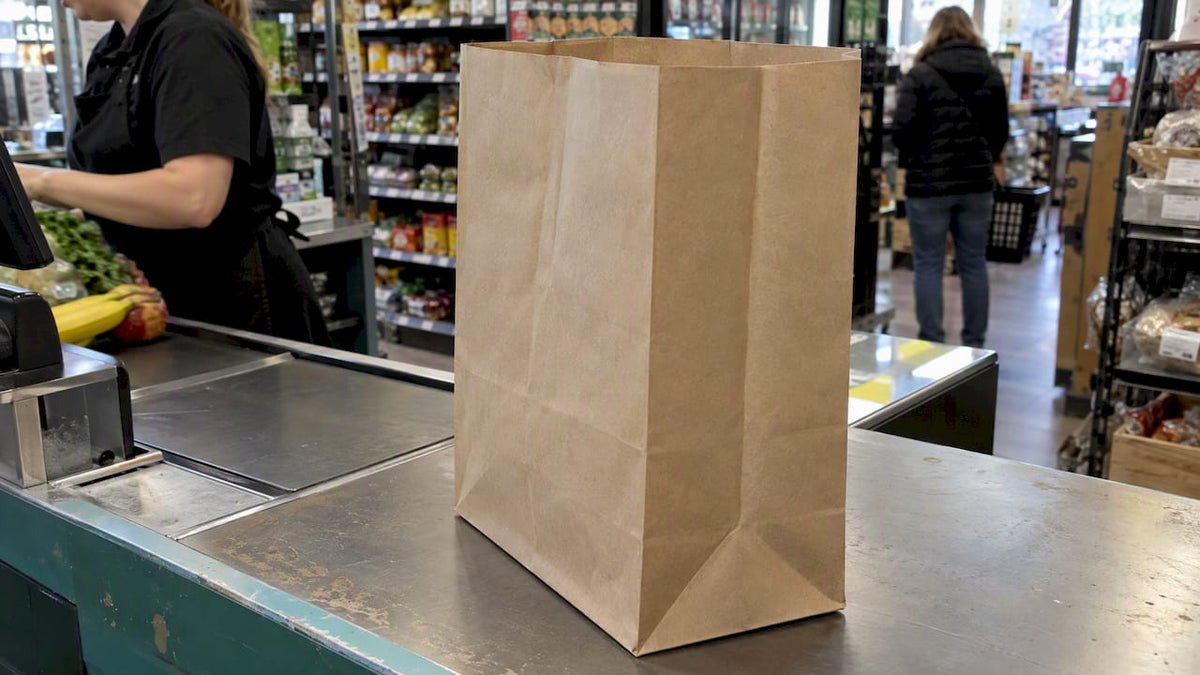
A block bottom paper bag, also called a square bottom bag, has a flat, rectangular base and folded side gussets, so it stands upright on its own and holds boxy items without tipping. If you are buying them for retail or takeout, the decisions that matter are gusset width, paper grade, handle type, print method and recyclability. This guide covers each one, and where our own range fits. Gather Packaging makes paper shopping bags in Toronto, and we would rather you ask the right questions of any supplier than buy on a unit price alone.
TL;DR
- A block bottom bag has a flat rectangular base and pleated side gussets. It stands upright when packed, which suits boxed goods, bottles and takeout containers.
- Choose gusset width from the product’s thickest dimension, not from its width. A bag that is too shallow bulges and tears at the folds.
- Handles and the paper behind them decide whether a bag survives a walk to the car. Ask how handles are anchored and request a load test on your actual product.
- Specify paper grade, ink system and adhesive in writing. Those three also determine recyclability in Canada.
- Our published lines are turn top, serrated top and tamper-resistant serrated top bags. If you need a block bottom format, contact us with your product and we will tell you plainly what fits.
Table of Contents
- What a block bottom bag actually is
- Gusseted or flat: how to decide
- Choosing gusset width and bag dimensions
- Handles and reinforcement
- Paper grade, print and finish
- Recyclability and compliance in Canada
- Our perspective: ask for the bag, not the brochure
- Where our range fits
- What to put in your RFQ
- Frequently asked questions
- Sources
What a block bottom bag actually is
The name describes the base. During manufacture a paper tube is formed, the bottom is folded into a rectangle and glued shut, and the result is a flat base with square corners. Machinery makers list block bottom bags as a distinct bag style alongside flat bags and satchel bags, and the same bag-making lines also produce carrier bags. If you want the full process, our walkthrough of how paper bags are made covers the seven steps for retail and food.

Two terms get mixed up in searches. “SOS” refers to the self-opening satchel style, and it is the same family as block bottom construction. “Square bottom” is simply another name for the flat base. If a spec sheet uses any of the three, confirm with the supplier that you are talking about the same structure by asking for a dimensioned drawing.
Gusseted or flat: how to decide
A flat bag has no depth. It works for paper, apparel in a folded stack, or a single flat item. A gusseted bag has folded side panels that expand to give volume. A block bottom bag adds a flat base to the gussets, so the volume is usable from the bottom up.
| Format | Best for | Watch for |
|---|---|---|
| Flat bag | Documents, flat apparel, thin items | No standing capacity; items slide to one side |
| Gusseted bag, pinched bottom | Soft goods, light retail | Base is not rigid, so the bag leans when set down |
| Block bottom (square bottom) | Boxed products, bottles, takeout containers, gift sets | Needs a base sized to the product footprint; heavier loads need stronger paper and a reinforced base |
The real question is what your customer does with the bag. If they set it on a car seat or a counter and it needs to stand, the flat base earns its cost. If they carry a folded sweater, a simpler style may do the job. We cover the retail side of that choice in our step-by-step paper bag design guide.
Choosing gusset width and bag dimensions
Bag sizes are quoted as width by gusset by height. The gusset is also the depth of the base, and it is the number buyers most often get wrong.
- Measure the packed product, not the product. Include its box, tissue, inserts and any other item that goes in the bag. Measure the widest, deepest and tallest points.
- Match width and gusset to the footprint. The base should be at least as large as the product’s footprint with a little room for easy loading. A tight fit is fine for rigid boxes. A loose fit is better for soft goods that compress.
- Set the height for the closing behaviour. Allow for the product to sit below the top fold. For items that should be partly visible, such as a bottle neck, decide that on purpose.
- Check the print area. Gusset panels are narrow and fold inward, so a logo that wraps across a gusset will be broken up when the bag opens. Keep key artwork on the two large faces and treat the gussets as a place for a repeat pattern or a short line of text.
- Test with the real product. A drawing says what fits. A prototype says what happens when someone carries it.
A practical example: a rigid candle box that measures 10 cm square and 12 cm tall needs a base a little over 10 cm by 10 cm, and a bag taller than 12 cm so the top can fold or close. Ask the supplier to confirm how the stated width and gusset are measured (flat, folded, or open), because they differ between catalogues.
We offer die-line preparation and prototyping so these dimensions are settled on a physical sample before a production run, not after.
Handles and reinforcement
Block bottom bags are usually specified with handles, and handles are where retail bags fail. The failure is rarely the handle material itself. It is the point where the handle meets the bag body.
When you request a quote, ask about:
- Handle type. Twisted paper, flat paper and cord or ribbon handles behave differently under load and look different on a counter.
- Attachment. Handles can be glued directly to the bag wall or anchored to a reinforcing patch inside the top fold. A patch spreads load over a wider area of paper.
- Top fold. A double-folded top adds stiffness and helps the mouth keep its shape.
- Base reinforcement. For heavier loads, a card insert in the base supports the product and keeps the flat bottom flat.
- Load testing. Ask what test was run, with what weight, and for how long. If the answer is vague, run your own with your heaviest packed product.
We do not publish a universal weight rating, because the number depends on paper, bag size, handle and product. Any supplier who quotes one figure for all sizes should be asked how it was measured.
Paper grade, print and finish
Most block bottom bags are kraft paper, either natural brown or white. Kraft is chosen for tear strength, and Canadian mills make it for packaging with high demands for strength and durability, such as grocery bags. Basis weight, fibre mix and whether the sheet is virgin or recycled all change how the bag feels and performs. Our kraft paper grades specification guide explains what to put on a purchase specification.
On print, we run vibrant 8-colour flexo printing with water-based inks, which suits solid brand colours and large logo areas on kraft. Brown kraft shifts colours, so a pale brand colour that looks right on white stock may need a white underprint or a white sheet. Always approve a pre-press proof on the stock you will actually order. Our pre-press proofing and pre-production prototyping exist for exactly this reason.
Recyclability and compliance in Canada
Kraft paper is recyclable by nature, but the finished bag may not be. According to industry guidance, water-soluble inks and adhesives are manageable in kraft bag recycling. Barrier coatings, plastic windows and metal elements are what complicate things. That is a design point as much as a materials point: a window patch or a laminated finish can turn a recyclable bag into a problem for the mill.
Three facts help in a procurement conversation:
- The paper packaging council reports that 96% of Canadians have access to recycling for paper bags as of 2025, which is the basis for marking paper bags as recyclable.
- The same industry body’s survey found that average recycled content across the three main paper packaging grades was just over 80% in 2022. That is an industry average and says nothing about any particular bag. If a supplier claims recycled content, ask for supporting mill data. Our piece on recycled content claims in Canadian procurement shows what to request.
- Retailers and restaurants that hand out bags at the point of sale may have reporting duties. Ontario’s regulator explains that service packaging such as take-out bags falls within Blue Box reporting. Provinces differ, so check the rules where you operate.
For the details, see our pages on design for recyclability, what to add to paper bag RFQs and EPR for packaging buyers. If you buy for takeout, the federal and procurement requirements for takeout bags are worth reading before you finalize a spec.
FSC® certification is a separate question. Certification confirms that forest-based materials are sourced from responsibly managed forests. If you need it on the bag, say so in the RFQ and ask for the certificate details.
Our perspective: ask for the bag, not the brochure
We make paper shopping bags in Toronto, and most of the problems we see start before a bag is ever printed. A buyer sends a size from a catalogue, a logo from a deck, and a target price. Nobody has put the real product in a real bag.
Here is how we think about block bottom and square bottom requests:
- Start with the product and the customer’s journey. A bag carried ten steps is a different job from a bag carried on public transit.
- Settle the structure first, then the artwork. Gusset, base and handle decisions change the print layout. Changing them afterward means redoing the die-line.
- Prototype before you commit. A sample in hand answers questions a drawing cannot.
- Write the sustainability claims down. Paper grade, certification, inks and adhesives belong in the specification so they can be verified on delivery.
- Use domestic production where timing matters. Making bags in Toronto shortens the distance between a proof approval and a delivery, and it means a quality issue can be inspected in person.
Our published range is turn top, serrated top and tamper-resistant serrated top bags. If your product calls for a flat, standing base, we would rather talk it through than force a style that does not suit. Sometimes a different construction meets the need. Sometimes it does not, and we will say so.
— Taylor
Where our range fits
If your goal is a retail or takeout bag made in Canada, with custom print and sustainable materials, start with our paper bag range. It includes turn top, serrated top and tamper-resistant serrated top styles, available in custom sizes and designs. For takeout operators, the tamper-resistant option is relevant because the bag can show if it has been opened. Our turn top design tutorial shows how that style is laid out for retail brands.
Beyond the bags, we handle consultation and quotation, die-line preparation, graphic design and layout, pre-press proofing, prototyping, and warehouse and logistics. You can see the full set on our home page, and read why we build here on our made-in-Canada page. To discuss your paper shopping bag or retail packaging needs, contact Gather Packaging with your product dimensions, target quantity and delivery timing.
What to put in your RFQ
Whatever style you choose, a complete request gets a better answer and a faster quote. Include:
- Bag style and dimensions (width, gusset, height) and how they were measured.
- Packed product weight and dimensions, and any heavy items.
- Paper type, colour and any certification you require, such as FSC®.
- Print: number of colours, coverage, and the Pantone references that matter.
- Handle type and any reinforcement requirements.
- Recyclability requirements: no plastic windows, water-based inks and adhesives where needed.
- Quantity, delivery location and required date.
- The tests and documents you expect: proof approval, prototype, load test, certificates.
Frequently asked questions
Are block bottom bags and square bottom bags the same thing?
Yes, in practice. Both names describe a bag with a flat, rectangular base and side gussets. Some suppliers use “SOS” for the same family. Confirm the structure with a dimensioned drawing before you order.
How wide should the gusset be?
Base it on the thickest dimension of your packed product, plus a little room for loading. A gusset that is too narrow makes the bag bulge and stresses the folds. A prototype with your actual product is the reliable check.
Do gusseted bags need reinforced handles?
If the bag will carry anything heavy or awkward, yes. Ask how the handle is anchored, whether there is a patch inside the top fold, and what load test was done. Soft, light items may not need it.
Can a block bottom paper bag be recyclable?
Often, if it is designed for it. Paper with water-based inks and adhesives is generally easier to manage, while coatings, plastic windows and metal parts cause problems. Put those requirements in your specification and ask the supplier to confirm them.
Does Gather Packaging make block bottom bags?
Our published range is turn top, serrated top and tamper-resistant serrated top paper bags. If you need a block bottom or square bottom format, contact us with your product details and we will tell you what we can offer.
Share:
Recycled Paper Bags: What Canadian Buyers Should Specify
Water-Based Ink Printing on Paper Shopping Bags