
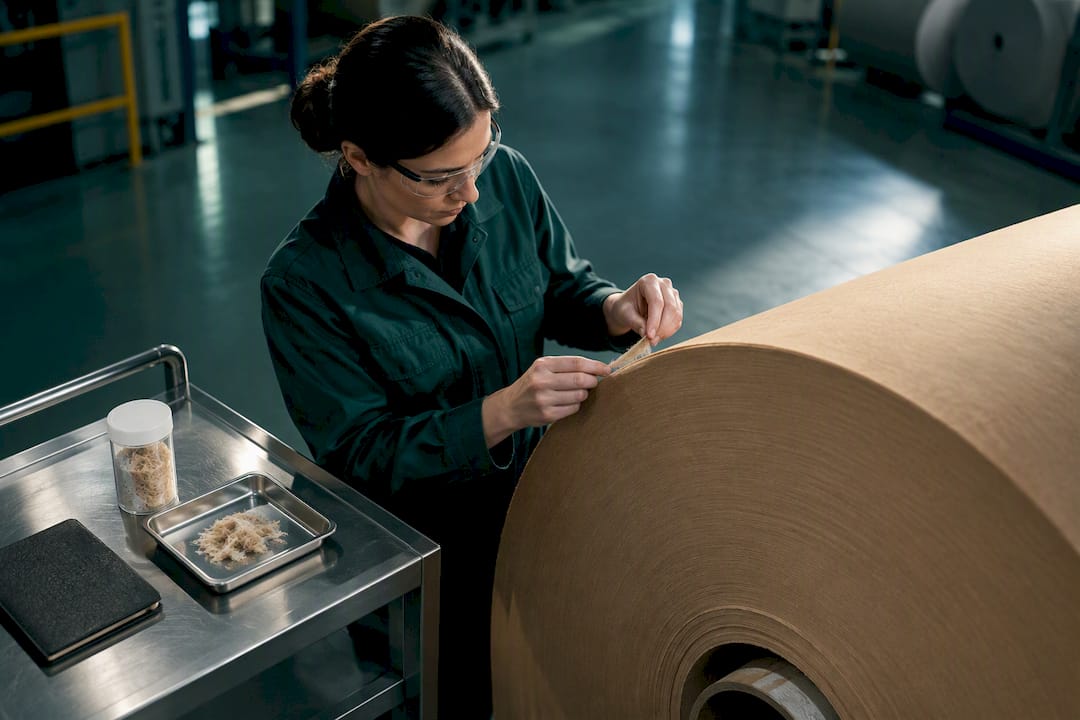
Make only the recycled-content claim your supplier can prove for that specific mill run or lot, never a rounded-up or industry-average figure. Back it with mass-balance records or a chain-of-custody certificate like FSC Mix or FSC Recycled, and keep that documentation on file. Anything vaguer, such as an unqualified “made from recycled materials” line, risks running afoul of the Competition Act’s rules against misleading environmental claims.
TL;DR:
- Recycled content claims must be backed by specific, mill-run documentation like mass-balance records or chain-of-custody certificates, not industry-wide averages.
- Suppliers should provide recycled-content data tied to each production run, along with FSC or equivalent certifications if used for certified claims.
- On-pack claims need to reflect exact documented percentages, clearly specify pre- or post-consumer content, and be approved through pre-press proofing.
- Procurement teams should embed documentation requests into RFQs upfront, including lot traceability, FSC scope, and signed warranties to prevent greenwashing risks.
- Domestic suppliers like Gatherpackaging enable quicker access to verified recycled content and FSC documentation, reducing delays and increasing claim verifiability.
Table of Contents
- What Does “Recycled Content” Actually Mean for Paper Shopping Bags?
- What Counts as Adequate Substantiation Under Canada’s Competition Act?
- How Should You Word an On-Pack Recycled-Content Claim?
- Building a Procurement Checklist for Recycled-Content Claims
- How Gatherpackaging Supports Verifiable Recycled-Content Claims
- Why Procurement Should Own Recycled-Content Documentation
- Get Mill-Run Documentation and Proofs From Gatherpackaging
- Sources
- FAQ
What Does “Recycled Content” Actually Mean for Paper Shopping Bags?
Recycled content splits into two categories: pre-consumer (mill scraps, trim, and offcuts that never reached a customer) and post-consumer (material recovered after use, like collected cardboard or office paper). Both count toward a valid recycled-content claim, but they come from different points in the supply chain, and your supplier should be able to tell you which one applies to their paper.
Mills typically report recycled content as a mass-balance average, calculated across a production run or a 12-month period, rather than tracking it fiber by fiber through the machine. PPEC’s guidance on recycled content explains why: pulp streams blend virgin and recycled fiber before they ever reach the paper machine, so “percent recycled” is an accounting figure, not a physical count.
That distinction matters when you look at industry ranges. PPEC’s 2022 survey found:
- Boxboard averaging around 86.2% recycled content nationally
- Containerboard averaging around 81%
- Kraft paper often running lower, since many bag-grade kraft mills rely more heavily on sawmill residues and virgin fiber than recovered post-consumer stock
Those numbers describe the Canadian paper industry as a whole. They say nothing about the specific bag your printer just ran, which is exactly why a national average can’t stand in for product-specific proof on your packaging.
What Counts as Adequate Substantiation Under Canada’s Competition Act?
The Competition Bureau requires that any environmental claim, including a recycled-content percentage, be backed by adequate and proper substantiation before you make it public. For a specific percentage claim, that generally means documentation showing the figure is not materially false or misleading, not a marketing rounding-up or a guess based on industry norms.
In practice, that means procurement should be requesting and archiving:
- Mill-run or lot-specific recycled-content averages from the paper supplier
- Mass-balance accounting records showing how recycled and virgin fiber were tracked into that run
- Chain-of-custody certificates, such as FSC Mix or FSC Recycled, when the claim references third-party certification
- Purchase invoices and order records that tie a specific shipment back to the documentation above
Third-party certification isn’t always required. A well-documented mill statement with mass-balance figures can satisfy the Bureau’s standard on its own. But if you plan to put a certification mark or logo on the bag itself, you need the matching chain-of-custody paperwork to back it, not just the supplier’s word that the mill is certified somewhere in its network.
Pro Tip: Ask your supplier to send recycled-content documentation with every purchase order, not just once at onboarding. Mill runs change, and last year’s mass-balance average may not match this year’s shipment.

How Should You Word an On-Pack Recycled-Content Claim?
Write the claim as a specific number tied to what your documentation actually supports, not a range or a rounded estimate. If your mill statement says 42% recycled content for the run supplying your order, print “Made with 42% recycled content,” not “Made with recycled materials” or “Up to 50% recycled.”
A few rules for keeping the wording defensible:
- Match the number on the bag to the number in your supplier’s mill-run documentation, exactly.
- Specify pre-consumer or post-consumer content if your marketing language implies one or the other.
- Date-stamp your internal record of the claim so you can show which documentation applied when that print run shipped.
- Route final wording through pre-press proofing before the plates are cut, so legal and marketing both sign off on the same line.
Avoid these common phrases, which raise enforcement risk because they can’t be tied to a specific figure:
- “Eco-friendly” or “green” without a defined, substantiated basis
- “Recyclable and recycled” used interchangeably (they are not the same claim)
- “Up to X% recycled” when X% only applies to a best-case run, not your actual order
- Any recycled-content logo or certification mark without the matching chain-of-custody documentation on file
Building a Procurement Checklist for Recycled-Content Claims
Turn the documentation requirements above into a standing part of your RFQ and supplier onboarding process, rather than something you chase down after the fact.
- Request the mill-run recycled-content percentage in writing before quoting artwork, not after the order ships.
- Ask for a copy of any chain-of-custody certificate, including its scope (which products and facilities it actually covers).
- Confirm lot traceability, meaning the supplier can connect a specific shipment back to the mill run the documentation describes.
- Require a sample proof showing the exact on-pack wording before final production approval.
- Add a warranty clause to your purchase agreement stating the supplier’s recycled-content figures are accurate and current for that order.
- Store every document (mill statements, invoices, CoC certificates) in a shared file tied to the purchase order number, kept for at least as long as the packaging stays on shelves.
Watch for red flags during supplier evaluation: vague answers about recycled content, an inability to produce mill-run data on request, or a chain-of-custody certificate whose scope doesn’t actually cover the product you’re ordering. Any of those should slow down the order, not speed past it.
Pro Tip: If a supplier’s certificate only covers one facility and your order runs through a second plant, ask directly whether that plant is included in scope. This is one of the most common gaps in CoC paperwork.
How Gatherpackaging Supports Verifiable Recycled-Content Claims
Gatherpackaging manufactures domestically in Toronto, using FSC-certified and recycled materials across its paper bag lines. Domestic production shortens the paper trail between mill and buyer, which makes it easier to get run-specific documentation quickly instead of waiting weeks on overseas paperwork.
Buyers working with Gatherpackaging can request:
- Material traceability records tied to a specific order or production run
- Pre-production proofs showing exact on-pack wording before plates are finalized
- Prototyping and quality assurance checks that confirm the physical bag matches the approved artwork
- FSC documentation covering the turn top, serrated top, and tamper-resistant bag styles in Gatherpackaging’s product line
Ask for mill-run statements and FSC scope details as part of the RFQ process rather than as a follow-up after receiving a quote.
Why Procurement Should Own Recycled-Content Documentation
Recycled content isn’t a marketing detail. It’s a traceability and accounting exercise, and someone in procurement needs to own it the same way they own price and lead time. Clear documentation requirements built into the RFQ, before artwork is finalized, close off most of the path to an accidental greenwashing allegation.
The fix here isn’t complicated. Require mill-run data as a standard line item, not a special request, and you protect both your marketing copy and your brand’s credibility with one small process change.
— Taylor
Get Mill-Run Documentation and Proofs From Gatherpackaging
Gatherpackaging is the domestic alternative to overseas suppliers who can’t turn around recycled-content documentation quickly. Because production runs through Toronto, you get run-specific mill statements and FSC certificate details without the multi-week wait that comes with importing.
If you’re sourcing custom paper shopping bags and need your recycled-content claim to hold up under scrutiny, request a quote that includes mill-run recycled-content documentation and FSC certificate scope alongside your pricing. Ask for pre-press proofs so you can see the exact on-pack wording before anything goes to plate. Gatherpackaging can also put together an RFQ checklist or sample contract clause covering recycled-content warranties, tailored to your order. Browse Gatherpackaging’s paper bag styles or reach out through the main site to start that conversation.
Sources
FAQ
What documents prove a recycled-content claim in Canada?
Suppliers should provide mill-run or lot-specific recycled-content averages, mass-balance accounting records, and, where relevant, a chain-of-custody certificate such as FSC Mix or FSC Recycled. Purchase invoices tying that documentation to your specific order round out the file.
Can I use a national industry average as my recycled-content claim?
No. National averages, like the ones in PPEC’s recycled content survey, describe the industry as a whole, not your specific bag order. The Competition Bureau expects claims to reflect the actual product being sold.
What’s the difference between pre-consumer and post-consumer recycled content?
Pre-consumer content comes from mill scraps and trim that never reached a customer, while post-consumer content is recovered material collected after use. PPEC’s guidance notes both count toward recycled-content claims, but your supplier should specify which applies.
Does Gatherpackaging provide recycled-content documentation with orders?
Yes, buyers can request mill-run material traceability, FSC documentation, and pre-production proofs directly from Gatherpackaging as part of the quoting process. Pricing for specific bag styles is available on request through the product pages.
Do I need FSC certification to make any recycled-content claim?
No. A detailed mill statement with mass-balance figures can satisfy the Competition Bureau’s substantiation standard on its own. FSC or similar chain-of-custody certification becomes necessary only if you plan to display a certification mark or reference third-party certification on the packaging itself.
Share:
Packaging Designers: Press Fingerprints That Unlock Flexo Limits
Fix Paper Bag Supply Shortages in 7 to 30 Days With Domestic Suppliers