
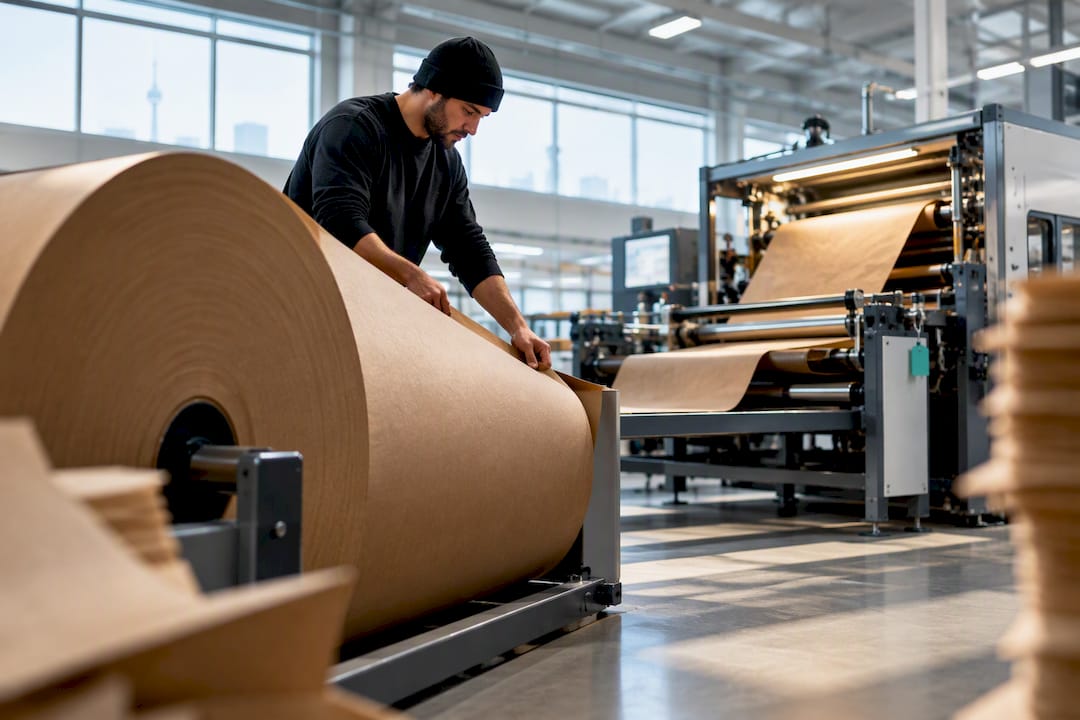
When paper bag supply shortages hit, procurement should move immediately to domestic suppliers who can prove batch traceability, offer flexible minimum order quantities, and confirm real lead times in writing. Ask any potential substitute supplier for per-lot test reports before accepting product. One available option for buyers who need certified, quick-turnaround paper bags without an overseas wait is a domestic Toronto production facility.
TL;DR:
- Domestic suppliers with proven batch traceability and flexible minimum order quantities can reduce paper bag shortages effectively.
- Verify technical parameters such as tensile strength, bursting strength, and TEA through batch test reports before accepting substitutes or new suppliers.
- Shorter lead times and improved responsiveness come from domestic manufacturing, which also minimizes freight and tariff disruptions.
- Proper storage in a dry, ventilated space with inventory rotation maintains bag quality and prolongs shelf life.
- Building a backup supplier list and maintaining clear, proactive communication during shortages helps prevent stockouts and ensures supply continuity.
Table of Contents
- Fixing Paper Bag Inventory Issues in the Next 7 to 30 Days
- What Technical Specs Should Procurement Verify From Suppliers?
- Which Material Substitutes Are Acceptable During a Shortage?
- How Domestic Sourcing Reduces Future Shortage Risk
- How Should You Store Paper Bags to Preserve Quality?
- What Lead Times and Minimum Order Quantities Should You Expect?
- How Are Demand Trends Affecting Paper Bag Availability?
- What Causes Paper Bag Shortages in the First Place?
- How Should Buyers and Suppliers Communicate During a Shortage?
- How Gather Packaging’s Domestic Model Addresses These Failure Points
- Get Custom Paper Bags Fast With Gather Packaging
- Sources
- FAQ
Fixing Paper Bag Inventory Issues in the Next 7 to 30 Days
Short-term shortfalls get solved through discipline, not panic. Here’s the sequence that actually protects your shelves and your brand.
- Audit your on-hand days by SKU. Pull current inventory against average weekly draw for every bag style and identify which SKUs will run out first. A tamper-resistant food bag running low matters more urgently than a decorative retail carrier with three weeks of stock left.
- Call your current supplier before you call anyone new. Ask specifically about partial shipments, rush production slots, and whether they’ll flex a minimum order quantity to get you a smaller, faster batch. Many converters keep reserve capacity for exactly this conversation, but only if you ask before the shelf is empty.
- Demand per-lot documentation on any substitute. Never accept unfamiliar stock without a batch number, mill certificate, and chain-of-custody paperwork if FSC compliance matters to your brand.
- Set a hard reorder trigger. Once inventory hits a set number of days of cover, the purchase order fires automatically. Don’t wait for a stockout to remind you.
- Check freight options beyond your default carrier. Regional trucking and expedited freight brokers can sometimes shave days off a delivery that would otherwise miss your reset date.
- Run acceptance sampling the moment stock arrives. Pull bags from multiple cartons, not just the top layer, and check handle strength, print registration, and base seams before the shipment goes into rotation.
Pro Tip: Keep a one-page “shortage playbook” with your top three backup suppliers, their typical lead times, and their minimum order flexibility. Building it during a calm period saves you hours during an actual scramble.
What Technical Specs Should Procurement Verify From Suppliers?
Paper weight tells you almost nothing about how a bag will perform once it’s loaded with product and carried down a sidewalk. Historic paper testing going back to NIST technical paper T187 established that tensile strength, bursting strength, tear resistance, and TEA (tensile energy absorption) predict in-service durability far more reliably than grams per square meter alone. A heavier bag that fails a burst test is still a failed bag.
Ask suppliers for documentation on these specific parameters:
- Tensile strength (tested to ISO 1924-3), which measures how much pulling force the paper withstands before tearing.
- Bursting strength (ISO 2758), which predicts how a loaded bag handles sudden stress at the base or seams.
- Tear resistance (ISO 1974, often via Elmendorf method), relevant for handle and gusset durability.
- TEA, the energy absorbed before failure, which correlates closely with real-world handling abuse.
- Cobb value, which measures grease and moisture resistance, critical for any bag touching food or damp products.
- Wet tensile strength, when bags face humidity or refrigerated retail environments.
Industry guidance from CEPI Eurokraft points to EN13590 as the reference standard for carrier bag durability certification. Request a mill certificate and lab test report tied to a specific batch number, and build a quarantine protocol for any shipment that arrives without one. Sample at least a handful of cartons per pallet, not just the top layer, and reject the lot if tensile or burst values fall outside your specified range.
Which Material Substitutes Are Acceptable During a Shortage?
Not every substitute is a safe substitute. Some swaps preserve performance and appearance; others quietly create returns, complaints, or compliance problems weeks later.
Generally acceptable, with documentation:
- Alternative kraft grades from a different, qualified mill, provided tensile and burst test reports match your original spec.
- Bleached kraft in place of natural kraft, which changes appearance but rarely affects strength, as long as print fidelity is verified on a proof.
- A slightly higher GSM paired with confirmed TEA values, which can offset a marginal drop in fiber quality without sacrificing durability.
Foodservice buyers face tighter limits. Any bag touching food needs food-grade inks and verified Cobb values for grease resistance, and a substitute mill must supply the same food-contact compliance documentation as your primary source. This is the one category within Gatherpackaging’s own scope where foodservice applies: takeout delivery bags, not general retail packaging.
Reject a substitute outright if the supplier can’t produce batch test results, if chain-of-custody breaks for an FSC-committed brand, or if wet tensile drops below your minimum for a refrigerated or humid environment. A cheaper bag that fails at the register costs more than the shortage did.
How Domestic Sourcing Reduces Future Shortage Risk
The single most effective lever against recurring shortages is geography. A supplier three time zones and one ocean away can’t offer the same responsiveness as one you can call, visit, or audit on short notice. Domestic manufacturing shortens lead times, cuts exposure to freight rate spikes and tariff shifts, and makes on-site quality audits realistic instead of theoretical, a point Gather Packaging’s Toronto operation has built its model around.
Build your supplier qualification checklist around these priorities:
- Documented batch traceability. Every roll of paper and every production run should trace back to a batch record you can request at any time.
- Continuity of raw material supply. A converter sourcing kraft paper from established domestic mills, the kind FPAC tracks across Canada’s pulp and paper sector faces fewer fiber-supply surprises than one dependent on a single overseas source.
- Flexible production capacity. Ask directly what capacity a supplier holds in reserve for rush orders and how often they’ve actually used it for existing customers.
- QA discipline you can verify. Request a sample QA report before you sign anything, not after the first shipment arrives.
- Realistic, written lead-time commitments. A verbal promise is not a commitment, and a converter unwilling to put a lead time in writing is telling you something.
Pro Tip: Split volume across two qualified suppliers even when one is performing well. A qualified backup that’s never had to fill an order is worth far more during a shortage than a backup you’re vetting for the first time under pressure.
Rolling orders, safety-stock tiers, and vendor-managed inventory arrangements all reduce the odds you’re caught flat-footed, but none of them substitute for a supplier base that can actually flex when demand spikes.
How Should You Store Paper Bags to Preserve Quality?
Bags sitting in a warehouse are not inert. Paper is hygroscopic, meaning it absorbs and releases moisture from the surrounding air, and that moisture exchange directly affects tensile and burst performance over time.

Store finished bags in a dry, ventilated space, away from direct sunlight and away from exterior walls that swing in temperature with the weather outside. Industry guidance from CEPI Eurokraft notes that poor storage conditions measurably degrade finished-bag strength and can promote mold growth in high-humidity environments, and that degradation often isn’t visible until the bag fails under load.
A few practical rules for your receiving and storage teams:
- Keep cartons off concrete floors on pallets or racking to avoid moisture wicking up from below.
- Maintain consistent humidity, ideally in the range your paper supplier specifies for that grade.
- Rotate stock on a first-in, first-out basis rather than pulling from whichever pallet is closest to the door.
- Reinspect any stock held longer than your supplier’s recommended shelf period before it goes into active use.
None of this requires special equipment. It requires a warehouse team that treats paper bags as a perishable-adjacent product rather than inert cardboard, because in humid climates, that’s closer to the truth.
What Lead Times and Minimum Order Quantities Should You Expect?
Lead time and minimum order quantity (MOQ) drive almost every shortage decision procurement makes, and both vary more by supplier discipline than by bag complexity. A converter with tight raw-material relationships and domestic production can often move faster on both fronts than one juggling overseas shipping schedules and container minimums.
Ask any supplier, current or prospective, three direct questions: What’s the standard lead time for a reorder of an existing SKU? What’s the lead time for a brand-new die-line and print setup? And what’s the actual minimum order quantity, not the number quoted in a sales deck, but the number they’ll confirm in a purchase agreement?
During a shortage, flexibility on MOQ often matters more than speed. A supplier willing to run a smaller batch to bridge you to your next full order is more valuable in that moment than one who can produce fast but only in full-pallet minimums. Build this flexibility into your supplier conversations before a shortage hits, not during one, since negotiating MOQ flexibility under deadline pressure rarely gets you a better outcome than negotiating it in advance.
Domestic converters generally hold an advantage here because shorter shipping distances make smaller, more frequent runs economically viable in a way that overseas freight rarely does.
How Are Demand Trends Affecting Paper Bag Availability?
Demand for paper bags has grown steadily as more jurisdictions restrict or tax single-use plastic bags, pushing retailers and foodservice operators toward paper alternatives as their default option. That shift concentrates demand on a supply chain that wasn’t originally sized for it, and converters who haven’t expanded capacity in step with regulatory change are the ones most likely to hit bottlenecks during peak retail seasons.
Seasonal demand compounds the pressure. Back-to-school, holiday retail, and major promotional periods all pull hard on the same converter capacity at the same time every year, which means procurement teams that wait until October to secure holiday-season bag supply are competing with every other retailer doing the same thing.
The practical takeaway: rising baseline demand for paper alternatives to plastic means the safety margin in the supply chain has narrowed generally, not just during acute disruptions. Buyers who lock in supply agreements ahead of peak seasons, rather than reactively during them, avoid the worst of the seasonal crunch. This is also where multi-sourcing pays off. A single-supplier strategy that worked fine when demand was flat becomes a real liability once demand growth outpaces the industry’s capacity additions.
What Causes Paper Bag Shortages in the First Place?
Most shortages trace back to a handful of recurring root causes, and understanding which one is hitting you shapes how you respond.

Raw material constraints sit at the top of the list. Kraft paper production depends on pulp mill capacity, and any disruption upstream, whether a mill maintenance shutdown, a fiber supply interruption, or a shift in pulp allocation toward other paper grades, ripples straight through to bag converters. Canada’s kraft paper sector, tracked in part by FPAC, remains a critical upstream resource for North American converters, and mill-level disruptions anywhere in that chain can tighten availability fast.
Freight and logistics bottlenecks hit overseas-sourced bags especially hard. Container availability, port congestion, and shipping rate volatility can stretch a six-week lead time into three months with no warning.
Converter capacity limits show up when demand outpaces the industry’s physical production capacity, particularly during seasonal peaks or after a competitor’s supply disruption pushes displaced volume onto remaining converters.
Tariff and trade policy shifts add cost and uncertainty to cross-border sourcing, sometimes forcing last-minute supplier changes that buyers hadn’t budgeted time or QA process for.
Single-source dependency turns any one of these causes into a full stockout instead of a manageable dip, which is the exact vulnerability multi-sourcing and domestic backup suppliers are built to close.
How Should Buyers and Suppliers Communicate During a Shortage?
Shortages get worse when communication breaks down between buyer and supplier, and they get manageable when both sides treat information sharing as part of the job, not an afterthought.
Start with transparency about your actual need date, not a padded one. Suppliers allocate constrained capacity based on real deadlines, and if every buyer inflates urgency, the supplier loses the ability to prioritize correctly. Share your realistic on-hand inventory and burn rate so the supplier can propose a shipment schedule that actually solves your problem instead of guessing.
Ask suppliers to proactively flag risk, not just confirm orders. A converter that tells you about a potential mill delay two weeks before it hits your production slot gives you time to react. One that stays silent until the ship date slips gives you none.
Put key commitments in writing, even informal ones. A confirmed lead time, a promised partial shipment, or an agreed MOQ exception should exist in an email thread, not just a phone call, so both sides have a reference point if something changes.
Finally, build a standing check-in cadence with your top suppliers, even when things are running smoothly. A quarterly call about capacity, raw material outlook, and upcoming demand spikes on your end costs little and often surfaces a looming shortage weeks before it would otherwise show up as a missed shipment.
How Gather Packaging’s Domestic Model Addresses These Failure Points
Paper shopping bags can be sourced domestically from Toronto-based manufacturers, who may offer 8-color flexo printing along with design, prototyping, quality assurance, and logistics services. That combination is built to shorten the distance, literally and procedurally, between a buyer’s order and a finished, tested bag on the shelf.
Onboarding with a new supplier should never be a leap of faith, and it shouldn’t be with Gather Packaging either. Expect a sequence: a sample run to confirm print and structural quality, a pre-press proof for sign-off before full production, a documented QA check, and an agreed lead time in writing before volume production starts.
When qualifying Gather Packaging or any domestic converter, ask for the same evidence you’d demand from anyone else: sample batch test results, FSC chain-of-custody documentation, and a clear statement of current production capacity and lead times. Domestic converters reduce freight and tariff exposure, but that advantage only holds if the supplier’s documentation backs it up.
— Taylor
Get Custom Paper Bags Fast With Gather Packaging
Manufacturing paper shopping bags domestically instead of overseas means shorter lead times, fewer freight surprises, and access to a converter you can reach by phone when a shortage occurs at reorder time. If you’re staring down a shortfall and need a supplier who can prove batch traceability and confirm a real turnaround, that’s the gap this fills.
Getting started is straightforward. Share your die-lines, request a pre-press proof, and approve a prototype before committing to volume, as part of the qualification process any buyer should follow with a new supplier. Once specifications are agreed, batch testing requirements and production timelines can be confirmed in writing.
Browse the Turn Top, Serrated Top, and Tamper-Resistant Serrated Top bag styles to see what’s available, or reach out through Gatherpackaging to request a quote, an expedited sample run, or a QA documentation pack for your next order.
Sources
Procurement teams qualifying a new or backup supplier should keep a short reference list on hand rather than relying on a supplier’s own claims alone.
- NIST technical paper T187 — paper-bag tests and specifications
- Industry guidelines: High-quality paper carrier bags (CEPI Eurokraft)
- Gather Packaging brings paper bag manufacturing back to Canada — Retail-Insider
- FPAC welcomes Canadian Kraft Paper — FPAC
FAQ
What Causes Most Paper Bag Supply Shortages?
Most shortages trace back to upstream kraft paper mill constraints, freight and logistics bottlenecks, converter capacity limits during seasonal peaks, and single-source dependency that turns a minor disruption into a full stockout. Rising demand as retailers shift away from plastic has also narrowed the industry’s overall safety margin.
How Do I Know if a Substitute Paper Bag Is Safe to Accept?
Request batch test reports covering tensile strength, bursting strength, and TEA before accepting any substitute, and confirm chain-of-custody documentation if FSC compliance matters to your brand. Reject any substitute that arrives without batch numbers or lab test data, since weight alone doesn’t predict performance.
Why Does Domestic Manufacturing Reduce Shortage Risk?
Domestic converters shorten shipping distances, which cuts exposure to freight rate spikes, port congestion, and tariff shifts that regularly disrupt overseas supply chains. It also makes on-site audits and rush production runs realistic, an advantage Gather Packaging’s Toronto operation is built around.
What Should I Ask a New Paper Bag Supplier Before Placing an Order?
Ask for a sample run with a pre-press proof, documented QA sign-off, confirmed lead times in writing, and evidence of raw-material continuity from qualified mills. For food-contact bags, also confirm food-grade ink compliance and Cobb grease-resistance values.
Does Gather Packaging Offer Pricing for Custom Paper Bags?
Gather Packaging doesn’t publish fixed pricing online because bag pricing depends on style, size, print complexity, and order volume. Current pricing is available by requesting a quote directly through Gather Packaging.
Share:
Canadian Procurement: Require Mill Run Data for Recycled Content Claims
Contract Ready Handle Strength Testing Specs for Paper Bag Buyers