
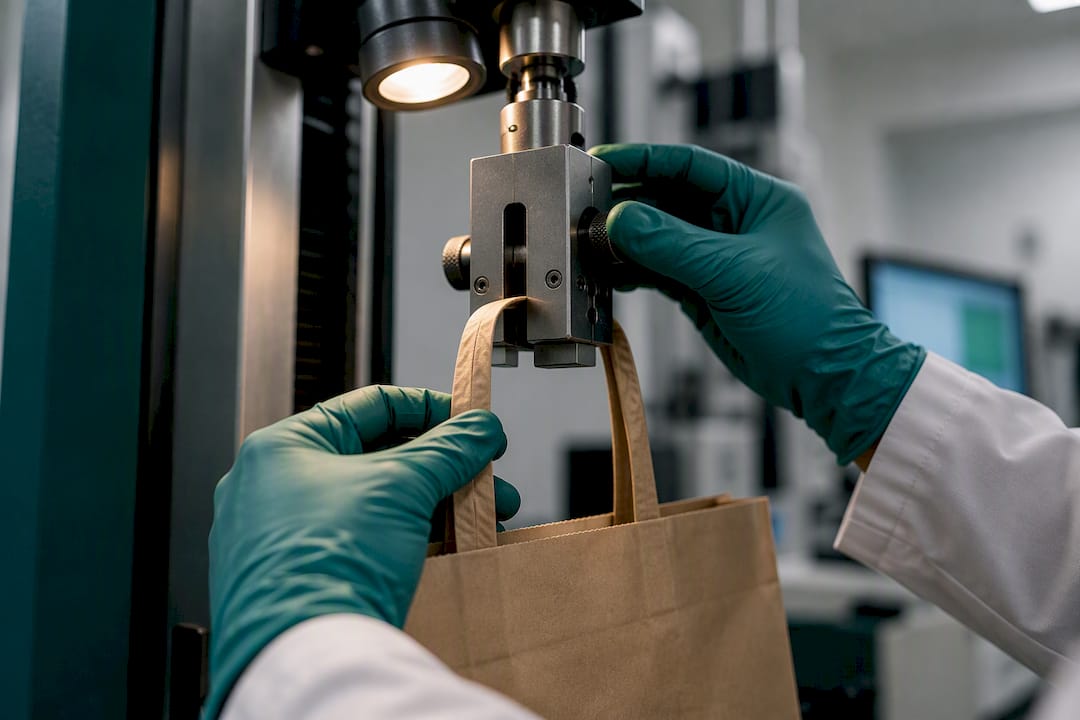
Require a finished-bag carrying-capacity and handle-attachment test to an accepted standard, such as EN 13590 or an agreed equivalent, with specified conditioning and a full test report before approving a bulk order. Testing the finished bag matters more than testing paper alone because handle failures usually come from the attachment method, adhesive, or seam, not just the raw material. A supplier with a documented QA program and prototyping capability can run this testing before production starts.
TL;DR:
- Handle testing must follow accepted standards like EN 13590 or an equivalent with matching conditioning, sampling, and reporting details for reliable results.
- Moisture conditioning affects handle strength, so testing conditions must reflect actual storage and transport environments to ensure valid comparisons.
- Handle attachment methods, especially reinforced internal patches, are critical for durability, particularly for bags meant to carry heavier loads or endure reuse.
- Proper test reports should include maximum load, handle elongation, failure description, and supporting photos; incomplete or missing data invalidate results.
- Manufacturers with pre-production prototyping and verified testing can better ensure handle strength before bulk orders, reducing costly rework or failures.
Table of Contents
- Standards that govern handle strength testing and what each covers
- Why conditioning and sampling change test outcomes
- Handle constructions and common failure modes buyers must understand
- Contract-ready test specification: what to put in purchase orders and lab requests
- How to interpret lab results and what to do next
- Procurement checklist: a copy-ready one-page list for QA and buying teams
- Gather Packaging’s approach to handle strength and QA
- Authoritative standards and guidance to reference in your specs
- Work with a manufacturer that tests before it ships
- Sources
- FAQ
Standards that govern handle strength testing and what each covers
Two categories of standards matter here, and buyers who confuse them end up with incomplete data. The first is prEN 13590, the European standard covering volume and carrying capacity of flexible carrier bags with handles. It specifies how to calculate an initial test weight (a common example uses bag volume multiplied by a factor determined by the standard), how samples must be conditioned before testing, the lifting rig and grip geometry to use, and what the final report must contain, including handle elongation and failure description. EN 13590:2003 is the earlier version of this standard and is still referenced in industry guidance and some national specifications, so a purchase order that names either version should state which one applies.
The second category is ASTM’s paper and packaging standards, which cover tensile strength, peel adhesion, and tear resistance at the material and adhesive level. These are useful for screening incoming paper stock or comparing adhesive systems, but they test components, not the assembled bag. A paper that passes a tensile test can still fail on a finished bag if the handle attachment method is weak.
When specifying tests, reference EN 13590 by name whenever a lab can run it. If a supplier’s lab cannot perform EN 13590 directly, ask for an “agreed equivalent to EN 13590” and require the equivalent method to match its conditioning, sampling, and reporting requirements point for point, not just its general intent.

Why conditioning and sampling change test outcomes
Paper and paperboard respond to moisture in ways that directly affect handle performance, and testing without controlling for humidity produces results that cannot be compared across suppliers or shipments. A 2026 research perspective on paper behavior notes that moisture changes the relative performance of different handle constructions, so tests should reflect the storage, transport, and use conditions the bags will actually see. EN 13590 and related conditioning references such as EN ISO 2233 call for conditioning samples at a defined temperature and relative humidity before mechanical testing.

For type testing on a new design, request a larger sample set to establish a reliable baseline. For routine production verification, a smaller sample count run consistently against the same criteria is enough to catch drift. When results vary widely within one batch, that variation itself is a red flag worth investigating before shipment.
Ask labs to confirm these equipment attributes before accepting a report:
- A conditioning chamber capable of holding specified temperature and relative humidity for the required dwell time.
- A lifting or pull-test rig with controlled, repeatable lift speed and documented grip geometry matching the standard.
- Calibrated load cells with a documented calibration date and traceable records.
Handle constructions and common failure modes buyers must understand
Handle strength depends heavily on how the handle is attached, not just what it is made from. Common constructions include twisted paper cord, flat folded handles, and handles reinforced with an internal patch. Industry guidelines from CEPI Eurokraft identify handle paper quality and attachment method as the parameters that most affect durability, and they recommend fixing handles inside the bag with a reinforcing patch for maximum strength.
Failure modes map fairly directly back to construction choices:
- Handle elongation or stretching under load, often tied to lower tensile energy absorption in the handle paper.
- Adhesive failure where the patch separates from the bag wall before the paper itself tears.
- Seam or fixation tear at the point where the handle meets the bag body.
Pro Tip: For bags expected to carry heavier loads or survive repeated reuse, specify an internally fixed, patch-reinforced handle rather than a simple glued or stapled attachment.
Contract-ready test specification: what to put in purchase orders and lab requests
A test request that leaves details to interpretation invites inconsistent results. Include these elements directly in the purchase order or lab request:
- The exact standard referenced (EN 13590, a specific version, or a named agreed equivalent).
- Conditioning temperature and relative humidity, plus dwell time before testing.
- Sample count for both type testing and routine production checks.
- The initial test weight calculation method, stated explicitly rather than assumed.
- Lift speed and grip geometry to be used on the test rig.
- Required data outputs: maximum carrying weight, handle elongation percentage, failure description, and photos.
- Pass or fail criteria and the corrective action required when a sample fails.
Set a clear decision flow with the supplier ahead of time: a passing result clears the batch, a marginal result triggers a re-test on a fresh sample set, and a failure triggers a documented corrective action before any further shipment. This avoids arguments after the fact.
It also helps to fold in storage and handling guidance from the paper supplier, since paper that sits in a humid warehouse before assembly can lose strength before it ever reaches a test rig. Our paper bag weight capacity guide covers this in more detail for teams building out a full spec.
How to interpret lab results and what to do next
A complete test report states the maximum carrying weight achieved, the handle elongation percentage at that load, a description of how and where the sample failed, and supporting photos. If any of these are missing, treat the report as incomplete rather than passing.
Watch for these red flags:
- No stated conditioning temperature or humidity, which makes the result impossible to compare against another supplier’s data.
- Adhesive failure noted in the failure description, which points to a bonding problem rather than a paper strength problem.
- Wide inconsistency across samples from the same batch, which suggests a process control issue on the production line.
When a report is incomplete, send it back before making any decision. When results fail outright, request a corrective action plan and a re-test on a new sample set rather than accepting a partial fix. When results are marginal, a short prototype run under the same conditions is often the fastest way to confirm whether the fix worked.
Procurement checklist: a copy-ready one-page list for QA and buying teams
Before approving an order, confirm the following:
- Standard referenced (EN 13590 or a named agreed equivalent).
- Conditioning temperature, relative humidity, and dwell time stated in the report.
- Sample count appropriate to type testing or production verification.
- Pass or fail rules and corrective action steps agreed in writing.
- Handle construction specified, including attachment method.
- Prototype approved before full production runs.
- Storage and handling notes from the paper supplier included in the contract.
Add a short supplier QA clause requiring a pre-production prototype, a pre-production test report, and a defined re-test process if results fall short.
Test reports without stated conditioning are not comparable across suppliers or shipments, according to prEN 13590’s own reporting requirements, which call for conditioning details to appear alongside the measured results.
Gather Packaging’s approach to handle strength and QA
Some manufacturers run prototyping and pre-production testing before full runs go into the queue, so handle construction and attachment issues surface early rather than after a container has shipped. Design assistance teams can work with buyers to match conditioning and sample counts to the intended use, whether that is a retail flagship bag expected to survive multiple reuses or a lighter promotional bag with a shorter service life. When a prototype falls short, corrective adjustments and a re-test can be run rather than pushing an unresolved design into production. Our paper bag QA checklist walks through the same workflow in more detail for teams building their own internal process. For handle construction options and reinforcement choices, our guide to paper bag handles is a useful next stop.
— Taylor
Authoritative standards and guidance to reference in your specs
Cite these directly in purchase orders and lab requests: prEN 13590 for carrying-capacity and handle-attachment methods, CEPI Eurokraft’s industry guidelines for handle construction recommendations, and ASTM’s paper and packaging standards for material and adhesive tests. Naming the exact standard removes ambiguity from supplier negotiations.
Work with a manufacturer that tests before it ships
Some manufacturers produce Turn Top, Serrated Top, and Tamper-Resistant Serrated Top paper bags with prototyping and pre-production testing built into the process, so handle construction gets verified before a bulk order commits budget. Domestic production can shorten prototype turnaround and re-tests compared to waiting on samples shipped overseas.

This fits buyers who need a documented handle-attachment test on file before a purchase order goes out, and who want a supplier that can adjust the construction and re-test rather than shipping a fixed design. Browse our paper bag product lines or reach out through our contact page to discuss a prototype and testing plan for your next order.
Sources
- prEN 13590 Packaging Flexible Carrier Bags Volume and Capacity Tests
- High-quality paper carrier bags
- Paper Standards and Packaging Standards - Standards Products - Standards & Publications - Products & Services
FAQ
What does handle strength testing actually measure?
It measures the maximum load a finished bag can carry before the handle or its attachment fails, along with how much the handle stretches under load. prEN 13590 sets out the conditioning, rig setup, and reporting details used to run this test consistently.
Is EN 13590 required, or can a lab use an equivalent method?
EN 13590 is the most widely referenced standard for carrying-capacity testing, but a lab can run an agreed equivalent as long as its conditioning, sampling, and reporting match EN 13590 point for point. Naming the exact standard or equivalent in the purchase order avoids disputes over incomplete reports.
Why does humidity matter so much for handle testing?
Moisture changes how paper and handle attachments behave under load, and a 2026 research perspective notes this can shift the relative performance between handle constructions. Specifying conditioning that matches real storage and transport conditions keeps results comparable across suppliers.
Which handle construction is strongest?
CEPI Eurokraft’s industry guidelines recommend handles fixed inside the bag with a reinforcing patch for maximum strength, compared with simpler glued or twisted attachments. The right choice still depends on the expected load and how often the bag will be reused.
What should I do if a supplier’s test report fails or looks incomplete?
Send the report back if it is missing conditioning details, sample counts, or failure photos, since an incomplete report cannot be used to make an approval decision. If the bag fails outright, request a documented corrective action and a fresh prototype re-test before allowing production to proceed.
Share:
Fix Paper Bag Supply Shortages in 7 to 30 Days With Domestic Suppliers
Designers: Prototype with 8 color Flexo to Print on Recycled Kraft