
A properly specified custom retail paper shopping bag can be engineered to carry light loads, standard retail loads, or heavy loads. The actual capacity depends on paper grade, handle design, bottom reinforcement, and verified QA testing — specifically burst strength, handle-pull, and dynamic-load tests, with samples conditioned per EN ISO 287. The actual capacity depends on paper grade, handle design, bottom reinforcement, and verified QA testing — specifically burst strength, handle-pull, and dynamic-load tests, with samples conditioned per EN ISO 287. Gatherpackaging’s pre-production QA checklist is a practical starting point.
First steps for procurement teams:
- Define the expected packed weight for a single bag, then add a moderate safety margin as your test target
- Request pre-production samples before approving any bulk run
- Mandate burst strength, handle-pull, and dynamic-load tests on conditioned samples
- Confirm EN ISO 287 humidity conditioning (23±1 °C) is applied before testing
Key Takeaways
A paper shopping bag’s load-bearing capacity is determined by paper grade, handle design, bottom reinforcement, and verified testing — not GSM alone.
| Point | Details |
|---|---|
| Capacity bands | Light (3–5 kg), standard (5–10 kg), and heavy (10–15+ kg) map to 60#, 70#, and — respectively. |
| Structural spec beats GSM | Bottom board, handle patch coverage, and glue quality determine real-world performance more than paper weight alone. |
| Three mandatory tests | Require burst strength, handle-pull (in Newtons), and dynamic load tests on EN ISO 287–conditioned samples before bulk approval. |
| Handle choice by environment | Flat multilayer handles lead at moderate RH; reinforced cut-out handles perform best at high relative humidity. |
| Gatherpackaging | Domestic Toronto manufacturing enables fast sample iteration, pre-production QA testing, and FSC-certified material options for capacity-critical orders. |
Table of Contents
- What determines a paper shopping bag’s weight capacity?
- How to express required capacity when ordering
- Which handle design holds up under real-world conditions?
- What tests must you require before accepting a batch?
- What fields belong in your procurement spec template?
- How do packing, palletization, and lead times affect your order?
- Why Gatherpackaging is a practical choice for capacity-critical orders
- Use-case examples: capacity needs and how they were specified
- What procurement teams consistently get wrong about bag capacity
- Gatherpackaging helps you spec and test bags that hold the load
- Sources
What determines a paper shopping bag’s weight capacity?
Bag weight capacity is a system property, not a single-material spec. Paper grade matters, but so does every joint, fold, and attachment point.
Material variables:
- Paper grade and GSM: Higher GSM generally means higher tensile and burst strength. Virgin kraft outperforms recycled fiber at equivalent GSM because longer fibers carry more load before breaking.
- Tensile Energy Absorption (TEA): TEA measures how much energy the paper absorbs before snapping — critical for bags that get swung or set down hard. A bag with high burst strength but low TEA can fail suddenly under a jerk load.
- Grain direction: Machine-direction (MD) vertical orientation significantly increases tensile strength compared with cross-direction. For heavy-load bags, specify MD orientation on production drawings.
- Ply and coating: Multi-ply construction and moisture-resistant coatings improve wet-strength performance.
Structural variables:
- Bottom board: A cardboard insert distributes load across the base. Without it, concentrated weight punches through the bottom seam. Structural reinforcement can make a lower-GSM bag outperform a thicker bag that lacks it.
- Gusset size and fold accuracy: A wider gusset increases volume and distributes lateral stress. Poorly folded gussets create stress concentrations that fail under load.
- Glue quality and coverage: Hot-melt adhesive at seams and handle patches must cover the full bonding area. Gaps in glue coverage are the most common source of handle detachment failures.
Environmental variable:
Moisture is the silent capacity killer. Paper loses tensile strength as relative humidity rises. EN ISO 287 conditioning (23±1 °C, specified RH) standardizes samples before testing so results reflect real-world performance rather than lab-dry conditions.

How to express required capacity when ordering
Procurement teams often write “heavy-duty” on a PO and hope for the best. That is not a spec. Here is how to translate a capacity need into language a manufacturer can actually build to.
**Capacity bands and example notations: **
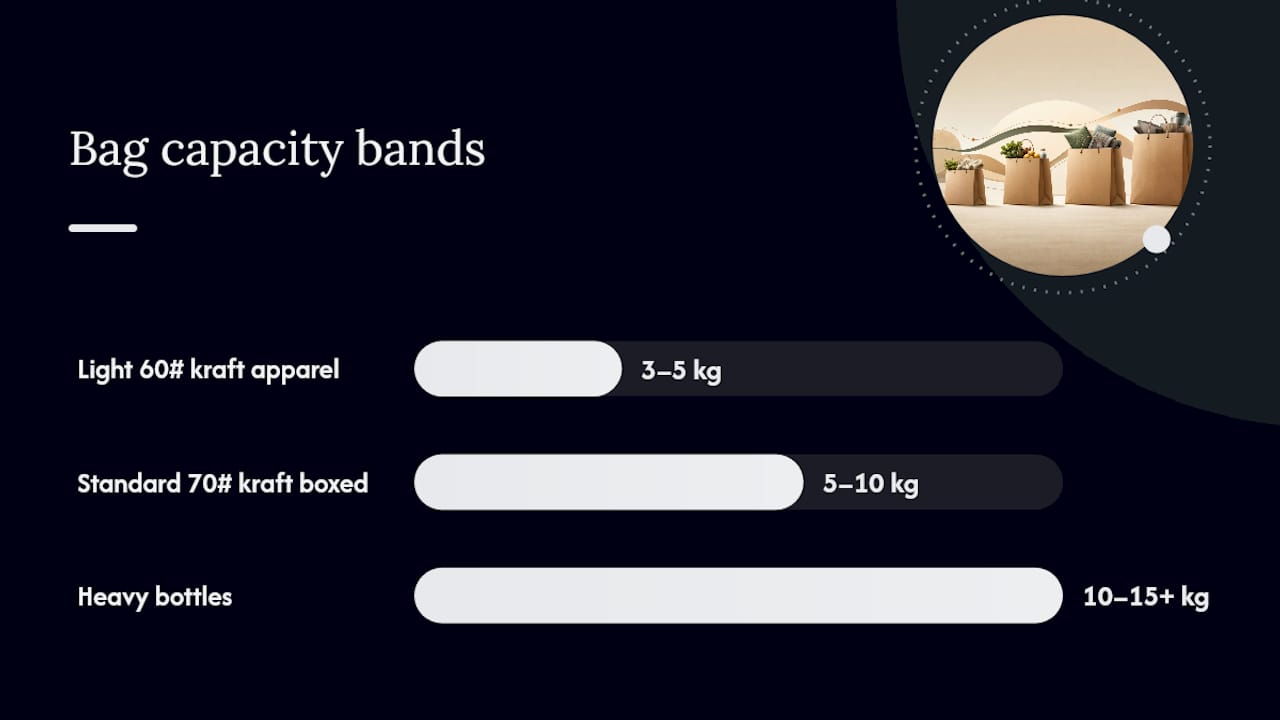
| Capacity band | Typical load | Example basis weight | Common use cases |
|—|—|—|—| | Light | 3–5 kg (6 lbs) | 60# kraft | Apparel, gifts, light accessories | | Standard | 5–10 kg (11 lbs) | 70# kraft | Boxed goods, shoes, folded clothing | | Heavy | 10–15+ kg (22 lbs) | — | Bottles, books, dense grocery items |
Supplier spec sheets commonly list basis-weight notations in the 60#–70# range with carton pack counts typically in the 200–250 range. For heavier applications, engineering metrics like TEA and burst strength — not GSM alone — are what designers use to size bags for 10+ kg loads.
Fields to include on every PO:
- Finished bag dimensions: L × W × H plus gusset depth
- Basis weight in GSM or pound notation (e.g., 70#)
- Paper type: virgin kraft or recycled content percentage
- Expected single-bag packed weight and test weight (packed weight + 10–20% margin)
- Carton pack count and Ti/Hi if palletization is planned
Which handle design holds up under real-world conditions?
Handle failure is the most visible bag failure — and the most preventable. The right choice depends on load, environment, and how customers actually carry the bag.
Handle families compared:
- Flat multilayer paper handles: Strongest at moderate humidity. The layered construction distributes tensile load across multiple fiber planes. Best for standard to heavy retail loads in controlled indoor environments.
- Twisted paper handles: Economical and adequate for light loads. Glue-line and fiber softening under high humidity reduces their strength noticeably, making them a poor choice for foodservice or outdoor retail.
- Die-cut / plain cut-out handles: Integral with the bag body, so no adhesive joint to fail. Strength is limited by the paper grade at the cut edge. Fine for light carry loads.
- Reinforced cut-out handles (cardboard insert): The best performer at high relative humidity. Laboratory testing confirmed that reinforced cut-hole handles outperformed plain cut-hole handles at high RH, while flat multilayer handles led at moderate RH.
- Rope or cotton handles: Premium option for heavy or luxury retail. Tensile strength is high, but attachment method (eyelet vs. glued patch) determines the real-world failure point.
Attachment method matters as much as handle type. Hot-melt adhesive with a full-coverage patch resists dynamic loads better than water-based glue applied in a narrow bead. Specify patch dimensions and adhesive type in your sample sign-off.
Pro Tip: *Specify the handle-pull acceptance threshold (in Newtons or lbs-force) and the EN ISO 287 conditioning RH in your sample sign-off document.
For humidity-exposed environments, handle and material selection guidance from Gatherpackaging covers how moisture affects both fiber and adhesive performance.
What tests must you require before accepting a batch?
Static tests alone do not predict how a bag performs in a customer’s hand. Require all three of the following.
- Burst strength test: Measures resistance to puncture and internal pressure. Sets the baseline for paper grade performance. Specify the minimum burst index (kPa·m²/g) or burst pressure (kPa) as a pass/fail threshold.
- Handle-pull (tensile) test: Applies a controlled tensile load to each handle until failure. Run on samples conditioned per EN ISO 287. Specify minimum force in Newtons or lbs-force.
- Dynamic load test: Fill sample bags to the specified packed weight, then walk with them and perform light swings for a defined number of cycles. This reveals seam failures, handle detachment, and bottom failures that static tests miss entirely. Test above expected weight to build in a safety margin.
Pre-production QA checklist (insert into your PO):
- Minimum 5 pre-production samples per SKU submitted before bulk run
- All samples conditioned at 23±1 °C per EN ISO 287 before testing
- Burst strength result reported with pass/fail threshold stated
- Handle-pull result reported in Newtons with threshold stated
- Dynamic load test completed at packed weight plus safety margin
- Bottom board present and glue coverage confirmed on cross-section
- Signed sample approval required before production release
Gatherpackaging’s step-by-step QA checklist outlines pre-production sample testing, acceptance thresholds, and QA hold points as required steps before bulk approval.
What fields belong in your procurement spec template?
A complete spec eliminates ambiguity between your team and the manufacturer. Use this as a starting point for RFQs and POs.
Bag construction fields:
- Finished dimensions: L × W × H (inches or mm) plus gusset depth
- Basis weight: GSM or pound notation (e.g., 70# virgin kraft)
- Paper type: virgin kraft / recycled content / FSC-certified
- TEA or tensile target if available (for heavy-duty applications)
- Handle type, dimensions, and attachment method (patch size, adhesive type)
- Bottom board: required / not required; board weight if specified
- Expected single-bag packed weight (lbs or kg) and test weight with safety margin
Sample and testing requirements:
-
Number of pre-production samples required per SKU
-
Tests required: burst, handle-pull, dynamic load
-
Conditioning: EN ISO 287 (state RH and temperature)
-
Acceptance thresholds for each test (numeric, not “adequate”)
-
Sample sign-off clause: bulk production cannot start without written approval
Order and logistics fields:
-
MOQ and target lead time
-
Carton pack count (e.g., 250 per carton)
-
Ti/Hi for palletization if applicable
-
QA hold points during production run
-
Remedial steps for failed batches (re-test, re-run, credit)
The Gatherpackaging bag design guide covers L × W × H, gusset choices, grain direction, and production notes in detail.
How do packing, palletization, and lead times affect your order?
Carton pack counts in the 200–250 range are standard across most retail bag SKUs. Higher pack counts reduce carton count and freight cost but increase carton weight — which matters if your warehouse team is hand-stacking. A carton packed too densely also increases the risk of bag crushing, which can damage handles and bottom boards before the bags ever reach the sales floor.
Ti/Hi planning example: A Ti of 10 and Hi of 8 gives 80 cartons per pallet. At 250 bags per carton, that is 20,000 bags per pallet position. Running this calculation before you finalize pack count lets you align order quantities with full-pallet increments and avoid partial-pallet freight surcharges.
| Variable | Domestic (Toronto) | Offshore |
|---|---|---|
| Typical lead time | Shorter, weeks not months | Longer, often 10 weeks |
| Sample iteration | Fast, 1–2 rounds practical | Slow, costly re-sampling |
| QA control | Direct, in-facility | Remote, third-party inspection |
| MOQ flexibility | More flexible on short runs | Higher MOQ typical |
Custom reinforcements (bottom boards, patch handles) add production steps and should be built into lead-time estimates from the start. For bulk order management guidance, the Gatherpackaging wholesale order guide covers carton planning, Ti/Hi, and scheduling in detail.
Moisture protection during transit is often overlooked. Bags stored in humid containers or unheated warehouses can arrive with weakened handles and softened bottom boards. Specify moisture-barrier inner liners for cartons when shipping through humid climates or during winter months.
Why Gatherpackaging is a practical choice for capacity-critical orders
Gatherpackaging manufactures custom paper shopping bags in Toronto, which means sample iterations happen in weeks, not months. For procurement teams trying to nail a capacity spec, that speed matters: you can test a pre-production sample, identify a handle-pull failure, adjust the patch size, and re-test before committing to a full run.
Capabilities relevant to weight capacity:
- Pre-production sample testing with burst, handle-pull, and dynamic-load verification
- FSC-certified and virgin kraft material options for heavier-capacity applications
- Bottom board and reinforced handle configurations across bag styles
- 8-color flexo printing without compromising structural spec
- Domestic QA oversight at the production facility
Buyers can also choose FSC-certified and sustainable material options without sacrificing load performance — virgin kraft FSC stock carries the same fiber length and tensile properties as non-certified equivalents. For buyers weighing environmental credentials alongside capacity, sustainable packaging resources from Expleco offer additional context on material sourcing and lifecycle considerations.
Contact Gatherpackaging to discuss your capacity requirements, request pre-production samples, and confirm which tests will be run before bulk approval.
Use-case examples: capacity needs and how they were specified
Apparel retailer, light carry load. A mid-market clothing brand needed bags for folded T-shirts and accessories, target weight under 4 kg. Spec: 60# natural kraft, die-cut reinforced handle, no bottom board required. Dynamic load test at 5 kg for 50 cycles. Result: clean pass, handle integrity confirmed at moderate RH.
Specialty food retailer, standard load. A gourmet grocery needed bags for jarred goods and boxed items, target weight 7–8 kg. Spec: 70# virgin kraft, flat multilayer paper handle with full-coverage hot-melt patch, bottom board required. Handle-pull threshold set at 150 N per handle. The bottom board was the deciding factor — without it, the base seam failed at 6 kg in initial samples.
Bookstore, heavy load. A university bookstore needed bags for textbooks, target weight 12 kg. Spec: 130 GSM virgin kraft, reinforced cut-out handle with cardboard insert, bottom board, gusset 4 inches. TEA target specified alongside burst strength. Dynamic load test at 15 kg. First sample run failed handle-pull at high RH; adhesive coverage was insufficient on one side. Patch spec was updated, second samples passed.
These examples reflect the pattern that structural choices — bottom board, handle attachment, glue coverage — determine real-world performance more reliably than paper weight alone.
What procurement teams consistently get wrong about bag capacity
The most common mistake is treating GSM as a proxy for capacity. A 120 GSM bag with a poorly glued handle and no bottom board will fail at loads a well-engineered 80 GSM bag handles without issue. The spec conversation needs to start with the load, not the paper weight.
The second mistake is skipping dynamic testing. A handle that holds 200 N in a static pull test can detach after 20 walking cycles at 8 kg because the adhesive fatigues under repeated peel stress. Static tests confirm material properties; dynamic tests confirm the bag as a system.
Procurement teams that set numeric acceptance thresholds — a specific Newton value for handle-pull, a specific burst index, a defined cycle count for dynamic load — get consistent results across production runs. Teams that write “good quality” on a PO get whatever the manufacturer decides that means.
Gatherpackaging helps you spec and test bags that hold the load
Specifying paper shopping bag capacity correctly is a technical process, and getting it right before a bulk run saves significant cost and reputational risk. Gatherpackaging’s Toronto manufacturing operation gives procurement teams direct access to pre-production sampling, in-house QA testing, and fast iteration cycles.
Custom kraft paper bags are available in configurations from light retail to heavy-duty, with FSC-certified materials, reinforced handle options, and bottom board construction. Every order starts with a sample approval process that includes the tests your spec requires.
Contact Gatherpackaging to share your capacity requirements and request pre-production samples.
Share:
Matte Varnish vs Gloss for Custom Paper Shopping Bags
Kraft Paper Grades: A Buyer's Specification Guide