

For most boutique and premium retail bags, matte aqueous varnish or matte film lamination is the stronger default. For mass retail, promotional, and high-visibility shelf bags, gloss delivers the color saturation and shelf impact that moves product. That said, the right call depends on your retail environment, print design, and sustainability requirements — and no finish decision should be final without physical prototypes reviewed under actual store lighting. Before you lock specs, request finish swatches and a color proof from Gatherpackaging, confirm your printing method (8-color flexo), and verify whether your substrate carries FSC® certification or recycled content.
Key Takeaways
For most retail and foodservice paper shopping bag applications, matte aqueous varnish suits premium and boutique environments while gloss aqueous or lamination suits mass retail and promotional use — and physical prototypes under store lighting are the only reliable way to confirm the right call.
| Point | Details |
|---|---|
| Matte vs gloss by environment | Matte suits boutique and luxury retail; gloss suits mass retail, grocery, and promotional bags. |
| Aqueous varnish limits | Aqueous gloss improves scuff resistance but is not a moisture barrier; specify lamination or barrier coatings for wet handling. |
| Lamination and recyclability | PP film lamination adds durability but typically removes the bag from municipal recycling streams. |
| Prototype before sign-off | Request physical finish swatches and a color proof under real store lighting before approving production. |
| Gatherpackaging next step | Contact Gatherpackaging for finish swatches, prototypes, and QA-backed sample approvals on FSC®-certified paper shopping bags. |
Table of Contents
- How do matte varnish vs gloss finishes compare for paper shopping bags?
- How are matte and gloss finishes actually applied to paper bags?
- Which finish fits your retail or foodservice scenario?
- How does your finish choice affect sustainability and recycling claims?
- What durability, cost, and QA factors should procurement plan for?
- What should you ask your bag supplier before sign-off?
- Gatherpackaging’s approach to helping clients choose and validate finishes
- Gatherpackaging can help you specify and prototype the right finish
- Sources
How do matte varnish vs gloss finishes compare for paper shopping bags?
The table below maps both finishes across the dimensions that matter most during spec reviews and supplier negotiations.
| Attribute | Matte finish | Gloss finish |
|---|---|---|
| Sheen / visual appearance | Flat, diffused, no glare | Reflective, high-shine |
| Tactile feel | Smooth to slightly textured | Slick, hard surface |
| Print color saturation | Slightly muted; rewards strong design | Boosted vibrancy and contrast |
| Glare / legibility under store lighting | Excellent — no hot spots | Can create glare under overhead lighting |
| Scuff / scratch resistance | Shows light scratches more readily | Aqueous gloss improves scuff resistance |
| Water / moisture resistance | Low without barrier coating | Low without barrier coating |
| Recyclability / compostability | Aqueous matte: generally recycle-friendly | Aqueous gloss: generally recycle-friendly |
| Per-unit cost impact | Slightly higher for film or soft-touch | Usually lower for aqueous gloss |
| Lead time / production steps | Lamination adds steps | Inline aqueous is fastest |
| Best-for retail environments | Boutique, luxury, apparel, cosmetics | Mass retail, grocery, promotional |
| Flexo / post-print compatibility | Confirm ink anchoring on matte film | Standard; color shift possible on gloss film |
Best use cases for matte:
- Boutique apparel bags where a tactile, premium feel matters
- Luxury cosmetics or skincare with minimalist design
- Brands making strong sustainability claims (aqueous matte over film)
- Designs with large unprinted areas or kraft-tone backgrounds
- Environments with bright overhead lighting where glare would hurt legibility
Best use cases for gloss:
- Mass retail and grocery bags where shelf contrast is the priority
- Promotional event bags with bold, full-bleed color designs
- Bags with photographic or high-detail imagery that needs color pop
- Short-run promotional runs where cost per unit is a factor
- Takeout delivery bags where a clean, professional look is needed
Key callout: Matte finishes hide fingerprints far better than gloss. Gloss boosts color vibrancy but shows smudges and scratches under handling. For foodservice takeout bags, neither aqueous matte nor gloss alone provides grease resistance — that requires a separate internal barrier coating.
How are matte and gloss finishes actually applied to paper bags?
The four main application methods are aqueous varnish, UV varnish, film lamination (PP matte or PP gloss), and soft-touch/velvet coating. Each sits at a different point in the production flow and carries different cost, lead-time, and recyclability implications.

Aqueous varnish is water-based and applied inline during or immediately after flexo printing. It dries quickly, adds a matte or gloss sheen, and improves scuff resistance. It does not, however, provide meaningful moisture protection. Aqueous gloss coatings improve scuff resistance and color vibrancy but are not equivalent to film lamination for moisture resistance — specify barrier coatings or film lamination when wet handling is a real risk.
UV varnish is cured with ultraviolet light and produces a harder, more durable surface than aqueous. It is typically a post-print step, which adds production time. UV gloss can be striking on full-bleed printing bags, but it is less recycle-friendly than aqueous options and requires careful ink anchoring to avoid delamination.
Film lamination (PP matte or PP gloss) is a post-print process that bonds a thin plastic film to the printed surface. Laminated paper bags offer greater durability and moisture resistance than non-laminated bags, but the plastic film complicates recycling and composting. Matte lamination diffuses light and reads as premium for boutique and luxury brands; glossy lamination reflects light and drives shelf impact for mass retail.
Soft-touch/velvet coating layers a matte look with a velvety tactile surface. It is the most tactile-premium option and typically costs more, requiring careful substrate and process control. Specify it only after prototyping on your actual substrate.
The production flow runs: substrate selection → 8-color flexo printing → drying → inline aqueous coating (if used) → post-print UV or lamination (if specified) → slitting, converting, and bag making. Each post-print step adds lead time and may affect minimum order quantities.
Pro Tip: Request a finish swatch and a color soft-proof from Gatherpackaging before final approval. Color appearance shifts between matte aqueous, matte film, and gloss film — what looks right on screen or a flat proof will look different on a finished bag under store lighting.
Which finish fits your retail or foodservice scenario?
Environment determines finish more reliably than personal preference. Here is how the decision maps to common scenarios.
- Boutique apparel: Matte aqueous or matte PP lamination. Prioritize tactile feel and glare-free legibility. Request a prototype under the store’s actual lighting before sign-off.
- Premium cosmetics/skincare: Soft-touch or matte lamination. The velvet feel signals quality at the point of handoff. Prototype on your exact substrate — process variation shows on soft-touch.
- Mass retail / grocery: Gloss PP lamination or aqueous gloss. Color saturation and shelf contrast are the priority. Glossy lamination drives shelf impact for this environment.
- Promotional event bags: Aqueous gloss or gloss lamination. Full-bleed printing bags with bold graphics benefit from gloss’s color amplification. Confirm ink anchoring with your printer for flexo-printed designs.
- Takeout foodservice bags: Aqueous coating (matte or gloss) over a kraft substrate with an internal grease barrier. For foodservice, aqueous or UV coatings are preferred over full plastic film lamination to stay food-safe; grease resistance comes from the internal barrier, not the outer finish. Request a grease-soak test on prototypes.
For shelf appeal under different retail lighting conditions, gloss performs best under bright overhead fluorescents where contrast matters; matte works best in boutique or minimalist environments where glare-free readability and tactile perception are the priority.
How does your finish choice affect sustainability and recycling claims?
Some film laminations and certain varnishes complicate recycling and composting. Aqueous coatings and water-based options are generally more recycle-friendly, but the specifics depend on your substrate, adhesive, and local recycling infrastructure.
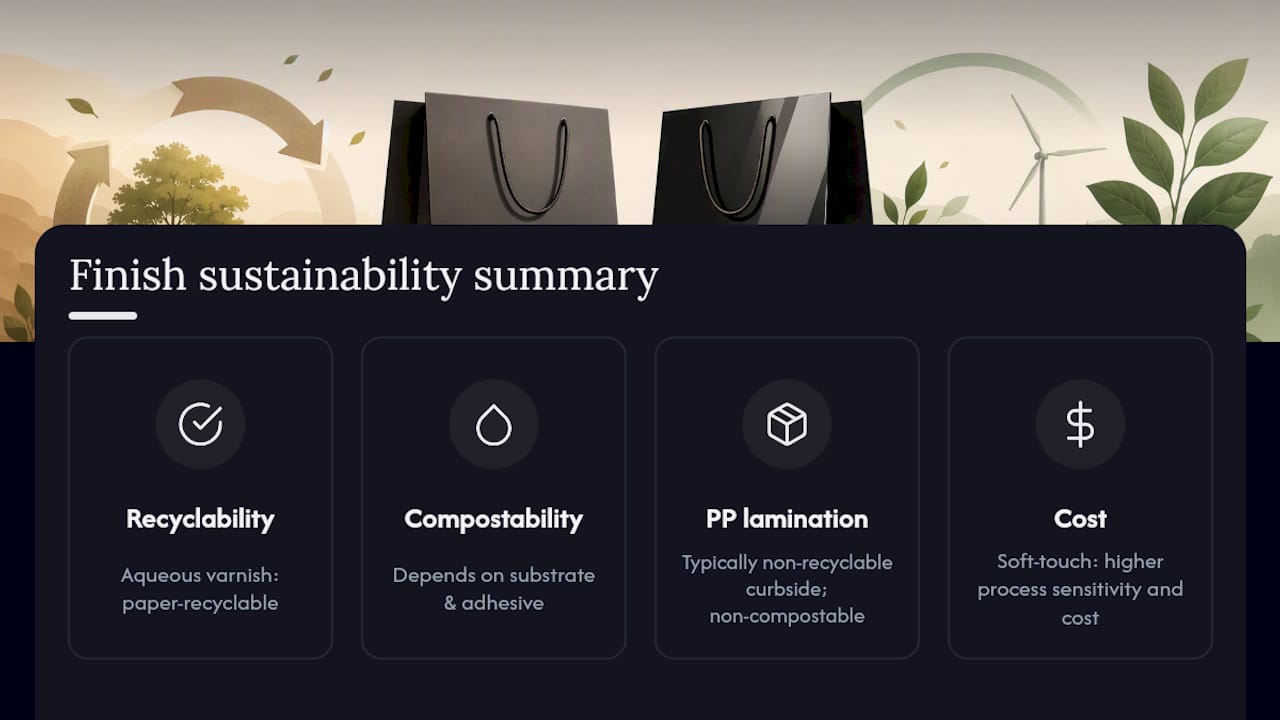
Matte and gloss aqueous varnish: Generally compatible with paper recycling streams. No plastic film is added, so the bag retains its paper-recyclable status. Compostability depends on the base substrate and any adhesives used.
PP film lamination (matte or gloss): The plastic film typically makes the bag non-recyclable in standard municipal curbside programs and non-compostable. Some industrial recycling streams accept it, but you cannot make a broad “recyclable” claim without verifying the stream your customers actually use.
Soft-touch lamination: Same recyclability concern as PP film. Higher process sensitivity and cost, with no recycling advantage over standard lamination.
For brands making FSC® or recycled-content claims, Gatherpackaging’s eco-friendly and compostable bag options cover substrate, adhesive, and end-of-life considerations. Explore finish choices that balance brand perception and sustainability before finalizing specs.
Pro Tip: Ask your supplier for a Material Declaration covering substrate, coating, adhesive, and any film used. If you plan to label the bag as compostable or recyclable, request a recommended disposal label and confirm the claim against the recycling stream your retail locations actually serve.
What durability, cost, and QA factors should procurement plan for?
Match finish to expected handling: in-store handoff bags face different stress than bags shipped inside a carton or handed across a takeout counter.
Cost and lead time: Aqueous gloss is the fastest and lowest-cost finish option — it runs inline with printing. Matte film lamination and soft-touch add post-print steps and cost more per unit, though the gap narrows at higher volumes. Soft-touch is the most process-sensitive and should be budgeted accordingly. Per-unit cost gaps narrow with bulk orders, so let brand fit and shelf conditions drive the decision rather than small cost differences at low quantities.
Color proofing and press-checks: Color shifts between matte aqueous, matte film, and gloss film are real and visible. Provide Pantone or CMYK targets and request both a wet-ink proof and a finished-sample proof for each finish type. A press-check on the first production run catches color drift before the full order runs.
Scuff and rub testing: Matte surfaces can show light scratches more readily than gloss, even while hiding fingerprints. Request a scuff/rub test on prototypes — this simulates bag-to-bag contact during transit and stacking. Gatherpackaging conducts scuff and rub testing as part of its QA process.
Moisture wipe tests: Neither aqueous matte nor aqueous gloss provides meaningful moisture resistance. For bags that will be handled in wet conditions or used for takeout, request a moisture wipe test and confirm whether a barrier coating is specified.
Pro Tip: Sign off on a physical sample — not a digital proof — before releasing the production order. Finish appearance, tactile feel, and color accuracy all need to be confirmed on the actual substrate under real lighting. For transit and handling protection, confirm how finished bags will be packed and shipped to avoid scuffing in transit.
What should you ask your bag supplier before sign-off?
Use this checklist during RFQ and sample approval to avoid surprises at production.
Spec checklist:
- Paper grade and GSM confirmed for the intended use (in-store handoff vs. shipped product)
- FSC® certification or recycled-content documentation provided
- Printing method confirmed (8-color flexo spec, ink type, water-based inks)
- Finish type and application method specified (aqueous matte or gloss, UV, PP matte or gloss lamination, soft-touch)
- Pantone or CMYK color targets provided; color tolerance agreed in writing
- Wet-ink proof and finished-sample proof requested and approved
- Scuff/rub test and moisture wipe test completed on prototype
- Lead time and MOQ confirmed in writing, including post-print finishing steps
- Packaging and transport spec for finished bags (how bags are packed to avoid transit scuffing)
- End-of-life claim verified against actual recycling stream (municipal curbside vs. industrial)
Supplier questions to include in your RFQ:
- “Do you apply aqueous or UV varnish? If lamination, what film type is used, and is it recyclable in municipal streams?”
- “Can you provide a Material Declaration covering substrate, coating, adhesive, and any film?”
- “What scuff and moisture tests do you run on finished bags, and can you share test results with the sample?”
- “What is the lead time from approved sample to delivery, including post-print finishing steps?”
- “Can you provide a finish swatch and a color soft-proof before we approve production?”
Minimum spec fields for a finished bag order: finish type, coating application method, proof requirements, Pantone or CMYK tolerances, sample approval signature, and end-of-life disposal label (if claiming compostable or recyclable).
Gatherpackaging’s approach to helping clients choose and validate finishes
Gatherpackaging evaluates brand fit, retail environment, and sustainability requirements before recommending a matte or gloss finish. The process starts with understanding where the bag will be used and how it will be handled, not with a default finish recommendation.
Prototyping and finish swatches: Physical samples are produced on the target substrate so buyers can evaluate finish appearance, tactile feel, and color accuracy under real conditions. This is the most reliable step in the decision process.
8-color flexo printing: Gatherpackaging’s custom printed paper bag capability runs up to 8 colors, supporting full-bleed printing bags with precise color registration. Press-check coordination is available for color-critical orders.
QA testing: Scuff/rub tests, moisture wipe tests, and color proofing are part of the production workflow. Buyers receive test results with sample approvals.
FSC® and sustainability options: FSC®-certified substrates, recycled-content materials, and water-based inks are available. Material Declarations can be provided for buyers making recycling or compostability claims.
Domestic manufacturing and lead times: Production in Toronto means shorter lead times and direct communication during production. Lead-time transparency is built into the quoting process.
Gatherpackaging can help you specify and prototype the right finish
Choosing between matte and gloss for your paper shopping bags is a decision that deserves physical prototypes, not just a spec sheet.
Gatherpackaging manufactures custom paper shopping bags in Toronto with FSC®-certified and recycled-content substrates, 8-color flexo printing, and a full range of finish options from aqueous matte and gloss to soft-touch lamination. Share your spec or brief with the team, and they will produce finish swatches and a prototype for review under real lighting before production begins. For buyers prioritizing sustainability, the eco-friendly and compostable bag options cover substrate, coating, and end-of-life documentation. Contact Gatherpackaging to request a sample, a finish swatch, or a quoting template for your next paper shopping bag order.
Share:
How Retail Paper Bags Are Palletized for DC Delivery
Paper Shopping Bag Weight Capacity: A Procurement Guide