

TL;DR:
- Choosing the right paper bag finish impacts brand perception, durability, and sustainability. Matte finishes hide fingerprints and convey a premium look, while gloss maximizes color vibrancy but shows handling marks easily, making each suitable for different applications. Selection should be based on brand positioning, product weight, handling needs, and environmental goals to ensure consistent quality and alignment with customer expectations.
Choosing the right finish for your paper bags affects far more than how they look on the shelf. The top paper bag finishes available today shape how customers perceive your brand, how long the bag holds up under real-world handling, and whether your packaging aligns with your sustainability commitments. For packaging designers and buyers balancing all three, the options can feel genuinely complex. This guide cuts through the noise and gives you a clear, practical view of what each finish delivers, where it falls short, and how to match it to your specific brand and product needs.
Table of Contents
- Key takeaways
- Top paper bag finishes: what to consider before you choose
- Matte finish: the quiet frontrunner
- Gloss finish: maximum visual punch
- Soft-touch lamination: the tactile differentiator
- Spot UV coating: contrast as a design tool
- Foil stamping and embossing: decorative upgrades with tradeoffs
- Lamination: functional durability with sustainability considerations
- Comparison of top paper bag finishes
- How to select the best finish for your brand and sustainability goals
- My take on where paper bag finishes are heading
- Work with Gatherpackaging on your custom finish needs
- FAQ
Key takeaways
| Point | Details |
|---|---|
| Matte outperforms for fingerprints | Matte finishes hide scuffs and fingerprints better than gloss, making them the stronger choice for frequent retail handling. |
| Gloss maximizes color impact | Gloss coatings make colors appear brighter and more saturated, best suited for seasonal or promotional packaging. |
| Lamination adds durability tradeoffs | Laminated finishes increase tear and water resistance but can complicate recyclability depending on material type. |
| Sustainability affects finish selection | Consumers increasingly favor eco-conscious packaging, so finish choices should account for compostability and recycled content. |
| Match finish to product weight and use | Heavier products and high-traffic retail demand more durable finishes than gift or boutique applications. |
Top paper bag finishes: what to consider before you choose
Before comparing individual finish types, you need a clear framework for evaluation. The best finish for your bags is not the most visually striking one. It is the one that performs well across the specific demands of your brand, your product, and your customer experience.
Here are the core criteria that should drive every finish decision:
- Durability and tear resistance. Will the bag be carried through a busy retail environment or handed over a counter once? Finish selection based on use should account for product weight, handling frequency, and whether the bag is meant to be kept or discarded.
- Visual aesthetics. Gloss finishes produce vivid color saturation. Matte finishes read as understated and premium. Specialty effects like soft-touch or foil add tactile and visual dimensionality that neither standard option delivers.
- Environmental impact. Some finishes, particularly plastic-based laminates, create barriers to recycling and composting. Eco-friendly finish choices that preserve recyclability or use water-based coatings align with consumer expectations and brand sustainability goals.
- Cost and lead time. Standard matte and gloss coatings are the most cost-effective options. Specialty finishes like soft-touch lamination, spot UV, and foil stamping add production complexity and cost.
- Brand alignment. A boutique jewelry brand and a casual apparel retailer should not reach for the same finish. Your packaging finish communicates brand positioning before a customer reads a single word of copy.
Pro Tip: Request physical samples of at least two finish options before committing to a production run. The difference between matte and soft-touch lamination is difficult to evaluate from a digital proof alone.
Matte finish: the quiet frontrunner
Matte bags absorb light rather than reflect it, producing a non-reflective surface that reads as premium and composed. They are strongly associated with high-end retail, boutique aesthetics, and brands that want to signal quality without visual aggression.
One practical advantage that often gets overlooked: matte masks fingerprints and everyday scuffs far better than gloss. For bags that are handled repeatedly or displayed in a retail context, this matters. Matte finishes also pair well with foil stamping, allowing brands to use spot metallic accents against a non-reflective background for a polished, layered effect.
The trade-off is color vibrancy. Matte coatings soften the perceived saturation of printed colors, which can reduce impact for designs that rely on bold, saturated hues.
Gloss finish: maximum visual punch
Gloss coatings add a reflective, light-bouncing surface that makes printed colors appear brighter and more saturated. Gloss is the natural choice when a brand wants maximum shelf presence, and it performs particularly well for seasonal displays, gift packaging, and promotional bags.
Gloss works well for maximum visual impact, especially for festive or promotional occasions. The downside is fingerprints. Gloss surfaces show handling marks quickly, which can be an issue in high-contact retail environments where bags are touched repeatedly before purchase.
For buyers choosing between glossy versus matte paper bags, the practical rule is straightforward. If your packaging is a short-term promotional vehicle and color impact is the priority, gloss delivers. If the bag represents an everyday brand touchpoint at a mid to high price point, matte tends to age better in the hands of customers.
Soft-touch lamination: the tactile differentiator
Soft-touch lamination sits at the premium end of the finish spectrum. It applies a thin laminate layer that creates a velvet or suede-like feel, making the bag noticeably different from anything a customer has carried from a competitor.

The sensory effect is not just a luxury signal. It also increases perceived product quality and gives packaging a differentiation advantage in crowded retail niches. Soft-touch finishes work well for premium apparel, cosmetics, and specialty retail where the unboxing or carry experience is part of the brand moment.
The cost is higher than standard matte or gloss, and the laminate layer introduces recyclability considerations. Buyers with strong sustainability mandates should confirm whether a soft-touch option meets their material recovery requirements before specifying it.
Pro Tip: Soft-touch lamination and matte ink printing are a natural pairing. The finish amplifies the understated quality of matte colors while adding a physical texture that photographs and photographs well in lifestyle imagery.
Spot UV coating: contrast as a design tool
Spot UV applies a glossy, clear coating to specific areas of the bag rather than the entire surface. The result is a contrast between a matte base and targeted gloss highlights, often used on logos, brand marks, or graphic elements.
This finish rewards deliberate design thinking. Used on a simple two-color kraft bag, spot UV on a logo can deliver a visual and tactile impact that costs less than foil stamping. The selective application means production costs are controlled while the perceived quality of the finished bag is meaningfully higher than a plain matte or gloss option.
Spot UV is particularly well-suited for boutique retail applications where the bag serves as a brand ambassador long after the transaction.
Foil stamping and embossing: decorative upgrades with tradeoffs
Foil stamping and embossing add metallic sheen and raised or debossed surface texture to specific design elements. Both techniques create a strong physical presence that photography and digital rendering cannot fully capture. They are most common in luxury retail, specialty gifting, and high-end apparel.
The practical tradeoffs are real. Foil and embossing add production time and cost, and both techniques require higher minimums to be economical. The metallic foil layer also introduces material complexity that can affect the recyclability of the finished bag. These finishes make sense when brand equity justifies the investment and volume supports the unit economics.
Lamination: functional durability with sustainability considerations
Lamination as a category covers any process that bonds a film layer to the paper surface. Laminated bags improve tear resistance and water resistance, extending bag lifespan and supporting reuse. For retail applications with heavier products or bags that need to perform across multiple uses, lamination adds meaningful functional value.
The sustainability consideration is critical. Plastic-based laminate films bonded to paper create a multi-material composite that is difficult to separate and recycle. Durable laminated bags are preferred for strength, but buyers committed to recyclability should look for water-based coating alternatives or confirm that their chosen laminate is compatible with paper recycling streams in their target markets.
Comparison of top paper bag finishes
| Finish | Visual impact | Fingerprint resistance | Durability | Sustainability | Relative cost |
|---|---|---|---|---|---|
| Matte | Understated, premium | High | Moderate | Good with water-based coatings | Low |
| Gloss | High, vibrant color | Low | Moderate | Moderate | Low |
| Soft-touch lamination | Luxury tactile feel | High | High | Lower (film layer) | Medium-high |
| Spot UV | High contrast on highlights | High (matte base) | Moderate | Good | Medium |
| Foil stamping | Maximum decorative impact | High | Moderate | Lower (metallic layer) | High |
| Lamination (film) | Depends on base | High | Very high | Lower (multi-material) | Medium |
How to select the best finish for your brand and sustainability goals
The right finish is not a category decision. It is a brand decision made through the filter of practical constraints. Here is how to work through it:
- Map your brand positioning. Premium and boutique brands tend toward matte, soft-touch, or spot UV. High-energy, promotional, or youth-oriented brands often benefit from gloss. There is no universal answer, but there is a right answer for your specific brand personality.
- Assess your sustainability commitments. Consumer demand for sustainable packaging is real and growing. If recyclability or compostability is part of your brand story, your finish selection must support it. Water-based matte coatings and unlaminated options preserve recyclability. Plastic film laminates and foil generally do not.
- Factor in product weight and handling. Heavier products and high-traffic retail need functional durability. A finish matched to end use prevents premature bag failure and customer frustration. Light boutique bags can prioritize aesthetics. Bags carrying apparel or footwear need structural and surface durability.
- Consider combining finishes. Matte base with spot UV on the logo is one of the most cost-effective ways to achieve a premium look without the unit cost of foil or soft-touch across the entire surface.
- Work with a manufacturer that offers real customization. Generic off-the-shelf bags rarely deliver finish quality that matches what a design team specifies. Working with a domestic manufacturer like Gatherpackaging, which offers custom kraft paper bags with multiple finish options and 8-color flexo printing, gives you the control to execute finishes that are actually consistent across production runs.
My take on where paper bag finishes are heading
I have watched the conversation around finishes shift noticeably over the past few years. Gloss used to be the default ask from retail clients. Now matte is often the starting point, and brands are asking harder questions about sustainability from the first briefing call.
What I find genuinely interesting is that matte is not winning just on eco grounds. It is winning because it aligns with premium brand perception in a way that feels current. Gloss looks promotional. Matte looks considered. That is a real shift in consumer taste, not just a sustainability story.
The brands getting the most out of their finish choices right now are the ones treating the bag as a designed object, not a commodity container. Spot UV on a kraft base, or soft-touch on a small-run seasonal bag, signals brand intent in a way that a plain gloss bag simply does not.
Working with a Canadian manufacturer has a practical dimension here too. Shorter supply chains mean you can prototype and test finish options with smaller minimums and faster turnaround than offshore sourcing allows. When a client wants to test a matte versus soft-touch option before a full seasonal run, that responsiveness matters more than any spec sheet.
My honest advice: make your first finish decision based on brand fit and durability need. Then pressure-test it against your sustainability requirements. The two are increasingly compatible, but only if you ask the right questions of your supplier upfront.
— Taylor
Work with Gatherpackaging on your custom finish needs
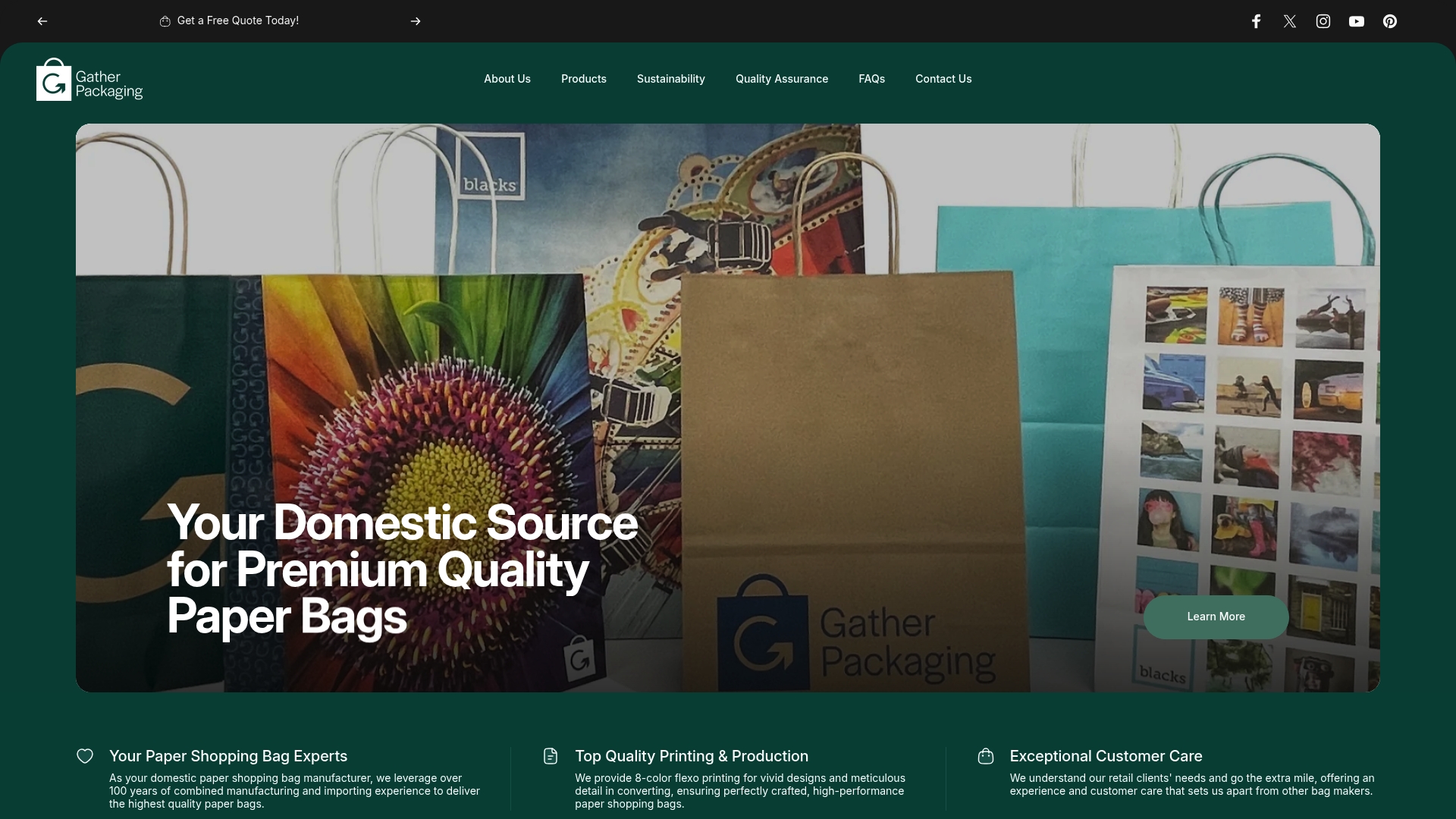
Gatherpackaging manufactures paper shopping bags in Toronto, Canada, with the custom finish options and print capabilities to bring your brand specifications to life. From water-based matte coatings to specialty finishes on FSC®-certified kraft stock, every bag is produced to consistent quality standards with shorter lead times than offshore alternatives. Their eco-friendly bag options include recycled content and biodegradable materials that align with sustainability mandates without sacrificing print quality or durability. If you are specifying finishes for a new retail season or revisiting your current packaging, contact Gatherpackaging to discuss what works best for your brand, your product, and your supply timeline.
FAQ
What is paper bag finishing?
Paper bag finishing refers to the surface treatments applied to a paper bag after printing, including coatings, laminates, and embossing techniques that affect appearance, texture, and durability.
What are the most popular types of paper bag finishes?
The most common finishes are matte, gloss, soft-touch lamination, spot UV, foil stamping, and film lamination, each offering different visual and functional characteristics suited to different brand needs.
Which finish is better for sustainability: matte or gloss?
Matte finishes with water-based coatings are generally the more sustainable option, as they are more compatible with paper recycling streams compared to gloss films or plastic-based laminates.
How do I choose the right finish for a retail paper bag?
Match the finish to your brand positioning, product weight, handling frequency, and sustainability goals. Heavier products need more durable finishes, while boutique and gift applications can prioritize aesthetics over functional strength.
Does lamination make paper bags less recyclable?
Plastic film lamination can interfere with paper recycling because it creates a multi-material composite that is difficult to separate. Water-based coatings and unlaminated options are better choices when recyclability is a priority.
Share:
What Is Packaging Print Registration for Operators
Why Reliable Packaging Supply Chains Matter for Retail