
TL;DR:
- Choosing a high-quality kraft paper with appropriate GSM, fiber orientation, and certifications is essential for durable paper bags. Handles must be properly attached, with die-cut handles offering superior strength and appearance, while bottom construction with correct gusset ratios and seal overlap ensures load stability. Compliant printing with eco-friendly inks and thorough quality assurance are critical for brand perception, sustainability, and operational reliability.
Choosing a paper bag sounds straightforward until you’re staring down dozens of specifications, suppliers, and trade-offs that directly affect your customer experience, your sustainability commitments, and your bottom line. The must-have features in paper bags are not always obvious from a supplier’s spec sheet, and getting them wrong means bags that split at checkout, handles that fail under load, or branding that fades before the customer gets home. This guide walks retail and foodservice operators through every feature that separates a high-performing paper bag from one that costs you twice when it lets your customer down.
Table of Contents
- Key takeaways
- 1. Must-have features in paper bags start with material quality
- 2. Handle design and attachment: where bags most commonly fail
- 3. Bottom construction and load distribution
- 4. Print quality and its effect on brand value
- 5. Compliance standards and quality assurance
- My take on what businesses consistently get wrong
- Work with Gatherpackaging on your next paper bag program
- FAQ
Key takeaways
| Point | Details |
|---|---|
| Material quality sets the foundation | Choose kraft paper in the right GSM range with proper fiber orientation and certifications before evaluating anything else. |
| Handle design drives usability | Die-cut handles carry heavier loads and outperform twisted handles in grip strength for most retail applications. |
| Bottom construction protects your product | Precise gusset ratios and seal width prevent the most common bag failure points under real-world load. |
| Print quality reflects your brand | Eco-friendly inks with accurate color matching improve brand perception and keep bags out of the landfill sooner. |
| Compliance protects your operation | Food-safe certifications and chain-of-custody documentation are non-negotiable for foodservice and retail operators. |
1. Must-have features in paper bags start with material quality
The paper itself is where every other feature either succeeds or falls short. Kraft paper remains the industry standard for shopping and foodservice bags, and for good reason. It balances tensile strength, tear resistance, and compostability in a way few other materials match. But not all kraft is equal.
Grammage, measured in grams per square meter (GSM), determines the base weight and density of the paper. Lightweight retail bags typically run 80 to 100 GSM, while bags carrying heavier merchandise or hot food containers need 110 to 150 GSM. That said, fiber orientation and wet strength affect food bag performance just as much as thickness does. A bag with poorly oriented fibers will tear along the grain under lateral stress even if the GSM looks right on paper.
For foodservice specifically, wet strength treatments matter enormously. A bag carrying a soup container or a damp food package needs to resist moisture penetration without becoming a soggy mess before the customer reaches their car. Grease resistance coatings add another layer of protection for fried or oily foods.
Sustainability is not just a selling point here. It changes the material specification. FSC or PEFC certification confirms that the fiber comes from responsibly managed forests, and that documentation travels with the bag through your supply chain audit. For brands with public sustainability commitments, uncertified fiber is an increasingly visible liability.
Pro Tip: Request a fiber orientation test report from your supplier, not just the GSM rating. Bags with the machine direction running vertically carry significantly more weight without tearing.
2. Handle design and attachment: where bags most commonly fail
Handles are the single point where customers interact with your bag the most, and poor handle attachment is a common cause of failure. Choosing the wrong handle type for your product weight or use case leads to returns, complaints, and reputational damage that a lower unit price never offsets.
Die-cut handles are punched directly from the top panel of the bag. They offer a clean, integrated look and, when cut with precision, provide excellent grip comfort. Die-cut handles improve grip strength by 20% over twisted handles and can support loads up to 8 kg when reinforced correctly. The key is manufacturing precision. Die-cut handles with 0.5mm tolerance reduce fraying at the cut edge and improve the feel in the customer’s hand.
Twisted paper handles are the most recognizable style in mid-range retail bags. They look premium at a glance but tend to underperform when the load exceeds 4 to 5 kg or when the customer carries the bag for an extended period. Flat paper handles are increasingly popular in foodservice takeout bags because they fold flat during stacking and storage, reducing kitchen clutter.
Handle attachment is where many manufacturers cut corners. The glue bond at the attachment point must be consistent, penetrate the paper fibers adequately, and cover enough surface area to distribute load. Laminated reinforcement patches at attachment points dramatically improve performance.
- Die-cut handles: best for boutique retail, apparel, and gifts where aesthetics and strength both matter
- Twisted handles: suitable for lighter retail merchandise up to 4 kg
- Flat handles: preferred for takeout food bags where stackability and low profile count
Pro Tip: Ask your manufacturer for a pull test specification on the handle attachment joint, not just the handle material. The joint, not the handle itself, is almost always what fails first.
3. Bottom construction and load distribution
The bottom of a paper bag does two jobs: it holds the shape of the bag and bears the full weight of the contents when the bag is lifted. Most operators focus on handles and overlook the bottom entirely until bags start failing at checkout.

Gusseted bottom designs expand the bag’s interior volume significantly. Gusseted paper bag designs enable 40% higher volume capacity without compromising structural integrity compared to flat-bottom alternatives. That extra capacity is not just about fitting more product. It changes how weight distributes across the base and reduces side stress on the bag walls.
The gusset-to-front panel ratio is a specification most buyers never ask about. Gusset depth should be 40 to 50% of front panel width to balance stability and prevent wrinkling or tipping during use. Outside that range, you get bags that either collapse inward or tip sideways when placed on a flat surface.
Bottom seal width is the other specification that separates a well-engineered bag from one that looks similar but performs differently.
| Bottom feature | Ideal specification | Risk if ignored |
|---|---|---|
| Seal overlap width | 12 to 18 mm | Stress point failures when filling |
| Gusset-to-panel ratio | 40 to 50% | Wrinkling, tipping, poor shape retention |
| Glue coverage | Full surface of overlap | Peeling, moisture infiltration |
| Bottom forming tolerance | Within 1 mm | Uneven base, reduced load capacity |
A bottom overlap seal of 12 to 18 mm distributes stress across the full base rather than concentrating it at a narrow hinge line. Precision forming equipment is what makes this achievable at production volume. You can read more about how glue application affects bag integrity in Gatherpackaging’s paper bag design guide.
Pro Tip: For bags carrying bottled beverages or dense food containers, always specify a reinforced flat-bottom with maximum seal overlap. The added material cost is minimal compared to the cost of a bag failure at the point of sale.
4. Print quality and its effect on brand value
Printing on a paper bag is not just decoration. It affects how customers perceive your brand at first glance, and it also determines whether the bag ends up reused or discarded after one trip.
Offset printing with UV or soy-based inks delivers vibrant, fade-resistant color that holds up through multiple uses. Flexographic printing, which Gatherpackaging uses with up to 8-color capability, is the right choice for high-volume runs where color consistency across thousands of units is what matters most. Both methods outperform digital printing for bag applications in terms of color saturation and abrasion resistance.
Ink selection has sustainability implications that matter to your buyers. Soy-based and water-based inks are biodegradable and do not compromise the bag’s recyclability. Plastic laminates and UV coatings that are not water-soluble, on the other hand, interfere with paper recycling streams. Avoiding them keeps your bag in the circular economy and away from landfill.
Key printing features to specify when ordering:
- Minimum 4-color flexo printing for brand accuracy on simple logos
- 6 to 8 color capability for photographic images or complex brand assets
- Water-based or soy inks to protect recyclability
- Bleed specifications that account for bag forming, so brand elements do not disappear into folds or seams
Custom sizing and color options also affect how well the bag represents your brand. A bag that is slightly too large for your product makes your merchandise look cheap. One that fits well and carries your brand colors accurately reinforces the value of what is inside. See how design affects sustainability and branding to dig deeper into this balance.
5. Compliance standards and quality assurance
For foodservice operators, compliance is not optional. Food contact materials must meet FDA CFR 21 or EU Regulation 1935/2004 standards, depending on your market. In practice, this means the paper, inks, adhesives, and any coatings inside the bag must all be tested and documented as safe for direct or indirect food contact.
FSC or PEFC certification adds the sustainability dimension to the compliance picture. Chain-of-custody documentation verifies that the certified fiber claim holds through every step from forest to finished bag. For retail brands publishing sustainability reports, this documentation is the evidence that backs up the claim.
Quality assurance testing tells you whether a bag that meets specifications on paper also holds up in the real world. The tests that matter most:
- Tensile strength test: measures the force required to pull paper fibers apart, confirming the material grade is correct
- Seam integrity test: applies stress to glued joints to confirm bond strength across the full production run
- Drop test: bags filled to rated capacity are dropped from a standard height to simulate checkout handling
- Wet strength test: relevant for foodservice bags exposed to moisture from food containers or condensation
- Colorfastness test: confirms that inks do not transfer to hands or products under normal handling conditions
“Durability is the result of interrelated factors including paper strength, handle attachment, and bottom construction, not just single features.” — What Makes Paper Bags Durable
Batch traceability is the operational piece that most buyers overlook. If a quality issue surfaces, you need your supplier to identify the production run, the paper lot, and the specific converting settings used. Inline inspection during production, rather than end-of-run sampling, is the practice that catches problems before they reach your store floor. Gatherpackaging’s QA checklist guide covers the full testing process in detail.
My take on what businesses consistently get wrong
I’ve seen retail and foodservice operators spend significant time comparing unit prices while ignoring the specifications that actually determine whether a bag performs. The lowest-cost bag is rarely the most economical choice once you account for customer complaints, reorders, and the brand damage that comes from a bag failure at the point of purchase.
In my experience, the two most overlooked features are bottom construction and handle attachment integrity. Buyers focus on what they can see: the print quality, the paper color, the style. They rarely ask for a pull test report or a gusset specification. Those are the details that separate a bag that lasts from one that splits.
Domestic manufacturing ties directly into this problem. When you source from a manufacturer in Toronto rather than overseas, you get faster access to the production team when a specification issue comes up. Lead times that fit your reorder cycle matter more than a slightly lower per-unit cost when your shelves are empty and your next order is eight weeks out on a container ship.
Sustainability is also not a checkbox. The brands I see doing it right build their bag specifications around FSC-certified material, water-based inks, and recyclable construction from the start. They treat it as part of product quality, not a marketing footnote. That approach holds up to scrutiny in ways that a “sustainable” sticker on a plastically laminated bag never will.
My recommendation: bring your packaging partner in early. Share your product weight range, your retail environment, your brand standards, and your sustainability commitments before you review a single sample. That conversation shapes specifications that actually serve your business.
— Taylor
Work with Gatherpackaging on your next paper bag program
If this article clarified what your current bag specification might be missing, the next step is a direct conversation with a manufacturer who can translate these features into bags that perform.
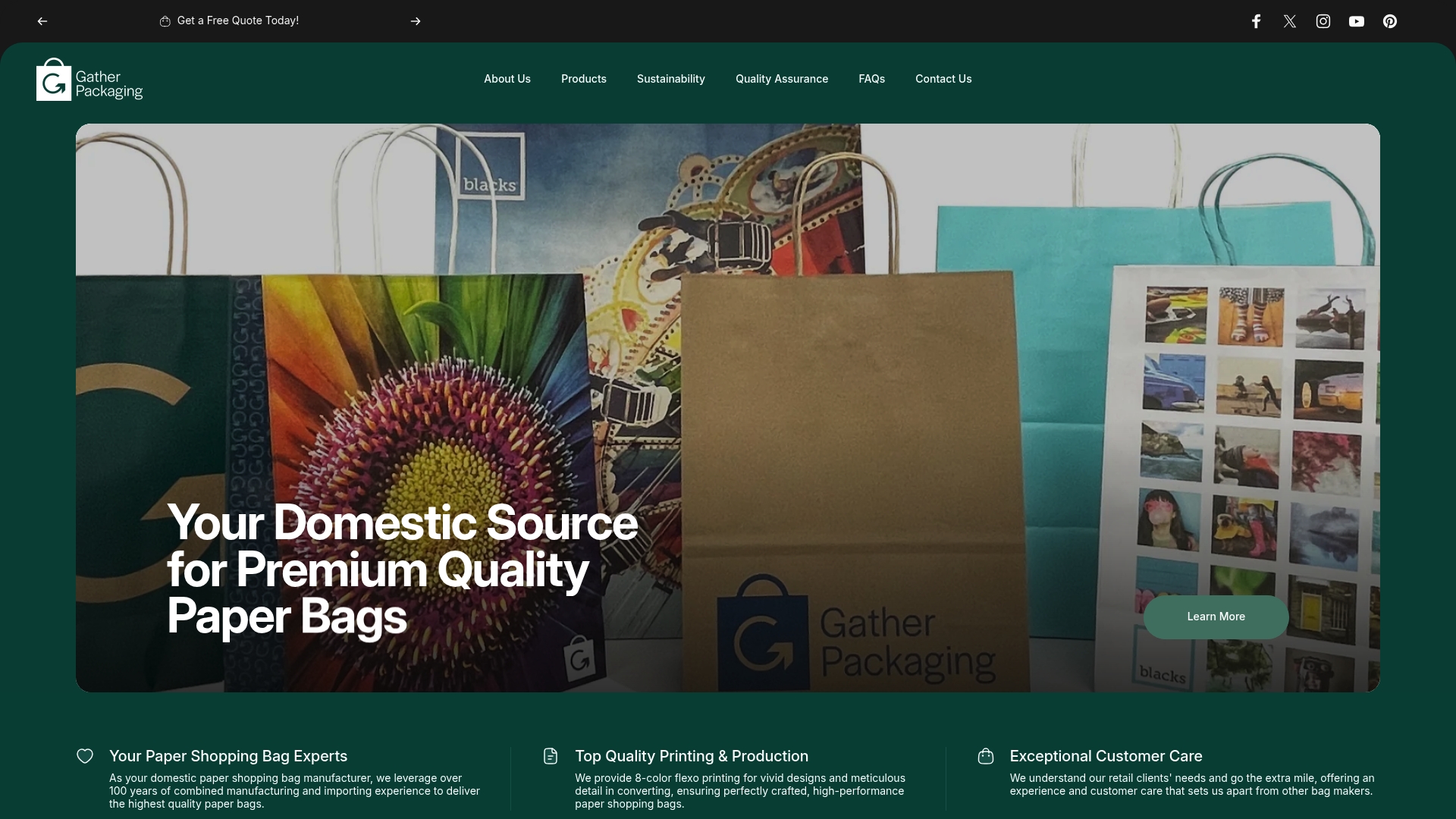
Gatherpackaging manufactures eco-friendly paper bags in Toronto, Canada, using FSC-certified materials, water-based inks, and precision converting equipment. Every product line is available with custom sizing, multi-color printing, and specification-matched quality assurance. The team supports retail and foodservice clients through design, prototyping, compliance documentation, and logistics. Domestic production means shorter lead times and direct access to the people making your bags. Contact Gatherpackaging to discuss your specifications and get a quote tailored to your volume and product requirements.
FAQ
What GSM is right for a retail paper shopping bag?
Most retail shopping bags perform well between 100 and 120 GSM for light to medium loads. Bags carrying heavier merchandise or bottles should use 130 to 150 GSM with reinforced handle attachment.
Are die-cut handles better than twisted handles?
Die-cut handles provide better grip strength and can support heavier loads than twisted handles when manufactured with precision and reinforced attachment points. They are the preferred choice for apparel, specialty retail, and any application where load exceeds 4 kg.
What certifications should a foodservice paper bag have?
Food contact compliance with FDA CFR 21 (for the US market) and FSC or PEFC chain-of-custody certification are the two most important credentials. Both should come with supplier documentation, not just a label on the bag.
How do I know if a paper bag’s bottom construction is adequate?
Ask your supplier for the gusset-to-panel ratio, bottom seal overlap width, and a drop test result for bags filled to their rated capacity. A well-constructed bag uses a 40 to 50% gusset ratio and a 12 to 18 mm seal overlap.
Can printed paper bags still be recycled?
Yes, if the inks are water-based or soy-based and no plastic laminate or non-soluble coating has been applied. Bags with these features are fully recyclable and compostable in most municipal programs.
Share:
Why Packaging Supply Chain Matters for Retail Efficiency
Why Custom Bag Sizes Matter for Your Brand