

TL;DR:
- Treating bag size as a last-minute decision can lead to inflated shipping costs, damage, and poor product presentation.
- Custom-sized bags improve cost control, enhance shelf appeal, and support sustainability by reducing material waste and transport emissions.
Most packaging buyers treat bag size as a last-minute spec decision. Pick something close to the product dimensions, round up a little for safety, and move on. That assumption is costing businesses real money. Understanding why custom bag sizes matter goes beyond fit. The wrong dimensions quietly inflate your freight invoices, damage your brand presentation on the shelf, and generate unnecessary waste in your supply chain. Get it right, and you gain tighter cost control, stronger product presentation, and a packaging footprint your customers will notice for the right reasons.
Table of Contents
- Key takeaways
- Why custom bag sizes matter for shipping costs
- Bag size and the customer experience in retail
- How structure and print areas interact with dimensions
- Operational and sustainability advantages of right-sized bags
- How to select the right custom bag size
- My perspective on why sizing gets overlooked
- Get the right bag size from Gatherpackaging
- FAQ
Key takeaways
| Point | Details |
|---|---|
| Size drives shipping costs | Dimensional weight pricing means even small overages push freight into higher rate tiers. |
| Presentation depends on fit | Bags that are too large or too small hurt perceived product value and shelf presence. |
| Structure affects print space | Gussets and handles reduce usable print width, so dimensions and design must be planned together. |
| Right-sizing supports sustainability | Smaller, precise bags use less raw material, reduce void fill, and lower transport emissions. |
| Test before you order at scale | Measuring filled bag shape, not just flat dimensions, prevents costly fit errors at production volume. |
Why custom bag sizes matter for shipping costs
Most retail brands discover dimensional weight pricing the hard way. The bill arrives and the freight charge is far higher than the actual product weight would suggest. Parcel carriers bill by dimensional weight using the formula Length × Width × Height divided by a carrier-specific divisor, and the result often exceeds actual product weight on lightweight goods like paper shopping bags and packaged retail items.
The mechanism is simple but its consequences are not obvious. Every cubic inch of air space inside an oversized bag is volume the carrier is pricing. A bag that runs two inches too wide and two inches too tall on a standard retail item adds meaningful cubic inches per unit. Multiply that across a full pallet, and you are not just paying more per shipment. You are fitting fewer units per container, which drives up cost per unit delivered on every order.
Here is what makes this particularly relevant for packaging buyers ordering paper shopping bags for their retail locations:
- A minor size overage of even 1.5 cm in one dimension can push your shipment into the next dimensional weight tier, triggering a higher rate on the entire shipment.
- Excess internal air space is the most common source of inflated dimensional weight on paper bag orders, especially on bags ordered “one size larger just to be safe.”
- Carriers have tightened their divisor figures over the past decade, meaning the penalty for oversized packaging has grown, not shrunk.
- Container cube utilization drops with oversized bags, directly reducing how many units you can move per freight dollar.
Pro Tip: Before specifying bag dimensions, measure your fully packed product with any tissue, wrap, or insert included. The filled product measurement, not the bare product measurement, is the correct starting point for custom bag dimensions.
The packaging fit balance between breakage risk and dimensional weight cost is the core of smart sizing. Going too tight risks product damage. Going too loose inflates freight. The sweet spot is specific to each product, which is exactly why standard off-the-shelf bag sizes so rarely deliver the best economics.
Bag size and the customer experience in retail
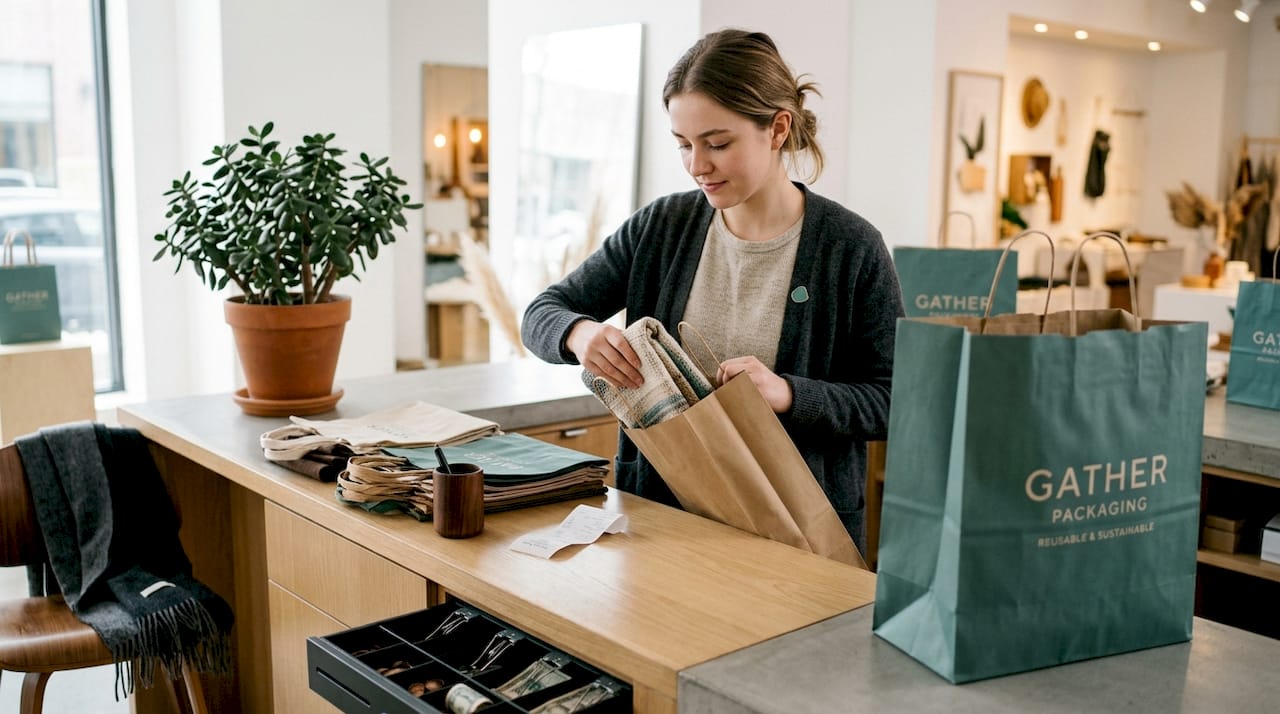
Walk through any well-merchandised retail floor and pay attention to the shopping bags at the register. The ones that look intentional, that hold products cleanly without flopping or bulging, are communicating something to customers without a word being said. Bags that are too small or too large undermine product presentation and create a negative impression at exactly the moment the customer is most engaged.
The effects run in both directions. A bag that is too small forces the sales associate to stuff the product in, risking scuffs, bent corners, and crushed tissue. A bag that is too large leaves the product rattling around inside, making the purchase feel diminished. Neither experience reflects well on the brand.
For foodservice operators, the stakes around bag size are even more specific. A bag with too much headspace loses its seal integrity faster in transit. A bag without adequate depth cannot close properly around a takeout order, compromising food safety and freshness during delivery. The right dimensions are a functional requirement, not just an aesthetic one.
Common sizing mistakes packaging buyers make include:
- Ordering by general product category rather than actual filled dimensions
- Ignoring product density, since low-density products like chips require significantly more bag volume than equal-weight dense items like nuts
- Failing to test the bag with actual product before committing to a production run
- Choosing depth dimensions that do not allow adequate headspace for clean closure and sealing
Pro Tip: Order sample prototypes with your actual product inside before finalizing dimensions. What looks right in a spec sheet often behaves differently when the product is inside and the bag is handled at point of sale.
The significance of bespoke bags extends to returns and damage rates as well. Tighter packaging configurations reduce product movement during transit, lowering damage-related returns and protecting your cost per delivered unit.
How structure and print areas interact with dimensions
Choosing custom bag dimensions does not happen in isolation from the structural features of the bag itself. Gussets, handles, fold lines, and closures all affect how your chosen dimensions translate into usable space and printable surface area. Skipping this step is one of the most common sources of artwork problems on first production runs.
Here is how the key structural elements interact with your dimension choices:
-
Gusset depth and print width. Gussets reduce usable print width by one to two inches per side on the flat front panel. A bag with a 4.5-inch gusset on each side loses nearly nine inches of front panel width from the total bag width spec. Your designer needs this number before finalizing artwork, not after.
-
Handle length and carry behavior. Handle length determines usability more than most buyers realize. Short handles limit the bag to hand or arm-crook carry only. Medium and long handles open up shoulder carry, which is relevant for heavier retail purchases and significantly affects how customers perceive the quality of the bag.
-
Fold lines and artwork placement. Design elements that cross fold lines distort in production. Any graphic placed near a crease or gusset fold needs to be reviewed against the actual folded bag geometry, not just the flat artwork file.
-
Closure and headspace interactions. Serrated, turn-top, and tamper-resistant bag styles each require specific headspace above the product line. These closure formats change the effective interior depth available for product, which means the spec for total bag height and the spec for usable product space are two different measurements.
Working with a manufacturer that provides pre-production prototypes and design previews removes most of this guesswork. Gatherpackaging’s paper bag design guidance covers these structural interactions in detail, and their team works with buyers to confirm artwork placement before any production begins.
Operational and sustainability advantages of right-sized bags
The case for tailored bag sizes is not only about presentation and freight. When you size your bags precisely, the operational benefits ripple through your supply chain in ways that compound over time.
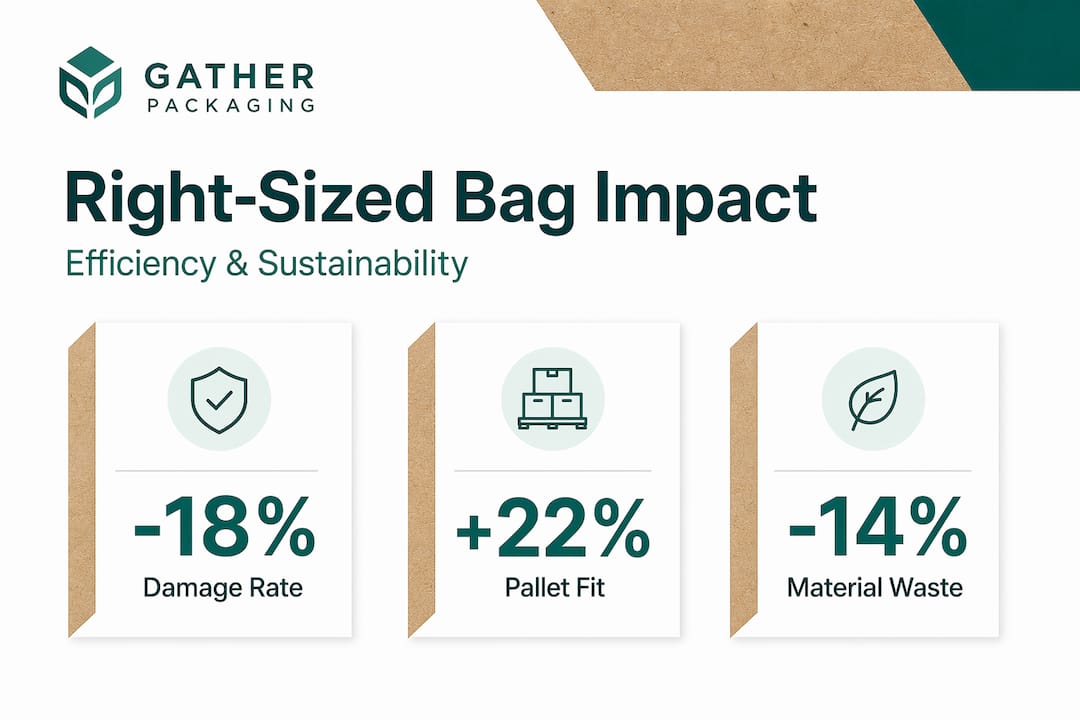
Consider warehouse utilization. Right-sized bags stack more efficiently on pallets and take up less shelf space in your stockroom. Oversized bags that hold excess air do not compress meaningfully during storage, which means you are storing air at your warehouse rates. For high-volume retail operations, this has a measurable impact on storage cost per unit.
| Packaging scenario | Dimensional weight impact | Damage risk | Void fill needed |
|---|---|---|---|
| Oversized bag (2+ inches excess) | High, pushes into higher rate tier | Higher product movement | More tissue or fill required |
| Undersized bag (too tight fit) | Lower dimensional weight | High product stress risk | None, but product is at risk |
| Right-sized custom bag | Optimized for actual product | Low | Minimal or none |
Packaging analytics research confirms that right-sized packaging reduces both damage rates and total cost per delivered unit by minimizing excess void fill and keeping dimensional weight in check simultaneously.
The sustainability dimension is equally concrete. Smaller, more precise bags require less raw material to manufacture. Fewer grams of paper per unit multiplied across a production run of 50,000 bags represents a meaningful reduction in material consumption. Less volume per bag means more bags per shipping pallet, which reduces the total number of shipments required to supply your operation. A 1.5 cm reduction in one dimension saved one US brand 22% in ocean freight costs through improved container utilization alone.
Pro Tip: When reviewing your bag spec with a manufacturer, ask specifically about the impact of reducing one dimension by 5 to 10 millimeters. The math on freight and material savings often justifies a prototype run to test the smaller size before committing.
Gatherpackaging’s manufacturing approach integrates FSC-certified materials, water-based inks, and recycled content into production. Right-sizing your bags amplifies all of those sustainability investments by ensuring less material goes to waste at every stage.
How to select the right custom bag size
Getting your bag dimensions right the first time requires a structured approach. Here is the process that delivers accurate specs and avoids costly reprints or rejected runs.
-
Measure the filled product, not the flat product. Bags bulge and settle with product inside in ways that flat measurements do not predict. Fill your bag prototype with the actual product, then measure width, depth, and height with the product in place.
-
Account for product density. Dense products like bottled goods and candles require very different bag proportions than low-density items like apparel or accessories. Do not assume the same bag dimensions will work across product categories.
-
Build in headspace for closure. Every closure style requires a different amount of headspace above the product fill line. A turn-top closure needs more vertical height than a flat-top fold. Specify headspace requirements explicitly, not as an afterthought.
-
Request a production prototype. No spec sheet replaces a physical sample. Ask Gatherpackaging for a prototype at your specified dimensions before approving the full run. Check how the ordering process works to build prototype review into your timeline.
-
Test with real handling conditions. Load the prototyped bag with product, carry it as a customer would, and observe where stress appears. Check whether the handles sit at the right length for your heaviest product configuration. Adjust dimensions and retest before final approval.
My perspective on why sizing gets overlooked
I have watched brands spend months obsessing over logo placement, ink color matching, and handle style, then specify bag dimensions in about thirty seconds by eyeballing a competitor’s bag. That is where the budget leaks.
In my experience, sizing is treated as a constraint rather than a decision, and that framing costs money at every point downstream. Freight costs, damage rates, warehouse density, customer perception at point of sale. All of it connects back to whether the bag dimensions were specified with care or just copied from a catalog.
The counterintuitive truth is that the brands with the best packaging economics are rarely the ones who paid the least per unit for their bags. They are the ones who got the dimensions right and then let that precision do the work across the supply chain. I have seen relatively small changes in bag height shave meaningful amounts off annual freight invoices for mid-size retail operations.
Sustainability adds one more layer to this. If you are committed to FSC-certified paper and water-based inks, right-sizing is the most direct way to honor that commitment at a material level. Less paper per bag, more bags per shipment, lower transport emissions per unit. The size choice and the sustainability goal are the same choice.
Work with your manufacturer to run the numbers. Do not guess.
— Taylor
Get the right bag size from Gatherpackaging
Gatherpackaging manufactures custom paper shopping bags in Toronto, Canada, with over a century of combined experience in production and import. Their team works directly with retail brands, foodservice operators, and packaging buyers to specify bag dimensions that optimize presentation, shipping costs, and sustainability from the first production run. Every order is supported by design assistance, prototyping, and quality assurance review before any bags ship.
If you are ordering custom kraft paper bags for retail or foodservice, or exploring eco-friendly bag options that align with your brand’s environmental commitments, Gatherpackaging’s domestic manufacturing means faster turnaround and tighter size control than overseas sourcing. Contact Gatherpackaging at gatherpackaging.com to discuss your sizing requirements and request a prototype.
FAQ
Why does bag size affect my shipping costs?
Parcel carriers calculate freight using dimensional weight, which factors bag length, width, and height into the billed weight. Oversized bags with excess air space can push shipments into higher freight rate tiers even when the actual product is lightweight.
What is the most common custom bag sizing mistake?
Most buyers measure the bare product instead of the filled bag. Bags shift and expand with product inside, so measuring the filled shape, including any tissue or inserts, gives the only accurate base dimension for ordering.
How do gussets change bag dimensions?
A gusset adds depth to the bag but reduces the usable front print width by roughly one to two inches per side. A bag with a wide gusset needs larger total width dimensions to maintain both the desired product capacity and adequate print area for branding.
Does bag size affect sustainability performance?
Yes. Smaller, precisely sized bags use less raw material per unit and fit more units per shipping pallet, which reduces total transport volume and emissions. Right-sizing directly amplifies the benefit of sustainable materials like FSC-certified paper and recycled content.
When should I request a prototype before a full production run?
Always, but especially when you are changing dimensions from a previous order, introducing a new product category, or ordering a bag style with structural features like gussets or tamper-resistant closures that affect usable space.
Share:
Must-Have Features in Paper Bags for Retail and Foodservice
What Is Packaging Print Registration for Operators