

TL;DR:
- Packaging supply reliability is essential for operational efficiency, minimizing delays, damage, and costs. It involves multisourcing, domestic sourcing, clear specifications, and supplier validation to ensure consistent quality and availability. Strong supply chain management protects brand perception, enhances sustainability, and reduces risk in an increasingly complex global environment.
Packaging rarely makes headlines until something goes wrong. A shipment of paper shopping bags arrives late, the print colors don’t match the previous run, or a supplier suddenly can’t deliver because their raw material source dried up overnight. These are not minor inconveniences. Understanding why reliable packaging supply chains are a core operational priority, not a procurement afterthought, is what separates brands that absorb disruptions cleanly from those that scramble. This article breaks down the real consequences of packaging supply instability and gives supply chain managers practical strategies to fix them.
Table of Contents
- Key Takeaways
- Why reliable packaging supply chains protect operations
- What happens when packaging supply breaks down
- Strategies for building a more reliable supply
- Environmental value and brand perception
- My take on getting this right
- How Gatherpackaging supports your supply reliability
- FAQ
Key Takeaways
| Point | Details |
|---|---|
| Reliability drives efficiency | Consistent packaging supply reduces delays, lowers damage rates, and keeps fulfillment operations running without costly interruptions. |
| Unreliability has measurable costs | OTIF gaps and elevated damage rates translate directly into higher operational costs and weaker customer satisfaction scores. |
| Multisourcing is standard practice | Most brand owners use primary and secondary suppliers with deliberate spend allocation to protect against single-source failures. |
| Domestic manufacturing reduces lead time risk | Local sourcing shortens replenishment cycles and reduces exposure to geopolitical and logistics disruptions. |
| Packaging design affects throughput | Bags and packaging formats designed to simplify handling steps measurably improve warehouse speed and reduce picking errors. |
Why reliable packaging supply chains protect operations
In supply chain management, the term “supply chain reliability” refers to a system’s consistent ability to deliver the right product, in the right quantity, at the right time, meeting agreed quality standards across repeated cycles. For paper shopping bags specifically, reliability means your bags arrive on spec, on schedule, and ready to use without rework, sorting, or emergency reorders.
The operational stakes are higher than most buyers assume. Packaging-optimized operations have demonstrated results like cutting warehouse fees by 50% and reducing inventory write-offs by 40%, with millions saved through tighter supply allocation and logistics coordination. Those numbers come from disciplined supply planning, not from negotiating a better unit price on bags.
Packaging reliability protects operations in three direct ways:
- Inventory continuity. When bags are in stock and arriving predictably, retail and fulfillment teams can plan packing schedules without buffer overstocking or emergency rush orders that inflate costs.
- Throughput at the packing station. Packaging designed to simplify handling steps directly reduces errors and speeds up fulfillment, linking the bag spec itself to warehouse performance.
- Damage prevention. Consistent bag construction, weight, and handle integrity mean products reach customers intact. One supplier batch with inconsistent paper weight can increase breakage rates across an entire season.
Pro Tip: When evaluating a packaging supplier’s reliability, ask for their batch consistency documentation. Print color tolerances, paper weight variances, and handle pull-strength results across multiple production runs will tell you far more than a price sheet.
The importance of packaging supply chains also shows up in how packaging specs interact with automated picking and labeling equipment. A bag that is even slightly off-dimension can jam an automated tagger, stopping a line entirely. Upstream compatibility testing before production approval is not optional. Small material changes can trigger costly equipment adjustments and delay entire fulfillment runs, making supplier-level quality validation a genuine operational safeguard.
What happens when packaging supply breaks down
The consequences of unreliable packaging rarely announce themselves all at once. They compound. A delayed shipment pushes dock-to-stock times out, which slows receiving, which backs up the fulfillment queue, which results in late deliveries to customers. Each link in that chain adds cost and erodes trust.
2026 3PL performance data shows the gap between current performance and industry targets clearly:
| Metric | Industry target | Median actual |
|---|---|---|
| On-time in full (OTIF) | 98% | 94.2% |
| Damage rate | 0.10% | 0.18% |
That 3.8-point OTIF gap represents orders arriving late, docking fees, customer service contacts, and reshipment costs. The damage rate gap, nearly double the target, ties directly to packaging integrity across the supply chain. Both metrics worsen during peak retail periods when packaging supply pressure is highest and the margin for error is smallest.
“Packaging reliability influences customer loyalty by protecting products and reinforcing brand identity at delivery moments.” — Deloitte Omnichannel Delivery Study
Packaging for e-commerce is often the largest cost after shipping and labor, which means packaging failures at scale are not small-margin problems. A returned order traced to a bag that failed during transit represents the full cost of that order cycle: packing labor, outbound shipping, return shipping, and customer recovery. None of that shows up in the original bag unit price, which is exactly why procurement decisions made purely on price tend to create downstream costs that dwarf the savings.
Why packaging consistency matters at the customer end is straightforward: a bag that arrives crushed, torn, or with faded print communicates something about the brand that no marketing budget can easily undo. The bag is the last physical thing the brand controls before the customer opens it.
Strategies for building a more reliable supply
Getting packaging supply reliability right requires deliberate structure. It does not happen by accident, and it does not come from a single low-bid supplier with no redundancy.
Here are the most effective approaches, drawn from how leading brands manage packaging supply chain risk:
-
Multisource your supply. 91% of brand owners now multisource packaging to reduce risk and improve lead times, cost, and geographic coverage. This is no longer a best practice reserved for enterprise brands. It is standard operating procedure for anyone who has lived through a single-supplier failure.
-
Allocate spend deliberately. Multisourcing only works if your secondary supplier stays viable. About 50% of brands direct 65 to 75% of spend to their primary supplier and keep the secondary engaged with enough volume to maintain capacity and responsiveness. Sending 5% of orders to a backup supplier and expecting them to deliver at full capacity in a crisis is not a strategy.
-
Prioritize domestic and geographically diversified sources. Geopolitical disruptions from tariffs to regional conflicts have repeatedly cut off single-country supply lines. Brands relying on overseas-only suppliers for paper bags face both material cost volatility and lead times that make fast replenishment impossible. A domestic manufacturer in North America gives you a predictable lead time, no import duties exposure, and the ability to respond to specification changes faster.
-
Build packaging specs that simplify handling. Work with your supplier to design bag formats that reduce packing steps and work with your existing equipment. Operational leverage comes when packaging specs align with your packing process. A bag that requires a separate tissue insert step, a re-sizing fold, or manual label placement adds time per unit that compounds across thousands of orders.
-
Validate compatibility before committing to a supplier. Run production samples through your actual packing line before approving a new supplier or a spec change. Material changes that pass visual inspection often fail under real workflow conditions. Testing upstream saves far more time than correcting downstream.
-
Treat supplier relationships as partnerships. Suppliers who understand your seasonal demand spikes, your quality standards, and your lead time windows respond faster when problems arise. Transactional sourcing relationships produce transactional results.
Pro Tip: When reviewing your local sourcing strategy, calculate not just the unit cost difference between domestic and offshore suppliers but the full landed cost including freight, duties, and the cost of carrying extra safety stock to cover longer lead times.
A useful comparison for procurement teams evaluating supplier options:
| Factor | Single offshore supplier | Multisourced with domestic option |
|---|---|---|
| Lead time | 8 to 14 weeks | 2 to 6 weeks (domestic leg) |
| Disruption exposure | High (single point of failure) | Low (geographic redundancy) |
| Spec change response | Slow, often requires new tooling | Fast, direct communication |
| Cost structure | Lower unit price | Higher unit price, lower total cost |
| Sustainability visibility | Limited | Full FSC®/material chain of custody |
Environmental value and brand perception
There is a connection between reliable packaging supply chains and sustainability goals that often goes unrecognized until a procurement team is forced to make emergency substitutions. When your primary bag supplier can’t deliver and you scramble for a replacement, sustainability criteria are usually the first thing dropped. The replacement bag may not carry FSC® certification, may use virgin fiber rather than recycled content, or may arrive without the documentation your brand needs to support its environmental claims.
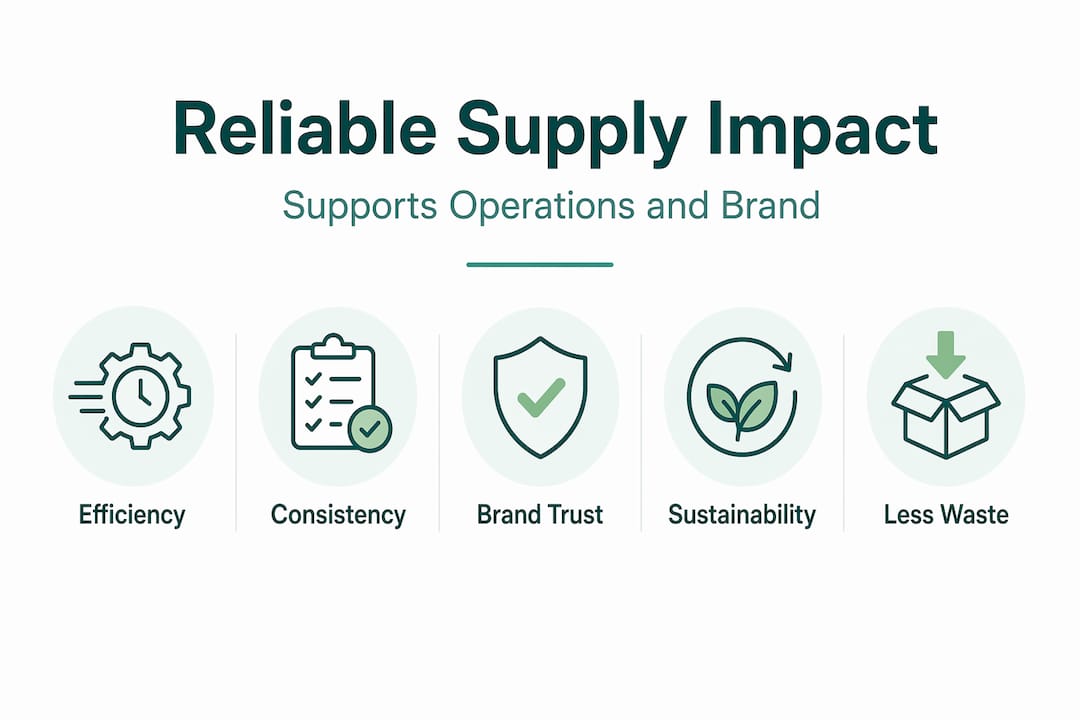
A sustainable packaging workflow only delivers on its brand promises when the supply chain behind it is consistent enough to actually deliver the promised materials, run after run. Reliability and sustainability are not separate goals. They reinforce each other.
From a brand identity standpoint, consider what the bag communicates at the moment of delivery:
- A consistently printed bag with clean color registration signals that your brand pays attention to detail.
- A bag in a certified recycled material with proper documentation supports your brand’s stated environmental values.
- A bag that arrives with crushed handles or ink bleed tells a different story entirely, regardless of what your website says about quality.
Reliable supply also supports waste reduction directly. When bags arrive consistently in the right quantity and spec, you avoid overordering to compensate for unpredictable quality, reduce obsolescence from off-spec stock, and eliminate emergency orders that often come with excess minimums you cannot use efficiently. These are real cost and waste reductions, not theoretical ones.
My take on getting this right
I’ve watched packaging supply chain failures unfold in ways that catch even experienced operations teams off guard. The common thread is treating packaging as a simple commodity purchase until the moment it stops being simple.
What I’ve found is that the brands managing this well share one habit: they treat their paper bag supply the same way they treat their most critical production input. They maintain a secondary supplier with real volume, they test batch quality consistently, and they have a domestic source they can activate quickly when overseas supply gets complicated. In 2026, with ongoing trade uncertainty and input cost volatility, that domestic option is not a premium. It is a baseline requirement.
The cost-versus-reliability tension is real. I understand the pressure to cut unit costs. But the math almost always favors reliability when you account for the full cost of a failure: the expedited freight, the customer complaints, the damaged merchandise, and the credibility hit with your retail partners. Reliability in packaging supply is not a luxury budget item. It is a risk management decision.
If there is one thing I would tell any procurement team today, it is this: audit your packaging supply structure before you need it, not after a disruption forces your hand. Map your single points of failure, build a secondary relationship, and validate it with real orders before you ever need it at full capacity.
— Taylor
How Gatherpackaging supports your supply reliability
Gatherpackaging manufactures custom paper shopping bags in Toronto, Canada, giving retail brands and procurement teams a domestic option that cuts lead times, removes import duty exposure, and delivers consistent quality across every production run. Their eco-friendly paper bags use FSC®-certified materials, recycled content, and water-based inks, so your sustainability documentation stays intact even when you need fast replenishment.
Every bag goes through quality assurance testing for construction integrity, print consistency, and handle strength before it ships. Gatherpackaging also provides design assistance and prototyping, so new bag specs are validated before full production runs. If your current supplier has left gaps in your packaging supply chain, reach out to Gatherpackaging to discuss your paper shopping bag requirements and build a more dependable supply structure for your operation.
FAQ
What is a reliable packaging supply chain?
A reliable packaging supply chain consistently delivers packaging materials on time, in the correct specification, and at a stable quality level across repeated order cycles. It includes supplier redundancy, quality validation, and predictable lead times.
Why does packaging consistency matter for retail operations?
Inconsistent packaging creates downstream problems including damaged products, fulfillment delays, and elevated return rates. Consistent packaging protects product integrity and supports accurate fulfillment planning across peak and off-peak periods.
How do most brands reduce packaging supply chain risk?
91% of brand owners multisource packaging, directing the majority of spend to a primary supplier while keeping a secondary supplier engaged with enough volume to maintain real capacity as a backup.
What are the main challenges in packaging logistics today?
Geopolitical disruptions, tariff volatility, and long offshore lead times are the primary structural risks. Single-source dependence amplifies all of these risks and makes fast recovery from supply failures difficult without a domestic or regionally diversified alternative.
How does domestic manufacturing improve packaging supply reliability?
Domestic manufacturers offer shorter lead times, direct communication on spec changes, and no exposure to cross-border tariff shifts. For paper shopping bags specifically, a North American manufacturer can respond to urgent orders and quality corrections far faster than an overseas supplier operating on a 10-week production cycle.
Share:
Top Paper Bag Finishes for Branding and Sustainability
Sustainable Packaging Myths Debunked for Retail Brands