

TL;DR:
- Local sourcing of packaging reduces transportation emissions by over 95% and shortens lead times to just one or two days. It also enhances supply chain resilience, lowers total costs despite higher unit prices, and improves sustainability compliance through better traceability and regional recycling alignment. Additionally, it enables faster customization and strengthens brand storytelling with verifiable local origins.
Sourcing packaging locally can cut transportation CO2 emissions by over 95% and shrink lead times from 60 days to just one or two. Those numbers alone challenge the assumption that global supply chains are the smarter, cheaper option. But the reasons why local sourcing for packaging deserves serious attention go well beyond transportation savings. For retail and foodservice businesses in North America, the decision touches sustainability goals, brand quality, regulatory compliance, and how quickly you can adapt when something goes wrong. This article covers all of it, with data to back it up.
Table of Contents
- How local sourcing for packaging cuts emissions and lead times
- Boosting supply chain resilience through local sourcing
- The true cost benefits of local packaging sourcing
- Enhancing sustainability and regulatory compliance with local sourcing
- Customizability and branding advantages of local packaging suppliers
- Our take: The hidden cost of “cheap” overseas packaging
- Work with a local packaging manufacturer that does all of this
- Frequently asked questions
Key Takeaways
| Point | Details |
|---|---|
| Significant emissions reduction | Local sourcing decreases transportation carbon emissions by over 95%, greatly lowering your packaging’s environmental impact. |
| Improved supply chain resilience | Shorter supply chains reduce risks from global disruptions, ensuring steady packaging availability. |
| Lower total costs | Despite higher unit prices, total landed costs decline due to savings in logistics, inventory, and packaging waste. |
| Better sustainability compliance | Local suppliers simplify emissions tracking and support adherence to evolving environmental regulations. |
| Enhanced branding opportunities | Local sourcing enables greater packaging customization and quality control, which elevate your brand image. |
How local sourcing for packaging cuts emissions and lead times
Most retailers and foodservice operators think about packaging in terms of unit cost. That framing misses the bigger picture. When you source packaging from overseas, a standard paper bag might travel 7,000 to 10,000 miles before it reaches your store or kitchen. Source it locally, and that distance drops to under 100 miles. The environmental gap between those two scenarios is staggering.
Local sourcing reduces transportation distance by 99.4% and transport CO2 emissions by 95.4%, while lead times shrink by 97.5%. That is not a rounding error. It is a structural shift in how your supply chain affects the planet.
The operational benefits are just as real. A 45 to 60 day lead time from an overseas supplier means you carry more inventory, pay more for storage, and absorb more risk when sales fluctuate. A local supplier delivering in one to two days means you order closer to actual need, reduce waste, and respond faster to demand spikes, whether it is a holiday rush or a sudden menu change.
There is another benefit that gets overlooked: less protective packaging. Sourcing within 100 miles can cut fossil fuel consumption by 40% while reducing the amount of protective filler material needed to survive a cross-Pacific shipment. Fewer corrugated layers, less bubble wrap, less damage overall.
| Metric | Global sourcing | Local sourcing |
|---|---|---|
| Shipping distance | 7,000+ miles | Under 100 miles |
| CO2 emissions (transport) | Baseline | Reduced by 95.4% |
| Lead time | 45 to 60 days | 1 to 2 days |
| Protective packaging needed | High | Minimal |
| Fossil fuel consumption | Baseline | Reduced by up to 40% |
Key advantages at a glance:
- Dramatically lower transport emissions per unit
- Near-real-time replenishment instead of months of forward planning
- Less risk of damage from extended handling in transit
- Lower protective packaging costs and waste
- Better ability to reduce packaging carbon footprint across your full supply chain
Pro Tip: When evaluating local suppliers, prioritize ones within 100 miles of your distribution center. That threshold tends to be where emissions and lead time savings are most dramatic.
“Shorter supply chains are not just greener. They are faster, lighter, and more controllable. The environmental win and the operational win are the same decision.”
Boosting supply chain resilience through local sourcing
Beyond emissions and speed, local sourcing also fortifies your supply chain against the kind of disruptions that make headlines and derail operations.
Anyone who managed packaging inventory during the global supply chain disruptions of the early 2020s knows how fast things can go wrong. Port congestion, container shortages, tariff changes, and overseas factory shutdowns can leave your business without bags, boxes, or wraps for weeks. That is not just an inconvenience. In foodservice or retail, running out of packaging means turning away customers or pausing operations.
82% of companies with local sourcing strategies achieved greater supply chain resilience against disruptions like port congestion and tariffs. A shorter, simpler supply chain simply has fewer points of failure. There is no ocean freight to miss, no customs clearance to navigate, and no exposure to currency swings or geopolitical events affecting a factory 12 time zones away.
Local sourcing also enables leaner inventory. When you can reorder and receive in two days instead of two months, you do not need to stockpile three months of packaging to feel safe. That frees up working capital and warehouse space. The hidden savings here are real, even if they do not show up on a price comparison sheet.
The domestic packaging advantages go even further when you consider relationship quality. Local supplier relationships are easier to build, easier to maintain, and easier to escalate when something needs to be fixed quickly. You can call someone who is in the same time zone, speak directly to the team handling your order, and get resolution in hours instead of days.
Key resilience benefits:
- Fewer supply chain links means fewer failure points
- No exposure to port delays, tariff changes, or international shipping backlogs
- Faster reorder cycles reduce the need for large safety stock
- Easier escalation and problem resolution with local contacts
- Flexibility to adjust orders quickly as your business needs shift
Pro Tip: Consider working with two or three local suppliers rather than one. Multi-sourcing locally gives you redundancy without adding the complexity or risk of an overseas fallback option.
The true cost benefits of local packaging sourcing
After discussing resilience, it is worth addressing the cost question directly, because the assumption that overseas packaging is always cheaper is simply wrong once you calculate the full picture.
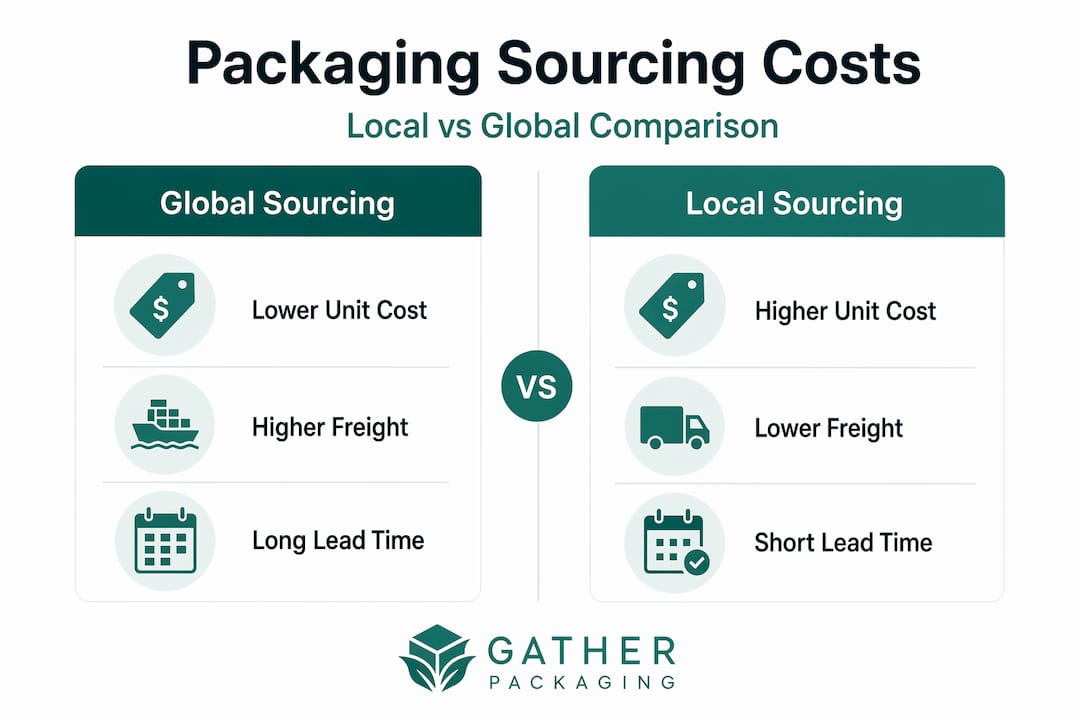
Yes, the unit cost from a local supplier may be around 10% higher. That is real. But unit cost is only one line in the true cost equation. When you factor in freight, customs brokerage, currency fluctuation, inventory carrying costs, waste disposal, and damage rates, the math flips.
Local sourcing results in total landed costs 10.7% lower than global sourcing, despite the higher unit price, because of major reductions in inventory and packaging waste costs. Inventory carrying costs alone can drop by more than 80% when you shift from holding months of stock to ordering on a near-just-in-time basis. Shipping damage and protective packaging cost and carbon savings compound those gains further.
| Cost category | Global sourcing | Local sourcing |
|---|---|---|
| Unit cost | Lower | ~10% higher |
| Freight and logistics | High | Minimal |
| Inventory carrying cost | High | Reduced 80%+ |
| Packaging waste disposal | High | Reduced 90%+ |
| Damage and rework costs | Elevated | Low |
| Total landed cost | Baseline | ~10.7% lower |
What the table above makes clear is that businesses optimizing for unit price alone are leaving money on the table elsewhere in the chain. A retail buyer who negotiates hard on the per-bag price from an overseas supplier, then watches margins erode through demurrage charges, warehouse fees, and damage claims, has not actually saved money. They have just moved the cost somewhere harder to see.
Key financial advantages of local sourcing:
- Total landed cost is lower despite higher unit pricing
- Smaller order quantities reduce minimum purchase requirements
- Faster turnaround reduces the capital tied up in unsold inventory
- Less damage means fewer replacement orders and lower waste disposal costs
- Local invoicing and payment terms are typically simpler and faster to resolve
Pro Tip: When requesting quotes from suppliers, ask them to provide a total landed cost estimate, not just unit price. Include freight, insurance, expected damage rates, and average inventory days. The comparison will likely surprise you.
Enhancing sustainability and regulatory compliance with local sourcing
Moving from costs, local sourcing also advances sustainability goals and positions your business for compliance with a wave of incoming environmental regulations.
Scope 3 emissions, which are the indirect emissions in your supply chain including packaging production and logistics, represent the majority of many retail and foodservice brands’ total carbon footprints. Most businesses have reasonable visibility into their own operations. Upstream packaging logistics is where the data gets murky, fast.
Local suppliers simplify Scope 3 emissions data collection with lower data uncertainty and improved traceability compared to global suppliers, directly supporting compliance with regulations like California’s SB 253. With a global supplier, emissions reporting uncertainty can run 40 to 60%. With a local supplier, that uncertainty drops to 10 to 20%. That is not just a sustainability metric. It is a legal one as disclosure requirements tighten across North American jurisdictions.
Local sourcing supports sustainability targets through lower transportation emissions and better alignment with regional recycling and regulatory systems. When your packaging is manufactured locally, it is more likely to be designed around the materials accepted by regional recycling programs, improving actual end-of-life outcomes rather than just theoretical recyclability.
Local manufacturers also tend to implement circular economy practices more easily, because the feedback loop between producer, brand, and waste management is shorter. A packaging compliance benefits review with a domestic supplier can happen in a single conversation rather than through months of back-and-forth email with a factory overseas.
Key sustainability and compliance advantages:
- Lower Scope 3 emissions uncertainty improves ESG reporting accuracy
- Better traceability supports third-party certifications like FSC® and recycled content claims
- Regional alignment makes packaging more likely to actually get recycled
- Easier collaboration on sustainability documentation and audits
- Reduced exposure as environmental disclosure regulations expand
Pro Tip: Engage your local packaging supplier early in your sustainability planning cycle, not just when you need new bags. Their proximity makes them a practical partner for emissions data, certification support, and compliance preparation.
Customizability and branding advantages of local packaging suppliers
With sustainability covered, local sourcing also brings direct branding benefits that are harder to quantify but easy to feel in the market.
Local sourcing allows greater customization power over packaging specifications and enables frequent quality inspections that ensure standards are met and shipping damage is minimized. For a retail or foodservice brand, this matters enormously. Your bag is often the last thing a customer touches before they walk out the door. It should be doing branding work, not just carrying weight.
Proximity to your supplier means faster iteration cycles. You can review a printed sample, request a change to the color saturation or handle placement, and have revised samples in hand within days. With an overseas supplier, that same conversation takes weeks and often requires minimum order quantities that lock you into a decision before you have confirmed it is right.
Reduced transit distance also means bags arrive without the crease damage, moisture warping, or color shifts that can occur over a six-week ocean voyage. What you approved in a sample room is what arrives on your floor.
There is also a positioning opportunity that many brands underuse. Highlighting locally made or made nearby packaging resonates with eco-conscious consumers in a way that vague sustainability claims do not. It is specific, verifiable, and tells a story your customers can act on. Strong packaging design tips often start with knowing exactly where and how your packaging is made, because that story becomes part of your brand.
Key customization and branding advantages:
- Faster sample turnaround and revision cycles without minimum order pressure
- In-person or regional quality inspections at the manufacturing facility
- Reduced transit damage preserves print quality and structural integrity
- Ability to communicate a locally sourced, sustainable brand story
- Closer collaboration on specialty finishes, sizes, and print specifications
Our take: The hidden cost of “cheap” overseas packaging
Here is what most sourcing conversations miss: the real cost of overseas packaging is not measured in dollars per unit. It is measured in decisions you could not make.
When your lead time is 60 days, you are not running a responsive business. You are running a prediction business. You order based on what you think you will need in two months, hope the demand forecast is accurate, and absorb the cost when it is not. That inflexibility is expensive, and it gets more expensive every year as consumer preferences shift faster and product lifecycles shorten.
We have seen retail brands pay for the same mistake repeatedly: locking into a minimum order of 50,000 bags with a design they later wanted to change, only to run out the old stock before they could afford to update. A local supplier with smaller minimums and faster turnaround would have cost more per bag and saved thousands in the end.
The other thing worth naming directly: a “sustainability claim” built on overseas packaging is fragile. Consumers and regulators are getting better at asking what is actually behind the label. FSC®-certified paper shipped 8,000 miles in a diesel container vessel has a very different environmental profile than FSC®-certified paper made down the road. The role of domestic sourcing in packaging is not just about cost or convenience. It is about whether your sustainability story holds up under scrutiny.
The impact of local sourcing on packaging extends to something even more fundamental: confidence. When your supplier is nearby, you can see what you are getting, fix problems fast, and build a relationship that improves over time. That is not a soft benefit. That is operational infrastructure.
Work with a local packaging manufacturer that does all of this
At Gather Packaging, we manufacture high-quality, eco-friendly paper shopping bags from our facility in Toronto, Canada, serving retail and foodservice businesses across North America.
Our bags are produced using FSC®-certified materials, recycled content, and water-based inks, with 8-color flexo printing capabilities for vibrant, brand-accurate results. Whether you need turn top, serrated top, or tamper-resistant styles, we offer full customization in size and design with fast turnaround times that overseas suppliers simply cannot match. If you are ready to reduce your packaging footprint, improve supply resilience, and strengthen your brand image with locally made packaging, we would love to help you get there.
Frequently asked questions
How does local sourcing reduce the carbon footprint of packaging?
Local sourcing cuts shipping distances by nearly 99%, which reduces CO2 emissions by 95.4% and also reduces protective packaging waste that would otherwise accompany long international shipments.
Can local sourcing actually save money compared to global suppliers?
Yes. Despite unit costs being roughly 10% higher, total landed costs are 10.7% lower with local sourcing once you account for logistics, inventory carrying costs, and waste disposal.
What role does local sourcing play in meeting sustainability regulations?
Local suppliers provide cleaner emissions data and stronger traceability, reducing Scope 3 reporting uncertainty to 10 to 20% compared to 40 to 60% with global suppliers, which directly supports compliance with laws like California’s SB 253.
How does local sourcing improve packaging customization and quality?
Proximity allows you to visit the facility, review samples quickly, and iterate on design without long delays. Frequent quality inspections and shorter transit distances also mean the packaging that arrives matches what you approved, not a degraded version of it.
Share:
How to choose sustainable bag materials: a practical guide
Why Packaging Supply Chain Matters for Retail Efficiency