

TL;DR:
- Choosing packaging materials aligned with local disposal infrastructure is crucial to avoid environmental harm and regulatory issues. Evaluating options through lifecycle assessments and obtaining third-party certifications ensures genuine sustainability claims and reduces brand risk. Prioritizing traceability, proper certification, and understanding end-of-life realities lead to responsible and verifiable packaging choices.
Picking the wrong bag material can cost you more than money. A packaging decision that ignores real-world disposal infrastructure can generate regulatory heat, consumer backlash, and genuine environmental harm, all while your brand takes the blame. Retail operators and foodservice brands across North America are under more pressure than ever to make packaging choices that hold up to scrutiny, not just to a label claim. This guide walks you through a step-by-step framework to evaluate, compare, and verify sustainable bag materials so that every decision you make is one you can stand behind.
Table of Contents
- Defining sustainability for your business and market
- Comparing bag material options using lifecycle thinking
- Recyclability: critical factors and North American standards
- Compostability and third-party validation: what you must know
- Responsible paper and fiber sourcing: recycled content and verification
- Our perspective: sustainability claims that cannot survive scrutiny are a liability, not an asset
- Ready to build a bag program that holds up?
- Frequently asked questions
Key Takeaways
| Point | Details |
|---|---|
| Start with your context | Define sustainability goals based on your products, customer locations, and local waste systems. |
| Use lifecycle assessment | Evaluate environmental impact from raw material to end-of-life instead of relying on single attributes. |
| Validate all claims | Ensure recyclability and compostability are backed by third-party North American standards and certifications. |
| Recycled and certified fiber | Choose paper/fiber bags with high recycled content and traceable, certified sourcing whenever possible. |
Defining sustainability for your business and market
With that urgency in mind, let’s begin by defining what sustainability really means for your brand and circumstances.
Sustainability is not a single standard you can look up and apply universally. What counts as sustainable in Vancouver, British Columbia looks different from what works in rural Texas. That difference comes down to local disposal infrastructure, consumer behavior, and municipal capabilities. A bag made from compostable material sounds ideal until you realize the nearest industrial composting facility is 200 miles away. That bag will end up in a landfill just like a conventional plastic one.
Before you choose a material, you need to understand the end-of-life reality for your specific customers. Here are the core distinctions to internalize:
- Recyclable means the material can be processed at a recycling facility. It does not mean your customer’s curbside program actually accepts it.
- Compostable means the material breaks down under specific conditions, typically industrial heat and microbial activity. Home composting is a different process entirely.
- Biodegradable is the loosest term of the three. It simply means something will break down eventually, with no timeframe or conditions specified. It is essentially meaningless without further qualification.
Consumer expectations also play a role. Your customers may strongly prefer packaging that looks and feels natural, or they may prioritize ease of disposal. Either way, your bag needs to perform in the real world, not just on paper.
Regulations are evolving rapidly across North America. California, New York, and several Canadian provinces have active extended producer responsibility (EPR) rules and plastic bag restrictions. What is acceptable today may be banned tomorrow. Staying ahead of that curve is part of responsible sourcing.
Pro Tip: Before selecting any bag material, map out the most likely disposal path your customers will take. Ask: Do they have access to curbside recycling? Is there a drop-off film recycling program nearby? Is industrial composting available in their city? Solid answers to these questions should shape your material decision just as much as cost and aesthetics. Using a decision workflow like this, as recommended by the Association of Plastic Recyclers, means you first define what “sustainable” means for your geography, then shortlist materials using lifecycle thinking, then validate your claims before going to market.
Thinking through your paper bag sustainability design tips early in the process helps you avoid costly redesigns later.
Comparing bag material options using lifecycle thinking
Once you know what sustainability looks like for your customers, the next step is to evaluate your material options using an unbiased framework.

The most rigorous tool for comparing packaging materials is a lifecycle assessment (LCA). An LCA evaluates a product’s environmental impact at every stage: raw material extraction, manufacturing, transportation, use, and end-of-life disposal. Without this full-picture view, it is easy to make decisions that feel green but are not.
A lifecycle assessment approach forces you to compare materials across every phase of impact, because single-attribute views can seriously mislead your decisions. A classic example: a bioplastic bag may require more water and energy to produce than a conventional plastic bag, even though it sounds more sustainable. Without running the full numbers, you would never know.
Here is a simplified comparison of the three main material types across common LCA factors:
| Material | Carbon footprint | Recyclability | Compostability | Typical disposal outcome |
|---|---|---|---|---|
| Paper (virgin fiber) | Moderate to high in production | Widely recyclable (curbside) | Conditionally compostable | Landfill or recycling |
| Paper (recycled content) | Lower than virgin fiber | Widely recyclable (curbside) | Conditionally compostable | Landfill or recycling |
| Conventional plastic (HDPE) | Lower production footprint | Limited (drop-off programs) | Not compostable | Landfill or recycling via drop-off |
| Certified compostable (PLA-based) | Moderate production footprint | Not recyclable with plastics | Industrial composting only | Landfill if no facility nearby |
The table above shows why context matters so much. Recycled-content paper bags often score very well across multiple categories, especially when local recycling infrastructure is strong. Compostable bags, on the other hand, score well only when industrial composting is actually available.
“Bioplastic” is not automatically better. Some compostable plastics require very specific industrial conditions to break down. Without the right facility, they behave like conventional plastic in a landfill, sitting there for decades.
Pro Tip: Prioritize whole-system impact over marketing claims. A bag that wins on one metric, such as being plant-based, may lose badly on another, such as greenhouse gas emissions during manufacturing. Run the full comparison before you commit.
For a deeper look at how different bag types perform against sustainability benchmarks, see our breakdown of the best sustainable bag types for retail use.
Recyclability: critical factors and North American standards
Beyond overall environmental impact, it’s vital to confirm that your bag materials can actually be recycled where you sell and distribute.
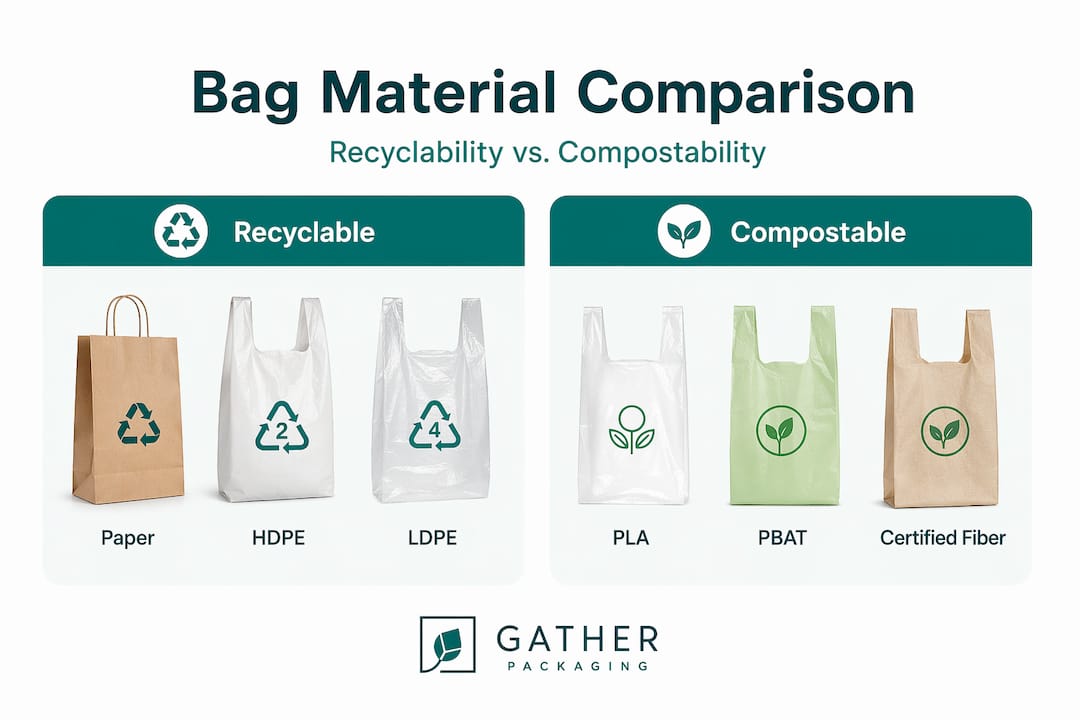
A “recyclable” claim on your bag packaging is only as good as the infrastructure behind it. The most common mistake brands make is printing a recycling symbol on a bag without verifying that the whole package, not just the base resin, meets recyclability standards.
The APR Design Guide is the key reference for plastic bag and pouch recyclability in North America. It requires brands to consider every component of the package. That means not just the film resin but also the inks, adhesives, labels, closures, and any added layers.
Here is where brands commonly get tripped up:
- Metallized inks and foils: These disrupt the recycling stream and will cause a recyclable film bag to fail APR criteria.
- Mixed materials: Laminating two different resins together, such as PET and PE, creates a package that neither recycler can process cleanly.
- Windows and non-film inserts: A paper bag with a plastic window may not be recyclable in standard paper streams unless the window is removed first.
- Heavy adhesives and labels: These can contaminate recycled material, lowering its quality and marketability.
- Moisture barriers and coatings: Some coatings applied to foodservice bags make them unacceptable in both paper and plastic recycling streams.
Below is a simplified look at APR-influenced pass and fail criteria for plastic film bags:
| Feature | Pass criteria | Common fail reason |
|---|---|---|
| Base resin | HDPE or LDPE only | Mixed resin laminates |
| Inks | Flexo or gravure, low contamination | Metallized or heavy solvent-based inks |
| Adhesives | Minimal, approved types | Heavy pressure-sensitive adhesives |
| Labels | Paper or polyolefin labels only | PET labels on PE film |
| Closures | Removable or polyolefin-compatible | Rigid plastic or metal closures |
Paper bags follow a different but equally strict set of criteria. Coatings that prevent grease or moisture infiltration can interfere with paper recycling, and your customer has no way of knowing that from a recycled logo on the outside.
Our sustainability practices page outlines the material certifications we rely on, and our guide on choosing paper bags covers key decisions for retail and foodservice operators in 2026.
Compostability and third-party validation: what you must know
If you’re considering compostables, you’ll need to go beyond packaging claims to hard evidence. Here’s how.
The word “biodegradable” on a bag means almost nothing from a regulatory or practical standpoint. In the United States and Canada, any material breaks down eventually. What matters is how fast, under what conditions, and whether that breakdown leaves harmful residues behind. That is where compostability standards come in.
The gold standard for North American compostable packaging is ASTM D6400, the primary standard for plastics designed to be aerobically composted in municipal or industrial facilities. This standard requires the material to pass three categories of tests: biodegradation rate, physical disintegration within a specific timeframe, and ecotoxicity, meaning no harmful residue left in the compost.
Certification through the Biodegradable Products Institute (BPI) is the most recognized mark for ASTM D6400 compliance in North America. If a supplier cannot show you a current BPI certificate, treat their compostability claim with serious skepticism.
As packaging compliance experts at Packaging Digest note, compostability requires documented verification, not just marketing language. “Biodegradable” alone is insufficient for substantiating environmental claims.
Here is a practical step-by-step process for verifying compostable bags:
- Request the certification document. Ask your supplier for a valid BPI certificate or equivalent that cites ASTM D6400 or ASTM D6868 (for coatings and laminates on paper). Check the expiration date.
- Check local compost collection. Verify that industrial composting is available in the areas where your customers shop. If it is not accessible, your compostable bag will not compost, full stop.
- Confirm the bag is clearly labeled. The compostable logo and a short explanation should be printed on the bag so customers know how to dispose of it correctly.
- Communicate at point of sale. Even the best-designed compostable bag fails if customers throw it in the regular trash. A small placard, receipt note, or QR code can make a measurable difference.
- Audit annually. Certifications expire and supply chains change. Build a review into your annual packaging audit to make sure your claims stay valid.
Pro Tip: Never make compostable claims on your packaging without a valid, current certification on file. Greenwashing complaints in the U.S. and Canada carry real legal risk, and the FTC Green Guides are explicit that unqualified compostability claims are deceptive if the product will not compost in the conditions available to most consumers.
Our packaging quality assurance checklist gives you a full framework for verifying sustainability claims before bags go to market.
Responsible paper and fiber sourcing: recycled content and verification
Paper and fiber-based bags can be a great choice, but only if you pay careful attention to the sources and supply chain.
Choosing paper bags is often the right call for retail and foodservice operators. Paper is widely accepted in curbside recycling, biodegrades faster than most plastics in landfill conditions, and signals sustainability clearly to consumers. But not all paper bags are equal. Where the fiber comes from matters enormously.
Using recycled fiber in your paper bags reduces demand on forests, diverts material from the waste stream, and significantly lowers the carbon and water footprint of production. According to the Sustainable Packaging Coalition, fiber sourcing decisions should prioritize recycled content where feasible and rely on credible sustainable-forestry certifications to reduce upstream environmental risks.
For virgin fiber, the three most credible certification bodies are:
- FSC (Forest Stewardship Council): Covers responsible forest management globally with strong chain-of-custody standards.
- SFI (Sustainable Forestry Initiative): North American focused with strong industry recognition.
- PEFC (Programme for the Endorsement of Forest Certification): An international umbrella body that endorses national programs including SFI.
Here is how to verify fiber sustainability in your supply chain:
- Request chain-of-custody (CoC) certificates from every supplier providing paper stock. CoC documentation proves the certified fiber was tracked from forest to finished product.
- Ask for the percentage of recycled content and whether it is post-consumer recycled (PCR) or pre-consumer. PCR content carries more environmental weight because it diverts material that would otherwise enter the waste stream.
- Review your supplier’s mill certifications directly, not just their sales claims. A credible manufacturer will have no problem providing documentation.
- Watch for greenwashing flags such as vague “eco-friendly” claims without supporting documentation, recycled-looking colors and textures without actual recycled content, and forest certification logos on bags that cannot trace the fiber back to a certified source.
The distinction between credible sourcing and greenwashing is documentation. If your supplier cannot provide it, find one who can. Brands that use our paper bags for sustainable retail branding benefit from full traceability because we build FSC certification and recycled content documentation into every order.
Our perspective: sustainability claims that cannot survive scrutiny are a liability, not an asset
Here is an uncomfortable truth most packaging conversations avoid. A lot of sustainable packaging in the market today is primarily about how a bag looks rather than how it actually performs environmentally. Kraft paper with a leaf logo. Bags labeled “eco-friendly” with no certification behind the claim. Compostable bags shipped to cities with zero composting infrastructure.
We have worked with enough brands to know that the instinct to move fast on sustainability claims, especially when a competitor appears to be doing it, is completely understandable. But the brands that win long-term are the ones who did the harder work first: traced their fiber, verified their compostability claims with actual certificates, and designed their bags for the recycling streams their customers actually have access to.
The brands that get hurt are the ones whose sustainability claims unravel under the scrutiny of a journalist, a regulator, or an informed customer. Once that trust is gone, it is very hard to rebuild.
Our honest recommendation is to start narrow and do it right. One certified, traceable, well-designed bag that performs exactly as labeled is worth far more than a full product line of vague “green” claims. That is not idealism. It is risk management.
Ready to build a bag program that holds up?
Sustainable packaging that actually delivers starts with materials you can trace, certifications you can document, and a manufacturing partner who has built sustainability into every step of their process.
At Gather Packaging, we manufacture FSC-certified paper bags from our Toronto facility using water-based inks and recycled content options, and we back every claim with documentation. Whether you are starting from scratch or auditing an existing bag program, our team can help you move from vague green intentions to a packaging solution that is genuinely verifiable. Explore our full range of sustainable paper bags and request a sample or quote to get started. We make the due diligence part straightforward, so you can focus on your brand.
Frequently asked questions
What is the best bag material for both recyclability and sustainability in the U.S. and Canada?
No single material wins across every situation. Your best choice comes from using a lifecycle assessment to compare options against your specific geography and local recycling or composting infrastructure.
Can I label my products as compostable if they are just biodegradable?
No. Compostable claims require testing and certification to recognized standards like ASTM D6400. Simply calling a product biodegradable does not meet the threshold for compostability claims under North American guidelines.
How important is it to use recycled content in paper and fiber bags?
Recycled fiber lowers your environmental footprint and supports circular economy goals. You should always request documented sourcing, as fiber sourcing decisions backed by chain-of-custody certification are the only way to substantiate recycled content claims reliably.
Why is third-party certification important for sustainable packaging claims?
Third-party certification independently verifies that materials perform as described under real-world conditions. Without it, environmental claims are simply self-reported marketing, and that exposes your brand to regulatory risk and consumer distrust.
Share:
Carbon neutral packaging: a practical guide for brands
Why local sourcing for packaging matters for your brand