
TL;DR:
- Many myths about sustainable packaging stem from misunderstandings about how eco-friendly materials degrade and get recycled in real-world conditions.
- Regulatory standards like the FTC Green Guides and EU PPWR are essential for clarifying claims such as biodegradable, recyclable, and compostable, ensuring compliance and transparency.
Sustainable packaging myths are widespread misbeliefs about how eco-friendly materials perform, degrade, and get recovered in real-world conditions. These misconceptions affect purchasing decisions for retail brands, procurement teams, and packaging buyers across North America. Regulatory frameworks like the US FTC Green Guides and the EU Packaging and Packaging Waste Regulation (PPWR) exist precisely because vague terms like “biodegradable,” “recyclable,” and “compostable” are routinely misapplied. This article addresses the most common sustainable packaging myths debunked through evidence, compliance context, and supply chain realities relevant to Canadian and North American markets.
1. Sustainable packaging myths debunked: biodegradable doesn’t mean it breaks down quickly
“Biodegradable” is one of the most misused terms in packaging. The word implies natural breakdown, but the timeline and conditions required are rarely disclosed on the label. Most biodegradable packaging requires industrial composting facilities operating at specific temperatures and humidity levels. Without access to those facilities, the material ends up in a landfill where it degrades no faster than conventional plastic.
The FTC Green Guides require that biodegradable claims must be substantiated to show full breakdown within about one year under customary disposal conditions. That standard disqualifies most packaging on the market today from making an unqualified biodegradable claim. Municipal composting infrastructure in Canada and the US remains limited, with many cities still lacking curbside organics programs that accept packaging.
Compostable packaging works well in closed-loop settings: corporate cafeterias, stadiums, and events with dedicated collection. It fails when consumers mix it into blue-bin recycling, which contaminates the entire stream. Retail brands choosing compostable paper bags need to confirm that their customers have access to the right disposal channel before the claim holds up.
- Compostable packaging requires industrial composting, not backyard bins, in most cases
- Mixing compostable packaging into recycling streams causes contamination rejections
- FTC requires qualification of biodegradable claims when breakdown is not timely or complete
- Municipal composting availability varies significantly across Canadian cities and US states
Pro Tip: Before selecting compostable packaging for your retail brand, contact your local municipality to confirm whether compostable packaging is accepted in curbside organics programs. If it isn’t, the environmental benefit disappears at the disposal stage.
2. Recyclable labels don’t guarantee your packaging gets recycled
Recyclable labeling is not a performance guarantee. It describes a material’s theoretical capacity to be processed, not the likelihood that it actually will be. Only 9% of all plastic waste ever produced has been recycled, despite 72% of North American consumers believing most plastic packaging is recycled. That gap between perception and reality shapes how brands and buyers should evaluate packaging claims.
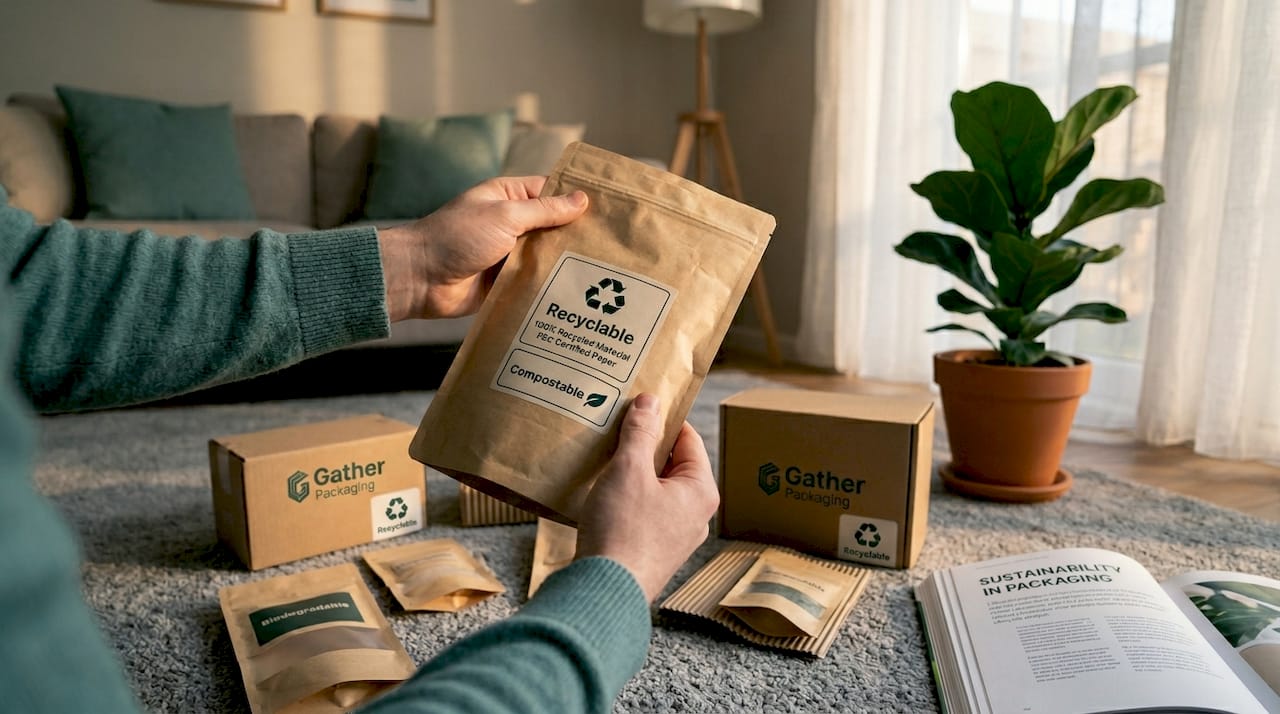
Food residue contamination and multilayer materials cause many recyclable packages to be rejected in sorting and sent to landfill or incineration instead. A paper bag with a plastic window, a foil liner, or a wax coating cannot be processed in standard paper recycling streams. The recyclable label on the outer material becomes irrelevant when the construction prevents separation.
Local recycling acceptance varies widely across municipalities. A material accepted in Toronto may be rejected in a smaller Ontario city with different sorting equipment. Businesses should verify local capabilities rather than relying on general recyclable claims printed on the packaging.
- Single-material paper bags with no coatings or laminations recycle most reliably
- Multi-layer and mixed-material packaging is frequently rejected at sorting facilities
- Contamination from food residue is one of the leading causes of recycling stream rejection
- Recycling rates depend on collection infrastructure, not just material composition
Pro Tip: Educating your customers on how to properly empty and prepare packaging before recycling can materially improve recovery rates. A simple instruction printed on the bag costs nothing and reduces contamination at the source.
3. Paper is not automatically better than plastic
The belief that paper packaging is always the greener choice is one of the most persistent eco-friendly packaging facts that turns out to be more complicated on examination. A Yale Center for Industrial Ecology meta-analysis found that paper alternatives had higher carbon impacts in 64% of compared cases. Paper production is energy-intensive, uses significant water, and results in heavier packaging that increases transport emissions per unit.
That does not mean paper is the wrong choice. For retail shopping bags, paper has clear advantages: it is widely accepted in curbside recycling, it is compatible with FSC® certification for responsible sourcing, and it carries no PFAS contamination risk. The point is that the decision requires a life cycle perspective, not a reflex toward whichever material sounds greener.
| Material | Strengths | Weaknesses |
|---|---|---|
| Paper | Widely recyclable, FSC® certifiable, no PFAS risk | Higher carbon footprint in production, heavier transport weight |
| Plastic | Lightweight, low production energy in some formats | Low actual recycling rates, persistent in environment |
| Glass | Infinitely recyclable, inert | Very high transport emissions, energy-intensive production |
| Compostable materials | Breaks down in right conditions | Requires industrial composting infrastructure |
Plastic-free alternatives are not automatically more environmentally friendly. Well-designed recyclable plastics can outperform some paper or glass options on a full life cycle basis. The right answer depends on the product, the supply chain, and the disposal infrastructure available to your customers.
4. Chemical recycling and reuse systems are not ready at scale
Chemical recycling is frequently cited as the technology that will solve plastic waste. The reality is more constrained. Chemical recycling technologies often produce fuel rather than recycled plastic and have low plastic-to-plastic yield with high carbon footprints. Most operational plants yield only 10 to 30% plastic feedstock from input material. The rest becomes fuel or waste, which means the environmental benefit is limited compared to the claims.
Reuse systems face a different set of challenges. Programs like Loop have struggled with low consumer return rates of approximately 50 to 65%, falling below the economically viable threshold needed for the system to function. Without strong financial incentives or regulatory mandates, consumer participation does not reach the levels required to justify the logistics and washing infrastructure.
For retail brands, this means that switching to a reuse-based packaging model requires years of planning, not a seasonal campaign. Packaging changes require multi-year timelines for product testing, line validation, regulatory approvals, and supply chain coordination before products reach market shelves. Brands that announce packaging transitions without that groundwork in place often miss their own deadlines.
Pro Tip: If you are planning a packaging transition, build a realistic timeline that includes supplier qualification, print testing, compliance review, and a pilot run before full rollout. Gatherpackaging’s sustainable packaging workflow guide outlines what that process looks like in practice.
5. Regulations are clarifying what sustainable packaging claims actually mean
Regulatory frameworks are the most reliable tool for separating genuine sustainability from marketing language. The EU Packaging and Packaging Waste Regulation (PPWR) 2025/40 requires recyclability grades A, B, or C starting January 2030, banning lower-grade packaging from the EU market. The regulation also mandates PFAS bans and harmonized labeling requirements across all EU member states. Any brand selling into European markets needs to begin compliance planning now.
In North America, the FTC Green Guides set the standard for environmental claims. Unqualified terms like “eco-friendly,” “green,” or “sustainable” without substantiation are considered potentially deceptive. Businesses sourcing paper shopping bags need documentation from their suppliers confirming material composition, recycled content percentages, and certifications like FSC® or SFI.
For Canadian packaging buyers, compliance documentation is not just a legal protection. It is a procurement requirement when selling to major retailers who conduct their own supplier audits. Gatherpackaging’s packaging compliance guide covers the specific documentation steps relevant to paper bag procurement in North American markets.
Key takeaways
Sustainable packaging decisions require evidence-based evaluation of materials, disposal infrastructure, and regulatory compliance rather than reliance on label claims alone.
| Point | Details |
|---|---|
| Biodegradable claims require proof | FTC requires breakdown within one year under customary disposal conditions or the claim must be qualified. |
| Recyclable labels reflect potential, not outcome | Only 9% of all plastic ever produced has been recycled; local infrastructure determines actual recovery. |
| Paper is not always lower-impact | Life cycle assessments show paper had higher carbon impacts than plastic in 64% of compared cases. |
| Packaging transitions take years | Multi-year timelines for testing, validation, and compliance review are standard before market launch. |
| Regulations define the truth | EU PPWR and FTC Green Guides set enforceable standards that replace vague marketing language with measurable criteria. |
What I’ve learned working through sustainable packaging transitions
The most common mistake I see brands make is treating a packaging switch as a marketing decision rather than a supply chain decision. A brand announces it is moving to compostable bags by Q3, then discovers six months later that their local fulfillment region has no industrial composting access. The bags go to landfill. The announcement was real. The outcome was not.
Evidence-based decision making means starting with disposal infrastructure, not material selection. Ask where your customers are located, what their municipal programs accept, and whether your packaging can actually complete the cycle you are claiming. That question alone eliminates most of the common sustainable packaging misconceptions before they become expensive mistakes.
Working with a domestic manufacturer matters here more than most buyers realize. When Gatherpackaging produces paper bags in Toronto, the lead times are shorter, the compliance documentation is current, and the conversation about FSC® certification or recycled content percentages happens before the order is placed. That is very different from sourcing overseas and discovering a compliance gap at customs.
Sustainability standards are also moving. The EU PPWR requirements taking effect in 2030 will affect any brand with European distribution. The FTC Green Guides are under review. Staying current with those changes requires ongoing supplier relationships, not one-time audits. The brands that get this right are the ones treating sustainability as a procurement discipline, not a label.
— Taylor
Work with a manufacturer that knows what sustainable actually means
Gatherpackaging manufactures paper shopping bags in Toronto, Canada, using FSC®-certified materials, recycled content, and water-based inks. Every bag comes with the compliance documentation your procurement team needs, including material declarations and certification records.
If you are sourcing retail paper bags and want to avoid the greenwashing traps outlined in this article, the right starting point is a conversation with a manufacturer who can back every sustainability claim with documentation. Gatherpackaging’s eco-friendly paper bags are produced domestically with short lead times, full customization, and quality assurance built into every run. Contact Gatherpackaging at gatherpackaging.com to discuss your paper shopping bag requirements.
FAQ
What does “biodegradable” actually mean on packaging?
Biodegradable means the material can break down through biological processes, but the FTC requires that breakdown must occur within about one year under customary disposal conditions. Most biodegradable packaging only degrades in industrial composting facilities, not in landfills or home compost bins.
Is recyclable paper packaging always the best choice for retail?
Paper is widely recyclable and FSC® certifiable, but life cycle assessments show it can have a higher carbon footprint than plastic in production and transport. The best choice depends on your supply chain, your customers’ disposal access, and the specific construction of the bag.
How do regulations like the FTC Green Guides affect packaging claims?
The FTC Green Guides require that environmental claims like “biodegradable,” “recyclable,” and “compostable” be substantiated with evidence. Unqualified claims that cannot be verified are considered potentially deceptive and expose brands to regulatory risk.
Why do packaging transitions take so long?
Switching packaging materials requires product testing, line validation, regulatory compliance review, and supply chain coordination. Multi-year timelines are standard before new packaging reaches retail shelves at scale.
Does chemical recycling solve the plastic waste problem?
Chemical recycling currently produces fuel rather than recycled plastic in most cases, with plastic-to-plastic yields of only 10 to 30%. It is not yet a scalable solution for retail packaging waste at the volumes brands require.
Share:
Why Reliable Packaging Supply Chains Matter for Retail
Creative Packaging Finishes That Build Stronger Retail Brands