
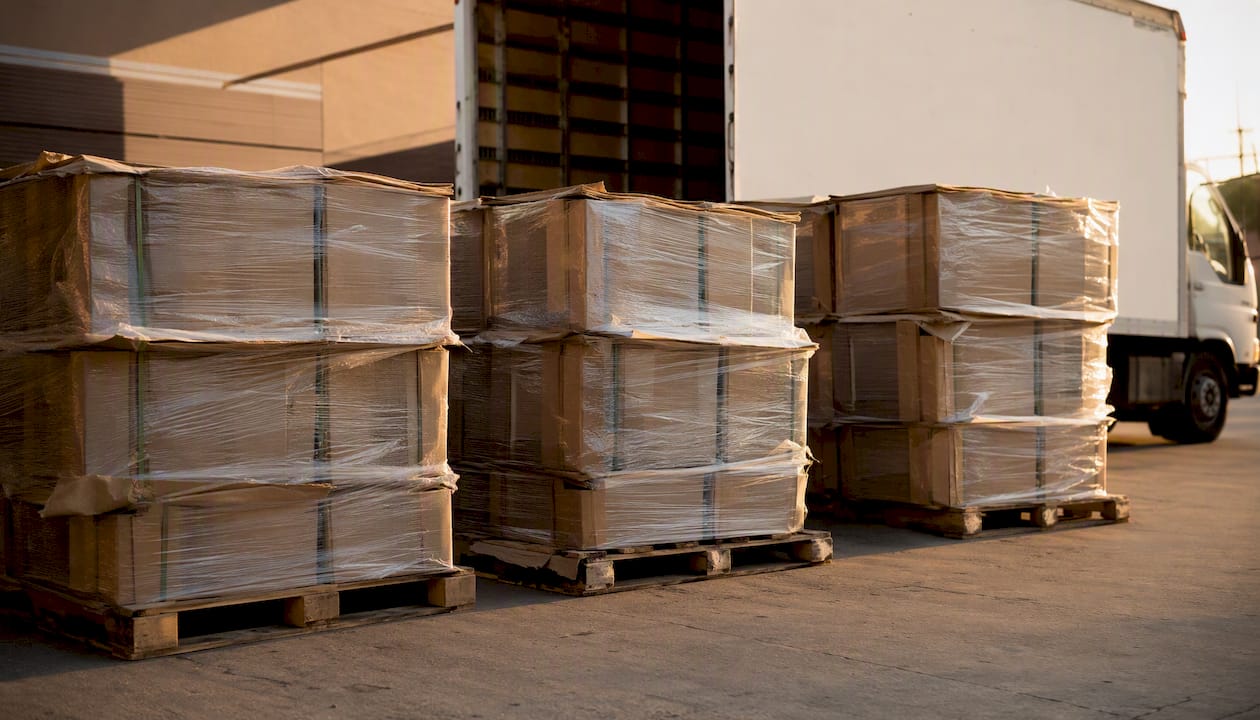
Finished retail paper shopping bags ship on a unitized pallet: cartons are column-stacked on a GMA 48×40 footprint, secured with a specified stretch-wrap recipe, labeled with a GS1-128 pallet barcode on two faces, and linked to an ASN before carrier pickup. Every element of that process must match the destination retailer’s vendor manual, or you risk chargebacks and rejected loads.
Before the PO goes out, confirm these items with your supplier:
- Pallet footprint and type (GMA standard or retailer-specific)
- Case count per carton and units per case
- Stacking pattern and maximum pallet height and gross weight
- Slip-sheet approval status (if applicable)
- Stretch-wrap and strapping recipe
- Pallet label fields and placement on two faces
- ASN/EDI match requirement and submission timeline
Non-compliance with any of these triggers chargebacks and, in the worst cases, full load rejection at the DC.
Pro Tip: Build a one-page palletization spec sheet and attach it to every PO as an appendix. Suppliers who sign it have no room to claim they were unaware of the requirements.
Key Takeaways
Correct palletization of retail paper bags requires matching the retailer’s pallet type, wrap recipe, label fields, and ASN data before the load leaves the dock.
| Point | Details |
|---|---|
| Confirm pallet type early | GMA 48×40 is the baseline; club retailers like Sam’s Club require 9-block pallets confirmed before production. |
| Column stack with zero overhang | Brick stacking undermines carton compressive strength and can crush bags in transit. |
| Follow the wrap recipe | Apply 3–5 bottom passes with 50% overlap, full-height wrap anchored to the top cap, with PET/PP strapping and corner boards. |
| Match ASN to pallet label exactly | Any field mismatch between the physical label and the ASN is a common chargeback trigger ranging from $100 to $1,000. |
| Gatherpackaging | Provides label proofs, pallet diagrams, QA documentation, and ASN support for DC-ready retail paper bag shipments from Toronto. |
Table of Contents
- What do major retailers require from palletized paper bag shipments?
- How should you configure pallets for paper shopping bags?
- How do you secure a pallet of finished paper bags?
- What goes on pallet and carton labels, and how does it link to the ASN?
- Which pre-shipment QA tests should you require?
- How should multi-pallet loads be arranged in a trailer or container?
- What chargebacks should procurement watch for, and how do you prevent them?
- Procurement palletization checklist and PO language
- What procurement teams consistently get wrong about palletizing paper bags
- Gatherpackaging handles DC-ready palletization from the first proof
- Sources
What do major retailers require from palletized paper bag shipments?
Retail compliance programs require GS1-128 barcodes on both cartons and pallets, accurate case counts, retailer-specific pallet configurations, and EDI/ASN accuracy. Chargebacks for violations can be significant depending on the infraction and the retailer, often in the range of hundreds of dollars per issue.
Common retailer demands to call out on the PO:
- GS1-128 barcodes on master cartons and pallet labels
- Exact case counts matching the ASN
- Approved pallet footprint and pallet type per the retailer’s DC rules
- Pallet height and gross weight within stated limits
- Floor-ready or shoppable presentation where required
- ASN submitted and confirmed before carrier pickup
Walmart’s supplier materials describe DC processing flows, automation-eligible packaging requirements, and palletized inbound freight preferences. Walmart’s OTIF program penalizes suppliers for late or incomplete shipments, so the pallet configuration and ASN must be correct before the truck leaves the dock. Sam’s Club operates under a separate set of rules: Sam’s Club structural packaging standards specify 9-block pallets and club-ready presentation, which differs from standard GMA expectations.
Pro Tip: Before the first shipment to any new retailer, request the retailer’s vendor manual ID from your supplier and require a written compliance template signed by both parties. Discovering a pallet-type mismatch at the DC is far more expensive than a 30-minute pre-production call.
How should you configure pallets for paper shopping bags?
The GMA 48×40 pallet is the baseline footprint for most North American DCs. Retailer exceptions exist: Sam’s Club requires 9-block pallets for domestic programs, and some club or specialty DCs specify pooled plastic pallets. Confirm the required pallet type in writing before production starts.
Slip sheets are only acceptable with prior DC approval. When approved, use solid fiber or plastic slip sheets on a 48×40 footprint with no overhang; corrugated slip sheets are typically rejected. Flaps must face outward from the trailer and must not be wrapped under the stretch film.
For stacking, flat packing paper bags is the most efficient method for both domestic and export orders. Column-stack cartons with zero overhang; brick-stacking undermines the compressive strength of corrugated cartons and can crush bags in transit. Maximum pallet height should not exceed 1.5 times the shortest pallet base dimension unless the retailer’s vendor manual explicitly approves a taller build.
Include these measurements on every PO:
- Pallet footprint (L×W in inches)
- Carton dimensions (L×W×H) and gross weight per carton
- Units per carton and cartons per layer
- Number of layers and expected pallet height
- Expected gross pallet weight
Pro Tip: Include a simple pallet diagram in the supplier spec showing layer count, column alignment, and top-cap placement. Require written sign-off on any deviation from that diagram before production.
How do you secure a pallet of finished paper bags?
Correct load securement is what keeps paper bags intact through fork handling, trailer transit, and DC conveyor systems. The EMS palletizing handbook specifies a wrap recipe that works: rope-band the stretch film under the deck boards, apply 3–5 tight bottom passes with 50% overlap, then wrap the full height of the load and anchor the film over the top cap. Automated wrappers produce more consistent tension than hand wrapping and make the Wrap Test easier to pass.
Additional securement requirements to include on the PO:
- PET or PP strapping with edge protectors under every strap
- Corner boards on all four vertical edges
- Top cap (corrugated or honeycomb) to level the pallet top and protect the uppermost layer
- Pallet shroud or stretch hood for humidity and dust protection on export or long-haul shipments
- Fork pockets kept clear; stretch film must not extend into fork entries
Freight packaging guidelines also call for verifying pallet condition before loading: no broken boards, no protruding nails, and no loose deck boards that could snag film or damage fork equipment.
Pro Tip: Require the supplier’s QA team to photograph the wrapped pallet from all four sides and submit those photos with the pre-shipment QA report. A photo takes 30 seconds; a chargeback dispute takes weeks.

What goes on pallet and carton labels, and how does it link to the ASN?
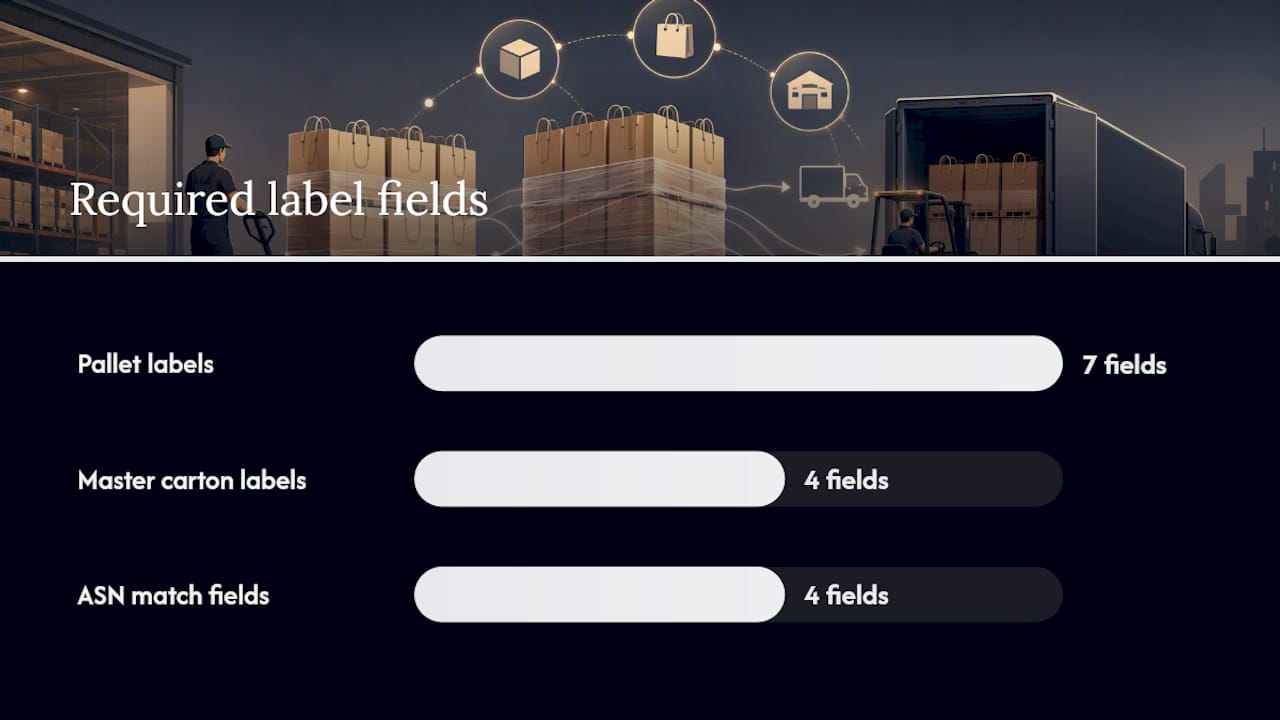
Every pallet label must appear on two adjacent vertical faces of the wrapped pallet. Required fields:
- Pallet ID barcode (GS1-128 format)
- SKU summary and total unit count
- Gross weight and pallet dimensions
- Destination DC name and address
- Ship-from address
- PO number and ship date
Master carton labels need the SKU and variant, units per carton, UPC/EAN barcode, and orientation arrows. Place the carton label on one long face, oriented correctly for how the carton will sit on the pallet.
The ASN must match the pallet label data exactly: case counts, GTIN/UPC, pallet count, and pallet IDs. Any mismatch between the physical label and the ASN is one of the most common chargeback triggers. Packaging material traceability from carton to pallet to ASN is what gives procurement visibility and protects against DC receiving disputes.
Pro Tip: Require a label PDF proof and a test ASN file before the first shipment to any retailer. Catching a field error on a PDF costs nothing; catching it after the load arrives at the DC costs real money.
Which pre-shipment QA tests should you require?
Three tests cover the most common failure modes for palletized paper bag shipments:
- Push Test: Apply lateral force to the pallet load. Pass = no carton shift greater than the approved tolerance. Fail = any layer slides or the load leans.
- Forklift Tilt Test: Lift the pallet and tilt to simulate transit movement. Pass = load remains stable with no carton displacement. Fail = any carton shifts or falls.
- Wrap Test: Inspect film tension across the full pallet height. Pass = film is taut, no loose tails, no gaps at the base or top. Fail = loose film, exposed corners, or film not anchored under deck boards.
Additional checks before carrier pickup:
- Verify pallet height and gross weight against PO spec
- Confirm carton ECT rating is sufficient for the number of stacked layers
- Scan pallet barcode and confirm it resolves in the WMS against the correct ASN record
- Require QA sign-off with operator initials and timestamp on each test
Supplier-side WMS configuration to retailer templates substantially reduces chargebacks by enforcing label generation, correct pallet builds, and ASN creation at the workflow level. A 3PL with retail compliance experience provides the same enforcement when the supplier’s own WMS cannot support retailer templates.
How should multi-pallet loads be arranged in a trailer or container?
Load sequence and void control protect paper bags from compression and shifting in transit.
Steps for loading:
- Generate an approved load map before the truck arrives.
- Place the heaviest pallets low and toward the nose of the trailer.
- Center weight left-to-right; avoid concentrated heavy spots on one side.
- Fill horizontal gaps between pallets with inflatable airbags, dunnage, or wooden shoring.
- Protect airbags from wood splinters with cardboard sleeves; confirm inflation pressure per the airbag manufacturer’s spec.
- Photograph the completed load before doors are sealed and attach photos to the shipment record.
For export shipments, paper bags need pallet shrouds or top caps to guard against humidity and condensation inside a container. If solid wood pallets are used for export, confirm ISPM-15 heat-treatment certification before loading. Plastic pallets eliminate that requirement entirely and are worth specifying for any ocean shipment.
What chargebacks should procurement watch for, and how do you prevent them?
Penalty ranges above are drawn from retail compliance program documentation.
Prevention steps to add to the PO:
- Require pre-shipment label PDF and barcode scan confirmation
- Mandate an ASN test file for the first shipment to any new retailer
- Confirm DC-specific pallet type in writing before production
- Require time-stamped photos of wrapped pallets before carrier pickup
- Name a compliance contact at the supplier for escalation
Procurement palletization checklist and PO language
Use this checklist when building supplier specs. Each item maps to a PO field your supplier must confirm in writing.
Checklist:
- Pallet footprint confirmed (48×40 GMA or retailer-specified)
- Pallet type confirmed (whitewood, 9-block, plastic, pooled)
- Slip-sheet approval obtained from DC (if applicable)
- Carton dimensions and gross weight per carton stated
- Units per carton and cartons per layer stated
- Maximum pallet height and gross weight stated
- Stacking pattern confirmed as column stack, zero overhang
- Wrap recipe confirmed (3–5 bottom passes, full-height, top cap anchored)
- PET/PP strapping with edge protectors confirmed
- Corner boards and top cap confirmed
- Pallet label fields listed and placement confirmed (two adjacent faces)
- Carton label fields listed and orientation confirmed
- ASN/EDI submission timeline confirmed
- ASN-to-label match requirement confirmed
- Push Test, Tilt Test, and Wrap Test required with photo documentation
- First-shipment validation scheduled
Copy-ready PO language:
- “Supplier shall palletize on a 48×40 GMA pallet unless retailer vendor manual specifies otherwise; pallet type must be confirmed in writing before production.”
- “Column stacking only; zero overhang; maximum pallet height inches; maximum gross weight lbs.”
- “Stretch wrap: 3–5 bottom passes with 50% overlap, full-height wrap anchored to top cap; PET/PP strapping with edge protectors required.”
- “Pallet label (GS1-128) applied to two adjacent vertical faces; label fields: Pallet ID, SKU, unit count, gross weight, destination DC, PO number, ship date.”
- “ASN must match pallet label data exactly; ASN to be submitted and confirmed before carrier pickup.”
- “Supplier to perform and document Push Test, Forklift Tilt Test, and Wrap Test; time-stamped photos required with pre-shipment QA report.”
- “Supplier sign-off on this palletization spec is required before production release; chargebacks resulting from non-compliance are the supplier’s responsibility.”
Pro Tip: Schedule a first-shipment validation call with your supplier and the 3PL before the initial order ships. Walk through the pallet diagram, label proof, and ASN test file together. One hour up front prevents months of chargeback disputes.
For a broader view of the procurement workflow for retail bag supply, including handoffs between design, QA, and logistics, that guide covers the full process from order placement to DC delivery.
What procurement teams consistently get wrong about palletizing paper bags
The most common mistake is treating palletization as a logistics detail rather than a compliance requirement. Procurement teams that specify the bag design and print specs in detail, then leave pallet configuration to the supplier’s discretion, are the ones who end up disputing chargebacks six weeks after the first shipment.
The second mistake is assuming one pallet spec works across all retail channels. It does not. A pallet built correctly for a standard Walmart RDC will be rejected at a Sam’s Club DC if it arrives on a GMA whitewood pallet instead of the required 9-block. The wholesale paper bag order management guide covers how to manage these channel-specific differences across bulk orders.
Domestic manufacturing shortens the feedback loop considerably. When the manufacturer is in North America, a label proof revision or a pallet diagram change takes hours, not weeks. That proximity is what makes first-shipment validation practical rather than aspirational.
Gatherpackaging handles DC-ready palletization from the first proof
Gatherpackaging manufactures custom paper shopping bags in Toronto and coordinates DC-ready palletization as part of the order process, not as an afterthought. That means label proofs before production, pallet diagrams in the supplier spec, QA documentation including Push, Tilt, and Wrap tests, and ASN support aligned to your retailer’s vendor manual. You get a single point of contact who understands both the bag and the pallet it ships on.
For procurement teams supplying Walmart, Target, Costco, or club-format retailers, Gatherpackaging’s domestic production and logistics coordination reduce the compliance risk that comes with overseas sourcing and long lead times. Contact Gatherpackaging to discuss your palletization specs and request a quote for your next paper shopping bag order.
Sources
- Retail Compliance: Requirements, Benefits & Best Practices
- 5.4 Palletizing and Container Loading | EMS handbook
- Export Carton and Packing Tips for Paper Bag Orders
- Sam’s Club Structural Packaging Standards
For domestic retail orders, start with the Walmart guide and the EMS handbook. For club-format orders, add the Sam’s Club standards. For export or ocean shipments, add the export packing tips and confirm ISPM-15 requirements with your freight forwarder. You can also explore durable pallet options when selecting the right pallet construction for your shipment type.
Share:
Paper Bag Pricing: Wholesale & Custom Costs for Brands
Matte Varnish vs Gloss for Custom Paper Shopping Bags