
wholesale pricing data](https://www.kimecopak.ca/blogs/news/how-much-do-paper-bags-cost). Small-quantity retail purchases are generally more expensive per bag, often significantly exceeding wholesale prices. The gap between those two numbers is almost entirely explained by order volume, print complexity, and whether you’re buying from a manufacturer or a middleman.
Here’s what drives where your order lands in that range:
- Basic unprinted kraft bags at high volumes sit at the low end, often below $0.15 per unit
- Custom-printed white or coated bags with two to four colors land in the mid-range
- Premium laminated or embossed bags with full-color flexo printing push toward $0.35 and above
- FSC®-certified and recycled-content options carry a modest premium over standard kraft
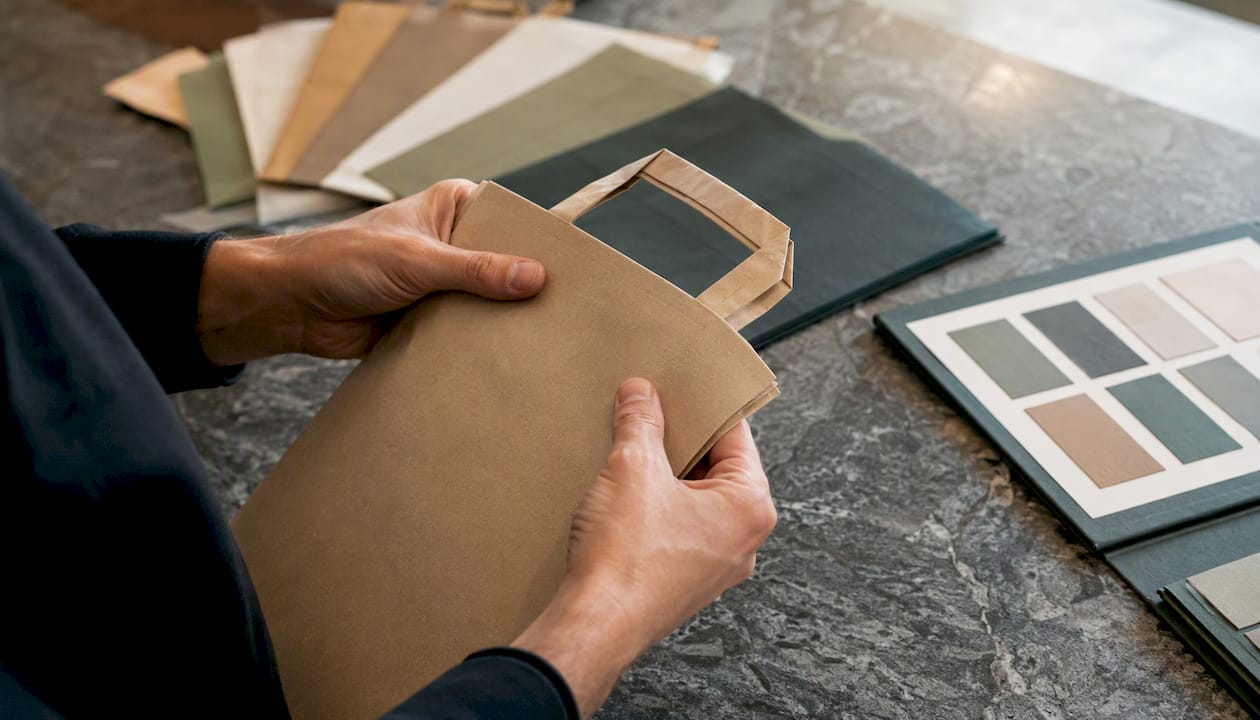
Pro Tip: Request a sample kit from Gatherpackaging before committing to a full run. Seeing the actual material weight, print quality, and handle construction in hand prevents costly spec changes after production starts.
Key Takeaways
Custom paper shopping bag pricing in North America runs $0.07–$0.35 per unit at wholesale volumes, with landed cost shaped primarily by order quantity, print complexity, and production origin.
| Point | Details |
|---|---|
| Per-unit price range | Wholesale custom bags run $0.07–$0.35/unit; small retail quantities can reach $0.30–$0.80 CAD. |
| Top cost drivers | Order quantity, print color count, and material GSM move price more than any other variables. |
| Fastest cost reduction | Raise order quantity and reduce print colors; amortize setup fees across reorders. |
| MOQs and lead times | Domestic runs start around 500–1,000 units with 3–6 week production; offshore starts at 5,000+ units with 10–16 week total lead time. |
| Gatherpackaging | Domestic Toronto manufacturer offering FSC® options, 8-color flexo, QA testing, and sample kits — contact for a quote. |
Table of Contents
- What does paper bag pricing actually look like by bag type and volume?
- What actually determines the price of a custom paper bag?
- How do you estimate total project cost and set a retail price?
- What MOQs and lead times should you plan around?
- How can you lower per-unit cost without hurting your brand?
- How Gatherpackaging prices custom paper shopping bags
- What specs do you need to get a fast, accurate quote?
- What Gatherpackaging sees in North American orders
- Work with Gatherpackaging on your next paper bag order
- Sources
What does paper bag pricing actually look like by bag type and volume?
Price bands shift significantly depending on bag style, material, and order size. The table below gives directional per-unit ranges for three common bag types at typical North American MOQ tiers. These are landed estimates for domestic orders; offshore FOB pricing will differ.
A few things worth noting about these ranges:
- Small-quantity retail buyers often pay several times the per-unit cost of a direct manufacturer order, as wholesale pricing comparisons confirm
- Stock kraft bags in bulk packs (commodity retail channels) can appear cheap per unit, but they offer no customization and inconsistent quality
- Offshore FOB pricing (China-origin) for basic bags can run as low as $0.05–$0.50+ per unit, but landed cost after shipping, duties, and QA often narrows that gap considerably
- Quantity price breaks are real and significant: moving from 200 units to 2,000+ units on a standard white kraft bag can cut per-unit cost by more than half
For foodservice takeout bags, unprinted kraft sandwich and bakery bags sit at the lower end of the basic kraft range. Adding a logo or spot color pushes them into the white coated tier.
What actually determines the price of a custom paper bag?
Material cost is the largest component of finished bag production costs, often representing a substantial portion of total expenses (https://e-huahao.com/paper-bag/custom-paper-bag-cost-breakdown/). Everything else builds on top of that base.
- Paper weight (GSM): Heavier paper costs more per sheet and adds to shipping weight. A 100 GSM kraft bag costs less than a 150 GSM bag of the same dimensions. Most retail shopping bags run 90–130 GSM; premium carry bags go higher.
- Print method and color count: Flexo printing is the standard for paper bags. Each color requires a separate plate. Two-color jobs cost less than six-color jobs, and full-bleed coverage uses more ink than spot printing. 8-color flexo gives you near-photographic results but carries the highest print cost per run.
- Handle type: Die-cut handles (punched from the bag itself) are the least expensive option. Twisted paper handles, flat ribbon handles, and rope handles each add cost in roughly that order. Reinforced patch handles add both material and labor.
- Lamination and finishing: Matte or gloss lamination adds a meaningful per-unit premium and also affects recyclability. Embossing and foil stamping add more. For most retail shopping bags, a clean flexo print on quality kraft reads just as well as lamination at a fraction of the cost.
- Bag construction: Reinforced bases, gussets, and multi-wall construction all add material and production steps.
- Setup and plate fees: One-time costs, typically charged per color per plate. On a small run, these fees can add $0.10–$0.30 per unit. On a large run, they amortize to near zero.
- FSC® certification: Carries a modest premium over uncertified material. Most B2B buyers choose FSC Mix certification to meet retailer and partner requirements while keeping that premium manageable. You can verify any supplier’s certificate directly at info.fsc.org.
- Shipping and duties: Domestic production eliminates import duties and compresses lead times. Offshore orders add ocean freight (LCL or FCL), port fees, customs brokerage, and inland delivery, all of which land on the per-unit cost.
Pro Tip: The two biggest cost levers are print color count and order quantity. Cutting from four colors to two and doubling your order quantity will move your per-unit cost more than any other single decision.
How do you estimate total project cost and set a retail price?
Work through the cost build-up in this order:
- Unit production cost — base material + print + handles + construction, per the quote
- Setup fees amortized — total plate/setup fees divided by order quantity
- Packaging and palletizing — how the finished bags are packed for shipment
- Freight — ocean LCL, FCL, or domestic truck depending on origin and volume
- Duties and customs brokerage — applies to offshore orders; domestic production skips this step
- Domestic handling and warehousing — receiving, inspection, and storage before distribution
Add those together and you have your landed unit cost. That’s the number that matters for margin planning, not the FOB factory price.
For retail pricing, the right approach depends on your brand positioning and how you use the bag:
- Charge for the bag: Some retailers recover cost by charging $0.25–$1.00 per bag at point of sale. Government guidance on carrier bag charges confirms this is standard practice for single-use carrier bags in many markets. Test the price point; customer sensitivity varies by category.
- Include in product margin: Treat the bag as a cost of goods and build it into your product pricing. Works well when the bag is a brand asset, not just a carrier.
- Use selectively: Reserve premium bags for purchases above a threshold and use a simpler bag below it. This controls cost without eliminating the brand moment.
There’s no universal markup formula. A $0.35 landed bag in a luxury retail context is a rounding error. The same bag for a high-volume commodity retailer is a real line item. Test what your customers respond to before locking in a policy.
What MOQs and lead times should you plan around?
MOQs and timelines vary by production path, and getting this wrong is one of the most common ways procurement teams create avoidable delays.
- Domestic small runs: MOQs can start as low as 500–1,000 units for standard configurations. Per-unit cost is higher, but lead times are shorter and QA is simpler.
- Standard domestic production runs: 2,500–10,000 units is a typical sweet spot for branded retail bags. Price breaks are meaningful at this range.
- Large-volume offshore orders: MOQs often start at 5,000–10,000 units per SKU. Per-unit cost is lower, but total lead time from order to warehouse can run 10–16 weeks including ocean transit.
Typical lead time windows to build into your schedule:
- Sample kit or prototype: 1–3 weeks from spec confirmation
- First production run (domestic): 3–6 weeks after proof approval
- First production run (offshore): 8–14 weeks including transit
- Reorders (domestic, same spec): Often 2–4 weeks with plates on file
Rush production is available in some cases but carries a premium. Domestic manufacturing shortens lead times and simplifies QA, which matters more than a small per-unit premium when a product launch or seasonal promotion has a fixed date.
For proofs, expect a digital proof before production and a physical sample before the first large run. Never approve a new bag spec from a digital file alone — paper weight, handle feel, and print registration all need to be verified on an actual sample.
How can you lower per-unit cost without hurting your brand?
The fastest cost reductions come from decisions made at the design and procurement stage, not after production starts. Design choices that reduce material waste also tend to lower cost.
- Raise your order quantity. The single most reliable lever. Moving from 1,000 to 5,000 units typically cuts per-unit cost by 30–50% on printed bags.
- Reduce print colors. Every color is a plate fee and additional press time. Two well-chosen brand colors often read stronger than four colors applied carelessly.
- Standardize bag sizes across SKUs. Running multiple products in the same bag dimensions lets you consolidate into one SKU and hit higher quantity breaks.
- Choose die-cut handles over ribbon or rope. For most retail shopping bags, a clean die-cut handle is structurally sound and significantly cheaper.
- Use recycled kraft where appropriate. Lower-GSM recycled kraft works well for lighter products and costs less than virgin coated stock.
- Amortize setup fees across reorders. Once plates are made, reorders cost less per unit. Spreading setup fees across repeat runs is one of the fastest ways to reduce effective per-unit cost for ongoing programs.
- Ship FCL instead of LCL for offshore orders above a certain volume. LCL adds per-bag freight cost; a full container load reduces it.
- Accept digital proofs for reorders of unchanged specs. Physical proofs add time and cost; they’re worth it for new specs, not for reprints.
Pro Tip: Lamination is the finish most buyers add and most often regret. A well-printed unlaminated bag on 120 GSM kraft looks premium and costs less. Reserve lamination for bags where durability or moisture resistance is a functional requirement, not just an aesthetic one.
How Gatherpackaging prices custom paper shopping bags
Gatherpackaging manufactures custom paper shopping bags in Toronto, Canada, which means domestic lead times, no import duties for Canadian and U.S. buyers, and direct access to QA at every production stage.
Pricing at Gatherpackaging is built from the same components described above: material and GSM, print colors and plate setup, handle type, bag construction, and outbound shipping. What buyers get on top of that:
- FSC® and recycled-content options across the product range, with sustainability credentials you can verify and pass through to your retail partners
- 8-color flexo printing for full-brand reproduction, including water-based inks
- Prototyping and physical samples before production commitment
- QA testing specific to paper shopping bags, including handle pull strength, base load testing, and print registration checks
- Design assistance to prepare print-ready files, which speeds up quoting and reduces revision cycles. The step-by-step design guide covers dielines, color references, and artwork specs in detail.
- Styles including turn top, serrated top, and tamper-resistant bags, all customizable in size
On a first quote, expect to provide bag dimensions, material preference, print colors, handle type, quantity, and shipping destination. Gatherpackaging will return a per-unit price, setup fee breakdown, and lead time estimate.
Pro Tip: Ask for the setup fee to be quoted separately from the per-unit price. That makes it easy to see how the fee amortizes across your order quantity and across future reorders.
What specs do you need to get a fast, accurate quote?
Incomplete RFQs are the most common reason quotes take longer than they should. Send these details upfront:
- Bag type — shopping bag, takeout bag, specialty style (turn top, serrated top, tamper-resistant)
- Dimensions — width × depth × height in inches or centimeters
- Material — kraft (natural or white), coated, recycled content, FSC-certified
- Paper weight — GSM if known, or describe the product weight the bag needs to carry
- Print specification — number of colors, placement (one side, two sides, full bleed), Pantone or CMYK references
- Handle type — die-cut, twisted paper, flat ribbon, rope, patch
- Finishing — lamination (matte/gloss), embossing, none
- Quantity — units per SKU, number of SKUs
- Required lead time — target in-warehouse date
- Shipping destination — city and postal code, plus Incoterm preference if applicable
- Certifications required — FSC®, recycled content percentage, other
- Proof/sample preference — digital proof only, physical sample, or both
For faster QA and production, also include:
- A dieline or dieline-ready artwork file
- Acceptable color tolerance (Delta E or visual match standard)
- Any structural requirements (handle pull strength, base load)
The design guide from Gatherpackaging walks through how to prepare print-ready files and what format works best for flexo production.
Pro Tip: Send Pantone references, not RGB or screen-captured colors. Flexo printing matches to physical ink standards, and a Pantone number eliminates the most common source of color disputes at proof stage.
What Gatherpackaging sees in North American orders
The most consistent pattern in procurement mistakes is underestimating setup fees on small first orders. A buyer prices out 1,000 bags, sees a reasonable per-unit cost, and then the plate fees add $0.20 per unit to the effective cost. That’s not a surprise if you plan for it, but it catches teams off guard when they’re comparing a first-run quote to a reorder quote without accounting for the difference.
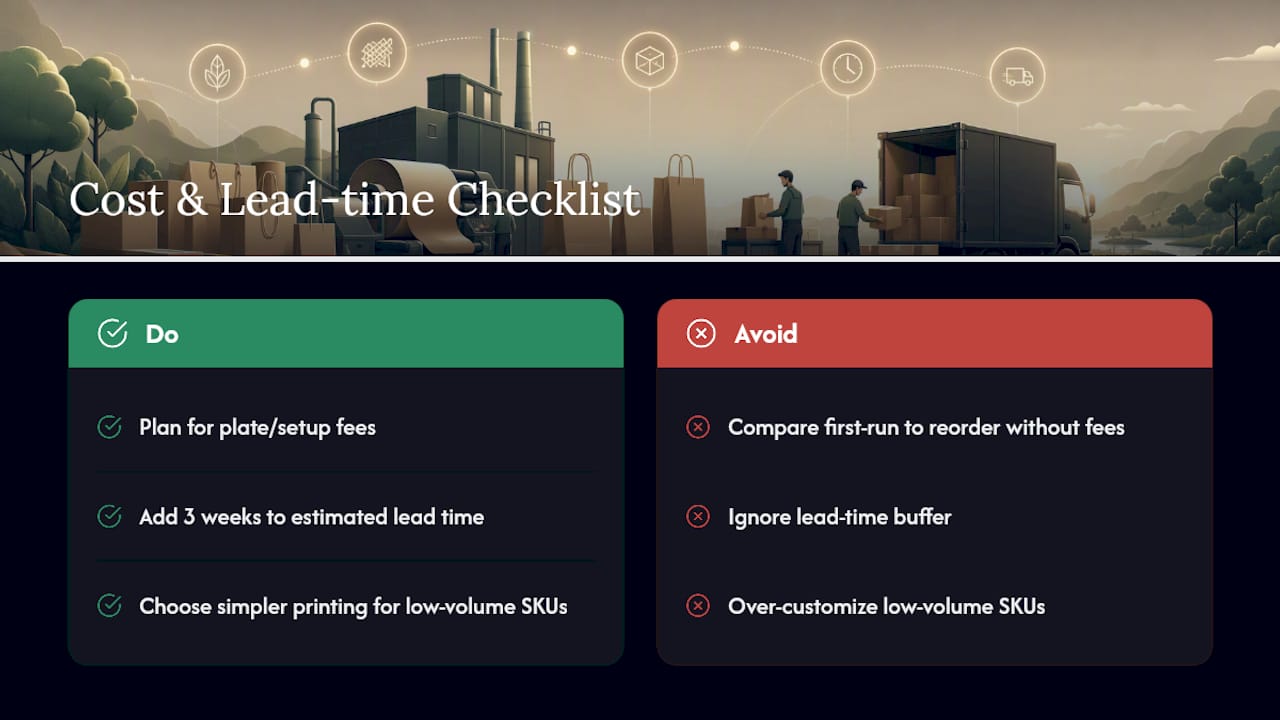
The second pattern is insufficient lead time. Retail launch dates and seasonal promotions are fixed. Bag production is not always fast, especially when artwork revisions push back proof approval. The correction is simple: add three weeks to whatever lead time you think you need, and get your dieline and Pantone references ready before you send the RFQ.
Over-customization on low-use SKUs is the third. A specialty bag for a limited-edition product that moves 500 units doesn’t need four-color laminated printing. A two-color kraft bag does the job at a fraction of the cost and keeps the SKU manageable.
Work with Gatherpackaging on your next paper bag order
Gatherpackaging manufactures custom paper shopping bags in Toronto for retail brands and procurement teams across North America. Domestic production means shorter lead times, no import complexity, and QA you can verify at every stage, from prototype through final run.
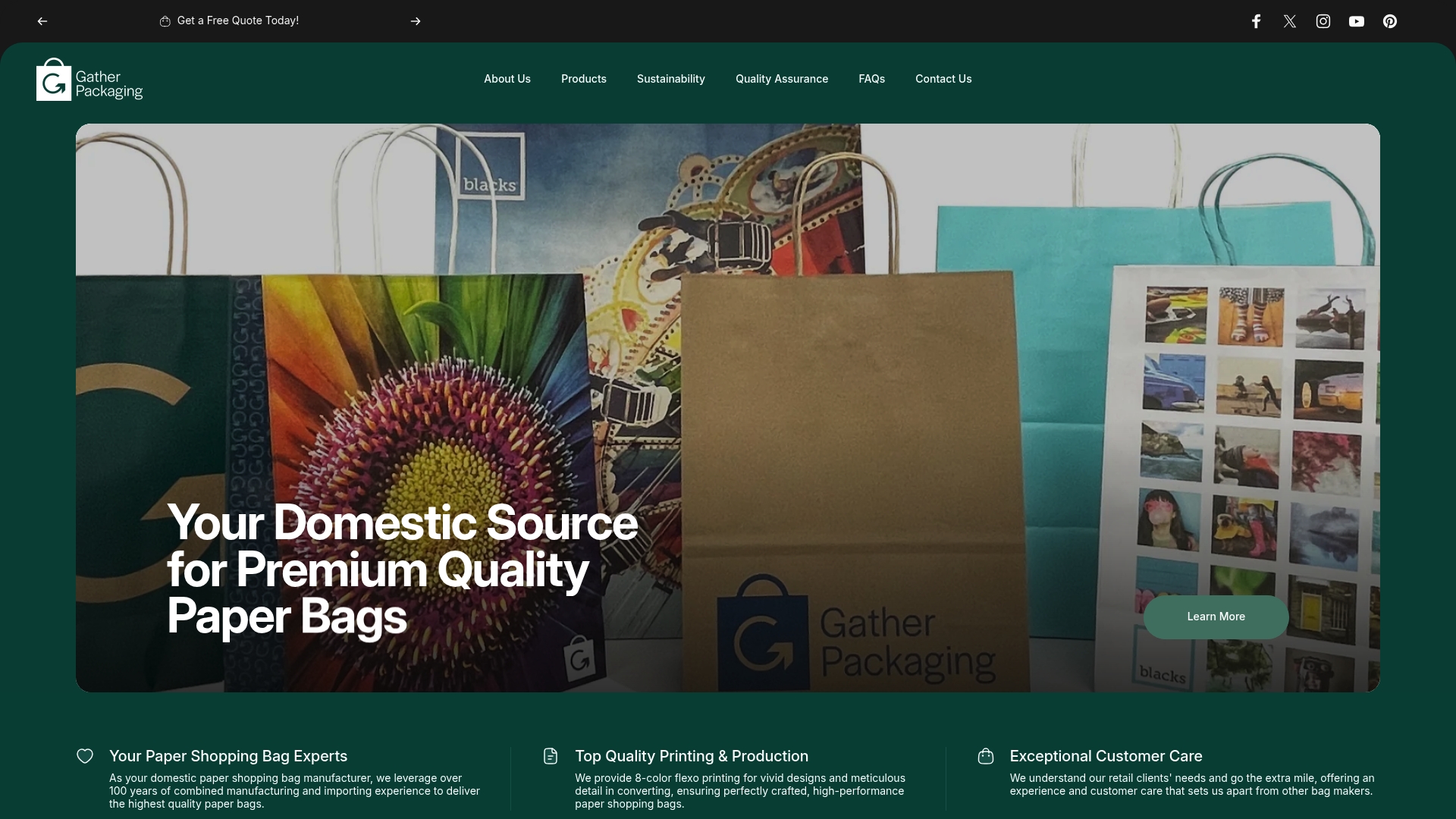
The process is straightforward: request a sample kit to confirm material and print quality, send an RFQ using the checklist above, and review a physical prototype before production begins. FSC® and recycled-content options are available across the range, and 8-color flexo printing handles everything from a clean two-color logo to full-brand coverage.
Contact Gatherpackaging through Gatherpackaging to discuss your bag specs, request samples, or get a quote. If you know your dimensions and quantity, you can get a preliminary price in one conversation.
Share:
GSM to LB Paper Conversion: Formulas and Charts
How Retail Paper Bags Are Palletized for DC Delivery