

Converting paper weight from GSM to lb (and back) takes one formula and one critical detail: the paper family. Here are the three quick conversion factors you’ll use most often for bag and retail-packaging specs:
- Text/Offset: lb = gsm ÷ 1.48
- Cover: lb = gsm ÷ 2.704
- Bond/Writing: lb = gsm ÷ 3.76
The full formula behind all three is: gsm = (lb × 1406.43) ÷ parent sheet area (in²). The constant 1406.43 comes from converting pounds per ream into grams per square meter, and the parent sheet area is what changes by family.
Quick example: a 120 gsm kraft stock converts to approximately 81 lb text or about 44 lb cover, illustrating how the same sheet can have different pound numbers depending on the family. Same sheet, but two very different pound numbers depending on which family you reference.
Key Takeaways
Converting paper weight accurately requires the formula, the family, and a physical sample — GSM alone is not enough to guarantee bag performance.
| Point | Details |
|---|---|
| Use GSM as your primary spec | GSM is grade-independent and consistent across suppliers; lb figures require a named family to be meaningful. |
| Name the family when using lb | Bond, Text/Offset, and Cover use different parent sheet sizes, so the same lb number means different masses across families. |
| Apply the correct factor | Divide GSM by 1.48 for Text/Offset, 2.704 for Cover, or 3.76 for Bond to get the approximate lb equivalent. |
| Request caliper alongside GSM | Caliper in points or mils determines fold performance and handle strength — grammage alone does not. |
| Gatherpackaging supports prototyping | Gatherpackaging provides specification advice, prototype runs, and QA checks for retail paper bag orders from its Toronto facility. |
Table of Contents
- Why does paper family change the GSM to lb conversion?
- Conversion chart: common GSM values across all three families
- How to work through GSM and lb conversions step by step
- Buying and printing tips: when GSM beats lb, and why caliper matters
- Why procurement teams and manufacturers prefer GSM plus samples
- A manufacturer’s perspective on GSM, caliper, and samples
- Gatherpackaging’s specification and prototyping services for paper bags
- Sources
Why does paper family change the GSM to lb conversion?
Basis weight is defined as the weight in pounds of 500 sheets cut to a specific parent-sheet size. The catch: each paper family uses a different parent size.
- Bond/Writing: 17 × 22 in (374 in²)
- Text/Offset: 25 × 38 in (950 in²)
- Cover: 20 × 26 in (520 in²)
Because the parent sheet areas differ, the same physical sheet of paper produces a different pound number depending on which family’s parent size you divide by. A 90 gsm sheet can correspond to different pound weights depending on the paper family, such as bond, text, or cover, because of differing parent sheet sizes. None of those numbers are wrong; they’re just measuring against different reference sizes.
The constant 1406.43 enters the picture when you convert the unit system. One pound equals 453.592 grams, and one square inch equals 0.000645 m². Multiply those out across a 500-sheet ream and you arrive at 1406.43 as the universal scaling factor. Divide it by the parent sheet area in square inches and you get the per-family multiplier.
Procurement note: Before converting any lb figure, confirm the paper family. An 80 lb text stock and an 80 lb cover stock are physically very different sheets. For bag material, Text/Offset and Cover are the families you’ll encounter most often; Bond appears mainly in writing and office papers.
Pro Tip: When a supplier quotes a pound weight without naming the family, ask. “80 lb” is incomplete information. The family is not optional detail — it changes the actual mass of the sheet by a factor of nearly two.
Conversion chart: common GSM values across all three families
The table below maps common GSM values to approximate pound equivalents for Bond, Text/Offset, and Cover. Figures are rounded to the nearest whole pound using the standard per-family factors.
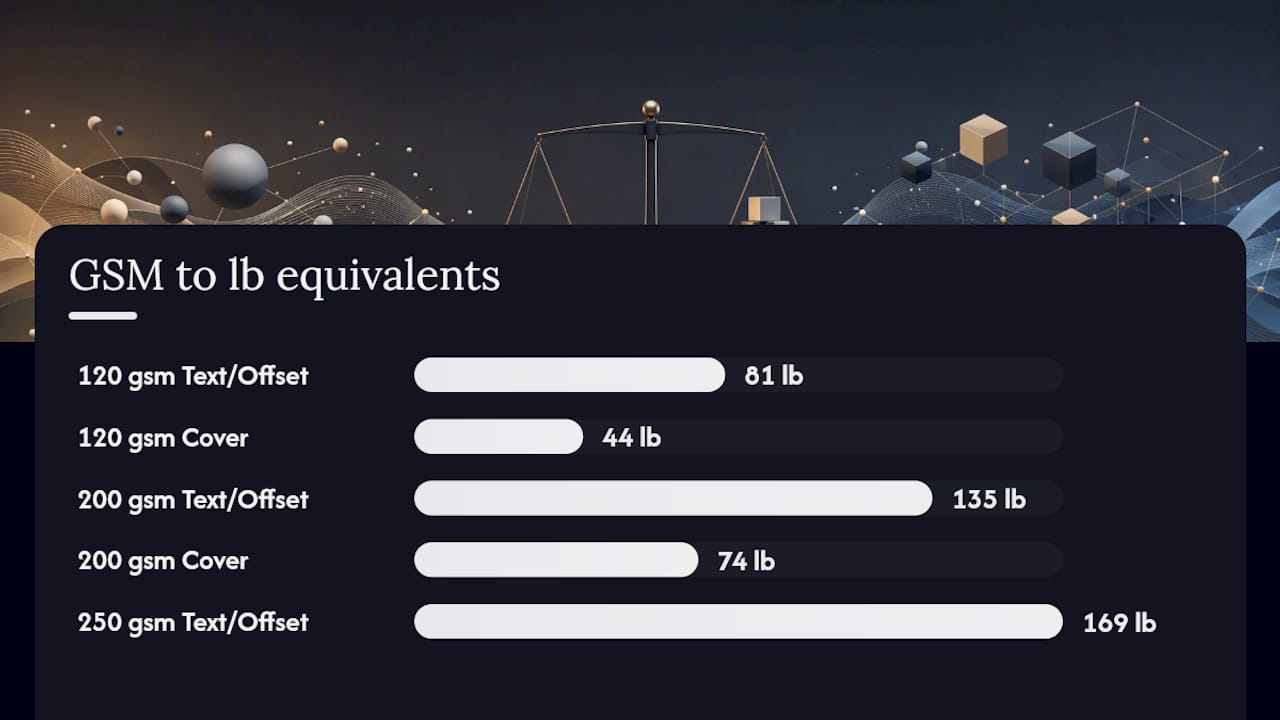
26 | | 80 | — | — | — |
| 90 | — | — | — |
| 100 | — | — | — |
| 120 | — | 81 | 44 | | 150 | — | 101 | — | | 200 | — | 135 | 74 | | 250 | — | 169 | — | | — | 80 | — | — | | — | — | — | 129 |
For retail paper shopping bags, the 120–250 gsm range is where most specs land. A lightweight gift bag or boutique tote typically runs 120–150 gsm (roughly 81–101 lb text). A heavier carry bag or kraft grocery-style bag often falls in the 200–250 gsm range (135–169 lb text). The Cover column is most relevant when a bag stock is specified against card or board grades.
Two quick reads from the table worth noting:
- 200 gsm converts to 135 lb text or 74 lb cover. If a supplier quotes “80 lb cover,” that’s about 216 gsm — noticeably heavier than a 200 gsm spec.
- 120 gsm converts to 81 lb text. ClearPrint’s FAQ cites 80 lb text ≈ 120 gsm as a standard reference point, which confirms the table’s rounding.
How to work through GSM and lb conversions step by step
Three worked examples cover the families procurement teams encounter most often.
1. Bond: converting 20 lb bond to GSM
Bond paper shows up in liner sheets and some specialty wraps. Using the formula:
gsm = (lb × 1406.43) ÷ 374 (Bond parent area) gsm = (20 × 1406.43) ÷ 374 = 28,128.6 ÷ 374 = 75 gsm
Verification: Papersizes shows that 75 gsm is a standard lightweight sheet, consistent with 20 lb bond being a thin writing-grade stock. Ask your supplier to confirm the parent size is 17 × 22 in if you’re sourcing Bond-grade material.
2. Text/Offset: converting 200 gsm kraft to lb text
This is the most common conversion for retail bag buyers. A 200 gsm kraft stock:
lb text = gsm ÷ 1.48 = 200 ÷ 1.48 = 135 lb text
That’s a heavy text weight, near the upper boundary of the Text family. Some suppliers will classify this stock as a light Cover instead. Ask which grade they’re using before finalizing the spec, because the pound number on the invoice will differ by family even though the physical sheet is identical.
3. Cover: converting 80 lb cover to GSM
Cover stocks are common for rigid shopping bags and heavier boutique carriers.
gsm = (lb × 1406.43) ÷ 520 (Cover parent area) gsm = (80 × 1406.43) ÷ 520 = 112,514.4 ÷ 520 = 216 gsm
Color Vision Printing lists 100 lb cover ≈ 271 gsm as a reference point, which tracks: 80 lb cover at 216 gsm sits proportionally below that. Confirm with your supplier that the parent sheet is 20 × 26 in when ordering Cover-grade bag stock.
Buying and printing tips: when GSM beats lb, and why caliper matters
For international sourcing and cross-supplier consistency, specify GSM. It’s a direct mass-per-area measurement with no family ambiguity. OKI’s paper weight guide makes this point plainly: GSM is grade-independent, which means two suppliers in different countries reading the same GSM spec are measuring the same thing.
Lb still appears throughout North American print and packaging supply chains, so you’ll need to speak both languages. The practical rule: use GSM in your written spec, and translate to lb only when a North American supplier requires it, always naming the family.
Caliper (thickness) is a separate measurement from grammage, and for bags it often matters more. PrinterArchive’s guide explains that density (gsm divided by caliper) determines how thick a sheet feels for a given weight. Two sheets at 200 gsm can have different calipers depending on whether the stock is calendered, coated, or bulky uncoated. For shopping bags, caliper affects:
- Folding and creasing: a low-caliper sheet at high gsm can crack at fold lines on automated bagging lines
- Handle punch-out strength: thicker stocks hold die-cut handles better under load
- Print surface: coated stocks at the same gsm as uncoated will feel stiffer and show finer halftones
Ordering tips for procurement teams:
- Request caliper in points (thousandths of an inch) or mils alongside the GSM spec
- Ask for a finish sample before approving a run — coated and uncoated stocks at the same GSM look and handle differently
- Confirm coated vs. uncoated with your printer; coated stocks require different ink settings for 8-color flexo work
- State the paper grade (Text, Cover, Bond) explicitly on every purchase order, not just the pound number
Pro Tip: Request GSM, caliper in points, and a physical prototype together. A spec sheet alone won’t tell you how a 200 gsm kraft bag feels when loaded or how the fold holds after 48 hours in a retail environment. The sample will.
Why procurement teams and manufacturers prefer GSM plus samples
ISO 536 defines grammage as the mass in grams of a 1 m² sheet and provides the standard test method for measuring it. Because the measurement is tied directly to a physical area, it’s consistent across suppliers, countries, and paper grades. A 200 gsm sheet is 200 gsm whether it’s made in Canada, Germany, or South Korea.
The U.S. pound system doesn’t offer that consistency. As Wikipedia’s basis weight article documents, the same pound figure means different physical masses depending on the family’s parent sheet. That ambiguity creates real procurement risk: a buyer who specifies “135 lb” without naming the family could receive a Text-grade sheet or a Bond-grade sheet, and they won’t weigh the same.
Industry practice: Printer and vendor guidance consistently recommends specifying GSM for international procurement while asking for caliper and prototypes for any structural item such as a bag. Combining GSM with a caliper spec and a physical sample reduces cross-supplier ambiguity to near zero.
For retail packaging specifically, grammage alone doesn’t guarantee folding or strength performance. ISO also publishes adjacent standards governing caliper and density measurements, which underpin why a complete bag specification needs both grammage and thickness data. A 200 gsm sheet that’s been heavily calendered will behave differently on a bag-making line than a bulkier 200 gsm uncoated kraft, even though both pass a GSM test.
Practical steps for a complete bag specification:
- State GSM as the primary weight reference
- Add caliper in points or mils
- Specify coated or uncoated, and surface finish (gloss, matte, natural kraft)
- Request a prototype run before committing to full production volume
- Run a paper bag QA checklist on the prototype to verify fold, handle strength, and print registration
A manufacturer’s perspective on GSM, caliper, and samples
At Gatherpackaging, every bag specification starts with three numbers: GSM, caliper, and the intended finish. Not because it’s procedural, but because those three inputs are what actually predict how a bag will perform on the line and in a customer’s hand.
Pound weights create confusion in cross-border procurement. A retail brand sourcing from a North American supplier and a European mill simultaneously will get two different pound figures for the same physical stock unless someone converts to GSM first. Domestic manufacturing in Toronto helps reduce that lag — when a buyer needs a prototype turned around quickly to verify a spec, proximity matters. There’s no six-week ocean freight window between a spec question and a physical sample.
The step-by-step paper bag design guide on the Gatherpackaging site walks through how to define material specifications before production begins. Procurement teams with an active bag spec are welcome to contact Gatherpackaging directly to discuss GSM, caliper, and prototype options.
Gatherpackaging’s specification and prototyping services for paper bags
Gatherpackaging manufactures custom kraft paper bags in Toronto, which means a procurement team can move from a GSM spec to a physical prototype without the delays that come with offshore sourcing. The practical advantage: you confirm fold performance, handle strength, and print registration on a real sample before committing to a full production run.
Services relevant to buyers working through a paper weight conversion:
- Specification advice on GSM, caliper, and paper grade for your bag style and load requirements
- Prototyping to verify how a chosen stock performs at fold lines and handle punch-outs
- 8-color flexo printing on coated and uncoated stocks, with color accuracy checks built into the QA process
- Sustainable material options including FSC®-certified and recycled-content stocks for brands with environmental commitments
Contact Gatherpackaging to discuss your bag spec, request a sample, or get a quote on a custom run.
Share:
Tamper Evident Paper Bags: A Procurement Buyer's Guide
Paper Bag Pricing: Wholesale & Custom Costs for Brands