
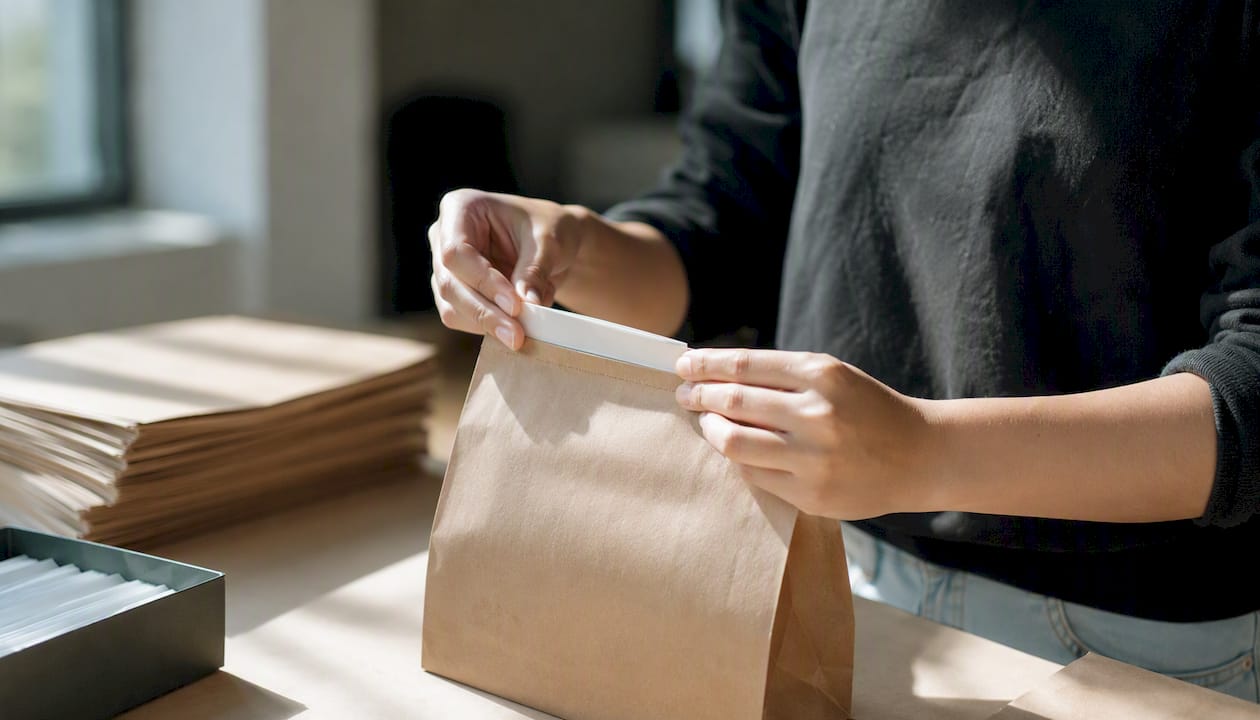
For foodservice and retail procurement, the right call is a kraft paper bag with an integrated single-use adhesive pull-tab or perforated tear-away flap. That combination gives you visible tamper evidence, a recyclable substrate, and a closure staff can apply without slowing down the packing line. Here is what to specify, what to ask suppliers, and where to start:
- Best for food delivery/QSR: Single-use peel-and-seal adhesive strip on a kraft delivery bag (flat or SOS bottom)
- Best for retail handoff: Perforated tear-away flap or fold-over panel with pull tabs
- Sustainability baseline: FSC® certified or recycled kraft, water-based inks, no PVC adhesive
- Next step: Contact Gatherpackaging to request samples and a lead-time quote for your volume and size requirements
Key Takeaways
Tamper-evident paper bags perform best when the seal mechanism, substrate, and packing workflow are specified together from the start.
| Point | Details |
|---|---|
| Match seal to workflow | Peel-and-seal adhesive strips suit high-volume QSR; perforated flaps suit retail and pharmacy handoffs. |
| Specify substrate and adhesive together | Test adhesive performance on your exact GSM and recycled-content level before approving production. |
| Require a structured sample program | Request an unprinted structural sample, a sealed production sample, and a packaged mock order before committing. |
| Demand sustainability credentials | Specify FSC® certification, recycled content percentage, and water-based inks for food-contact and eco compliance. |
| Gatherpackaging for domestic supply | Gatherpackaging manufactures custom tamper-resistant bags in Toronto with 8-color flexo printing and a full sample and QA program. |
Table of Contents
- What types of tamper-evident paper bags should you choose?
- How do tamper-evident seals show tampering?
- What materials and compliance specs should you require?
- Common sizes, case counts, and ordering logistics
- Printing, handles, and finishing options that affect seal performance
- Procurement checklist: what to ask suppliers and red flags to avoid
- Quality assurance, proofing, and sample requests
- Gatherpackaging’s capabilities for tamper-evident paper bags
- What procurement teams learn after deployment
- Gatherpackaging: custom tamper-evident bags for North American buyers
- Sources
What types of tamper-evident paper bags should you choose?
The seal mechanism is the most consequential spec decision. Get it wrong and you either slow your packing team or give customers a seal they can defeat with a thumbnail.
- Perforated/tear-away flap: A sealable flap with a scored perforation line. Opening the bag tears the perforation visibly and irreversibly. Patent literature confirms this is one of the most common embodiments for paper delivery bags. Best fit: multi-item delivery orders, ghost kitchens, QSR.
- Adhesive pull-tab (peel-and-seal): A single-use pressure-sensitive strip under a release liner. Staff peel the liner and press the flap closed. Reopening leaves a visible gap or residue. Best fit: high-volume takeout, third-party delivery platforms.
- Fold-over paperboard panel with tabs: A separate panel folds over the bag opening and is secured to the sides; pulling the tabs tears the perforations and shows tampering. Best fit: pharmacy handoffs, premium retail, prescription bag programs.
- Tamper-evident label bridge: A security label spans the bag’s opening seam. Removal leaves a VOID message or residue. NCCO’s food-safety guidance notes these labels build consumer trust and support accountability across delivery and takeaway formats. Best fit: retail merchandise, add-on security for existing bag stock.
Handle and bottom style interact with your seal choice. Twist-handle bags typically seal above the handle attachment; die-cut handles require a flap that clears the cutout. SOS flat-bottom bags pair well with adhesive strips because the standing base keeps the bag stable during sealing.
Pro Tip: Pick the closure that matches your packing flow first, then verify security level. A tear-away flap applied inconsistently is less secure in practice than a peel-and-seal strip applied correctly every time.
How do tamper-evident seals show tampering?
Knowing what a compromised seal looks like is as important as knowing how to apply one. Train staff on both.
Sealing steps by closure type:
- Pack the order and fold the bag top to the correct closure height.
- Peel-and-seal: Remove the release liner from the adhesive strip, fold the flap down, and press firmly for 3–5 seconds along the full width.
- Tear-away flap: Fold the perforated flap over the bag opening and press the adhesive tabs to the bag sides.
- Label bridge: Center the label across the bag’s opening seam and press from center outward to remove air pockets.
- Hand off or bag the order within 60 seconds of sealing to preserve adhesive bond.
What tampering looks like:
- Peel-and-seal: Visible gap between flap and bag body; adhesive residue on one or both surfaces; flap will not lie flat on reclose attempt.
- Tear-away flap: Torn or ragged perforation line; flap hangs loose or is missing entirely.
- Label bridge: VOID pattern printed on the label surface or substrate; label corners lifted; residue on the bag where the label was removed.
Integrated tamper-indicating bags go further: release materials and ink layers are built into the bag during manufacture so that pulling the adhesive removes portions of an ink layer and reveals a void message. That approach is more tamper-resistant than an external label because the evidence cannot be transferred to a replacement bag.
Pro Tip: Keep a sealed reference sample at the packing station. Staff can compare a freshly sealed bag against the reference before handoff, catching adhesive failures before the order leaves the kitchen.
What materials and compliance specs should you require?
Substrate choice affects seal performance, food safety, and recyclability. Specify all three together.
- Virgin kraft (70–120 GSM): High tensile strength, consistent surface for adhesive bonding. Standard for retail shopping bags and premium delivery bags.
- Recycled kraft (70–100 GSM): Lower virgin fiber content; surface porosity varies by recycled content percentage. Adhesive and VOID tape performance must be tested on the actual stock. Procurement teams should always test tamper-evident adhesives on the exact paper stock and print finish used, since high recycled content can change adhesive behavior.
- FSC® certified options: Confirms chain-of-custody for virgin fiber. Request the supplier’s FSC® certificate number and scope.
For food-contact delivery bags, specify grease-resistant treatment or a food-contact safe liner. Grease migration can degrade adhesive bonds on peel-and-seal strips, so the grease barrier needs to stop short of the sealing zone or use a compatible adhesive chemistry.
On sustainability: paper-based VOID tapes engineered for porous substrates now deliver permanent, irreversible VOID messages on recycled paper, closing the gap between plastic-free mandates and security performance. If your brand has a no-plastic-film policy, specify paper VOID tape or an integrated ink-layer system rather than a polyester-film label.
Credentials to request from any supplier: FSC® certificate, recycled content percentage (pre- or post-consumer), food-contact compliance documentation (FDA 21 CFR or equivalent Canadian standard), and water-based ink confirmation for printed areas. Gatherpackaging’s kraft paper bag options cover FSC-certified and recycled-content stocks with water-based inks as standard.
Common sizes, case counts, and ordering logistics
Bag fit matters more than most buyers expect. A delivery bag that is too wide lets containers shift and can stress the seal; one that is too narrow forces overpacking and breaks the flap fold.
Units per case and case count vary by supplier and substrate weight. Confirm the count details in your quote, not the catalog default.
Ordering logistics to confirm before placing an order:
- MOQ: Custom-printed tamper-evident bags typically carry a minimum order quantity. Ask for it upfront; some suppliers offer a small pilot run for new programs.
- Sample availability: Request an unprinted structural sample and a sealed production sample before approving artwork. A structured sample program reduces launch risk and should be written into the purchase order.
- Lead time: Domestic North American manufacturing shortens lead times versus offshore. Confirm weeks from proof approval to ship date, not from order date.
- FOB terms and freight: Clarify whether pricing is FOB origin or delivered. For large case counts, freight can shift the landed cost meaningfully.
- Payment terms: Net 30 is standard for established accounts; new accounts may require a deposit.
Printing, handles, and finishing options that affect seal performance
Customization decisions upstream of the seal zone can either protect or undermine tamper-evident performance.
- Flexo printing (up to 8 colors): Water-based inks are compatible with most adhesive chemistries. Specify a clear, unprinted seal area on the artwork file. Heavy ink coverage or varnish in the sealing zone reduces adhesive bond strength.
- Handle types: Twist handles attach below the bag top and do not interfere with flap seals. Die-cut handles require the seal flap to clear the cutout; confirm the flap geometry with your supplier before finalizing the die. Flat ribbon handles work well on retail bags where the seal is a label bridge rather than a folded flap.
- Reinforced bottoms and gussets: SOS flat-bottom construction with side gussets gives delivery bags stability and keeps the bag upright during sealing. Specify a reinforced bottom for orders over 3 lbs.
- Internal receipt pocket: A printed receipt area or glued pocket near the bag top lets drivers and customers verify order contents alongside the seal check.
Pro Tip: Send your supplier a sealed mock-up photo showing exactly where the seal lands relative to your print design. Artwork revisions after tooling is cut cost time and money.
Gatherpackaging’s custom printing capabilities include 8-color flexo with water-based inks and physical press proofs, so you can verify seal-zone clearance before production runs.
Procurement checklist: what to ask suppliers and red flags to avoid
Use this list in your RFQ. Any supplier who cannot answer these questions clearly is a risk.
- What is the seal mechanism (adhesive pull-tab, perforated flap, label bridge, integrated ink layer)?
- What adhesive specification is used, and has it been tested on your specific paper stock and recycled content level?
- What is the substrate GSM and fiber source (virgin, recycled, FSC®)?
- Can you provide FSC® certificate number and food-contact compliance documentation?
- What is the sample process: unprinted structural, sealed production sample, and packaged mock order?
- What are lead times from proof approval to ship date?
- What is the MOQ for custom-printed bags, and is a pilot run available?
- What are your printing limits (colors, coverage, seal-zone clearance)?
- Can you provide QA test reports for adhesive performance and seal integrity?
Red flags:
- No sample sealing test offered before production
- Cannot confirm adhesive compatibility with your paper stock
- Lead time quoted from order date, not proof approval
- Hidden surcharges for color matching or die setup not disclosed upfront
- No food-contact documentation for delivery bag applications
Decision criteria to weight: seal security performance first, then recyclability and sustainability credentials, then domestic lead time, then print quality, then unit cost. Lowest unit cost on a bag with an unreliable seal is not a saving.
Quality assurance, proofing, and sample requests
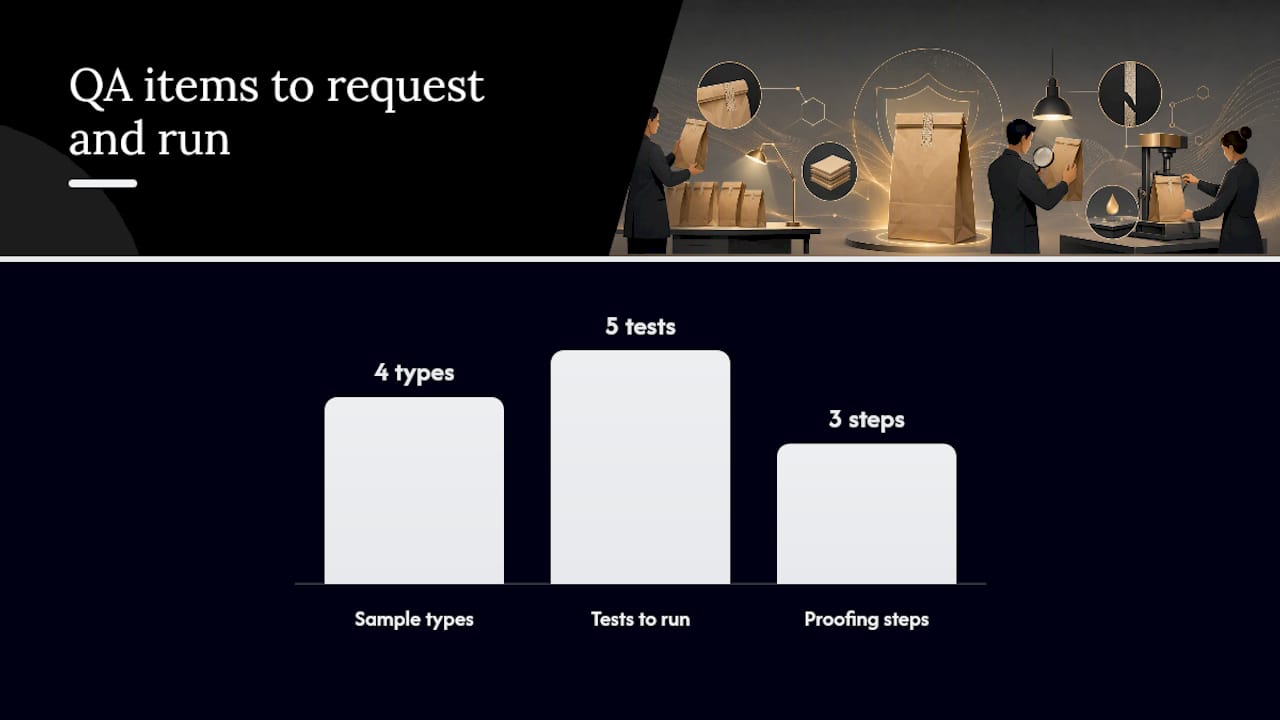
QA for tamper-evident bags has more steps than standard shopping bags because the seal mechanism itself needs to be tested, not just the bag structure.
Sample types to request:
- Unprinted structural sample (confirm dimensions, GSM, handle, bottom construction)
- Sealed production sample with the actual adhesive or perforation applied
- Printed press proof with seal area marked
- Packaged mock order: fill the bag with representative contents, seal it, and photograph the sealed and opened states
Tests to run on samples:
- Handle pull test: load the bag to the maximum intended weight and lift by the handles for 60 seconds.
- Bottom standing test: set the loaded bag on a flat surface; the bottom should not bow or split.
- Seal integrity test: attempt to open the sealed bag by hand and photograph the result. The seal should show clear, irreversible evidence of opening.
- Grease resistance spot check: place a greasy food item against the interior wall for 15 minutes and inspect the exterior and seal zone.
- Food-contact check: confirm the interior surface and any coating meet applicable food-contact standards.
Proofing and acceptance steps:
- Approve the digital proof (dimensions, print layout, seal-zone clearance).
- Approve the physical press proof before full production.
- For high-value or high-volume programs, run a small pilot batch and verify seal performance across the full case count before committing to the full order.
Buyers should test samples with the real order — load test, handle pull, standing, and seal behavior checks are the minimum pre-production QA steps.
Gatherpackaging’s capabilities for tamper-evident paper bags
Gatherpackaging manufactures tamper-resistant paper bags from its Toronto facility, giving North American buyers domestic lead times without the freight and customs exposure of offshore supply.
Core capabilities buyers care about:
- Tamper-resistant bag formats: perforated flap, tear-away strip, and integrated closure options
- FSC® certified and recycled-content kraft substrates with water-based inks
- 8-color flexo printing with seal-zone clearance built into the artwork process
- Prototyping and physical sample program before production commitment
- QA testing for adhesive performance, handle pull, and seal integrity
- Logistics support and domestic shipping from Toronto
Gatherpackaging works with retail brands, foodservice operators, and procurement teams on custom programs from initial spec through ongoing supply. The domestic manufacturing advantage is real: shorter lead times mean you can respond to menu or program changes without carrying months of safety stock.
Pro Tip: When you contact Gatherpackaging, bring your current bag dimensions, your weekly volume estimate, and a photo of the seal type you are currently using. That gives the team enough to quote accurately on the first call.
What procurement teams learn after deployment
The seal type that looks best on paper does not always win in a real packing environment. Peel-and-seal adhesive strips are fast when staff are trained, but the first week typically surfaces two issues: bags sealed before the order is complete (because the liner is removed too early) and bags where the strip is pressed only at the center, leaving the edges open.
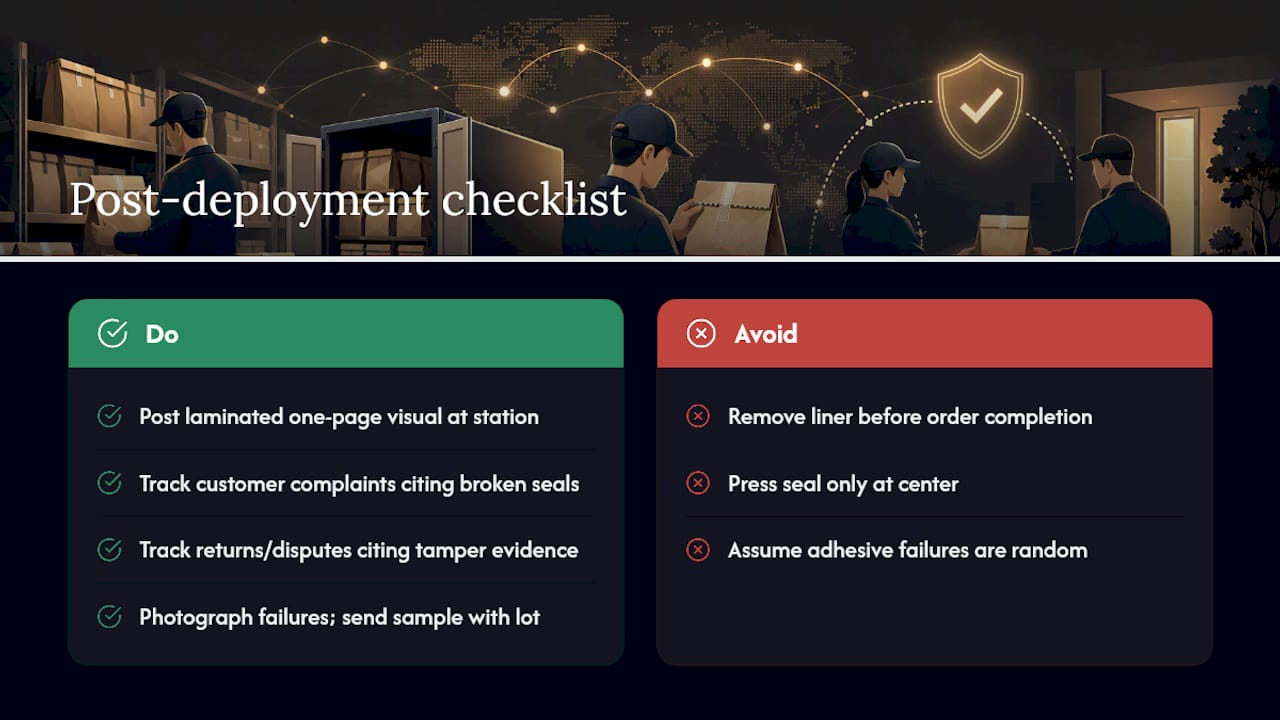
Both problems are training issues, not product failures. A laminated one-page visual at the packing station, showing the correct seal sequence and what a properly sealed bag looks like, cuts those errors quickly.
Post-deployment, track three things: customer complaints citing a broken or missing seal, returns or disputes where tamper evidence was cited, and any adhesive failures you catch during outbound QA. A handful of adhesive failures in the first case usually points to a substrate compatibility issue, not a random defect. Pull a sample from that case, photograph the failure mode, and send it to your supplier with the lot number. A supplier with a real QA program will trace it.
Gatherpackaging: custom tamper-evident bags for North American buyers
Gatherpackaging manufactures custom tamper-evident paper bags domestically in Toronto, which means your samples arrive faster, your proofs get approved sooner, and your production run ships without the lead-time uncertainty of overseas supply.
The process is straightforward: request a sample to confirm the bag format and seal type, submit your artwork for a press proof with seal-zone clearance confirmed, approve the proof, and move to production. Gatherpackaging’s team handles custom printing and eco-friendly material options including FSC® certified and recycled kraft, water-based inks, and multiple closure formats. Contact Gatherpackaging to request samples, discuss your volume and size requirements, and get a custom quote.
Share:
Custom Store Paper Bags: A Procurement Guide for Retail Brands
GSM to LB Paper Conversion: Formulas and Charts