

TL;DR:
- A single compromised product can ruin months of brand trust, emphasizing the importance of tamper-resistant packaging. Using eco-friendly, durable materials and implementing structured processes ensures seal integrity and compliance while supporting sustainability goals. Regular inspection, troubleshooting, and team training are essential to prevent failures and maintain genuine security in packaging operations.
A single compromised product on a shelf can unravel months of brand equity. Whether you operate a specialty food business, a retail apparel brand, or a high-volume foodservice operation, the stakes around packaging integrity are real and rising. Consumers expect their products to arrive untouched, and regulators expect documented proof. This guide walks you through the materials, process steps, verification protocols, and troubleshooting strategies you need to build a tamper-resistant packaging workflow that is both airtight and genuinely eco-friendly.
Table of Contents
- Key materials and tools for tamper resistant packaging
- Step-by-step: Tamper resistant packaging process
- Quality assurance: Verification and testing for tamper evidence
- Common pitfalls and troubleshooting tips
- Why sustainable tamper resistant packaging calls for a scientific mindset
- Next steps: Get durable, sustainable tamper resistant packaging solutions
- Frequently asked questions
Key Takeaways
| Point | Details |
|---|---|
| Use a tiered QA process | Combine visual inspections with sensitive leak-detection methods to ensure robust tamper resistance. |
| Prioritize controlled, data-driven sealing | Manage heat/pressure parameters systematically to prevent weak points and seal failures. |
| Select eco-friendly, high-integrity materials | Opt for materials that meet both security and sustainability goals, without compromising product safety. |
| Document every step | Detailed records support compliance, continuous improvement, and rapid troubleshooting. |
| Troubleshoot proactively | Monitor for common issues and fix variability before it leads to safety or brand problems. |
Key materials and tools for tamper resistant packaging
To get started, you’ll need the right eco-responsible materials and specialized tools. The good news is that sustainable options have caught up with conventional packaging in both durability and seal strength. You no longer have to sacrifice barrier performance to reduce your environmental footprint.
Eco-friendly material options worth considering include:
- Recycled fiber bags made from post-consumer waste, suitable for retail and foodservice with proper coatings
- Compostable films derived from plant starch, which work well for short-shelf-life food products
- Water-based adhesives that bond effectively without relying on solvent chemistry, reducing VOC emissions
- FSC-certified paper sourced from responsibly managed forests, verifiable through chain-of-custody documentation
The right combination depends on your product category, your distribution environment, and your customer’s end-use expectations.
Tamper-evident seals serve different functions depending on application. Heat seals bond layers of material together through controlled thermal energy, making them ideal for high-volume automated lines. Pressure-sensitive security labels leave a visible residue or “VOID” pattern when peeled. Security tapes work well for outer cartons or reshipment scenarios. Each method carries its own trade-offs in cost, speed, and detectability, so matching the seal type to the package format is critical.
| Seal Type | Best Application | Sustainability Factor | Detection Method |
|---|---|---|---|
| Heat seal | High-volume flexible bags | Compatible with recyclable films | Visual + sensor |
| Security label | Individual retail units | Recyclable base stocks available | Visual (void pattern) |
| Security tape | Outer cartons, reshipment | Paper-based options available | Visual |
| Compostable adhesive | Specialty food or gift items | Fully compostable | Visual |
For inspection tools, ASTM F1886 visual inspection criteria define how to evaluate seal integrity for flexible packaging using a structured visual protocol, while ASTM also describes a mass extraction leak-detection method capable of identifying very small defects when tighter tolerances are required. Understanding which tier of inspection your product category demands will guide your equipment choices.
Pro Tip: Review the tamper resistant bag features most relevant to your product category before locking in a material specification. Small design details, like serrated or turn-top closures, can reinforce seal performance without adding cost.
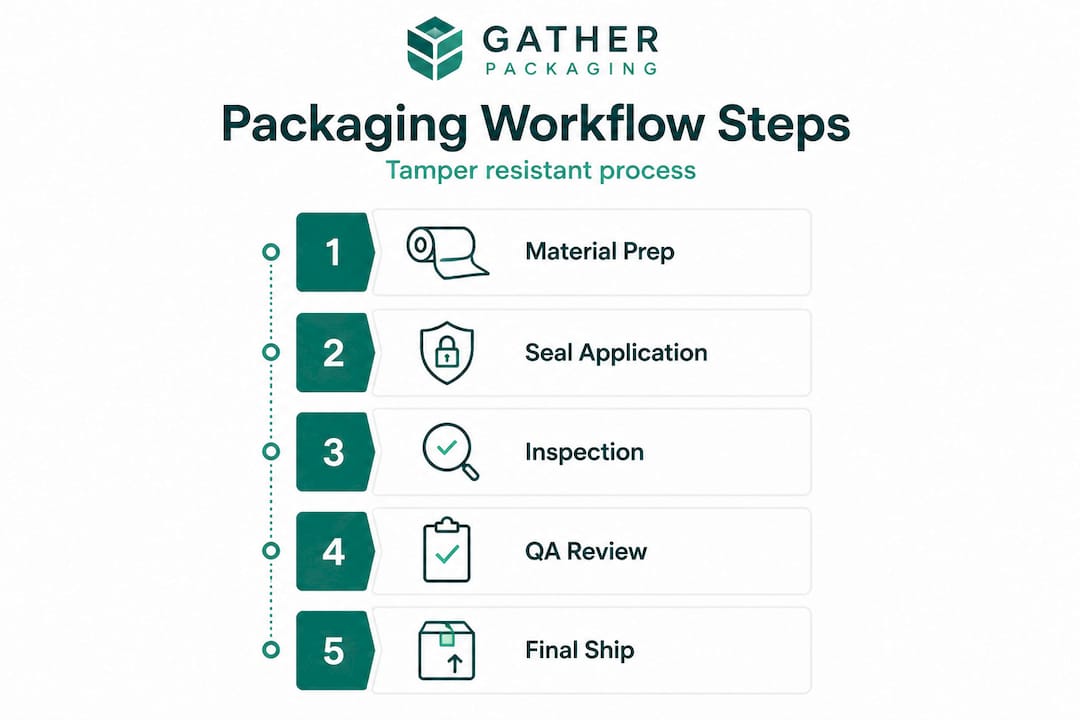
Step-by-step: Tamper resistant packaging process
With your materials assembled, let’s move step-by-step through the packaging process itself. A structured workflow reduces variability, keeps operators aligned, and makes compliance documentation far easier.
-
Select and pre-qualify your materials. Confirm that your chosen film, paper, or composite material is compatible with your sealing equipment. Run a small batch of test seals at your target parameters before committing to a production run. Check moisture content in paper-based materials, since excess humidity weakens adhesive bonds.
-
Prepare your workstation. Clean sealing bars or heat platens before every shift. Residue from previous runs can create uneven contact pressure, which leads to weak spots. If you’re using automated equipment, verify that conveyor speeds are calibrated and that temperature sensors are functioning within spec.
-
Execute a data-driven seal process. Heat sealing has shifted from “art” to science, meaning seal quality depends on controlled parameters like temperature uniformity, dwell time, and consistent line speed. Document your settings for each product SKU and treat that record as a controlled document, not a suggestion.
-
Apply tamper-evident features. Apply seals immediately after filling, not as an afterthought. For bags, a heat seal at the closure point followed by a security label over the seam gives you two independent indicators of tampering. For cartons, security tape across the full opening width prevents partial-entry attacks.
-
Automate where possible for consistency. Manual sealing introduces operator-to-operator variability that undermines your QA data. Automated bag manufacturing produces more uniform seals at higher throughput while actually reducing material waste per unit, making automation a sustainability win as much as a quality win.
-
Document every step. Record material lot numbers, seal parameters, operator IDs, and inspection results for each production run. This isn’t bureaucracy for its own sake. When something goes wrong, documented records let you trace failures to their source within minutes instead of days.
| Process Variable | Manual Sealing | Automated Sealing |
|---|---|---|
| Temperature consistency | Operator-dependent | Machine-controlled |
| Throughput speed | Low to moderate | High |
| Material waste per unit | Higher variability | Lower, optimized |
| Documentation ease | Manual logs | Automated data capture |
| Seal uniformity | Variable | Consistently repeatable |
Pro Tip: Build your custom packaging workflow documentation before you scale production, not after. Retrofitting process controls onto a live production line costs significantly more in time and rework than designing them in from the start. For additional context on reducing costs while maintaining quality, wholesale packaging tips offer a practical framework applicable to tamper-resistant operations.
Quality assurance: Verification and testing for tamper evidence
After packaging is complete, thorough verification is crucial to ensure true tamper resistance. A finished package that looks secure but passes air or liquid under pressure is a liability, not an asset.
A tiered QA approach works best:
- Tier 1: Visual inspection. Assess gross defects like open seams, wrinkled seals, misaligned closures, or visible contamination. This catches the majority of failures in high-volume lines and is the fastest way to reject bad units before they reach downstream distribution.
- Tier 2: Leak detection testing. Use sensor-based methods when product sensitivity demands it. ASTM testing programs make seal integrity and leak detection repeatable across production shifts and across facilities, giving you defensible compliance data.
- Tier 3: Destructive pull testing. Periodically sacrifice sealed samples to measure peel-force values. This confirms that your seal strength is within specification, not just visually acceptable.
For QA programs, a tiered verification approach combining visual inspection for gross defects with higher-sensitivity leak tests when micro-leaks matter reduces the risk of false acceptance based purely on human-visible indicators.
“A seal that looks good from the outside isn’t necessarily a seal that holds under distribution stress. Multi-method validation catches what the eye misses.”
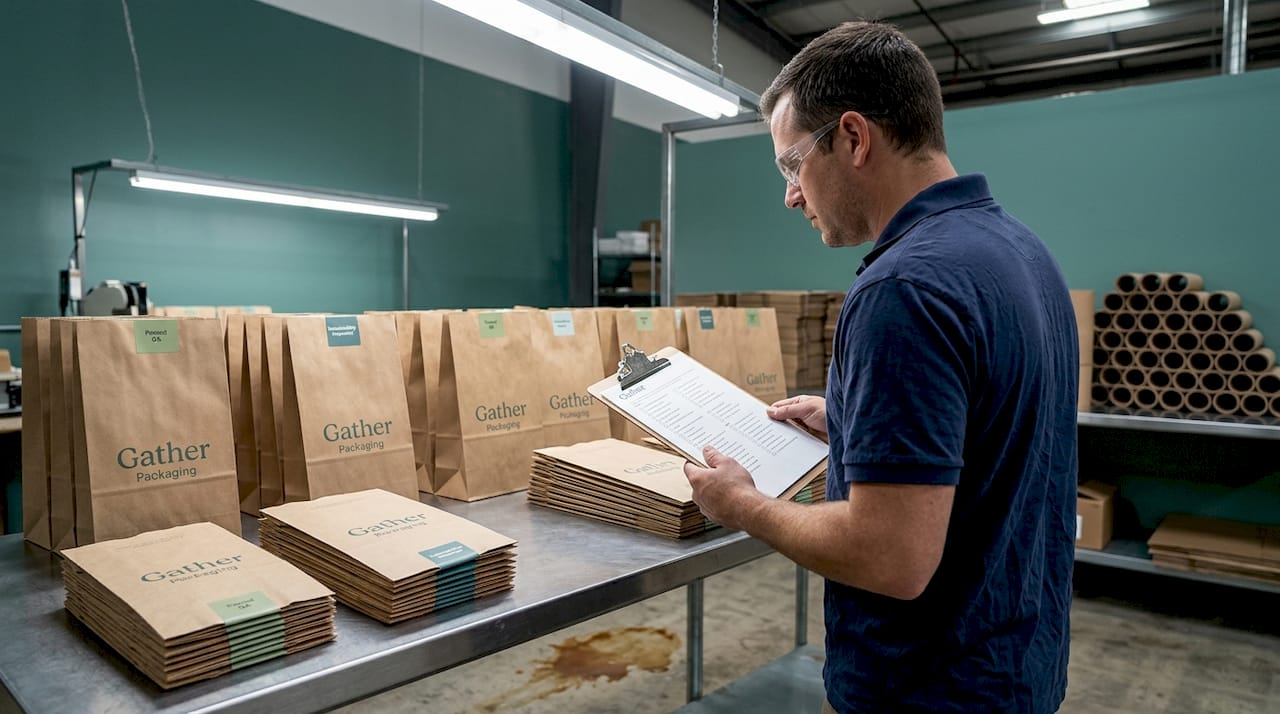
Integrating QA into production means running checks at defined intervals, not just at the beginning and end of a shift. Sample at least 5 to 10 units per hour on active lines, and increase frequency when you change materials, operators, or equipment settings. Record every result against your documented packaging quality assurance checklist to build a defensible compliance trail.
For operations scaling up, invest in quality controlled paper bags sourced from manufacturers who have already integrated multi-stage inspection into their production process. This dramatically reduces your incoming inspection burden. And if you need a structured starting point, a well-built paper bag QA checklist helps standardize evaluation criteria across your team without requiring specialized training for every inspector.
Common pitfalls and troubleshooting tips
Even well-designed systems can falter. Here’s how to spot, correct, and prevent packaging failures before they reach your customer.
-
Identify the failure mode first. Don’t adjust parameters blindly. Determine whether the failure is an incomplete seal (not enough heat or dwell time), a burned seal (too much heat), or a delaminated seal (wrong material combination). Each requires a different fix.
-
Control your temperature uniformity. Heat-seal variability creates weak points even when the overall process design is correct. Use calibrated temperature probes across the full width of your sealing bar, not just at the center. Edge temperatures often run 5 to 15 degrees cooler than the center, and that margin is enough to produce intermittent failures.
-
Manage line speed deliberately. Faster isn’t always better. Higher speeds reduce the dwell time the heat platen contacts the material, which can fall below the minimum threshold needed to fully activate an adhesive or bond a film layer. Test at your maximum intended speed, not just your average speed.
-
Watch for material lot variation. Even materials from the same supplier can vary slightly in thickness or moisture content from lot to lot. Log incoming lot numbers and run a quick test seal whenever you open a new batch. This prevents an entire production run from being compromised by a material shift you didn’t catch.
-
Address design factors proactively. Gussets, pleats, and multi-layer zones in bag construction create thickness variations at the seal zone. These spots are statistically more likely to produce common seal failures because the heat platen makes uneven contact. Work with your bag manufacturer to specify reinforced seal zones at these points.
Pro Tip: Keep a physical “failure library.” Collect one sealed sample of each defect type, label it clearly, and use it to train new operators. A visual reference of what bad looks like is far more effective than a written description.
Important callout: Studies on packaging integrity show that the majority of product tampering incidents that result in consumer harm trace back to process failures in the production environment rather than malicious external interference. Fixing your internal process controls addresses the larger share of real-world risk.
Why sustainable tamper resistant packaging calls for a scientific mindset
Here’s a perspective you won’t hear often: most packaging failures aren’t material failures. They’re discipline failures.
We’ve worked with brands that sourced excellent eco-friendly materials, invested in modern sealing equipment, and still ended up with inconsistent seal quality. The common thread wasn’t the paper or the adhesive. It was the absence of a documented, repeatable process that people actually followed every shift. Materials and equipment are the foundation, but your commitment to process discipline is the structure built on top.
The packaging industry tends to treat tamper resistance as a compliance checkbox, something you do to satisfy a retailer requirement or regulatory inspection. That mindset is exactly backward. A tamper-resistant seal that fails under real distribution stress is worse than no seal at all, because it creates false confidence. Your customer assumes the product is protected. Your quality data says it passed inspection. But the package failed in the truck between the warehouse and the store, and nobody caught it.
Sustainability adds another layer to this. When you move to eco-friendly materials, compostable films, recycled paper, water-based adhesives, you’re often working with materials that have narrower process windows than conventional plastics. That means your temperature tolerance, dwell time, and pressure settings need to be dialed in more precisely, not less precisely. A sustainable packaging workflow that treats process control as a core value, not an operational afterthought, is the only way to make sustainability and security reinforce each other.
Our view is straightforward: invest in training your team on the why behind each process parameter, not just the what. An operator who understands that a 10-degree temperature variance at the seal bar edge creates a failure zone will self-correct faster than one who only knows to push a button. That knowledge compounds over time into a culture where quality is owned by everyone on the floor, not just the QA manager.
Next steps: Get durable, sustainable tamper resistant packaging solutions
Ready to build a packaging process that delivers real security and genuine sustainability? The path from intention to execution is shorter than most brands expect when you have the right manufacturing partner behind you.

At Gather Packaging, we design and manufacture eco-friendly bag options built from FSC-certified materials, recycled content, and water-based inks, without sacrificing the seal strength and structural integrity your product requires. Our custom printed paper bags are available in tamper-resistant styles including turn-top and serrated-top configurations, fully customizable with 8-color flexo printing to align with your brand identity. Produced at our Toronto facility, our Canadian made packaging means faster lead times, lower shipping costs, and a smaller carbon footprint compared to offshore alternatives. Reach out to our team and let’s build the right solution for your operation.
Frequently asked questions
What is the difference between tamper resistant and tamper evident packaging?
Tamper resistant packaging is designed to deter or prevent unauthorized access or alteration of a product, while tamper evident packaging is designed to display a visible sign if tampering has already occurred. Many effective packaging solutions combine both features.
What’s the best verification method to ensure seals are secure?
Use a tiered approach: visual inspection catches gross defects quickly, and ASTM leak-detection methods identify micro-leaks that visual checks miss, making your QA program both fast and thorough.
How do process variables affect seal integrity?
Seal quality varies with temperature uniformity, dwell time, and line speed, so maintaining precise, documented process parameters is essential to producing consistently reliable tamper-resistant seals across every production shift.
Are sustainable materials suitable for tamper resistant packaging?
Yes. Eco-friendly materials including recycled fibers, compostable films, and water-based adhesives can be engineered and process-controlled to deliver tamper-resistant performance that meets food contact and retail compliance standards.
What if I discover a weak seal or leak in my product line?
Stop the production run immediately, isolate the suspect units, review your equipment settings and material lot records, and retest a fresh sample set using both visual and sensor-based methods before restarting production.
Share:
How packaging logistics shapes brand value and sustainability
Secondary packaging for sustainable brand growth