
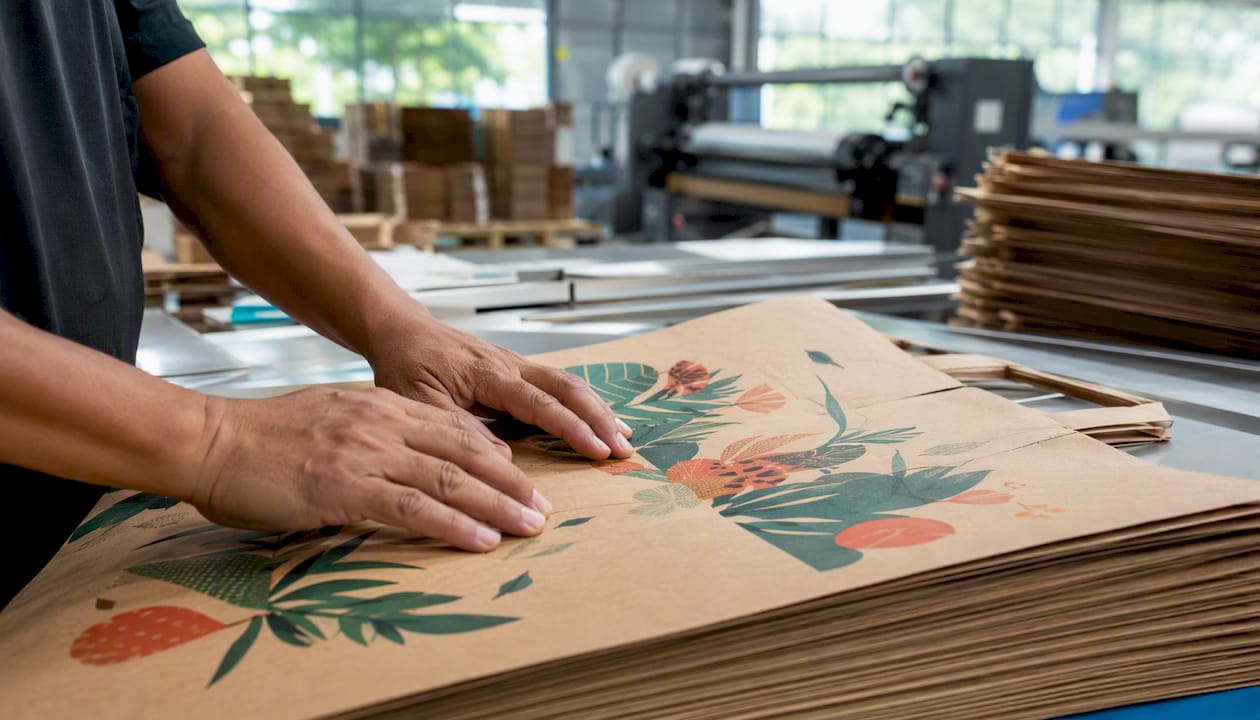
For custom store paper bags in North America, source from a domestic manufacturer with FSC-certified material options, in-house QA, and multi-color flexo printing — Gatherpackaging, manufactured in Toronto, fits that spec directly.
Three reasons procurement teams choose a domestic, certified supplier:
- FSC® and PEFC-certified material options, plus recycled-content grades, so you can match sustainability claims to your brand commitments
- 8-color flexo printing for sharp, brand-accurate graphics on kraft and specialty paper stocks
- Domestic manufacturing in Toronto means shorter lead times, easier QA access, and no ocean-freight delays on reorders
Contact Gatherpackaging to request samples, physical proofs, and a lead-time quote before committing to a production run.
Pro Tip: Request a physical sample before approving artwork. Color on screen and color on kraft stock read differently, and a physical proof catches registration issues that a digital proof misses entirely.
Key Takeaways
Custom store paper bags for North American retail require a domestic supplier with certified materials, in-house QA, multi-color print capability, and documented food-contact compliance for any takeout application.
| Point | Details |
|---|---|
| Certifications to require | Ask for FSC or PEFC chain-of-custody certificates and recycled-content mill statements before placing any order. |
| Food-contact compliance | Takeout bags need GHP/HACCP or equivalent manufacturing hygiene documentation and a clean feedstock declaration. |
| Domestic lead times | Toronto-based domestic production typically delivers in 4–6 weeks vs. 10–16 weeks for offshore with freight. |
| Cost control | Standardize on one or two bag sizes and limit print colors to three or four to reduce plate costs and qualify for volume pricing. |
| Gatherpackaging | Manufactures custom kraft bags in Toronto with 8-color flexo printing, FSC-certified options, and a full QA and proofing process. |
Table of Contents
- What styles, materials, and specs do store paper bags come in?
- Sustainability certifications and food-contact compliance you need to verify
- How ordering, sampling, QA, and domestic manufacturing work
- What drives price for custom paper bags and how you can control it
- How to choose a paper bag supplier: a procurement checklist
- How long do paper bags last in storage before quality degrades?
- Handling and storage tips to prevent moisture damage and crushing
- How paper bags are packaged and shipped to retailers
- Paper bags vs. plastic bags and reusable bags: how to decide
- Why domestic manufacturing matters more than most buyers realize
- Gatherpackaging: custom paper bags manufactured in Toronto
- Sources
What styles, materials, and specs do store paper bags come in?
Retail paper bags fall into a few distinct constructions, and the wrong choice for your use case shows up fast — handles that tear at the POS, bags that collapse under product weight, or a print surface that won’t hold fine detail.
Common styles and their typical uses:
- Turn top — clean folded closure, standard for apparel and specialty retail
- Serrated top — open-top with a torn-edge finish, common in grocery and general merchandise
- Tamper-resistant — sealed or reinforced closure for takeout delivery and food-adjacent retail
- Flat-bottom with gusset — stable base for heavier products or gift packaging
- Twisted-handle kraft — the classic retail shopping bag, available in a wide grammage range
Materials and grammage: Virgin kraft runs from roughly 70 gsm (light-duty, small accessories) up to 120–150 gsm for heavy retail or takeout bags. Recycled-content kraft is available across a similar range, though printability can vary by mill. Higher grammage improves burst and tensile strength but adds weight and cost per unit. For food-contact takeout bags, virgin pulp with a certified food-safe source is often required — recycled feedstock must meet strict contamination standards before it qualifies.
Handle types:
- Twisted paper handles — cost-effective, adequate for light-to-medium loads
- Flat die-cut handles — integrated into the bag body, cleaner look, good for apparel
- Reinforced flat handles — glued-on ribbon or rope, highest load capacity, premium retail
Spec fields to include in every RFQ: finished size (W × D × H), gusset depth, handle type and attachment method, grammage (gsm), number of print colors, ink type, any coating or laminate, and a food-contact statement if the bag will carry food. Gatherpackaging’s custom kraft paper bag formats cover retail and takeout configurations with 8-color flexo printing across all major styles.
Pro Tip: For POS retail bags, 90–110 gsm with twisted or flat die-cut handles handles most loads. For foodservice takeout, go 120 gsm minimum with a tamper-resistant or reinforced closure and confirm food-contact compliance on the paper source.
Sustainability certifications and food-contact compliance you need to verify
Sustainability claims on paper bags are only as good as the documentation behind them. Procurement teams should require certificates, not just vendor assurances.
Certifications that matter:
- FSC® (Forest Stewardship Council) and PEFC certify that virgin pulp comes from responsibly managed forests — the standard ask for retail brands with sustainability commitments
- Recycled content requires mill documentation showing the percentage and feedstock source; Green Label paper packaging criteria set recycled-pulp thresholds by package type and require testing and certification for food-contact paper
- Compostable vs. biodegradable: compostable means the bag meets a defined standard (EN 13432 or ASTM D6400) and breaks down in industrial composting conditions. Biodegradable is an unregulated claim — it means almost nothing without a standard attached. Don’t accept “biodegradable” as a sustainability credential without a test report
Food-contact compliance: For takeout bags, the paper source must be free of prohibited feedstocks — hospital waste paper, municipal mixed waste, and certain recycled grades are excluded from food-contact use. Factories producing food-contact paper should comply with Good Hygiene Practices (GHP) and, where best practices are absent, apply HACCP, BRC, ISO 22000, or FSSC 22000. Request the mill statement and the manufacturing hygiene certification, not just the bag supplier’s word.
Ink and print compliance: The 4evergreen Circularity by Design guideline recommends inks compatible with the EUPIA exclusion policy so printed bags remain recyclable and compostable. Water-based inks are the standard for food-adjacent and eco-certified bags. UV-cured or solvent inks can disqualify a bag from composting streams.
Gatherpackaging’s sustainability page documents the certified material options available — FSC, recycled content, and compostable grades — so buyers can request the specific certificate for each.
Compliance checklist to demand from any supplier: FSC or PEFC chain-of-custody certificate, recycled-content mill statement, food-contact compliance declaration (if applicable), GHP/HACCP or equivalent manufacturing hygiene documentation, and ink compliance statement.
How ordering, sampling, QA, and domestic manufacturing work
The ordering process for custom bags has more steps than most buyers expect the first time. Here is the sequence:
- Inquiry and brief — submit finished size, style, grammage, handle type, print spec, and quantity range
- Design assistance — artwork review, color separation, and prepress file preparation; Gatherpackaging’s step-by-step design guide covers technical artwork requirements
- Sample or prototype — physical sample of the bag construction before print is committed
- Prepress proof — color proof on the actual substrate for approval before plates are made
- Production — flexo printing, bag conversion, handle attachment
- QA inspection — burst and tensile tests, print registration check, color comparison against approved proof, handle pull test, dimensional verification
- Delivery and documentation — packing list, certificates, and QA report shipped with the order
Lead times: Domestic North American production typically runs 4–6 weeks from approved artwork to delivery. Offshore production commonly adds 10–16 weeks when ocean freight and customs clearance are included. For seasonal reorders or a rush replacement run, domestic manufacturing in Toronto removes the freight variable entirely.
MOQ: Custom printed bags generally start at a few thousand units per SKU, with higher MOQs for specialty handles or premium coatings. Standardizing on one or two sizes across your product range is the fastest way to lower MOQ and reduce per-unit cost.
QA checklist procurement should request: print proof sign-off record, physical property test results (burst strength, tensile, handle pull), color delta against approved standard, dimensional check report, and a defect rate statement. Gatherpackaging’s QA checklist outlines the specific tests and acceptance criteria buyers should require before shipment.
Pro Tip: Always run a pilot order of 2,000–5,000 units before committing to a full-season volume. It surfaces handle attachment issues, color drift, and dimensional tolerance problems at a cost you can absorb.
What drives price for custom paper bags and how you can control it
Price per unit moves on six variables. Know which ones you can trade off without hurting brand impact.
- Material grade and grammage — heavier stock costs more per unit; virgin kraft runs higher than recycled-content grades at equivalent gsm
- Bag size and gusset — larger bags use more paper; a deeper gusset adds material and a conversion step
- Handle type — twisted paper is the lowest cost; reinforced flat handles add material and labor
- Print colors and effects — each additional flexo color adds plate cost and press time; spot UV or foil stamping adds a separate finishing pass
- Coatings and lamination — matte or gloss aqueous coating is modest; full lamination adds significant cost and may affect recyclability
- Order quantity — plate and setup costs are fixed; per-unit cost drops meaningfully as quantity increases
Print complexity is where buyers most often overspend. A two-color design on natural kraft reads as premium and photographs well. Adding a fifth or sixth color for a marginal visual gain rarely justifies the plate cost at moderate volumes. Full-bleed printing requires more ink coverage and tighter registration control, which increases waste and press time.
Shipping and storage also affect landed cost. Bulk bags ship flat and stack efficiently, but oversized bags or non-standard dimensions can reduce pallet density and raise freight cost per unit.
Pro Tip: Standardize on one or two bag sizes across your SKU range and limit your palette to three or four colors. You keep brand consistency, lower plate costs, and qualify for better per-unit pricing at volume.
How to choose a paper bag supplier: a procurement checklist
Run every candidate supplier through this sequence before placing a first order.
- Request FSC, PEFC, or recycled-content certificates — not marketing claims, actual chain-of-custody documents
- Ask for a physical sample of the bag construction in your specified grammage and handle type
- Confirm food-contact compliance documentation if any bags will carry food
- Request a prepress proof on the actual substrate before approving production
- Get a written lead-time commitment with milestone dates (artwork approval, production start, ship date)
- Confirm MOQ for your specific configuration — custom handles and special inks often carry higher minimums
- Ask how defects are handled: what is the accepted defect rate, and what is the remediation process?
- Request references from clients in your sector (retail, foodservice, apparel)
- Run a pilot order before committing to full-season volume
Red flags to watch for:
- No physical sample process — a supplier who ships without a proof approval is a quality risk
- Certificates that can’t be verified through the issuing body’s registry
- Lead-time answers that are vague (“6–8 weeks, depending”) with no milestone breakdown
- Inability to provide a food-contact compliance statement for takeout bags
- No written QA report or defect rate data from previous production runs
Pro Tip: Ask specifically: “Can you show me a QA report from a recent production run?” A supplier with a real QA process has this on file. One without it will stall.
How long do paper bags last in storage before quality degrades?
Paper bags stored correctly hold their structural and print quality for 12–24 months from production. The main threats are moisture, UV exposure, and compression.
Kraft paper absorbs ambient humidity. Above roughly 65% relative humidity, bags can soften, warp, or develop mold on the interior surface — a particular concern for food-contact takeout bags. Store bags in a climate-controlled warehouse, ideally between 15–25°C and below 60% relative humidity. Avoid ground-level storage directly on concrete floors, which wick moisture upward.
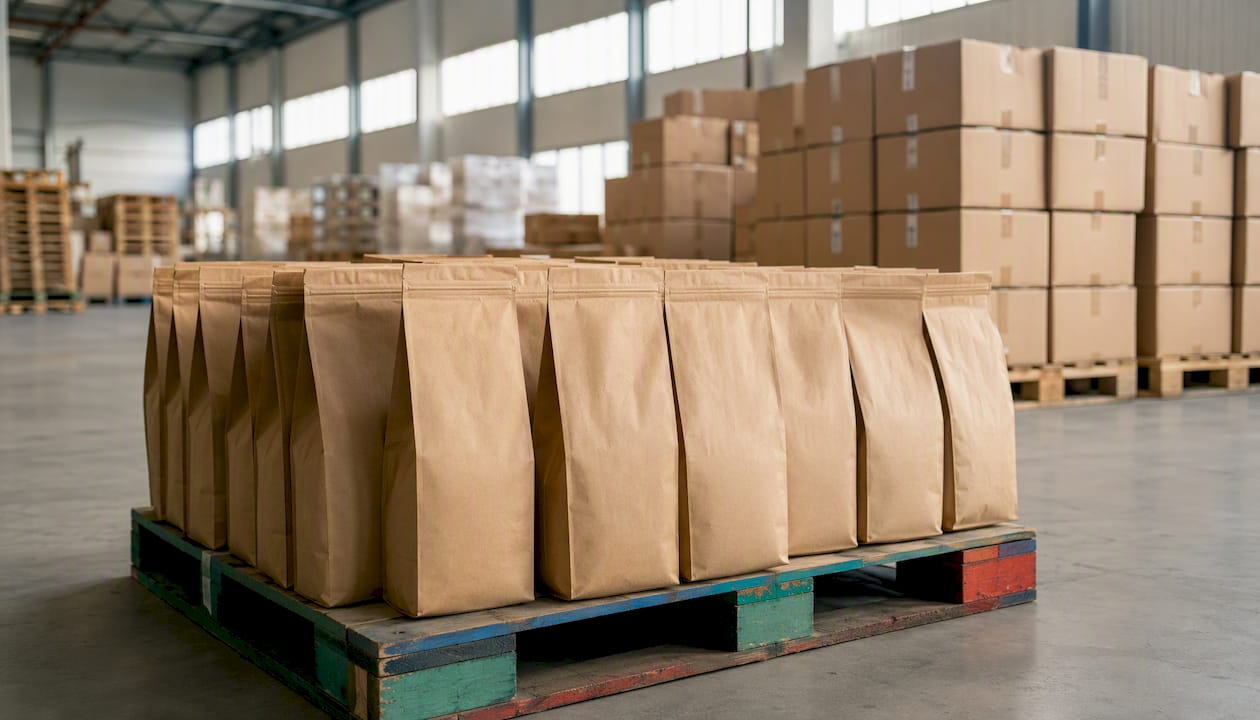
UV exposure fades printed colors over time, particularly on water-based inks without a UV-protective coating. Keep bags away from direct sunlight and fluorescent lighting in storage areas.
Compression from overstacking crushes handles and deforms gussets. Follow the supplier’s recommended stack height per pallet, and never store heavy goods on top of bag cartons.
Handling and storage tips to prevent moisture damage and crushing
A few practical rules prevent most warehouse damage to paper bags before they reach the sales floor.
Keep bags in their original cartons until needed. The carton provides structural support and a moisture barrier. When opening cartons for replenishment, pull from the top of the stack and rotate inventory on a first-in, first-out basis so older stock moves first.
For takeout bags in a foodservice environment, store away from cooking steam and dishwashing areas. Even brief exposure to high-humidity air softens the paper and weakens handle attachment points. A sealed storage room or dry goods cabinet is the right location.
If bags arrive with minor compression from transit, stand them upright in the carton for 24 hours before use. Most kraft bags recover their shape once the compression is released and the paper re-equilibrates to ambient humidity.
How paper bags are packaged and shipped to retailers
Finished bags ship flat-packed in corrugated cartons, typically banded or wrapped in poly film inside the carton to protect against transit moisture. Carton counts vary by bag size — smaller bags pack at higher counts per carton, larger bags at lower counts, with carton weight kept within standard freight handling limits.
Pallets are stretch-wrapped and labeled with carton counts, SKU, and production batch information. For large orders, a packing list and QA documentation ship with the pallet so procurement teams can match received quantities against the purchase order and verify the QA report on arrival.
For domestic North American orders, LTL (less-than-truckload) freight is standard for mid-volume orders; full truckload for high-volume seasonal buys. Domestic shipping eliminates customs clearance delays and makes it practical to receive partial shipments or phased deliveries against a blanket order.
Paper bags vs. plastic bags and reusable bags: how to decide
The choice between paper, plastic, and reusable bags turns on three factors: regulatory environment, brand positioning, and total cost of ownership.
Paper bags are recyclable through standard paper streams, compostable when certified, and carry strong brand associations with sustainability. They work well for retail POS, apparel, specialty food, and takeout. The trade-off is cost per unit (higher than single-use plastic) and sensitivity to moisture.
Single-use plastic bags are lower cost per unit and moisture-resistant, but face active regulatory restrictions across Canadian provinces and many U.S. states. For most retail and foodservice operators in North America, single-use plastic is either already restricted or on a near-term restriction timeline. Procurement teams planning 12–24 months out should treat paper as the default.
Reusable bags (woven polypropylene, cotton, or heavy-gauge paper) carry a higher per-unit cost but shift the cost-per-use calculation when customers actually reuse them. They work well as a premium retail offer or loyalty item, not as a standard checkout bag at volume.
For most retail and foodservice procurement teams in North America, custom kraft paper bags offer the best combination of regulatory compliance, brand flexibility, and supply reliability at scale.
Why domestic manufacturing matters more than most buyers realize
The conventional wisdom in packaging procurement is that offshore production saves money. For large, stable SKUs ordered 12 months in advance, that can be true. But for most retail and foodservice operators, the real cost of offshore sourcing shows up in the gaps: the seasonal reorder that arrives two weeks late, the color proof that requires three rounds of revision across a 14-hour time difference, the food-contact compliance question that takes a week to answer through a distributor.
Domestic manufacturing in Toronto means a QA issue found during production can be corrected in days, not weeks. It means a rush reorder for a holiday season doesn’t require a freight gamble. And for foodservice clients navigating changing food-contact regulations, it means the manufacturer is operating under the same regulatory environment you are, not interpreting foreign standards on your behalf.
The buyers who get the most value from domestic sourcing are the ones who treat it as a supply-chain decision, not just a cost-per-unit comparison. When you factor in the cost of a late shipment, a failed QA run, or a compliance gap on a food-contact bag, the math often shifts.
Gatherpackaging: custom paper bags manufactured in Toronto
Gatherpackaging manufactures custom kraft paper shopping bags in Toronto, with 8-color flexo printing, FSC-certified and recycled-content material options, and a full prepress, proofing, and QA process built into every order. Bag styles include turn top, serrated top, and tamper-resistant formats in a range of grammages and handle configurations for retail and foodservice takeout.
For procurement teams that need compliance documentation, physical samples, and a clear lead-time commitment before placing a first order, Gatherpackaging’s process covers all three. Sustainable material certifications — FSC, recycled content, compostable grades — are available on request with supporting documentation.
Contact Gatherpackaging to request samples, a prepress proof, and a lead-time and MOQ quote for your specific bag configuration.
Sources
Standards and guidelines procurement should validate against supplier claims:
Share:
Best Astroboxcorp.com Alternatives for Packaging Buyers
Tamper Evident Paper Bags: A Procurement Buyer's Guide