

TL;DR:
- A structured retail bag supply workflow aligns specifications, supplier evaluation, approval processes, and lead time planning to ensure on-time delivery. Avoiding misaligned specifications and evaluating suppliers thoroughly reduce rework, delays, and compliance issues, safeguarding production schedules. Internal ownership of approval gates and clear lead time definitions are essential for building reliable and responsive procurement processes.
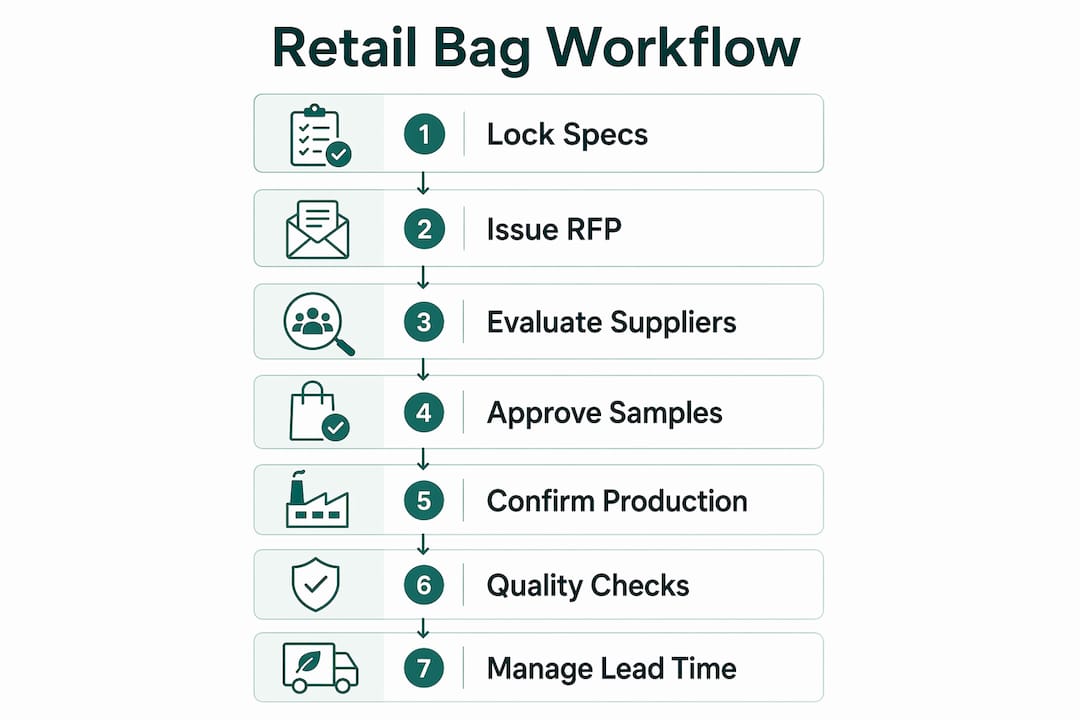
A well-structured workflow for retail bag supply is defined as the sequential process that aligns specifications, supplier selection, sample approvals, and production scheduling to deliver paper shopping bags on time and to specification. Without this structure, procurement teams face rework cycles, missed launch dates, and compliance failures that cost far more than the bags themselves. The most effective bag supply process integrates four core disciplines: specification locking, supplier evaluation, approval gate management, and lead time planning. Each discipline builds on the last, and skipping any one of them creates downstream problems that are expensive to fix.
What does a strong workflow for retail bag supply require upfront?
The most common reason retail bag procurement fails is issuing an RFP before specifications are locked. Misaligned specifications cause rework and late-cycle corrections that push delivery dates back by weeks. Procurement teams that lock critical-to-quality requirements before contacting any supplier avoid this entirely.
Critical-to-quality requirements for paper shopping bags include:
- Dimensions: Width, depth, gusset, and handle drop, all confirmed with the merchandising team
- Material: Basis weight, kraft grade, recycled content percentage, and surface finish
- Print specifications: Number of colors, ink type (water-based is standard for FSC-compliant bags), and bleed tolerances
- Compliance documentation: FSC certification, PCR content verification via GRS, PFAS-free declarations, and social audit evidence such as Sedex or BSCI
Cross-functional alignment is not optional. Engineering, marketing, supply chain, and operations each own a piece of the specification. A marketing team that finalizes artwork after the RFP goes out will add at least one full sampling cycle to the schedule.
Pro Tip: Build a one-page specification sheet that requires sign-off from each department head before the RFP is issued. This single document eliminates the most common source of late-stage corrections.

| Requirement category | What to confirm before RFP |
|---|---|
| Structural specs | Dimensions, handle type, gusset, and basis weight |
| Print and artwork | Color count, ink type, dieline approval, and bleed setup |
| Compliance | FSC, GRS/PCR, PFAS-free, and social audit status |
| Logistics | Carton pack count, pallet configuration, and port of entry |
How do you evaluate and select suppliers for reliable retail bag supply?
Supplier selection based on price alone is the fastest route to supply chain failure. Procurement teams that evaluate suppliers across multiple dimensions, including facility certifications, production capacity, financial stability, and lead time discipline, consistently achieve better long-term outcomes.
The evaluation criteria that matter most for paper shopping bag suppliers:
- Facility certifications: ISO 9001 for quality management and ISO 14001 for environmental management are baseline expectations. BRCGS Packaging certification signals a higher level of process control.
- Production capacity: Confirm the supplier runs the specific equipment your bag style requires. A supplier with flexo printing capability up to 8 colors is a different operation than one running 2-color offset.
- Financial stability: Request trade references and verify payment history. A supplier under financial stress will deprioritize your order when capacity is tight.
- Lead time discipline: Ask for documented on-time delivery rates from existing clients, not just quoted lead times.
- References: Call at least two current clients and ask specifically about how the supplier handles problems, not just routine orders.
Supplier responsiveness during the evaluation phase predicts their problem-handling speed once they are an active vendor. A supplier that takes four days to answer a basic technical question will take four days to respond to a production defect.
Pro Tip: Conduct a virtual facility audit before placing a first order. Request a live video walkthrough of the production floor, quality inspection area, and finished goods storage. What you see in 30 minutes tells you more than any certification document.
What is the step-by-step sample approval and production schedule for paper bags?
Custom printed retail paper bags follow a defined approval sequence that directly controls your delivery date. End-to-end lead time runs 9–12 weeks from inquiry to production departure, plus 15–35 days for sea freight or 3–7 days for air. Every additional sampling round adds 5–7 working days to that total.
The approval sequence works as follows:
- Structural sample: The supplier produces an unprinted bag in the correct dimensions and material. This confirms construction, handle attachment, and load capacity before any print investment is made.
- Packed sample: A printed sample, often in a reduced color run, confirms that artwork registers correctly and that the bag survives the packing process without damage.
- Pre-production sample (PPS): A full-specification sample from the actual production run materials. This is the final approval gate before mass production begins.
- Order confirmation and deposit: Deposit payment and written order confirmation should align with PPS approval, not precede it.
- Mass production: Tooling, material procurement, and production scheduling begin only after PPS sign-off.
- In-line and final quality inspections: Inspections occur during production and at the finished goods stage before packing for shipment.
Each late design change after a sample is approved adds a full sampling cycle. A single artwork revision after packed sample approval adds 5–7 working days and can shift a sea freight window by an entire vessel departure.
| Production phase | Typical duration |
|---|---|
| Structural sample | 5–7 working days |
| Packed sample | 5–7 working days |
| Pre-production sample | 5–7 working days |
| Mass production | 3–4 weeks |
| Sea freight transit | 15–35 days |
| Air freight transit | 3–7 days |
Pro Tip: Assign a single internal owner to each approval gate with a hard deadline. Use a shared project tracker, even a simple spreadsheet, to make approval status visible to every stakeholder. Approval delays caused by internal review bottlenecks are more common than supplier delays.
How do you build lead time discipline into retail bag procurement?
Lead time discipline starts with a definition problem. Buyers often count lead time from the purchase order date, while suppliers clock it from order confirmation, which can differ by 2–3 weeks. That gap alone can cause a missed delivery without any production problem occurring.
Best practices for lead time management in retail bag procurement:
- Define the start date in writing: Specify whether lead time begins at PO issuance, deposit receipt, or written order confirmation. Put this in the purchase order terms.
- Use a 12-week rolling forecast: A rolling forecast with locked windows for the first 4 weeks and flex windows for weeks 5–12 gives suppliers enough visibility to pre-allocate raw materials and reduce your effective lead time.
- Pre-allocate materials: Ask your supplier to hold kraft paper stock against your forecast. This removes the longest variable from the production timeline.
- Plan freight mode early: Sea freight is significantly cheaper but requires 15–35 days of transit buffer. Decide your freight mode at the time of order confirmation, not after production completes.
- Qualify a second supplier: Single sourcing is a risk that shows up at the worst possible time, typically during peak season or when your primary supplier has a capacity constraint.
Pro Tip: Build a “not-to-ship-before” and “must-arrive-by” date into every purchase order. These two dates force both sides to work backward from the retail floor date rather than forward from a production start.
What quality assurance checks protect your retail paper bag supply?
Quality assurance for paper shopping bags is not a single inspection. It is a series of checkpoints built into the workflow from material sourcing through finished goods. Compliance documentation is often inconsistent across suppliers, and structured checklists prevent costly compliance gaps after production starts.
Key QA checkpoints for retail paper bags:
- Material certificates: Verify FSC chain-of-custody certificates, GRS certificates for recycled content, and PFAS-free declarations before production begins, not after.
- Dimensional inspection: Confirm bag dimensions, handle drop, and gusset against the approved structural sample specification sheet.
- Print quality: Check color registration, ink adhesion, and print consistency against the approved PPS. Water-based inks require specific drying conditions that affect adhesion.
- Strength testing: Conduct handle pull tests and load-bearing tests on finished bags. A packaging quality assurance checklist should specify minimum load requirements by bag size.
- Social compliance audit evidence: Confirm Sedex or BSCI audit documentation is current before placing repeat orders.
FSC-certified materials require longer lead times than standard stock. Building certification timelines into the specification from day one avoids the scenario where a supplier substitutes uncertified material to meet a deadline. Include a non-conformance response clause in every supplier contract that specifies the remediation timeline and cost responsibility.
Key Takeaways
A structured workflow for retail bag supply reduces delivery failures by integrating specification locking, supplier evaluation, approval gate discipline, and proactive lead time planning into a single connected process.
| Point | Details |
|---|---|
| Lock specs before the RFP | Misaligned specifications cause rework; confirm dimensions, materials, print, and compliance before contacting suppliers. |
| Evaluate suppliers beyond price | Assess certifications, capacity, references, and responsiveness to predict long-term reliability. |
| Own every approval gate | Each sampling round adds 5–7 days; assign an internal owner with a hard deadline to each gate. |
| Define lead time in writing | Specify whether the clock starts at PO, deposit, or order confirmation to close the 2–3 week measurement gap. |
| Build QA into every phase | Verify material certificates, dimensional specs, print quality, and strength before and during production. |
What I’ve learned about retail bag workflows the hard way
The biggest mistake I see procurement teams make is treating the approval process as the supplier’s responsibility. It is not. The supplier produces samples. The buyer approves them. Every day a sample sits in an internal review queue waiting for sign-off is a day the delivery date moves. I have watched teams lose an entire vessel departure because artwork approval took three days longer than planned, and no one had flagged the freight booking deadline.
The second mistake is optimism about design changes. A “small” logo adjustment after packed sample approval is never small. It resets the sampling clock. The teams that run tight bag supply workflows treat the packed sample approval as a creative freeze date, not a suggestion.
Working with a domestic supplier changes this dynamic considerably. When your manufacturer is in Toronto rather than overseas, the feedback loop on samples compresses from weeks to days. You can resolve a print registration issue with a phone call and a revised file rather than a 10-day email chain. For retail brands that need to respond to seasonal changes or last-minute merchandising decisions, that agility is worth more than a lower unit price from a distant supplier.
The teams I have seen run the most dependable bag supply operations share one habit: they document everything. Approved samples are photographed and filed. Specification sheets carry version numbers. Supplier communications go through a single tracked channel. When something goes wrong, and it will, documentation is what separates a one-day fix from a three-week dispute.
— Taylor
Gatherpackaging’s approach to retail bag supply
Retail managers and procurement specialists who want a dependable bag supply process without the overseas complexity have a direct option in North America.
Gatherpackaging manufactures custom paper shopping bags in Toronto, Canada, with FSC-certified materials, water-based inks, and 8-color flexo printing. The domestic location shortens sample turnaround, reduces freight risk, and supports faster response to specification changes. Gatherpackaging’s product range covers turn top, serrated top, and tamper-resistant styles, all available with kraft paper customization and sustainable material options including recycled content and biodegradable constructions. Contact Gatherpackaging to discuss your retail bag specifications, lead time requirements, and compliance needs.
FAQ
What is the typical lead time for custom retail paper bags?
Custom printed paper bags take 9–12 weeks from inquiry to production departure, plus 15–35 days for sea freight. Each additional sampling round adds 5–7 working days.
When should an RFP be issued in the bag sourcing process?
Issue the RFP only after all critical-to-quality specifications, including dimensions, materials, print, and compliance requirements, are confirmed and signed off across all internal teams.
What certifications should a retail paper bag supplier hold?
Look for FSC chain-of-custody certification for paper materials, GRS certification for recycled content, PFAS-free declarations, and social compliance audit evidence such as Sedex or BSCI.
How do you prevent lead time miscalculations in bag procurement?
Define in writing whether lead time starts at PO issuance, deposit receipt, or written order confirmation. Buyers and suppliers often measure from different dates, creating a gap of 2–3 weeks that causes missed deliveries with no production fault.
What is the most important quality check for paper shopping bags?
Verify material certificates, including FSC and PFAS-free declarations, before production begins. Conduct handle pull tests and dimensional checks against the approved pre-production sample to confirm finished goods meet specification.
Share:
Why Branding Agencies Need Packaging Guides
Why Choose Minimal Packaging: Benefits for Brands