

TL;DR:
- Minimal packaging uses only what is necessary to protect a product, reducing waste and costs. It can cut freight expenses by up to 40% and corrugated material use by about 25%. This approach improves environmental sustainability, protects product quality, and enhances brand perception.
Minimal packaging is the deliberate practice of using the smallest amount of packaging necessary to protect a product, reduce waste, and lower costs. The industry term for this practice is “right-sizing,” and it applies to every layer of packaging a product touches before it reaches the customer. Understanding why choose minimal packaging matters starts with a simple fact: right-sized packaging can reduce parcel freight costs by up to 40% and corrugated board consumption by roughly 25%. Those numbers represent real margin, not theory. For procurement leaders and sustainability advocates, this is the most direct path from packaging decisions to measurable business outcomes.
Why choose minimal packaging for cost reduction?
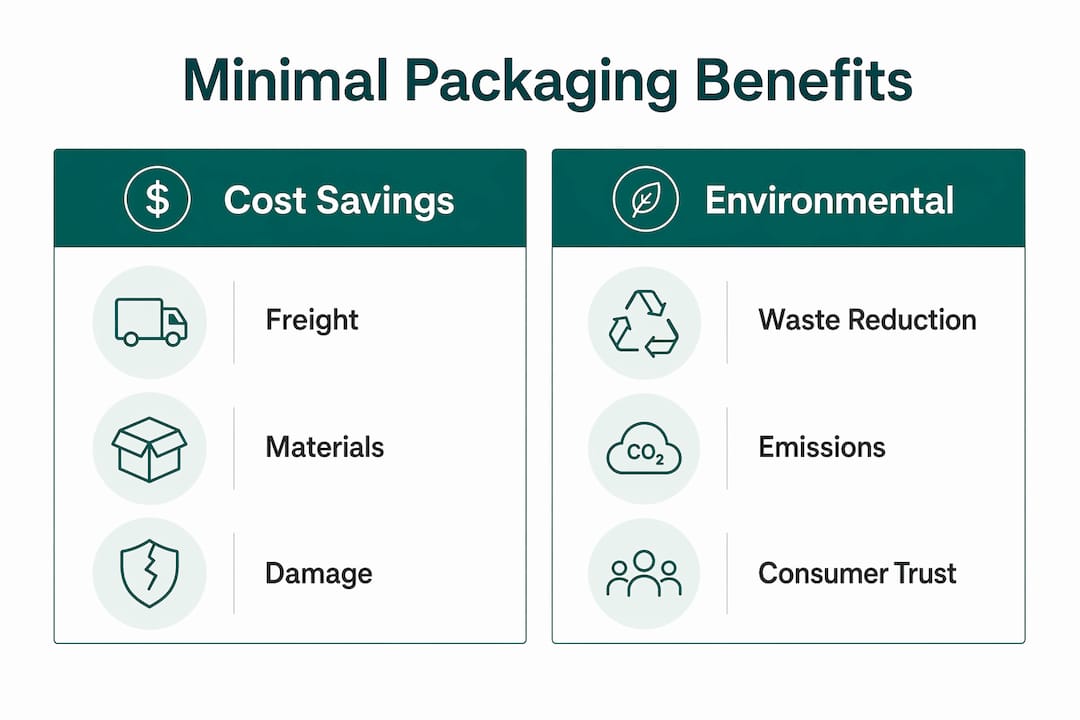
Packaging size is one of the largest hidden freight cost drivers in retail and e-commerce logistics. Carriers charge based on dimensional weight, which means a box that is too large costs more to ship even when the product inside is light. Right-sizing packaging to product dimensions reduces billable dimensional weight by 20–30%, which compounds across thousands of shipments per year. That reduction shows up directly in freight invoices.
The cost savings extend well beyond freight. Smaller packaging uses less material, which lowers purchasing costs for corrugated board, tissue, and tape. Tighter packages also take up less warehouse space, which improves pick-and-pack efficiency and reduces storage overhead. For high-volume retailers, these operational gains add up faster than most procurement teams expect.
Damage rates drop with right-sized packaging too. Oversized boxes cause higher damage rates because products shift during transit. A snug fit eliminates that movement and reduces the reverse logistics costs that come with returns, replacements, and customer service claims. Fewer returns mean lower total fulfillment cost per unit sold.
Here is a breakdown of where minimal packaging creates measurable cost advantages:
| Cost Category | Impact of Minimal Packaging |
|---|---|
| Parcel freight | Reduces dimensional weight fees by up to 40% |
| Material purchasing | Cuts corrugated board use by roughly 25% |
| Warehouse storage | Smaller packages improve space utilization |
| Reverse logistics | Snug fit reduces product damage and return rates |
| Compliance reporting | Less packaging volume lowers EPR tax exposure |
Pro Tip: Audit your three highest-volume SKUs first. Calculate the gap between current box dimensions and actual product dimensions. That gap is costing you money on every single shipment.
Treating packaging dimensions as a last-step decision misses recurring margin advantages. Procurement teams that bring packaging size into early product development cycles capture those savings from day one.
How does minimal packaging help the environment?
Minimal packaging reduces environmental impact across three distinct areas: material waste, shipping emissions, and regulatory compliance. Each area compounds the others, making right-sizing one of the most efficient sustainability levers available to a brand.

The material waste reduction is direct. Less corrugated board and less plastic in the supply chain means less material going to landfill or recycling streams. Every gram of excess packaging eliminated lowers compliance reporting burden and future waste-management tax risk under Extended Producer Responsibility (EPR) frameworks. EPR regulations are expanding across North America, and brands that minimize packaging now face lower financial exposure as those rules tighten.
Shipping emissions fall when packages get smaller. Smaller packages increase trailer utilization, which means more units per truck and lower fuel burn per shipped unit. For brands with sustainability reporting obligations, this improvement shows up in Scope 3 emissions calculations. That matters to investors, regulators, and increasingly to retail buyers who evaluate supplier sustainability credentials.
The benefits of minimal packaging also extend to product waste prevention. Barrier-strong materials reduce spoilage in food and cosmetics well beyond what packaging reduction alone achieves. A product that arrives intact and fresh generates no replacement shipment, no wasted goods, and no additional carbon footprint from a second delivery.
Consumer behavior reinforces the environmental case. 53% of Gen Z consumers stopped buying from brands that use excessive plastic packaging. That is not a fringe preference. It reflects a broad shift in purchasing behavior that brands ignoring eco-friendly packaging options will feel in repeat purchase rates.
Pro Tip: When building your sustainability report, track packaging weight per unit shipped alongside freight costs. Both metrics improve together with right-sizing, giving you a dual-purpose business case for leadership.
For brands pursuing sustainable packaging solutions, the environmental and cost arguments point in exactly the same direction. That alignment is rare in business decisions and worth acting on.
Balancing minimal packaging with protection and brand experience
Minimal packaging fails when it compromises product integrity or creates a poor unboxing experience. The goal is not to strip packaging down to nothing. The goal is to use exactly what the product needs and nothing more.
High-barrier materials solve the protection problem without adding bulk. A well-engineered paper bag with FSC-certified materials and water-based inks can protect a retail product through the full supply chain without the excess layers that add cost and waste. The key is selecting materials based on the product’s actual protection requirements, not defaulting to oversized boxes with filler.
Several principles guide effective minimal packaging design:
- Match packaging to product dimensions. Gaps between product and packaging cause damage. A snug fit protects better than padding.
- Use barrier materials where they count. For food, cosmetics, and apparel, the right barrier layer prevents spoilage and damage without requiring excess outer packaging.
- Maintain brand presence through quality, not quantity. A well-printed, high-quality primary package communicates brand value more effectively than layers of secondary packaging.
- Test before scaling. Run drop tests and transit simulations on right-sized packaging before committing to full production runs.
“Balancing minimal external packaging with premium interior materials mitigates ‘unboxing backlash’ while maintaining a luxury brand experience. The outside can be simple. The inside should still feel considered.”
Brands reducing packaging waste build trust with customers, while oversized boxes filled with padding actively damage brand perception and repeat sales. The packaging experience is part of the product experience. Getting it right means using less material more thoughtfully, not just using less.
For retail brands, packaging design for sustainable branding requires thinking about the customer’s hands-on experience from the first moment of contact. A clean, well-structured paper bag with quality printing delivers that experience without excess.
Practical steps to adopt minimal packaging solutions
99% of brand owners expect to change their packaging strategy within three years. The brands that move first capture the cost and compliance advantages before competitors do. Here is how to start.
- Audit current packaging dimensions against product dimensions. Measure the void fill percentage across your top SKUs. Any package that is more than 20% air by volume is a right-sizing candidate.
- Bring packaging into product development early. Early integration of packaging size and weight creates recurring margin advantages that compound over the product’s full lifecycle.
- Evaluate flexible stock options. Paper shopping bags in standardized sizes cover a wide range of retail products without custom tooling costs. They ship flat, store efficiently, and print well.
- Set measurable targets. Track freight cost per unit, damage rate, and return rate before and after any packaging change. These three metrics capture the full cost picture.
- Review EPR obligations by market. Identify which jurisdictions require packaging waste reporting and calculate your current exposure. Packaging minimization directly reduces that liability.
Pro Tip: Paper bags from a domestic manufacturer like Gatherpackaging ship faster and with shorter lead times than imported alternatives. Shorter lead times mean you can hold less inventory and respond faster to demand changes, which is itself a form of operational efficiency.
Building a sustainable packaging workflow requires treating packaging as a core design variable, not a procurement afterthought. The brands that do this consistently outperform on both cost and sustainability metrics.
Key Takeaways
Minimal packaging, or right-sizing, delivers measurable cost reductions, lower emissions, and stronger brand trust when brands treat packaging dimensions as a core design decision rather than a logistics afterthought.
| Point | Details |
|---|---|
| Freight cost reduction | Right-sized packaging cuts parcel freight costs by up to 40% through lower dimensional weight fees. |
| Material savings | Corrugated board consumption drops by roughly 25% when packaging matches product dimensions. |
| Environmental compliance | Less packaging volume reduces EPR reporting burden and future waste-management tax exposure. |
| Brand trust | Customers, especially Gen Z, actively avoid brands using excessive packaging materials. |
| Protection through fit | Snug packaging reduces product shifting, lowering damage rates and reverse logistics costs. |
The case for treating packaging as a strategic decision
Packaging used to be the last item on the product development checklist. In my experience working with retail brands across North America, that mindset has cost companies more than they realize. Freight invoices, damage claims, and compliance fines are the visible costs. The invisible cost is the brand perception damage that comes from a customer opening an oversized box stuffed with plastic air pillows.
The shift I’ve seen with brands that get this right is not just operational. It is cultural. When procurement, design, and sustainability teams align on packaging early in the product cycle, the decisions are better and the outcomes are measurable. A paper bag that is right-sized, well-printed, and made from FSC-certified materials does more for a brand than three layers of secondary packaging ever could.
The regulatory pressure from EPR frameworks is accelerating this shift. Brands that treat minimal packaging as a compliance strategy today will be ahead of the curve when those regulations tighten. The ones waiting for a mandate will be reacting under pressure, which always costs more.
My honest view: the importance of minimal packaging is not a sustainability talking point. It is a margin and risk management decision that belongs in the same conversation as freight contracts and supplier terms.
— Taylor
Gatherpackaging’s approach to minimal, sustainable retail packaging
Retail brands and procurement teams looking to act on these principles have a direct path forward with Gatherpackaging. The company manufactures custom printed, eco-friendly paper bags in Toronto, Canada, using FSC-certified materials, recycled content, and water-based inks. Every bag is designed to carry product efficiently without excess material.
Gatherpackaging’s domestic manufacturing model means shorter lead times, lower minimum order risk, and direct quality control from production through delivery. Their range includes turn top, serrated top, and tamper-resistant styles, all customizable in size and print with 8-color flexo printing. For brands ready to move toward custom retail packaging that is both minimal and brand-forward, Gatherpackaging is the right manufacturing partner. Contact Gatherpackaging to discuss your paper shopping bag requirements and get a quote tailored to your product and volume.
FAQ
What is minimal packaging, exactly?
Minimal packaging, also called right-sizing, means using only the materials necessary to protect and present a product. It eliminates excess void fill, oversized boxes, and unnecessary secondary packaging layers.
How does minimal packaging reduce freight costs?
Carriers charge based on dimensional weight, so smaller packages cost less to ship. Right-sized packaging can reduce parcel freight costs by up to 40% by lowering the billable dimensions of each shipment.
Does minimal packaging affect product protection?
Snug packaging actually improves protection by eliminating the product movement that causes damage in transit. Oversized boxes with excess void fill allow products to shift and break, increasing return rates.
How does minimal packaging support sustainability goals?
Smaller packages improve trailer utilization, which lowers fuel burn and carbon emissions per unit shipped. Reduced packaging volume also lowers EPR compliance costs as waste-management regulations expand across North America.
What packaging materials work best for minimal retail packaging?
FSC-certified paper bags with high-quality flexo printing deliver strong brand presence with minimal material use. They ship flat, store efficiently, and meet sustainability criteria without sacrificing the customer experience.
Share:
Workflow for Retail Bag Supply: A Procurement Guide
The Role of Innovation in Bag Design: 2026 Guide