

TL;DR:
- Design innovation integrates new materials, structural engineering, and digital technology to enhance bag performance and sustainability. Using verified, recyclable, and durable materials enables bags to be reused more times while meeting regulatory and consumer expectations. Digital features like QR codes and lifecycle data strengthen traceability, credibility, and regulatory compliance through lifecycle-focused procurement.
Innovation in bag design is the deliberate application of new materials, structural engineering, and digital technology to improve how bags perform, last, and decompose. For designers and product developers in retail and packaging, this definition matters because the pressure is no longer just aesthetic. Regulatory requirements, consumer expectations around sustainability, and procurement shifts toward lifecycle value have made design innovation a functional requirement. Gatherpackaging, a Toronto-based paper shopping bag manufacturer with over a century of combined manufacturing experience, builds its product development around exactly these principles: FSC®-certified materials, verified recyclability, and durable construction that holds up across multiple uses.
How does material innovation drive sustainable bag design?
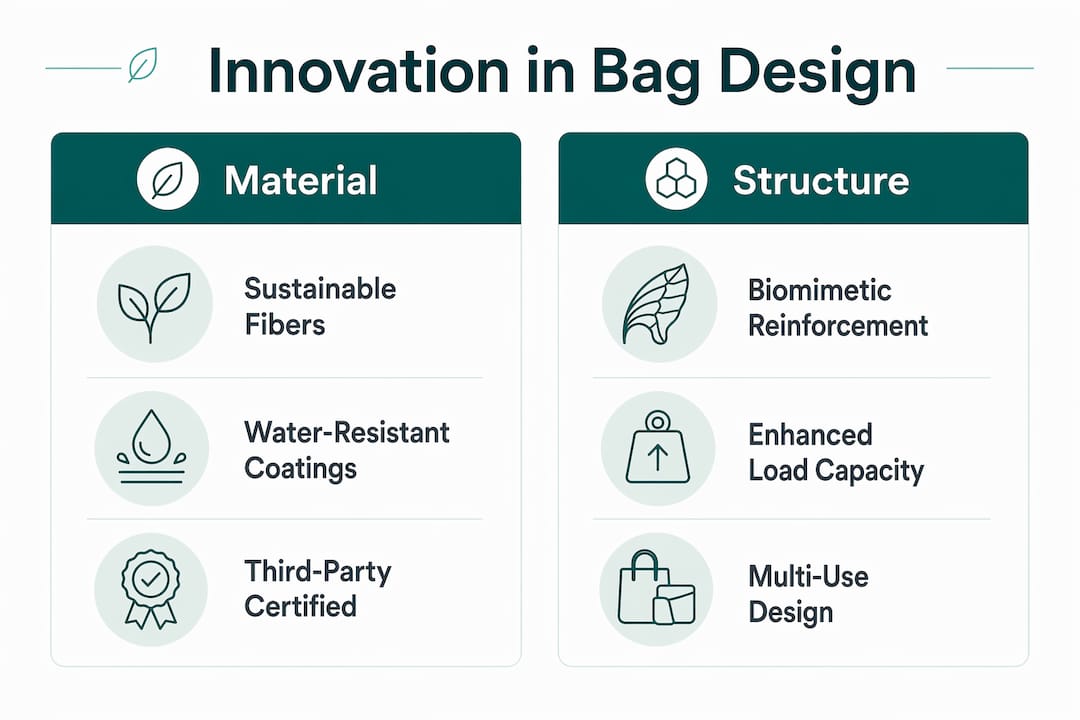
Material selection is the single most consequential decision in bag design. The fiber, coating, and finish you choose determines durability, recyclability, and whether your sustainability claims hold up to scrutiny. 86% of consumers report a positive influence on purchase decisions when packaging uses recycled materials. That figure tells you that material transparency is now a sales driver, not just a compliance checkbox.
The most credible material choices in 2026 share three traits: verified origin, recyclability at end of life, and durability sufficient for multiple uses. FSC®-certified paper, recycled kraft fiber, and organic cotton all meet the origin test. The harder question is what happens to the bag after use.
Key material categories and their trade-offs:
- FSC®-certified kraft paper: Verified sustainable fiber sourcing, strong print surface, and compatible with standard paper recycling streams. The go-to for retail paper shopping bags.
- Recycled content paper (post-consumer fiber): Reduces virgin fiber demand and signals circular intent to consumers. Requires quality control to maintain tear resistance.
- Bio-based or seaweed-derived coatings: Emerging alternatives to plastic lamination. Bio-based coatings facilitate fiber recovery at end of life, unlike traditional polyethylene lamination, which contaminates paper recycling streams.
- Water-based inks: Lower VOC output than solvent inks and compatible with paper recycling. Standard practice at Gatherpackaging across its 8-color flexo printing process.
- Plastic lamination: Adds moisture resistance but creates a mixed-material product that most municipal recycling programs cannot process. Use only where moisture protection is non-negotiable and a take-back program exists.
The lamination trade-off deserves direct attention. A laminated bag feels premium and resists water, but it typically cannot enter standard paper recycling. High-performance coatings must be compatible with recycling streams, prioritizing monomateriality or coatings that allow fiber recovery. Designers who ignore this create a greenwashing liability, not a sustainability asset.
Pro Tip: Request third-party certification documentation from every material supplier before finalizing a spec. FSC® chain-of-custody certificates and recycled content verification from bodies like the Rainforest Alliance are publicly verifiable. Unverified claims expose your brand to regulatory risk under consumer protection laws in both Canada and the United States.
What structural engineering techniques improve bag functionality?
Structure determines whether a bag survives one trip or fifty. The most significant advance in paper bag structural engineering draws from biomimicry: applying load-distribution patterns found in natural structures like honeycomb lattices and bamboo fiber alignment to kraft paper construction.

Biomimetic reinforcement structures can increase the load capacity of kraft paper bags by 2–3 times, enabling safe carrying of 8–15 kg. That is a meaningful jump. A standard unmodified kraft bag typically handles 4–6 kg before handle stress or base failure. Doubling or tripling that range opens paper bags to product categories that previously required plastic or woven alternatives.
Beyond raw load capacity, structural innovation addresses usability. Gussets, reinforced bases, and adjustable handle configurations all reduce the stress concentration points where bags typically fail. A well-placed gusset distributes lateral load across a wider surface area. Twisted paper handles with reinforced attachment points outperform flat ribbon handles under repeated use.
| Feature | Traditional design | Structurally engineered design |
|---|---|---|
| Load capacity | 4–6 kg | 8–15 kg |
| Handle type | Flat ribbon, single attachment | Twisted paper or cotton, reinforced gusset |
| Base construction | Single-ply glued base | Multi-ply or die-cut reinforced base |
| Reuse potential | 1–3 uses | 10+ uses |
| Secondary function | None | Foldable, storable, or convertible |
Multi-use design is the structural frontier that most retail packaging teams underestimate. Bags designed as personal accessories with ergonomic features and secondary uses drive higher reuse rates and extended brand exposure. A paper bag that folds flat for storage, or converts into a desk organizer, stays in circulation longer. Every additional use is a brand impression that costs nothing after the initial production run.
Pro Tip: When briefing a structural design, specify the intended load in kilograms and the number of expected uses before the bag is discarded. These two numbers should drive every material and construction decision. Vague briefs produce average bags.
How does technology influence bag design and traceability?
Digital integration in bag design has moved from novelty to regulatory necessity. The EU Packaging and Packaging Waste Regulation (PPWR) is driving adoption of digital product passports, which require brands to document material composition, recyclability, and supply chain origin in a machine-readable format. QR codes, NFC chips, and digital watermarks are the three primary delivery mechanisms.
Digital-enhanced designs like QR codes, digital watermarks, and product passports improve traceability, security, and lifecycle transparency. For retail packaging teams, this means the bag itself becomes a data carrier. A consumer scans the QR code and sees verified recycling instructions, material origin, and brand story. That interaction builds trust in a way that printed text alone cannot.
Smart packaging features extend beyond traceability:
- Thermochromic inks: Change color in response to temperature. Useful for food-adjacent retail bags where temperature indication adds functional value.
- Glow-in-the-dark elements: Increase visibility and create a memorable unboxing moment without adding non-recyclable materials when applied as water-based coatings.
- Digital watermarks: Invisible to the naked eye but readable by sorting facility scanners. These improve recycling stream accuracy by communicating material type directly to automated sorting equipment.
Smart packaging features fulfill growing regulatory requirements and enhance product security and transparency. This is the point most design teams miss: these features are not marketing extras. They are infrastructure for compliance and supply chain integrity. Brands that build digital traceability into their bag design now will face far less friction as North American regulations catch up to European standards.
Sustainability claims must be substantiated with scientific lifecycle data to avoid consumer skepticism and greenwashing effects. A QR code that links to a verified lifecycle assessment is a stronger claim than any printed eco-label.
What is lifecycle-focused procurement for packaging?
Lifecycle-focused procurement treats a bag’s total environmental and financial cost across all its uses, not just its purchase price. The transition from unit-cost procurement to lifecycle packaging engineering emphasizes durability, material content, and circularity over upfront price. This shift changes which suppliers win contracts and which bags get specified.
The math is straightforward. A bag that costs more per unit but survives 20 uses has a lower cost per use than a cheaper bag that fails after three. Durable reusable bags rated for 15–18 kg can replace dozens to hundreds of single-use carriers, drastically reducing packaging footprint. That replacement ratio is where the environmental and financial case converges.
| Bag type | Unit cost | Expected uses | Cost per use | Single-use bags replaced |
|---|---|---|---|---|
| Low-durability paper bag | Low | 1–3 | High per use | 1–3 |
| Mid-durability kraft bag | Medium | 5–10 | Moderate | 5–10 |
| High-durability engineered bag | Higher | 15–20+ | Lowest | 15–100+ |
Supplier evaluation for lifecycle procurement requires more than a price sheet. Third-party audits, FSC® chain-of-custody documentation, and transparent material content declarations are the minimum. Winning suppliers provide optimized durability, material content, and circularity rather than the lowest purchase price. Procurement teams that evaluate on unit cost alone consistently end up with higher total spend and weaker sustainability outcomes.
Design for recyclability is the final piece. A durable bag that cannot enter a recycling stream at end of life still creates landfill waste. The packaging quality assurance checklist for sustainable solutions should include end-of-life pathway verification alongside durability testing. Both matter equally in a lifecycle framework.
Key Takeaways
Innovation in bag design delivers measurable gains in durability, recyclability, and consumer trust only when material choices, structural engineering, and digital features are specified together from the start.
| Point | Details |
|---|---|
| Material choice drives recyclability | FSC®-certified and recycled-content papers outperform laminated alternatives in recycling stream compatibility. |
| Structure determines reuse rate | Biomimetic reinforcement raises load capacity to 8–15 kg, enabling 10+ uses per bag. |
| Digital features fulfill compliance | QR codes and digital watermarks support EU PPWR product passport requirements and verified sustainability claims. |
| Lifecycle procurement lowers total cost | High-durability bags cost less per use and replace dozens to hundreds of single-use carriers. |
| Substantiated claims build trust | Sustainability messaging backed by lifecycle data and third-party certification avoids greenwashing risk. |
Why most bag design briefs still get innovation wrong
The most common mistake I see in retail packaging briefs is treating innovation as a finish, not a foundation. Teams specify the bag structure, then ask whether it can be made “more sustainable” at the end of the process. That sequence produces compromises. The material that would have enabled recyclability gets swapped out because the structural spec was already locked. The digital traceability feature gets dropped because the print layout was finalized without accounting for QR code placement.
The briefs that produce genuinely better bags start with three fixed constraints: end-of-life pathway, minimum use target, and load requirement. Everything else, including aesthetics, print, and handle style, gets designed around those anchors. That is not a limitation. It is the framework that makes the creative work matter.
The other misconception worth naming directly: sustainability and durability are not in tension. Designers sometimes treat them as a trade-off, as if a more durable bag must use more material or more processing. The biomimetic structural work shows the opposite. Better geometry, not more material, is what raises load capacity. A bag engineered to carry 12 kg uses less material per kilogram carried than a flimsy bag that fails at 4 kg and gets replaced three times.
The sustainable packaging workflow that actually works treats the bag as a product with a lifecycle, not a cost line with a logo on it. Brands that make that mental shift consistently produce packaging that performs better, costs less over time, and holds up to regulatory scrutiny.
— Taylor
Gatherpackaging’s approach to paper bag design
Gatherpackaging manufactures paper shopping bags in Toronto, Canada, with FSC®-certified materials, recycled content options, water-based inks, and 8-color flexo printing across a full range of retail bag styles. Every bag goes through documented quality assurance processes before it ships.
If you are specifying bags for a retail program and want to discuss load requirements, material certifications, or custom print options, Gatherpackaging’s team works directly with designers and procurement teams from brief to production. Their custom kraft paper bags page covers available constructions, sizes, and sustainability credentials. Contact Gatherpackaging to talk through your paper shopping bag requirements and get a production-ready quote from a domestic manufacturer with verified supply chain documentation.
FAQ
What is the role of innovation in bag design?
Innovation in bag design applies new materials, structural engineering, and digital features to improve durability, recyclability, and traceability. The goal is to make bags perform better across more uses while reducing environmental impact at end of life.
How do biomimetic structures improve paper bag strength?
Biomimetic reinforcement patterns, inspired by natural structures like honeycombs, can increase kraft paper bag load capacity by 2–3 times, reaching 8–15 kg. This makes structurally engineered paper bags viable for product categories that previously required plastic or woven carriers.
What makes a bag design truly sustainable?
A truly sustainable bag design uses verified materials like FSC®-certified paper, avoids coatings that contaminate recycling streams, and is built for multiple uses. Sustainability claims require third-party certification and lifecycle data to be credible with consumers and regulators.
Why does lifecycle procurement matter for bag sourcing?
Lifecycle procurement evaluates cost per use rather than unit price. A high-durability bag that replaces 15–100 single-use carriers delivers lower total cost and a smaller environmental footprint than repeated purchases of cheaper, short-lived alternatives.
What digital features are becoming standard in retail bag design?
QR codes, digital watermarks, and NFC chips are becoming standard tools for traceability, recycling guidance, and regulatory compliance. The EU PPWR’s digital product passport requirements are accelerating adoption, and North American brands are beginning to align with those standards proactively.
Share:
Why Choose Minimal Packaging: Benefits for Brands
Packaging Prototyping Process: A Step-by-Step Guide