

TL;DR:
- Packaging material traceability tracks components from raw materials to end use, ensuring regulatory compliance and consumer trust. It also reduces costs by supporting eco-modulation and enables quick identification of supply chain issues through detailed, structured data. Brand managers must build dynamic data systems that link supplier declarations to production, aligning with evolving regulations and market demands.
Packaging material traceability is the process of tracking packaging components from raw materials through production to end use, creating a verifiable record of composition, origin, and recyclability. For brand managers and product developers working with paper shopping bags, traceability is no longer optional background work. Regulations like the EU Packaging and Packaging Waste Regulation (PPWR) and Extended Producer Responsibility (EPR) frameworks now require structured, auditable material data as a condition of market access. Traceability delivers four concrete outcomes: regulatory compliance, consumer trust, operational control, and financial optimization.
Why packaging material traceability matters for regulatory compliance
Packaging material traceability is the backbone of EU sustainability compliance under PPWR and EPR. Companies must document material composition, recycled content, recyclability, labeling evidence, and packaging weight in a structured, auditable format to gain market access from august 2026. That deadline is not a soft target. Brands that cannot produce this documentation face blocked market entry and potential penalties.
The compliance chain starts with your suppliers. Manufacturers need current upstream declarations on material composition, substances, and recyclability to produce a legally required Declaration of Conformity. Without those supplier declarations, a brand cannot complete its conformity assessment. This dependency makes supplier data management a core compliance function, not a procurement afterthought.
The challenge most brands underestimate is the difference between static documents and structured data. A PDF certificate from a supplier is not traceability. It is a snapshot that goes stale the moment a material formulation changes. Structured, dynamic data systems update continuously and remain audit-ready at any point.
Pro Tip: Build your supplier onboarding process around data fields, not documents. Require suppliers to submit composition, recycled content percentage, and recyclability classification as structured inputs, not scanned PDFs.
Key compliance requirements under PPWR and EPR include:
- Material composition by weight and type for each packaging component
- Recycled content percentage with supporting supplier evidence
- Recyclability classification and supporting technical documentation
- Packaging weight and format data at the SKU level
- Labeling compliance evidence for consumer-facing recycling instructions
- Up-to-date supplier declarations linked to each production lot
For paper shopping bag manufacturers and the brands they supply, packaging compliance requires mapping every material input, from the kraft paper grade to the ink system, against these regulatory fields.
How traceability affects EPR fees and eco-modulation costs
EPR fee modulation links your recyclability and recycled content performance directly to what you pay. Better traceability and credible recyclability evidence can reduce packaging disposal fees by 20–30%, while weak or unverifiable data risks higher fees and penalties. That is a direct financial consequence of data quality.

Eco-modulation works by rating packaging materials on a scale, often described as red, amber, and green classifications. Green-rated packaging, which is fully recyclable and made with verified recycled content, attracts the lowest fees. Red-rated packaging, which lacks recyclability evidence or contains problematic materials, attracts the highest. The rating your packaging receives depends entirely on the quality of the traceability data you can present.
| Data quality | Eco-modulation outcome | Financial impact |
|---|---|---|
| Structured, verified supplier data | Green or amber rating | Lower EPR fees, potential incentives |
| Incomplete or outdated documentation | Amber or red rating | Higher fees, compliance risk |
| No traceability data | Default worst-case rating | Maximum fees, possible market exclusion |
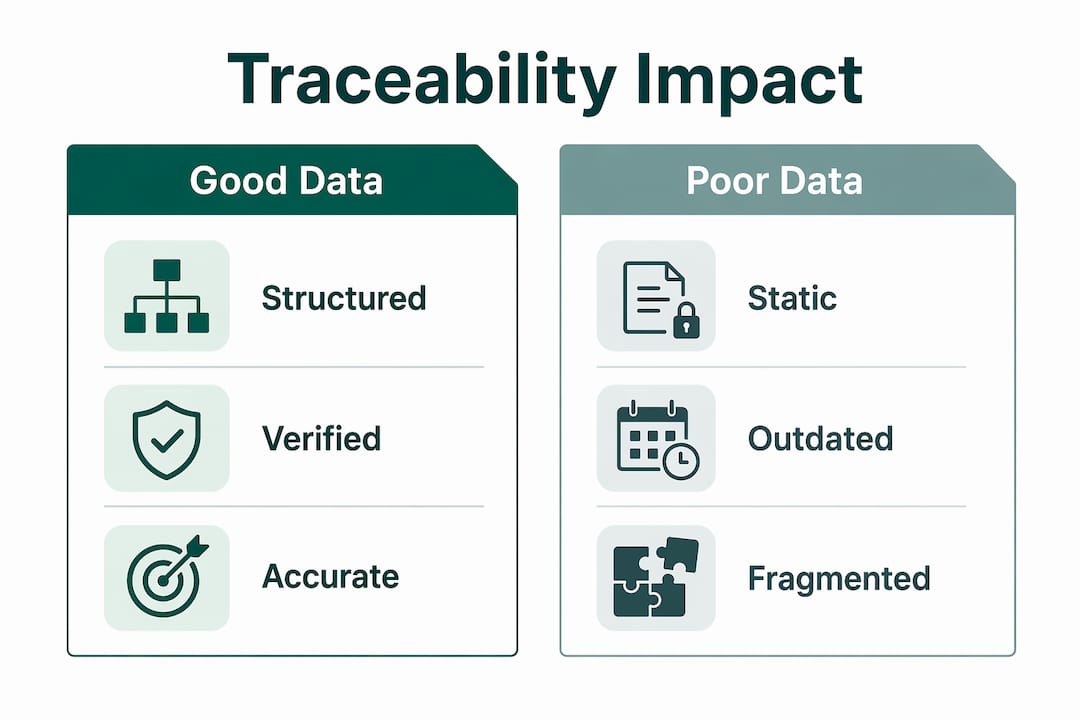
To optimize eco-modulation fees, brands need SKU-level packaging composition, precise weight data, credible recyclability evidence, and multi-country reporting logic. A paper shopping bag with FSC-certified kraft paper and water-based inks can qualify for favorable ratings, but only if the supporting data is structured, current, and linked to the correct SKU.
Pro Tip: Map your packaging components to their eco-modulation rating categories before your next EPR reporting cycle. Identify which materials are pulling your rating down and request updated recyclability declarations from those specific suppliers.
The financial downside of poor data is not theoretical. Brands that rely on outdated supplier PDFs or fragmented spreadsheets cannot substantiate their recyclability claims during audits. That gap translates directly into higher fees. For brands managing large SKU counts across multiple markets, the cumulative cost difference between green and red ratings is significant.
Does traceability actually build consumer trust?
Traceability builds consumer trust by making sustainability claims verifiable rather than decorative. Machine-readable packaging links connect packaging claims with audited supply chain data, strengthening credibility and combating greenwashing. A QR code on a paper shopping bag that links to verified material origin data is a fundamentally different claim than a printed leaf icon with no backing.
The concept of a “digital thread” describes traceability as a continuous data connection from raw material sourcing through production to the retail shelf. That thread lets a brand manager answer a specific consumer question: where did this paper come from, and is it actually recyclable? Without traceability, the answer is a marketing claim. With traceability, it is a documented fact.
Greenwashing regulations in the EU and North America are tightening. Brands that cannot substantiate their sustainability claims face regulatory action and reputational damage. Traceability is the mechanism that separates authentic claims from unsubstantiated ones. For brands using domestic paper shopping bags with FSC-certified materials, traceability makes those credentials visible and defensible.
Consumer-facing benefits of traceability include:
- Verified recycled content claims linked to supplier documentation
- Recyclability instructions backed by material composition data
- Transparent sourcing information accessible via digital identifiers
- Audit-ready evidence for third-party sustainability certifications
- Reduced exposure to greenwashing allegations and regulatory scrutiny
How traceability reduces operational risk in packaging supply chains
Traceability reduces operational risk by enabling fast root-cause analysis when defects or non-compliance issues appear. Without traceability, organizations waste days guessing the source of a problem. With traceability, issues are isolated to specific lots or shipments quickly. That speed difference determines whether a quality issue becomes a contained correction or a costly recall.
The operational value of traceability shows up most clearly in targeted corrective actions. High traceability granularity, including lot-level and forward-backward linking, enables precise supply chain tracking. A paper bag manufacturer that can link a print quality defect to a specific ink batch and a specific production run can correct the issue without pulling unaffected inventory.
A structured approach to operational traceability follows this sequence:
- Assign unique identifiers to each incoming material lot from every supplier.
- Link those lot identifiers to specific production runs and finished SKUs.
- Record forward links from production runs to outbound shipments and customer orders.
- Maintain backward links from finished bags to raw material sources and supplier declarations.
- Store this data in a system that supports rapid querying by lot, date, supplier, or SKU.
This structure also supports quality assurance processes at every stage. When a brand manager reports a handle attachment failure on a specific bag style, a manufacturer with lot-level traceability can identify the paper grade, the adhesive batch, and the production shift within hours, not weeks.
The supply chain efficiency gains extend beyond defect response. Traceability data supports accurate inventory management, reduces duplicate data collection across markets, and improves communication between manufacturers and their retail clients. For brands managing packaging supply chains across multiple regions, that data clarity has direct operational value.
Best practices for implementing packaging material traceability
Effective traceability starts with a dedicated packaging master data system. Packaging master data is often buried in bills of materials or logistics processes, which makes it hard to find and harder to audit. Creating a separate packaging data object that links materials, SKUs, and suppliers gives you a single source of truth for compliance and reporting.
Supplier engagement is the second critical step. Dynamic, supplier-driven data systems are required for audit readiness and ongoing PPWR and EPR compliance. Static documents fail because they do not reflect material changes in real time. Require suppliers to maintain and update their declarations as a condition of your supplier agreements.
Standardized identifiers are the third pillar. Consistent identification standards like GTIN and structured packaging attribute models support interoperability and audit-ready reporting across markets. A paper shopping bag SKU with a consistent GTIN can be reported across EU, Canadian, and American EPR programs without rebuilding the data set each time.
Pro Tip: Reuse your packaging attribute data across jurisdictions. The same composition, weight, and recyclability data that satisfies EU PPWR reporting also supports North American EPR filings. Build your data model once and map it to each program’s requirements.
Common pitfalls to avoid:
- Relying on scanned PDFs as traceability evidence
- Storing packaging data in fragmented spreadsheets with no version control
- Collecting supplier declarations once at onboarding and never updating them
- Treating traceability as a compliance project rather than an ongoing data function
- Failing to link material lot data to specific production runs and outbound shipments
| Implementation step | Common mistake | Better approach |
|---|---|---|
| Supplier data collection | One-time PDF request | Ongoing structured data submissions |
| Product identification | Internal part numbers only | GTINs for multi-market interoperability |
| Data storage | Spreadsheets by market | Centralized packaging master data system |
| Audit readiness | Reactive document gathering | Continuous, dynamic data updates |
Key Takeaways
Packaging material traceability is a compliance requirement, a financial tool, and a brand credibility asset that brand managers and product developers cannot afford to treat as a secondary concern.
| Point | Details |
|---|---|
| Regulatory compliance | PPWR and EPR require structured, auditable material data for EU market access from august 2026. |
| Financial impact | Credible traceability data can reduce EPR disposal fees by 20–30% through favorable eco-modulation ratings. |
| Consumer trust | Machine-readable identifiers link packaging claims to verified supply chain data, countering greenwashing. |
| Operational risk | Lot-level traceability isolates defects to specific shipments, avoiding costly broad recalls. |
| Implementation foundation | A centralized packaging master data system with dynamic supplier declarations is the starting point. |
Traceability is the part brands keep underestimating
Most brand managers I speak with treat traceability as a compliance checkbox. They collect supplier certificates at onboarding, file them somewhere, and assume the job is done. That approach fails the moment an auditor asks for current data or a material formulation changes without notice.
The brands that get traceability right treat it as a data infrastructure problem, not a documentation problem. They build systems that connect supplier declarations to SKUs, link SKUs to production lots, and link lots to outbound shipments. That structure does not just satisfy regulators. It gives procurement teams real leverage in supplier negotiations and gives sustainability teams verifiable claims to put in front of consumers.
The regulatory pressure from PPWR and EPR is accelerating this shift. Brands that invest in traceability infrastructure now will spend less time scrambling for data during reporting cycles and more time using that data to reduce fees and strengthen their market position. The brands that wait will face the same compliance requirements with far less time and far weaker data.
— Taylor
Gatherpackaging’s approach to traceable, sustainable paper bags
Traceability starts with knowing exactly what your packaging is made of and where it comes from. Gatherpackaging manufactures paper shopping bags in Toronto, Canada, using FSC-certified materials, recycled content, and water-based inks, with full documentation available to support your compliance and sustainability reporting needs.
Brand managers and product developers working toward PPWR, EPR, or North American sustainability requirements can review Gatherpackaging’s eco-friendly paper bag options and discuss material documentation, recyclability classifications, and custom production requirements directly with the team. Gatherpackaging’s domestic manufacturing model also supports shorter lead times and cleaner supply chain records, which makes traceability documentation more straightforward to maintain. Contact Gatherpackaging to discuss your paper shopping bag and compliance needs.
FAQ
What is traceability in packaging?
Packaging traceability is the ability to track and document every material component in a package from raw material sourcing through production to end use. It creates a verifiable record of composition, recycled content, recyclability, and supplier origin.
Why does supply chain traceability matter for packaging compliance?
Supply chain traceability provides the structured supplier data that manufacturers need to produce a Declaration of Conformity under regulations like EU PPWR. Without current upstream declarations, brands cannot complete conformity assessments or access regulated markets.
How does traceability affect EPR fees?
Traceability data substantiates recyclability and recycled content claims, which directly determine a packaging material’s eco-modulation rating. Better data supports lower fee classifications, while unverifiable data results in default worst-case ratings and higher costs.
What is the difference between a static document and traceable data?
A static document, such as a scanned supplier certificate, is a point-in-time snapshot that becomes outdated when materials change. Traceable data is dynamic, structured, and continuously updated, making it audit-ready at any point in the compliance cycle.
How does packaging traceability support consumer trust?
Traceability enables brands to connect consumer-facing sustainability claims to audited supply chain data through machine-readable identifiers like QR codes. That connection makes claims verifiable rather than decorative, reducing greenwashing risk and building credibility.
Share:
Qualities of Premium Shopping Bags: A Buyer's Guide
What Is Specialty Packaging? A Guide for Brand Owners