
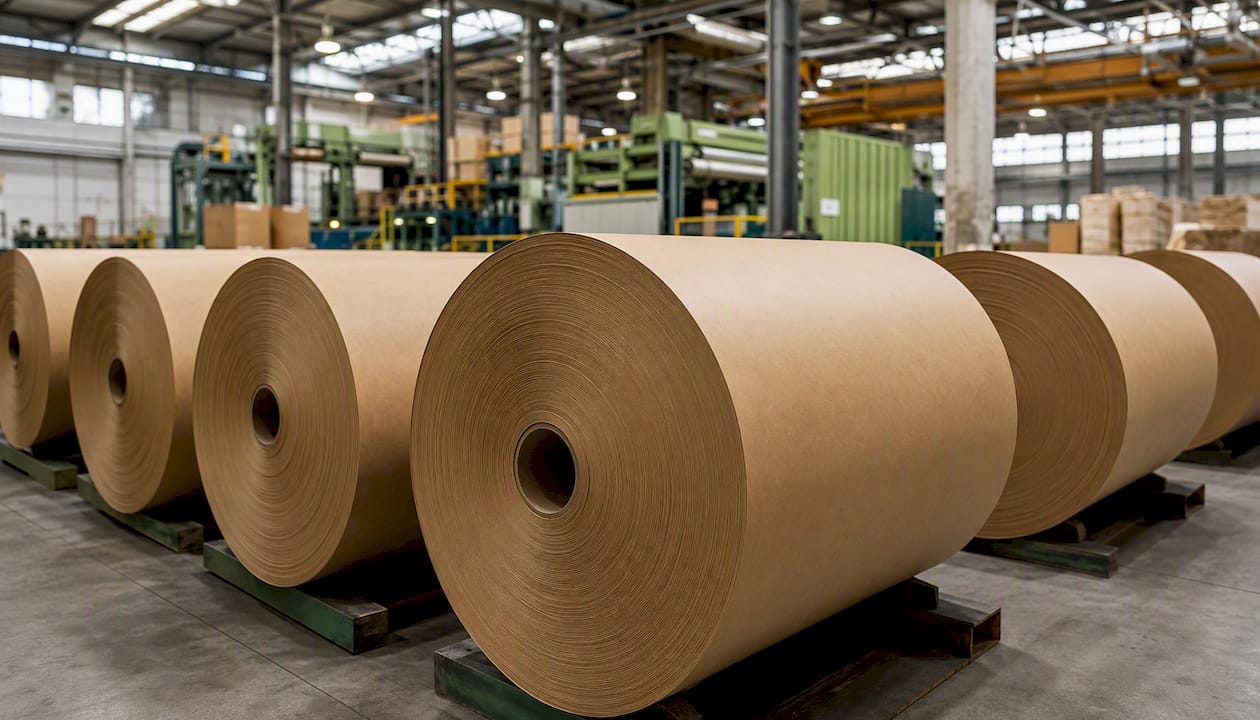
For retail shopping bags, Grade 1 virgin kraft in the 80–120 GSM range covers most applications, from gift bags to everyday grocery carry-out. Light retail and gift bags typically run within a lower GSM range; standard grocery and boutique bags use a moderate GSM range; heavy-duty sacks and industrial applications use heavier paper, often with wet-strength treatment. The term “grade” in commercial kraft refers to three variables: fiber source (virgin, semi-virgin, or recycled), the pulping process used, and the surface finish applied.
Quick decision checkpoints before you write a spec:
- GSM band: match to expected load and handle type, not just bag size
- Fiber source: virgin for maximum tensile and tear; recycled where sustainability targets outweigh load requirements
- Wet-strength or coating: required for cold-chain, condensation-prone, or food-contact applications
- Surface finish: machine-finished for standard flexo; machine-glazed or supercalendered for high-resolution or 8-color print work
- Certifications: FSC or equivalent chain-of-custody documentation for retail sustainability claims
The procurement checklist and manufacturer notes in the sections below give you the exact test values and supplier questions to use in an RFQ.
Key Takeaways
Fiber source, GSM, and surface finish together determine whether a kraft paper bag performs in the field. Specifying grade without all three leaves critical performance variables undefined.
| Point | Details |
|---|---|
| Specify fiber source, not just GSM | A 110 GSM Grade 1 virgin sheet outperforms a 110 GSM recycled sheet on tensile and tear; always name the grade. |
| Match GSM band to application | Light retail bags run within a low GSM band; grocery and boutique bags use a moderate GSM band; heavy-duty sacks use a high GSM band. |
| Require four test reports | Request ISO 536 (GSM), ISO 1924 (tensile), ISO 1974 (tear), and ISO 2758 (burst) on every supplier lot. |
| Specify wet-strength for moisture exposure | Condensation and cold-chain applications require resin treatment; increasing GSM alone does not compensate. |
| Gatherpackaging for domestic production | Gatherpackaging manufactures Grade 1 virgin kraft shopping bags in Toronto with short sample cycles and 8-color flexo printing. |
Table of Contents
- What are kraft paper grades, and how is kraft paper made?
- How do Grade 1, Grade 2, and Grade 3 differ in practice?
- What specs on a supplier data sheet actually predict bag performance?
- Which grade band fits your bag application?
- How do bleaching, surface finish, and coatings affect print and moisture resistance?
- Which standards and test reports should you request from suppliers?
- Procurement checklist and sample RFQ specification
- Common specification mistakes that cause bag failures
- How a paper-bag manufacturer evaluates and converts kraft grades
- Why fiber integrity and printability drive grade selection at Gatherpackaging
- Gatherpackaging’s kraft paper bag capabilities and how to get started
- Sources
What are kraft paper grades, and how is kraft paper made?
Kraft paper gets its name from the German word for strength, and that name is earned by the chemistry behind it. The kraft (sulfate) pulping process cooks wood chips in a solution of sodium hydroxide and sodium sulfide, dissolving lignin while leaving cellulose fibers largely intact. Those long, undamaged fibers are what give kraft its characteristic tensile and tear performance compared to papers made by mechanical or soda pulping.
The steps that matter most to a buyer:
- Sulfate cook: determines fiber length retention and, therefore, baseline tensile strength
- Bleaching (optional): removes lignin color to produce white kraft; the trade-off is a modest reduction in raw fiber strength
- Refining and calendering: controls surface smoothness, which directly affects ink absorbency and print registration
- Wet-strength treatment: adds resin (typically polyamide-epichlorohydrin) during forming; essential for moisture-exposed applications
Virgin kraft uses wood chips that have never been pulped before, so fibers are at maximum length. Recycled kraft uses post-consumer or post-industrial fiber that has been pulped at least once; each cycle shortens and weakens the fibers. The practical result: a 90 GSM virgin sheet routinely outperforms a 110 GSM recycled sheet on tensile and Elmendorf tear tests. GSM alone does not tell you what you are buying.
How do Grade 1, Grade 2, and Grade 3 differ in practice?
The most widely referenced commercial classification comes from IS 1397, the Bureau of Indian Standards specification for kraft paper, which divides kraft into three grades based on fiber source and finish. The same three-tier framework is used informally across North American and European trade.
Grade 1: virgin kraft
Made from 100% unbleached sulphate (virgin) pulp. No recycled content. Delivers the highest tensile, tear, and burst values in its GSM range. The natural brown color is a visual signal of unbleached, long-fiber construction. Standard choice for retail shopping bags, grocery bags, and any application where load-bearing performance and print quality both matter.
Grade 2: semi-virgin kraft
Blends virgin sulphate pulp with agricultural residue fibers (bagasse, wheat straw) or a controlled proportion of recycled content. Mechanical properties sit between Grade 1 and Grade 3. Useful when a buyer needs to reduce material cost or increase recycled content without fully sacrificing strength. Print results are acceptable for single-color or two-color flexo work; high-resolution 8-color runs are better suited to Grade 1.
Grade 3: recycled kraft
Produced from waste paper or post-consumer recovered fiber. Fiber length is shorter, surface consistency is lower, and tensile/tear values are reduced compared to virgin grades at the same GSM. The sustainability case is real, and recycled kraft works well for light-duty wrapping, void fill, and secondary packaging. For a handled retail bag carrying more than a few pounds, the load math usually favors upgrading to Grade 1 or specifying a heavier GSM in Grade 3 to compensate.
Terminology reference:
- Virgin kraft: pulped from unprocessed wood; maximum fiber length
- Semi-virgin: blended with agricultural residue or limited recycled content
- Recycled / non-virgin: post-consumer or post-industrial recovered fiber
- Sack kraft: high-stretch, high-porosity Grade 1 variant for multiwall industrial sacks
- Wet-strength kraft: any grade treated with resin to resist moisture-induced tensile loss
- Bleached kraft: white surface achieved by chlorine-free or elemental-chlorine-free bleaching
- Unbleached kraft: natural brown; retains full fiber strength
What specs on a supplier data sheet actually predict bag performance?
Four numbers tell you most of what you need to know. Here is how to read each one.
GSM and basis weight
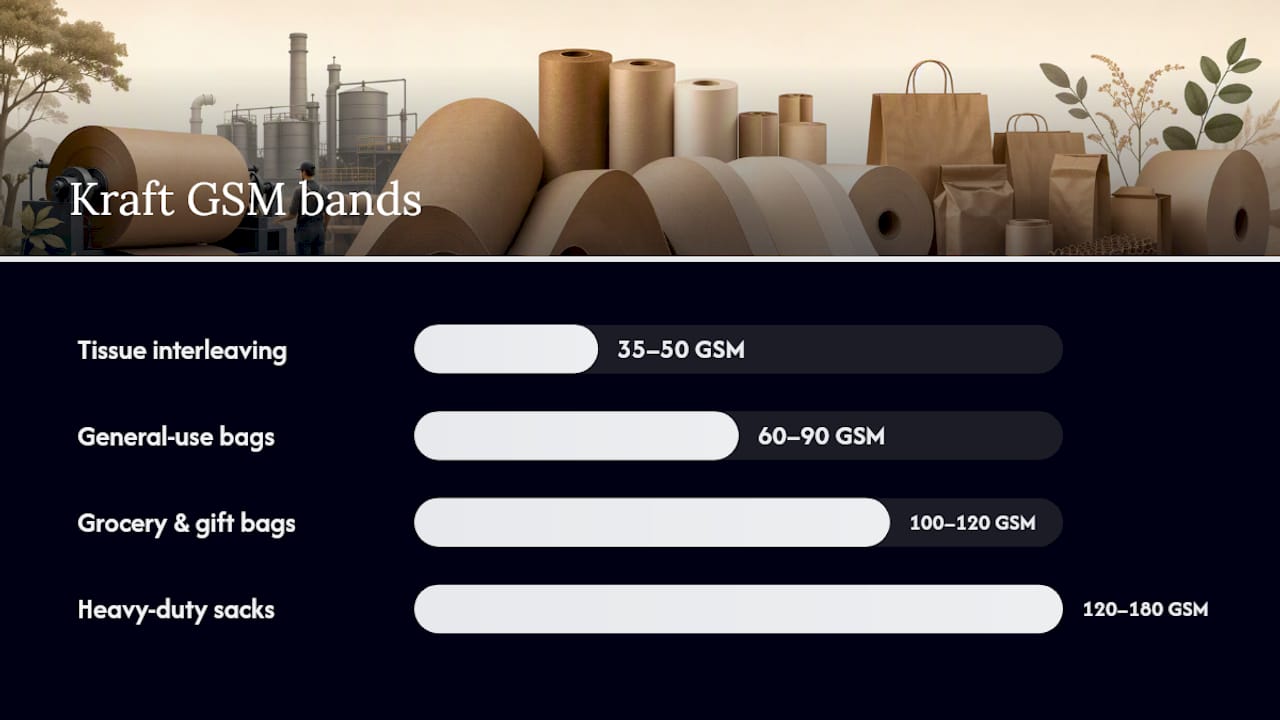
GSM (grams per square meter) is the standard weight measure for kraft in most markets. North American suppliers sometimes quote basis weight in pounds per 3,000 sq ft ream; the conversion is straightforward but always confirm the ream size. Trade guidance from packaging suppliers identifies four practical bands:
| GSM range | Typical application |
|---|---|
| 35–50 GSM | Tissue interleaving, lightweight wrapping |
| 60–90 GSM | General-use bags, light retail |
| 100–120 GSM | Grocery bags, boutique retail, gift bags |
| 120–180 GSM | Heavy-duty sacks, industrial liner, multiwall |
Tensile strength (MD and CD)
Tensile is measured in both the machine direction (MD) and cross direction (CD). MD tensile governs how a bag handles vertical load; CD tensile governs resistance to side-wall splitting when the bag is full. Supplier sheets report values in kN/m or N/15mm. Always request both directions. A sheet with strong MD but weak CD will split at the side seam under a full grocery load.
Elmendorf tear resistance
Tear resistance (mN or gf) measures how much force propagates a tear once it starts. This matters most when bags have die-cut handles, perforations, or sharp-edged contents. Food-packaging specifications tie minimum tear values to GSM bands, which is the right approach: a 90 GSM sheet should meet a defined minimum, not just “be kraft.”
Burst index (Mullen)
Burst index (kPa·m²/g) measures resistance to puncture under distributed pressure, which maps to how a bag handles a sharp corner or a concentrated point load from inside. Mullen burst is the older imperial measure (psi); burst index normalizes it to GSM so you can compare sheets of different weights fairly.
Pro Tip: Prioritize Elmendorf tear when your bag has die-cut handles or sharp product edges. Prioritize burst index when the bag carries distributed weight, like bottles or canned goods. Tensile in both directions matters for every handled retail bag.
Which grade band fits your bag application?
Retail packaging guidance identifies six main kraft types aligned to GSM ranges and end uses. The table below maps those to the grade framework and common bag applications.
MF = machine-finished; MG = machine-glazed; SC = supercalendered
A few cases where the standard grade bands do not apply:
- Multi-ply construction: two plies of 70 GSM Grade 1 outperform one ply of 130 GSM Grade 3 on tear and burst, and the construction adds puncture resistance for heavy or sharp contents.
- Poly-coated or laminated bags: the coating carries moisture resistance, so the base sheet can be a lighter Grade 1 without wet-strength resin. Confirm adhesive compatibility before specifying.
- Block-bottom vs. pinch-bottom: block-bottom bags place more stress on the base panel and side gussets; Grade 1 at the upper end of the GSM range (110–120) is the safer call.
How do bleaching, surface finish, and coatings affect print and moisture resistance?
The choice between brown and white kraft is not purely aesthetic. Unbleached brown kraft retains longer fibers and typically delivers better raw mechanical strength; bleached white kraft improves print clarity and the perceived premium quality of the finished bag. For 8-color flexo work on retail shopping bags, white or near-white substrates produce truer color reproduction, especially for brand colors with tight tolerances.
Surface finishes
- Machine-finished (MF): standard calendering; adequate for most single- to four-color flexo runs; good ink absorbency
- Machine-glazed (MG): one side highly polished, one side rough; the glazed side accepts fine-detail printing well; the rough side bonds well to adhesives and coatings
- Supercalendered (SC): both sides smoothed under high pressure; best surface for high-resolution or 8-color work; lower ink absorbency means faster drying but requires press calibration
Coatings and specialty treatments
Specialty kraft grades solve specific contact problems that a plain kraft sheet cannot handle:
- Poly-coating (PE or PP): moisture barrier for food-contact or produce bags; reduces recyclability unless certified compostable
- Wet-strength additives: resin treatment that preserves tensile strength when the sheet is wet; essential for cold-chain and condensation-prone environments
- Sulfur-free kraft: required for direct contact with metals or electronics to prevent corrosion
- VCI (vapor corrosion inhibitor): for metal parts packaging; the inhibitor volatilizes and coats the metal surface
- Silicone release: for peel-and-seal or label-liner applications
- Greaseproof / glassine: for food-contact applications where oil migration is a concern
Pro Tip: For retail shopping bags going through 8-color flexo printing, specify MG or SC surface finish and confirm the coating weight (g/m²) on the print side with your supplier before press setup. Ink adhesion failures on the first production run are almost always a substrate-finish mismatch, not a press problem.
For more on how surface finish choices interact with branding and sustainability goals, paper bag finishes for branding covers the practical tradeoffs in detail.
Which standards and test reports should you request from suppliers?
Specifying “kraft paper” without citing a test standard gives a supplier room to ship anything that looks like kraft. These are the references worth citing in an RFQ.
Standards to reference:
- ISO 536: GSM (grammage) measurement
- ISO 1924 / TAPPI T494: tensile strength (MD and CD)
- ISO 1974 / TAPPI T414: Elmendorf tear resistance
- ISO 2758 / TAPPI T403: bursting strength (Mullen)
- ISO 535 / TAPPI T441: Cobb water absorption (relevant for moisture-exposed applications)
- IS 1397 (BIS): the three-grade classification standard; useful as a reference framework even outside India
- EN 868 / ISO 11607: for food-contact or medical-adjacent packaging
Test reports to request from every supplier:
- GSM certificate with lot number and test date
- Tensile strength report (MD and CD, per ISO 1924 or TAPPI T494)
- Elmendorf tear report (MD and CD, per ISO 1974 or TAPPI T414)
- Burst index or Mullen burst report (per ISO 2758 or TAPPI T403)
- Cobb value (60-second water absorption) for any moisture-exposed application
- pH certificate (target: 6.5–8.5 for most retail applications)
- Wet-strength proof if specified (retained tensile after 2-hour water soak)
- FSC or recycled-content chain-of-custody certificate if sustainability claims are required
Supplier questions worth asking before you issue an RFQ:
- What is the fiber source (species, origin, virgin/recycled ratio)?
- What bleaching process is used (ECF, TCF, unbleached)?
- What surface finish is standard, and what alternatives are available?
- Can you provide a mill test report (MTR) from the paper manufacturer, not just the converter?
- What is the roll width tolerance and GSM tolerance (typically ±3–5%)?
- What is the minimum order quantity for a custom GSM or finish?
Procurement checklist and sample RFQ specification
Use this checklist when building a supplier brief or comparing bids. Every item that is left blank in an RFQ becomes a variable the supplier fills in for you, usually in their favor.
Ordered checklist:
- Application: bag type (retail, grocery, gift, sack), handle type (flat, twisted, rope, die-cut)
- Expected maximum load per bag (kg or lbs)
- Handling environment: ambient, cold-chain, food-contact, outdoor
- Target GSM and acceptable tolerance (e.g., 110 GSM ±4%)
- Fiber specification: Grade 1 virgin / Grade 2 semi-virgin / Grade 3 recycled; bleached or unbleached
- Surface finish: MF / MG / SC
- Coatings or treatments: poly-coat, wet-strength, sulfur-free, none
- Required test reports: list by standard (ISO/TAPPI references above)
- Certifications: FSC, recycled-content percentage, food-contact compliance
- Lead time requirement and acceptable production window
- MOQ and run size
- Roll or sheet delivery; pallet configuration and labeling requirements
Sample RFQ specification snippet:
Replace bracketed values with your actual requirements. Pre-production samples are non-negotiable for any first run with a new supplier or a new GSM. A pilot run of 500–1,000 bags before full production catches coating adhesion, print registration, and handle-bond issues before they become a full-order problem.
Pro Tip: Domestic manufacturing shortens the sample-to-production loop significantly. When a supplier is in the same country, you can physically inspect a pre-production sample within days rather than waiting weeks for an overseas shipment. For retail programs with tight launch windows, that lead-time difference is often the deciding factor.
For a complete procurement workflow, retail bag supply procurement guidance walks through the full process from brief to delivery.
Common specification mistakes that cause bag failures
Most retail bag failures trace back to one of five procurement errors. Each one is avoidable.

Mistake 1: Specifying GSM without fiber source. A 110 GSM recycled sheet and a 110 GSM virgin sheet are not interchangeable. Virgin fibers are longer and undamaged; the virgin sheet will outperform on tensile and tear at the same weight. Always specify grade and fiber source alongside GSM.
Mistake 2: Skipping wet-strength treatment for cold-chain or produce applications. Condensation on a cold bottle or moisture from fresh produce degrades an untreated kraft sheet quickly. Increasing GSM does not compensate for moisture-induced weakening. Specify wet-strength resin treatment and request a retained-tensile-after-soak test result.
Mistake 3: Mismatching handle type to load. A twisted-paper handle on a 90 GSM Grade 3 bag carrying 8 lbs of wine bottles is a failure waiting to happen. Handle attachment points concentrate stress; the substrate around the handle hole needs sufficient tear resistance to hold. Match handle type, attachment method, and substrate grade together as a system, not separately.
Mistake 4: Ignoring surface finish for print work. Ordering a standard MF sheet for an 8-color flexo job produces color that looks muddy compared to what the brand team approved on a proof. The proof was almost certainly run on MG or SC stock. Confirm the finish before press setup.
Mistake 5: Accepting a supplier’s generic “kraft” specification. Without a named grade, GSM tolerance, and test standard, “kraft paper” is a category, not a specification. Any paper that is brown and made from wood pulp qualifies. Write the spec; do not accept a generic material call.
Pro Tip: Before signing off on a new bag spec, fill the bag with the actual product, tie the handles, and carry it for two minutes. Walk up a flight of stairs. That test costs nothing and catches handle-bond and base-panel failures that no data sheet predicts.
How a paper-bag manufacturer evaluates and converts kraft grades
Incoming kraft rolls at a bag-manufacturing facility go through a receiving inspection before they touch a machine. The steps below reflect the kind of QA protocol a serious manufacturer runs on every lot.
Incoming roll inspection:
- Visual check: surface defects, moisture damage, roll edge condition, core integrity
- GSM spot check: three samples per roll, weighed against the certificate
- Tensile and tear verification: pull tests on MD and CD samples against the specified minimums
- pH strip test: confirms the sheet is within the neutral-to-slightly-alkaline range that protects adhesives and inks
- Moisture content check: high moisture content causes dimensional instability on press and in the bag-making machine
Conversion notes by grade:
Grade 1 virgin kraft runs well on high-speed automated bag-making equipment. The consistent fiber structure and surface finish hold registration through multi-color flexo passes without tension variation. Grade 2 semi-virgin sheets are generally compatible with automated lines but may require slightly reduced line speed to manage surface variation. Grade 3 recycled sheets present the most variability: surface roughness, GSM variation within a roll, and lower tensile can cause web breaks on high-speed lines. Slower line speeds and more frequent tension checks are standard practice.
Handle type also changes production settings. Flat paper handles require a clean, consistent fold and bond at the attachment point; the substrate needs adequate CD tensile to resist the peel force. Rope handles concentrate load at a smaller area; the die-cut hole demands high tear resistance in the surrounding sheet. Twisted handles sit between the two in terms of substrate demand.
QA steps before full production release:
- Sample run of 50–100 bags from the production roll
- Print proof check against approved color targets (Delta E tolerance per brand spec)
- Fold and crease inspection: no fiber fracture at fold lines
- Handle adhesion pull test: handles pulled to failure; minimum force recorded against spec
- Base panel integrity check for block-bottom constructions
Block-bottom vs. pinch-bottom implications: Block-bottom bags place higher stress on the base panel and gusset folds, which is why Grade 1 at 110–120 GSM is the standard call for that construction. Pinch-bottom bags distribute load differently and can run at 90–100 GSM in Grade 1 for most retail applications. Switching between the two constructions is a production complexity decision that should be driven by display requirements and shelf presentation, not by default or cost alone.
Pro Tip: If you are switching from an overseas supplier to a domestic manufacturer, request that the new manufacturer run a side-by-side pull test on bags made from your current substrate and their proposed substrate. The test takes an hour and eliminates any ambiguity about whether the grade change affects performance.
For more on how automated manufacturing affects grade selection and production settings, automated bag manufacturing insights covers the production side in detail.
Why fiber integrity and printability drive grade selection at Gatherpackaging
The procurement decisions that matter most for retail shopping bags come down to two things: will the bag hold what it is supposed to hold, and will it look the way the brand intended when it reaches the customer. Those two requirements pull in the same direction when you start with the right substrate.
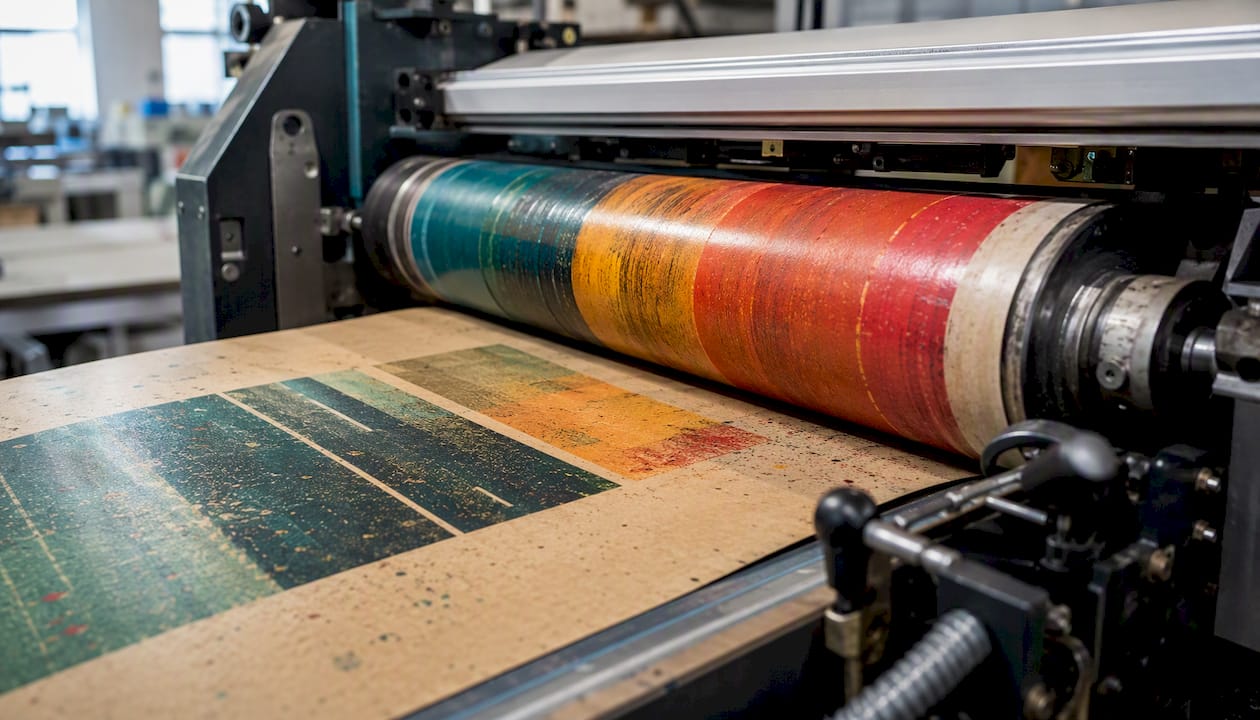
Gatherpackaging’s position is that Grade 1 virgin kraft, properly specified by GSM and surface finish, is the right starting point for the majority of retail and boutique grocery applications. The fiber integrity delivers predictable tensile and tear performance across production runs, which means fewer surprises at the QA stage and fewer returns from retail partners. The consistent surface finish supports 8-color flexo printing with the color accuracy that brand teams expect. Recycled-content grades have a real role in the product mix, particularly for sustainability-committed retail programs, but the specification has to be honest about the load and print requirements before recycled content is chosen as the default.
Supply-chain reliability is the third variable that rarely appears in a data sheet. Domestic manufacturing in Toronto means pre-production samples arrive in days, production schedules are visible and adjustable, and QA issues get resolved in real time rather than across time zones. For retail programs with defined launch windows, that predictability is worth more than a marginal cost saving on the substrate.
Gatherpackaging’s kraft paper bag capabilities and how to get started
Gatherpackaging manufactures custom kraft paper shopping bags in Toronto, Canada, using FSC-certified and recycled-content substrates, water-based inks, and 8-color flexo printing. The product range covers turn-top, serrated-top, and tamper-resistant styles in a full range of sizes, with flat, twisted, and rope handle options. Every production run includes incoming substrate inspection, pre-production sample approval, print proof sign-off, and handle pull testing before bags ship.
For procurement teams working through a grade selection decision or preparing an RFQ, Gatherpackaging offers prototyping and short-run pilot production so you can validate the substrate and print spec before committing to full volume. Domestic production means sample-to-approval cycles measured in days, not weeks, and production schedules that flex with retail program timelines.
Contact Gatherpackaging to discuss your custom kraft paper bag requirements, request a pre-production sample, or start an RFQ. The team can advise on grade selection, GSM, surface finish, and coating options based on your specific load, print, and sustainability requirements. Reach out through Gatherpackaging to get the conversation started.
Share:
Paper Shopping Bag Weight Capacity: A Procurement Guide
Vector vs Raster Printing: What Actually Prints Cleanly