

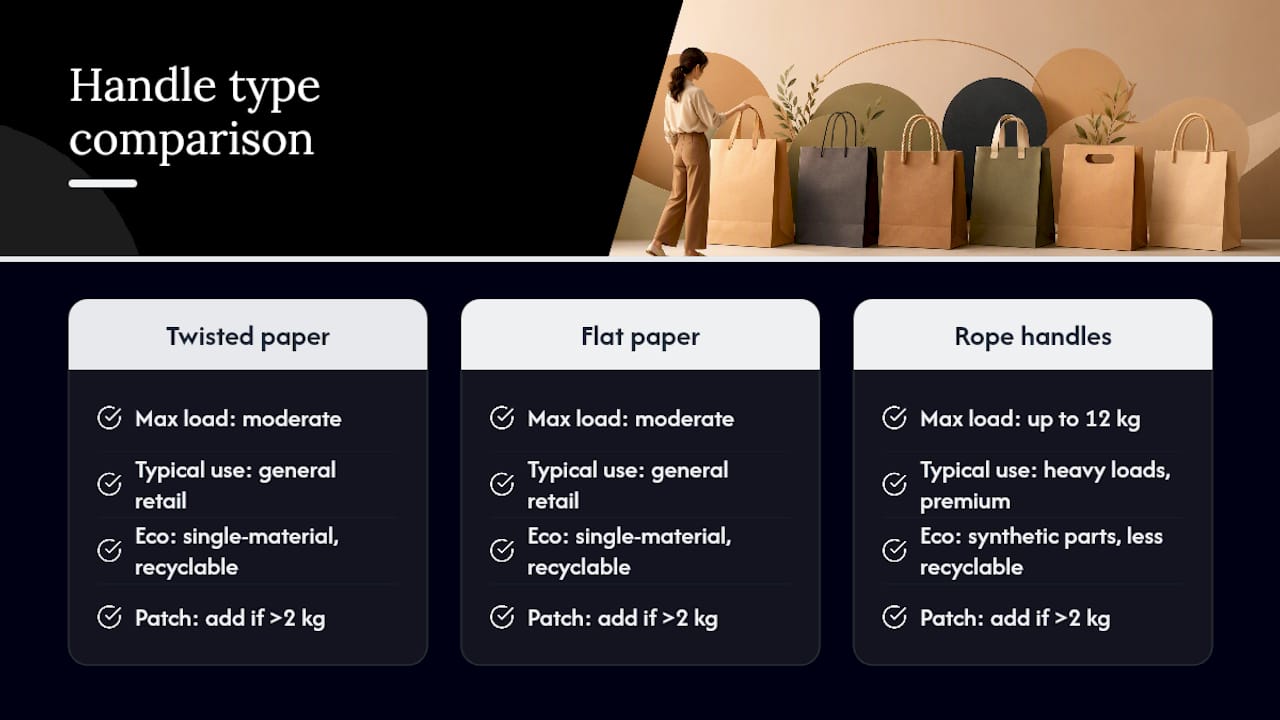
For light promotional items, flat or die-cut handles do the job. For everyday retail, twisted paper handles carry roughly 2 to 5 kilograms and hit the price-to-durability sweet spot most shops need. For premium or heavier goods, rope and ribbon handles take loads up to 12 kilograms depending on material. The rule that matters more than any of that: if a bag will carry more than 2 kilograms or gets reused, specify an internal reinforcement patch before you approve a single sample.
- Light items (under 1.5 kg): die-cut handles, minimal cost
- General retail (2 to 5 kg): twisted paper handles
- Premium or heavy loads (3 to 12 kg): rope or ribbon, material-dependent
Pro Tip: The handle area fails before any other part of a paper bag. Industry guidelines from CEPI point to it as the most common weak point, and EN13590 exists specifically to test carrying capacity at that joint.
Key Takeaways
Matching handle type to product weight and specifying internal reinforcement for any bag over 2 kilograms prevents most field failures before they happen.
| Point | Details |
|---|---|
| Match handle to load | Die-cut for under 1.5 kg, twisted for 2 to 5 kg, rope or ribbon for 3 to 12 kg. |
| Always reinforce over 2 kg | Require an internal paper patch for any bag expected to carry more than 2 kilograms or get reused. |
| Reference EN13590 in RFQs | Ask suppliers for test reports or sample lifting-cycle tests against EN13590 or the newer prEN 13590 draft. |
| Flag print-patch conflicts early | Reinforcement patches can overlap logo placement, so resolve this before final art approval. |
| Gather Packaging builds in reinforcement | Custom twisted, flat, die-cut, and rope handles ship with internal patches and QA testing as standard from our Toronto facility. |
Standards and guidance worth bookmarking
- CEPI industry guidelines on paper carrier bags
- EN13590 carrying capacity test standard
- Gather Packaging QA checklist
Table of Contents
- What Are the Main Paper Bag Handle Types?
- How Do You Match Handle Type to Product Weight and Brand?
- Why Does Handle Reinforcement Matter So Much?
- What Should You Include in a Handle Specification and RFQ?
- Ready to Order Custom Paper Bag Handles?
- Frequently Asked Questions
- Sources
What Are the Main Paper Bag Handle Types?
Every paper bag handle on the market falls into one of five categories, and each one signals something different to the person carrying it.
- Twisted paper handles. Made from tightly wound kraft paper cord, these are the workhorse of retail packaging. They flex without cracking, cost less than rope, and handle medium loads well. Load range: roughly 2 to 5 kilograms.
- Flat paper handles. Die-cut or laminated flat strips glued directly to the bag panel. Clean, minimal, and cheap to produce, but best kept under 2 kilograms since the flat profile concentrates stress at the attachment point.
- Die-cut handles. Cut straight from the bag material itself, no separate piece attached. Fastest to produce, lowest cost, but weakest option, suited only to light loads like a boutique tissue-wrapped item or a single garment.
- Rope handles for bags. Twisted cotton or polyester cord threaded through reinforced eyelets. These read as premium and can carry heavy loads depending on the cord material, but the synthetic versions complicate recycling.
- Ribbon and twine or jute handles. Grosgrain ribbon or natural jute cord, usually knotted through a grommet. Strong visual impact for gift retail and specialty shops, suitable for moderate to heavy loads when properly reinforced.
Twisted vs flat handles come down to load and budget: twisted costs more but survives more abuse. Twisted vs die-cut is really a question of whether the bag needs to be carried any real distance at all.
On recyclability, single-material paper bag handles (twisted, flat, die-cut) go straight into standard paper recycling streams. Rope and ribbon handles, especially those with polyester content or plastic ferrules, complicate that recycling path even though they photograph beautifully for a premium brand.
Attachment method matters as much as the handle material itself:
- Glued with internal patch: strongest option, distributes stress across a wider paper area
- Stitched: durable, common on rope handles, visible on the outside of the bag
- Knotted with ferrule: typical for rope/ribbon, load depends heavily on knot quality
- Grommeted: clean look, but the grommet itself can become a tear point if the surrounding paper isn’t reinforced
How Do You Match Handle Type to Product Weight and Brand?
Start with the number that actually matters: what’s the heaviest single item this bag will realistically carry, and will the same bag get picked up more than once?
Run it as a short sequence:
- Step 1: Define expected max load and whether the bag is single-use or reusable.
- Step 2: Shortlist handle types that clear that load with margin, not right at the edge of it.
- Step 3: Add internal reinforcement if the load exceeds 2 kilograms or the bag will be reused.
- Step 4: Weigh comfort and brand cues, since a rounded, wider handle reads as higher quality even when the load capacity is identical to a thinner one.
Handle width changes how a bag feels in hand long before it changes how much it can carry. A narrow twisted handle at 4 millimeters can dig into fingers under a 4 kilogram load, while a flatter, wider rope handle spreads that same weight more comfortably. If your product line skews toward bottles, boxed goods, or anything with sharp edges, that comfort factor becomes a quiet complaint generator if you get it wrong.
Pro Tip: Before locking in a handle spec, fill three sample bags to your expected max weight and have actual staff or a few customers carry them around the store for five minutes. Handle failures and comfort complaints show up fast under real use, faster than any spec sheet will tell you.
Brand perception rides on this decision more than most buyers expect. A step-by-step design guide can help you map handle choice against your overall packaging look before you commit to a production run.
Why Does Handle Reinforcement Matter So Much?
Reinforcement is the difference between a bag that survives one grocery trip and one that survives ten.
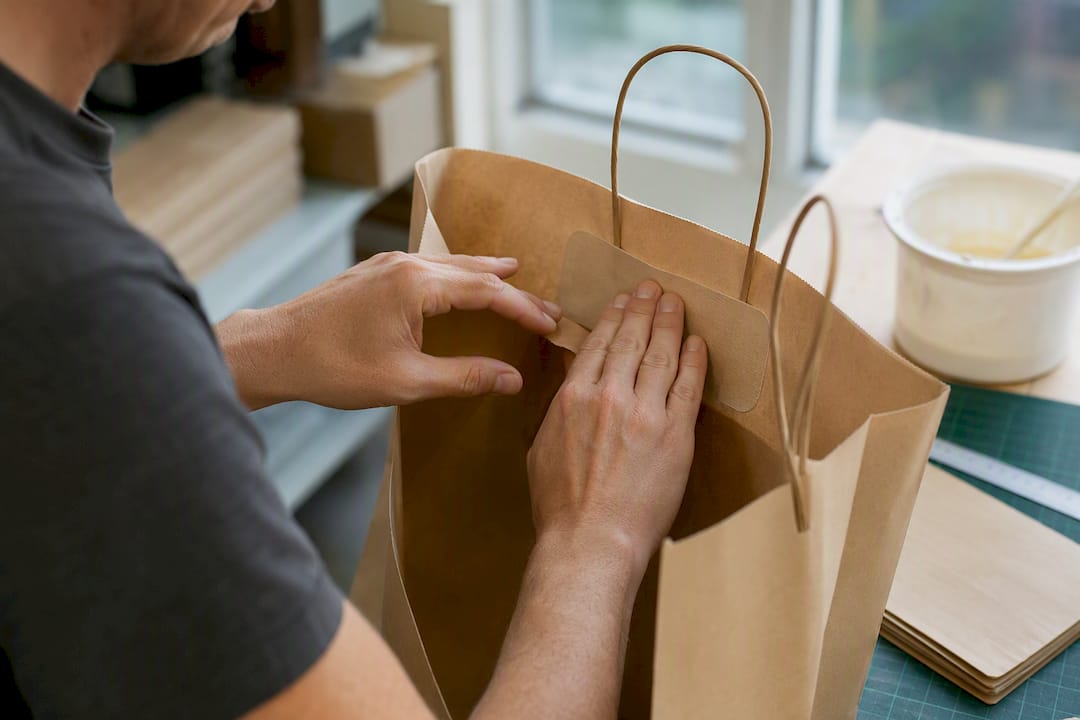
The handle area is the single most frequent site of bag failure. Manufacturers advise using high-strength handle paper and, critically, fixing handles inside the bag with an internal reinforcement patch rather than gluing the handle straight to the outer panel. That internal patch spreads load across a wider area of paper, which is what actually prevents the tear.
Specify the patch as its own line item, not an assumption. A patch should extend well beyond the handle attachment point on both sides, and the adhesive choice matters just as much as the patch size: water-based glues applied under proper converting supervision hold better than assumptions about “standard glue” would suggest.
For testing, EN13590 sets out the methods for measuring volume and carrying capacity on handled bags, and it’s the reference to cite when you ask a supplier for test reports. The draft update, prEN 13590:2026, adds handle elongation measurements and defined lifting sequences, worth asking your supplier whether they’re already testing against it, especially if you’re ordering reusable bags.
What Should You Include in a Handle Specification and RFQ?
A vague RFQ gets you a vague quote. Give your supplier these specifics and you’ll get a number you can actually compare against another bid:
- Bag dimensions (width, depth, height)
- Paper grade in gsm for both the bag body and the handle stock
- Handle type and material (twisted, flat, die-cut, rope, ribbon, twine)
- Handle length and width
- Internal patch size and placement
- Attachment method (glued, stitched, knotted, grommeted)
- Intended max load and expected reuse frequency
- Print colors and placement, noted separately near the handle zone
- Sample request with a stated quantity
- QA or test method reference, EN13590 or supplier-equivalent
- MOQ and lead time expectations
- Reinforcement patches often sit in the same zone where a logo would go, so flag that conflict before final art, not after proofs come back.
- Water-based inks paired with 8-color flexo printing let you keep brand color accuracy without pushing print near the stress zone at the top of the bag.
- Stock handle options move faster than fully custom runs. If your timeline is tight, ask what’s already tooled before requesting a custom width or material.
- Domestic manufacturing shortens the gap between sample approval and delivered stock, which matters most when a launch date is already fixed. A Canadian-made supply chain removes a lot of the shipping-delay risk that comes with overseas custom orders.
A production note on the mistakes we see most
The two mistakes we run into most often: buyers skip the internal patch to save a fraction of a cent per bag, and buyers approve a sample without loading it to the actual weight it’ll carry in-store. Both show up as complaints months later, not during production. We build reinforcement and sample testing into our standard process for exactly that reason.
Ready to Order Custom Paper Bag Handles?
Getting handle specs right on paper is one thing. Getting a supplier who reinforces every patch, tests before shipping, and prints in true brand color on the first run is another. Gatherpackaging builds all three into a single production process out of our Toronto facility, so you’re not chasing separate vendors for handles, printing, and quality checks.
Every bag we produce can carry custom twisted, flat, die-cut, or rope handles with internal reinforcement patches built in from the start, not bolted on after a complaint. Our 8-color flexo printing runs on FSC-certified stock with water-based inks, and our sustainability page covers the recycled-content and biodegradable options available for handle and body materials alike. For buyers weighing broader sustainable materials questions beyond our own product line, Expleco’s sustainable packaging resources are worth a look too.
Contact Gatherpackaging to request a sample bag built to your load and reuse requirements, get a real RFQ number back, and confirm a production timeline before you commit to a print run.
Frequently Asked Questions
What’s the strongest type of paper bag handle? Rope handles, particularly cotton or polyester twisted cord set through reinforced grommets, carry the heaviest loads, up to 12 kilograms depending on material. Twisted paper handles come close for general retail use at a lower cost.
Do paper bag handles need reinforcement patches? Any bag expected to carry more than 2 kilograms or get reused should have an internal reinforcement patch. The handle area is the most common failure point on a paper bag, and a patch spreads the load across a wider section of paper instead of concentrating stress at one glue line.
Are twisted or flat paper handles more eco-friendly? Both are single-material paper constructions, which makes them easier to recycle than rope or ribbon handles that include synthetic cord or plastic ferrules. If recyclability matters more than premium appearance, twisted or flat handles are the simpler choice.
How do I know what load capacity my paper bag handles need? Weigh your heaviest single product, or the heaviest realistic combination a customer might carry out, then add margin. Reference EN13590 test methods when you ask a supplier to confirm that capacity on a sample run.
What information should I include when requesting a quote for custom bag handles? Bag dimensions, paper grade, handle type and material, patch size and placement, intended load, print placement near the handle zone, and your target MOQ and lead time. That level of detail gets you a quote you can actually compare across suppliers.
Share:
Domestic vs Offshore Packaging: How to Choose the Right Fit
Grease Resistant Paper Bags: A Procurement Buying Guide