
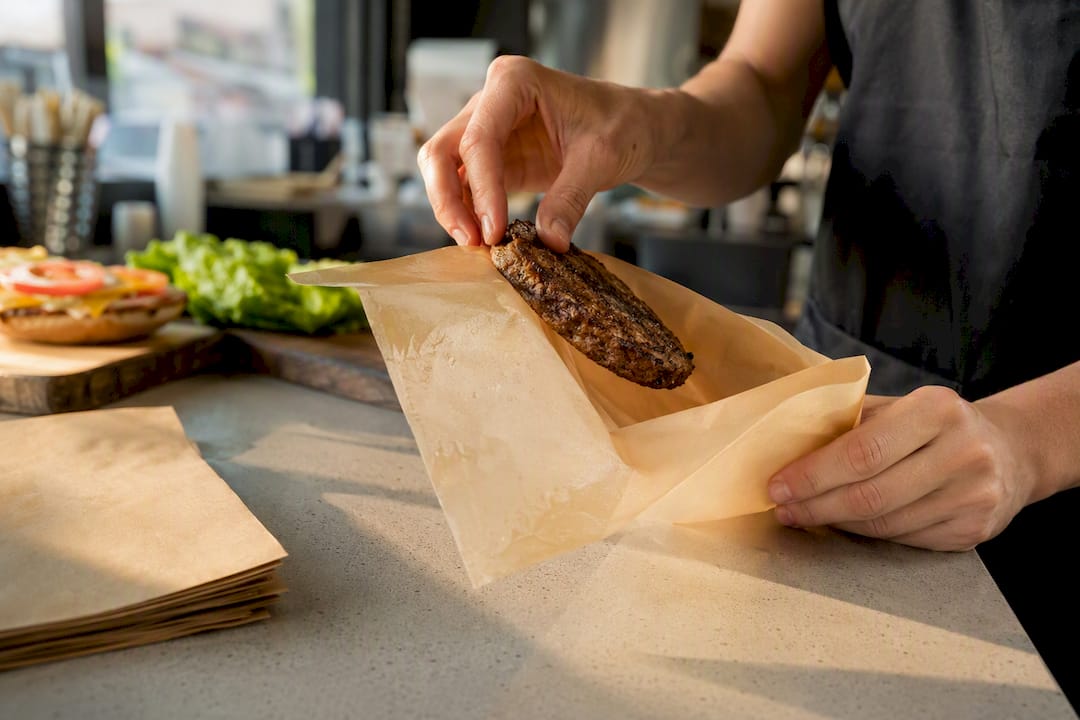
Grease resistant paper bags are food-contact packaging engineered to hold up against oil and fat without turning translucent, weak, or leaky. The technical term is greaseproof paper, and the single rule that matters most in procurement is this: match the bag’s tested Kit rating to the greasiness of the food it will carry, and confirm the fluorochemical status of the coating before you sign a purchase order.
Everything else in a spec sheet is secondary to those two facts. A supplier can advertise “grease resistant” on a product page with no lab data behind it at all — the phrase carries no standardized threshold unless it’s backed by a quantitative test rating.
- The term to know: greaseproof or grease resistant paper, verified by a Kit rating (TAPPI T 559), not just a marketing label.
- The primary spec to require: a Kit rating appropriate to the food category, plus written confirmation of fluorine-free (PFAS-free) coating chemistry if that matters to your brand or your market.
Gatherpackaging can supply custom-spec grease resistant bags with test documentation on request, built to the Kit range your product actually needs.
Key Takeaways
Grease resistant paper bags work reliably only when the Kit rating is matched to the food’s grease level and the coating chemistry is verified in writing, not assumed from a label.
| Point | Details |
|---|---|
| Know the term | “Greaseproof paper” is the industry name; a Kit rating from TAPPI T 559 is the number that backs the claim. |
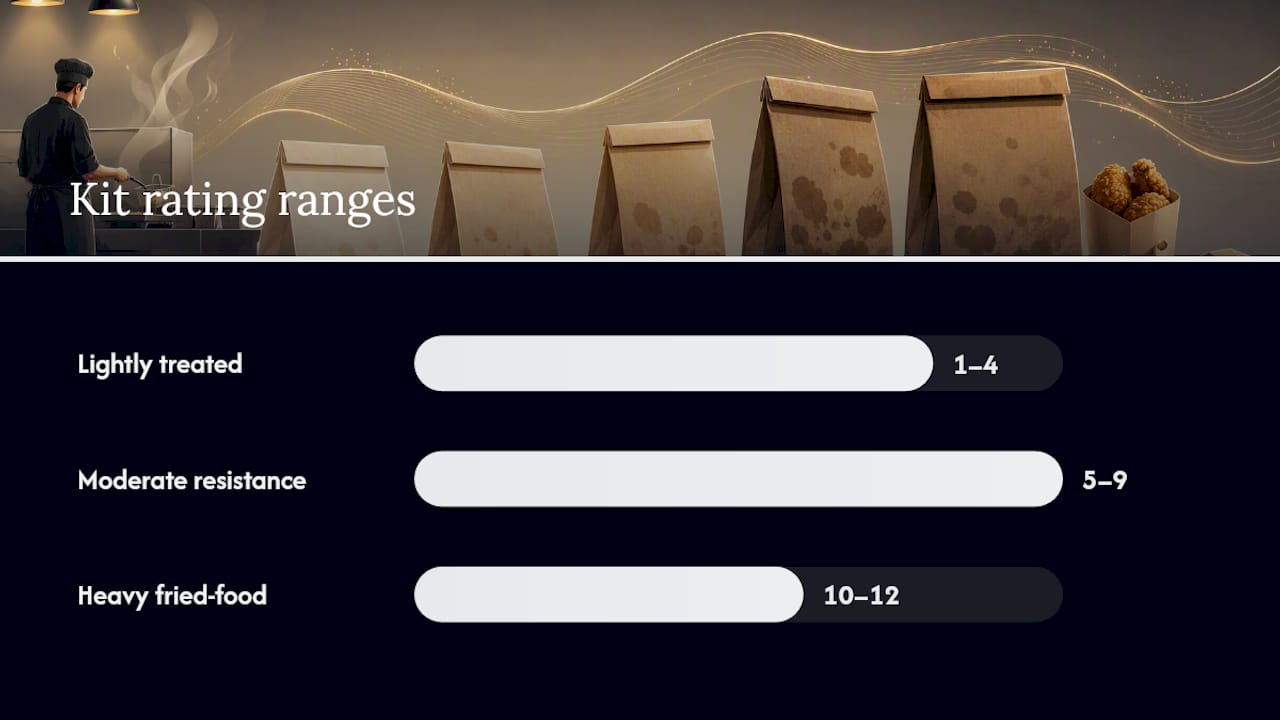
| Match Kit to food | Light snacks need Kit 4 to 6, medium-grease items Kit 7 to 9, heavy fried foods Kit 10 to 12. |
| Verify PFAS status separately | “Grease resistant” and “PFAS-free” are different claims; request a COA or TOF report to confirm which one applies. |
| Request real test data | Ask for Kit, OGR, and Cobb60 reports, not just a spec sheet summary, before approving a supplier. |
| Work with a documented supplier | Gatherpackaging provides custom Kit-rated bag specs with lab documentation and prototyping available on request. |
Table of Contents
- What Are Grease Resistant Paper Bags Made Of?
- How Is Grease Resistance Measured?
- Which Kit Rating Fits Which Food?
- Is Grease Resistant the Same as PFAS-Free?
- What Should Go in a Grease Resistant Bag RFQ?
- How Gatherpackaging Builds Grease Resistant Bags to Spec
- Why Kit Ratings Get Overspecified, and What Actually Matters
- Get Custom Grease Resistant Bags Built to Your Kit Spec
- Frequently Asked Questions
- Sources
What Are Grease Resistant Paper Bags Made Of?
Three material families show up on most supplier spec sheets, and they behave very differently once oil hits the surface.
Glassine is a smooth, dense, semi-translucent paper made by super-calendering pulp fibers until they pack tightly together, closing off the tiny air channels oil would otherwise travel through. It’s naturally grease resistant without any topical treatment, which is why bakeries have used it for decades to wrap butter and pastries.
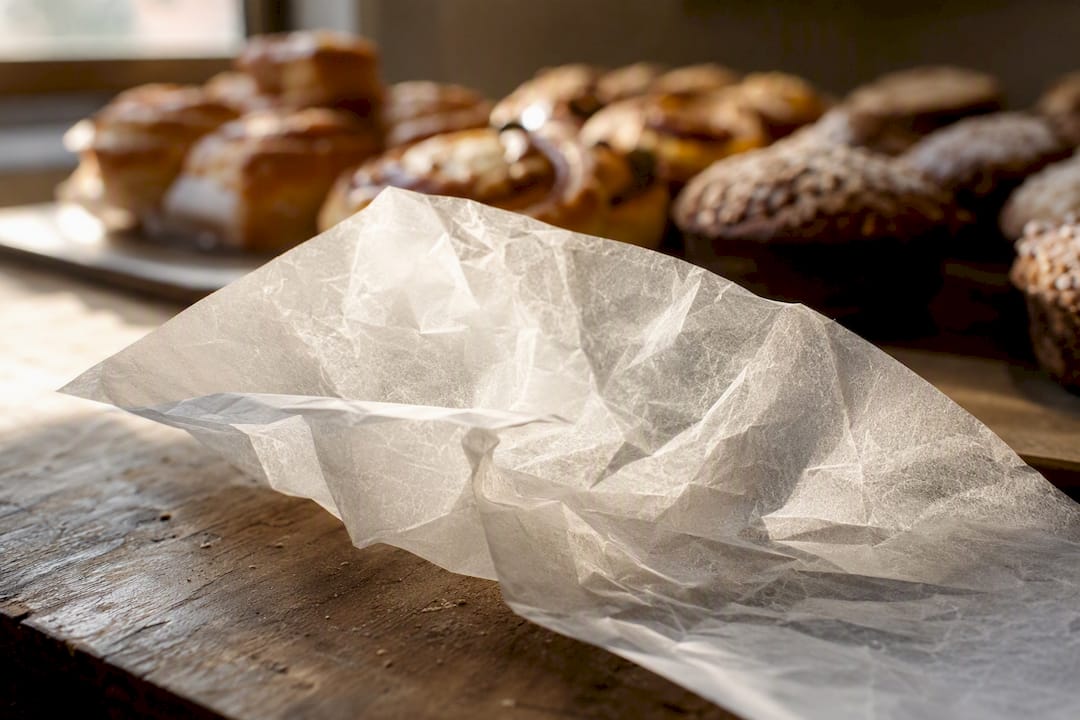
Mechanically greaseproof paper achieves a similar barrier through heavy refining of the pulp rather than surface treatment. It tends to be less transparent than glassine and often costs less, making it common in mid-tier takeout and bakery bags.
Coated papers start with a standard kraft or machine-glazed base sheet and add a barrier layer on top, aqueous coatings, PLA (polylactic acid), polyethylene, or newer bio-based films made from starch or chitosan. Coated stock gives suppliers more control over exact performance, but the coating type drives everything downstream: recyclability, compostability, and cost.
Basis weight matters as much as the coating. Lighter sheets in the 30 to 40 g/m² range suit dry snacks and light pastries; heavier stock from 50 to 80 g/m² holds up under sandwiches, fried items, and anything with real weight or moisture. Go too light for the application and even a perfect Kit rating won’t save the bag from tearing at the seams.
- Glassine: naturally grease resistant, premium feel, higher cost per unit.
- Mechanically greaseproof: solid mid-range performance, more economical.
- Coated (aqueous, PLA, bio-based): customizable barrier strength, but recyclability depends entirely on the coating chemistry.
Pro Tip: Ask suppliers for a physical swatch, not just a spec PDF. Grease resistance claims are easy to overstate on paper; a hands-on grease or oil-drop test on the actual stock takes two minutes and tells you more than any brochure.
How Is Grease Resistance Measured?
Procurement teams need a number, not an adjective, and the industry standard for getting one is the TAPPI Kit test, formally Test Method T 559. It rates a paper’s grease resistance on a scale from 1 to 12 by exposing the surface to a series of castor oil, toluene, and heptane solutions, numbered so a higher score means the paper resists a more aggressive, lower-surface-tension mixture. A Kit 12 sheet stops nearly everything; a Kit 3 or 4 sheet is only lightly treated.
That scale has one real limitation: it’s a pass/fail style test at each level, not a continuous quantitative measurement, so two papers can both score Kit 8 while performing noticeably differently in the field. That’s why TAPPI’s own journal has pushed for improved OGR (oil and grease resistance) methods, giving waterborne coatings a more numeric, reproducible comparison rather than a bracketed score.
Cobb testing rounds out the picture. Cobb60 measures how much water a sheet absorbs in 60 seconds, which matters for condensation resistance in anything cold or refrigerated, separate from oil resistance entirely. A bag can score high on Kit and still fail if moisture from a chilled item soaks straight through.
When you’re comparing suppliers, ask for:
- A current Kit rating (T 559) with the test date.
- OGR or oil breakthrough data if the coating is waterborne.
- Cobb60 figures if the product will see refrigeration or ice contact.
Statistic Callout: Kit ratings run on a 1 to 12 scale under TAPPI T 559, and industry guidance generally places heavy fried-food applications at the top of that range, around Kit 10 to 12.
Which Kit Rating Fits Which Food?
Matching the Kit number to the product is where most procurement mistakes happen, usually in the direction of overspecifying and paying more than necessary.
- Light snacks and dry baked goods (cookies, chips, dry pastries): Kit 4 to 6 is generally sufficient, since these items release little to no free oil.
- Medium-grease items (sandwiches, pizza slices, muffins with butter or oil content): Kit 7 to 9 covers most of this category, per common industry Kit-rating guidance.
- Heavy fried foods (fried chicken, fries, samosas, doughnuts): Kit 10 to 12 is the range to specify, particularly for anything held warm for an extended period.
- Hot oil, long hold times, or heavy exudate (deep-fried items sitting in a warmer, or bags stacked in delivery totes for 30+ minutes): consider film-laminated or foil-lined bags rather than relying on paper barrier alone. A straight paper solution, even at Kit 12, has limits once oil volume and heat combine over time.
Forming and printing decisions layer on top of the material choice. Side-gusseted bags handle bulkier, irregular items like whole sandwiches better than flat interfolded sheets, while windowed bags let customers see the product but require careful film selection so the window itself doesn’t become the weak point for grease bleed-through. If branding is part of the order, confirm the print process and ink system are rated for food contact before locking in the design.
Is Grease Resistant the Same as PFAS-Free?
No, and this is where a lot of buyers get caught off guard. For decades, the paper industry relied on fluorinated compounds, PFAS chemistry, to achieve high Kit ratings cheaply and reliably. That chemistry worked extremely well, which is exactly why it became the default. It’s also now restricted or phased out across a growing list of jurisdictions because of environmental persistence concerns.
A bag can still say “grease resistant” on the label with zero indication of whether it used fluorinated or fluorine-free chemistry to get there. The two claims are not the same thing, and a supplier who doesn’t volunteer which one they’re using should be asked directly.
The good news for buyers is that fluorine-free alternatives have caught up substantially. Bio-based coatings using starch and chitosan have demonstrated strong oil-resistance improvements alongside reduced water vapor transmission in lab testing. Reviews of the broader field point to polysaccharide- and protein-based biopolymers, starch, chitosan, nanocellulose, zein, soy, as viable PFAS-free routes, though they often need multilayer coating structures to match fluorinated performance on water barrier specifically. Separate research on non-fluorinated cellulosic coatings has reached Kit values as high as 9 using alginate and CMC-based chemistry, which covers most medium-to-high grease applications without fluorine at all. Broader sustainable-materials perspectives from partners like Expleco reinforce the same shift away from fluorinated agents across the packaging sector.
Verification steps to build into any RFQ:
- Request a Certificate of Analysis (COA) or Total Organic Fluorine (TOF) test report, not just a written PFAS-free statement.
- Ask whether migration testing has been done for direct food contact.
- Confirm end-of-life claims, recyclable versus compostable, with documentation, since coating chemistry determines which claim is actually true.
Pro Tip: A verbal “yes, it’s PFAS-free” from a sales rep is not documentation. If a supplier can’t produce a TOF report or third-party COA within a reasonable timeframe, treat that as a signal, not a technicality.
What Should Go in a Grease Resistant Bag RFQ?
A well-built RFQ turns a vague “send me your grease resistant bags” request into something a supplier can quote accurately and that you can actually compare across vendors.
- Kit rating required, with test date and lab reference.
- Basis weight in g/m², matched to the product’s weight and handling needs.
- Coating type: aqueous, PLA, bio-based, or fluorinated, stated explicitly.
- Cobb60 value, especially for anything refrigerated or exposed to condensation.
- Film or laminate spec, if the application calls for foil lining or lamination beyond straight paper.
- Print ink certification for food contact, if the bag will carry branding near the product zone.
Beyond the spec fields, request these documents before approving a supplier: a current product spec sheet, a recent lab test report covering Kit, OGR, or Cobb as applicable, a PFAS COA or TOF report, the sample policy, standard lead times, and minimum order quantity.
Sample evaluation should include a kitchen hot-oil test using the actual product going into the bag, a transit test to check for condensation buildup if the item ships chilled, and a printing or branding test to confirm ink adhesion and legibility hold up under handling. Set acceptance criteria before testing starts, not after, so a marginal sample doesn’t get waved through because nobody defined “pass” in advance.
Pro Tip: Run the hot-oil test with a fully loaded bag, not an empty one held over a flame. Real-world grease resistance shows up under actual weight and heat exposure, not in a lab-clean simulation.
How Gatherpackaging Builds Grease Resistant Bags to Spec
Gatherpackaging manufactures paper shopping and takeout bags domestically in Toronto, with custom sizing, up to 8-color flexo printing, and a choice of turn top, serrated top, or tamper-resistant styles depending on the application. Material options include FSC-certified and recycled content stock, with water-based inks available for brands that need food-contact-appropriate print systems.
On the quality side, every custom order goes through in-house prototyping and sample testing before production runs begin, and lab documentation, including Kit rating and Cobb data, is available on request for buyers who need it for their own procurement files.
- Custom sizes, styles, and up to 8-color flexo printing.
- FSC-certified and recycled paper options, water-based inks.
- In-house prototyping and sample testing ahead of full production.
- Domestic Toronto manufacturing for predictable lead times.
Buyers who ask for test documentation upfront, rather than after a complaint, consistently end up with fewer surprises once bags hit the kitchen floor.
Reach out to discuss custom bag specifications for your product line, request sample bags, or get a lab report walkthrough before committing to a production run.
Why Kit Ratings Get Overspecified, and What Actually Matters
Most procurement teams default to the highest Kit rating available, treating it like a safety margin. It isn’t. A Kit 12 bag for a bag of dry pretzels is money spent on a barrier the product will never test, and it often comes with a heavier basis weight and higher unit cost that adds up fast across a full order.
The bigger blind spot isn’t the Kit number at all, it’s assuming grease resistance and PFAS-free status travel together. They don’t, and the research on fluorine-free alternatives shows real progress, not a compromise buyers have to accept begrudgingly. Starch, chitosan, and cellulosic coatings are closing the performance gap fast enough that “PFAS-free means weaker” is no longer a safe assumption to build a spec around.
What should come first in any RFQ is documentation, not adjectives. A supplier who hands over a Kit rating, a COA, and a Cobb figure without being asked twice is telling you more about their operation than any glossy spec sheet ever will.
Get Custom Grease Resistant Bags Built to Your Kit Spec
Gatherpackaging manufactures custom paper bags domestically in Toronto, which means shorter lead times and direct access to production, rather than routing your order through an overseas broker with limited visibility into the actual paper stock or coating batch. For grease resistant applications specifically, that means you can request a specific Kit rating, confirm PFAS-free coating chemistry, and get a prototype in hand before committing to a full production run.
If your current supplier can’t produce a Kit rating, a Cobb figure, or a straight answer on fluorine content, that’s a gap worth closing before your next order ships. Gatherpackaging offers custom bag styles and printing across turn top, serrated top, and tamper-resistant formats, with FSC-certified and recycled material options for brands that need documented sustainability claims alongside grease performance. Contact Gatherpackaging to request a sample, review test documentation, or get a quote scoped to your product’s exact grease and moisture profile.
Frequently Asked Questions
What is the difference between greaseproof paper and grease resistant paper? The terms are used interchangeably in most of the industry. Both describe paper treated or manufactured to resist oil and fat penetration, verified through a Kit rating under TAPPI T 559.
Are grease resistant paper bags biodegradable? It depends entirely on the coating. Uncoated or bio-based coated papers (starch, chitosan, cellulosic) are typically recyclable or compostable, while PE-laminated papers generally are not. Confirm the specific coating with your supplier rather than assuming based on the base paper alone.
What Kit rating do I need for a bag holding fried chicken or fries? Heavy fried foods generally call for Kit 10 to 12, and for extended hold times or hot oil exposure, a foil-lined or film-laminated bag may outperform paper alone.
How can I confirm a paper bag is PFAS-free? Request a Certificate of Analysis or a Total Organic Fluorine test report from the supplier. A written “PFAS-free” claim without lab backing is not sufficient documentation for most procurement or compliance needs.
Does a higher Kit rating always mean a better bag? No. Overspecifying Kit rating for a low-grease product adds unnecessary cost and often unnecessary basis weight. Match the rating to the actual food category instead of defaulting to the maximum.
Sources
- Greaseproof paper products: A review emphasizing ecofriendly approaches
- Research Status and Prospects of Bio-based Materials for Grease Barrier Coatings on Paper Food Packaging
- Improvements in oil and grease resistance (OGR) test methodology for waterborne barrier coatings, TAPPI Journal November 2022
- Fabrication of grease resistant paper with non-fluorinated chemicals for food packaging
Share:
Choosing the Right Paper Bag Handles for Retail Packaging
Wet Strength Paper Bags: What Buyers Should Know Before Ordering