
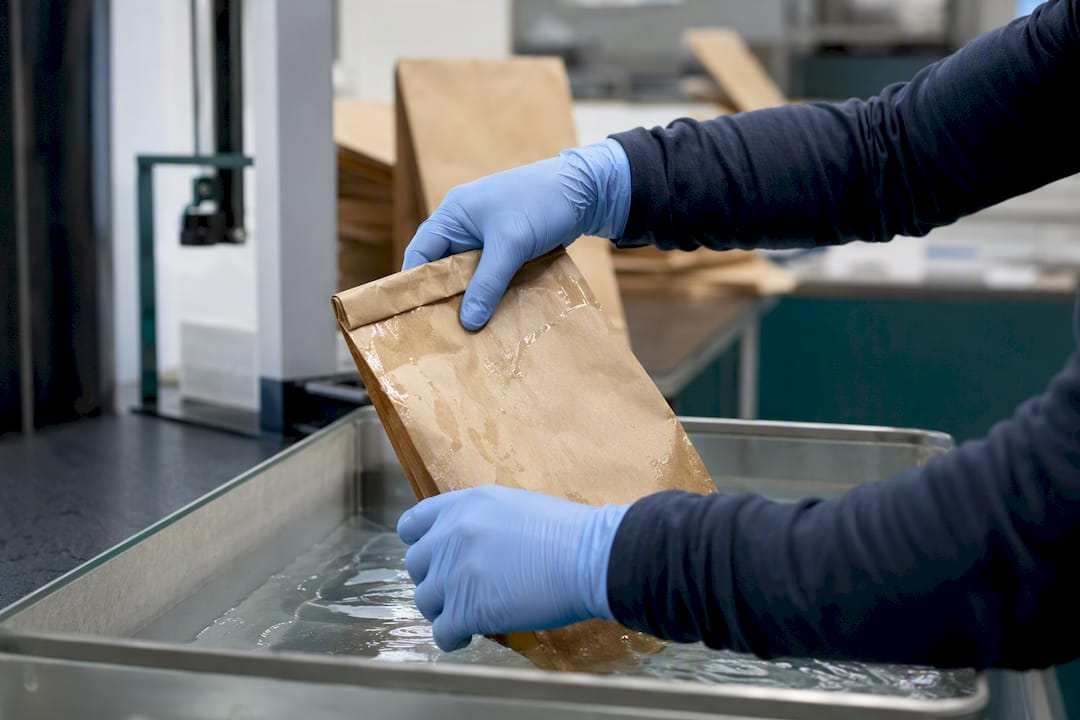
Wet-strength paper bags are made or treated to hold onto a set portion of their dry tensile strength even after they get soaked, and they’re the right call for produce, damp goods, frozen items, and farm market or takeout orders where moisture is a given, not a maybe. Before you sign off on a supplier, ask for one thing first: wet tensile results tested to ISO 3781, or a stated relative wet strength percentage. One more distinction matters immediately:
- Wet strength keeps the bag from tearing apart when it’s wet.
- A barrier or liner is a separate spec that stops liquid from soaking through in the first place, and you need both if the product is genuinely wet, not just cold or humid.
Key Takeaways
Wet-strength paper bags hold their integrity when wet because a treated resin restores fiber bonds that plain hydrogen-bonded paper loses on contact with moisture, typically retaining more than 15% of their dry tensile strength after saturation.
| Point | Details |
|---|---|
| Know the threshold | Paper is generally considered wet-strength once it retains more than 15% of its dry tensile strength when saturated. |
| Request ISO 3781 data | Ask suppliers for wet tensile results tested in the machine direction, with conditioning and dates included. |
| Separate strength from barrier | Wet strength keeps bags intact; a liner or coating with TAPPI T 821 WVTR data stops liquid migration. |
| Ask about resin chemistry | PAE, glyoxalated alternatives, and natural agents like starch or CNF carry different recyclability trade-offs. |
| Work with a domestic supplier | Gatherpackaging manufactures in Toronto and provides ISO 3781, TEA, and burst/tear data on request for produce and wet-goods bags. |
Table of Contents
- What Does “Wet Strength” Actually Mean for Paper Bags?
- What Standards Should You Request from a Paper Bag Supplier?
- Which Materials and Treatments Actually Deliver Wet Strength?
- How Do You Choose the Right Wet-Strength Bag for Your Products?
- How Gatherpackaging Handles Wet-Strength Paper Bag Production
- How Should You Store and Inspect Wet-Strength Paper Bags?
- Why Procurement Teams Keep Getting This Wrong
- Ready to Spec Wet-Strength Bags That Actually Perform?
- Sources
What Does “Wet Strength” Actually Mean for Paper Bags?
Wet strength is a ratio, not a feeling. Industry practice defines a sheet as genuinely “wet-strength” when it retains more than 15% of its dry tensile strength after full saturation. That threshold exists because untreated paper falls apart almost entirely once it’s wet.
Untreated kraft paper loses nearly all of its strength when soaked. Saturated paper without any wet-strength treatment drops to roughly 3 to 10% of its dry strength, which is why a plain grocery sack turns to mush the moment it touches a wet head of lettuce or a leaking container. Commercial wet-strength resins, by contrast, can push that figure up to 20 to 50% of dry strength.
The mechanism is straightforward. Paper fibers hold together dry through hydrogen bonds between cellulose chains. Water disrupts those bonds, which is why wet paper feels limp and tears with almost no resistance. Wet-strength additives work by forming a different kind of bond entirely:
- Crosslinking resins bond covalently or ionically to the fiber network, and those bonds don’t dissolve the same way hydrogen bonds do.
- The result is a sheet that keeps structural integrity through handling, carrying, and stacking, even when it’s damp or fully wet.
- That’s the difference between a bag that survives a farmers market Saturday and one that splits open at the handles halfway to the customer’s car.
What Standards Should You Request from a Paper Bag Supplier?
Ask for named test standards, not adjectives. “Durable” and “strong” mean nothing on a spec sheet. Here’s what actually tells you something:
- ISO 3781 (wet tensile strength). This test fully saturates a paper specimen and then pulls it apart in the machine direction to measure tensile strength after saturation. It’s the most direct wet-strength number you can request, and it should be reported as a percentage of dry tensile or as an absolute value with the dry baseline attached.
- TAPPI T 821 (WVTR). This measures water vapor transmission rate in grams per square meter per day, and it’s a barrier test, not a wet-strength test. It matters when moisture migration, not just handling durability, is the concern. Practical WVTR bands run from about 15 g/m²/day for aqueous-coated board down to 5 g/m²/day for multilayer constructions.
- TEA, burst strength (ISO 2758), and Elmendorf tear (ISO 1974). Tensile Energy Absorption and tear/burst numbers predict how a bag handles drops, sudden loads, and the repeated stress a handle takes when someone carries six pounds of wet greens across a parking lot. A high wet tensile number alone doesn’t guarantee the bag survives real-world abuse.
When a supplier sends test data, ask for the method name, sample direction (machine direction versus cross direction), conditioning details, and the date of certification.
Pro Tip: Wet-strength resin needs curing time to fully develop after the paper is manufactured. If a supplier tests a fresh, uncured sample, the wet tensile number can read lower than what ships weeks later. Ask when the tested sample was conditioned relative to production.
Which Materials and Treatments Actually Deliver Wet Strength?
Not every wet-strength approach solves the same problem, and the chemistry choice has real downstream consequences for recycling.
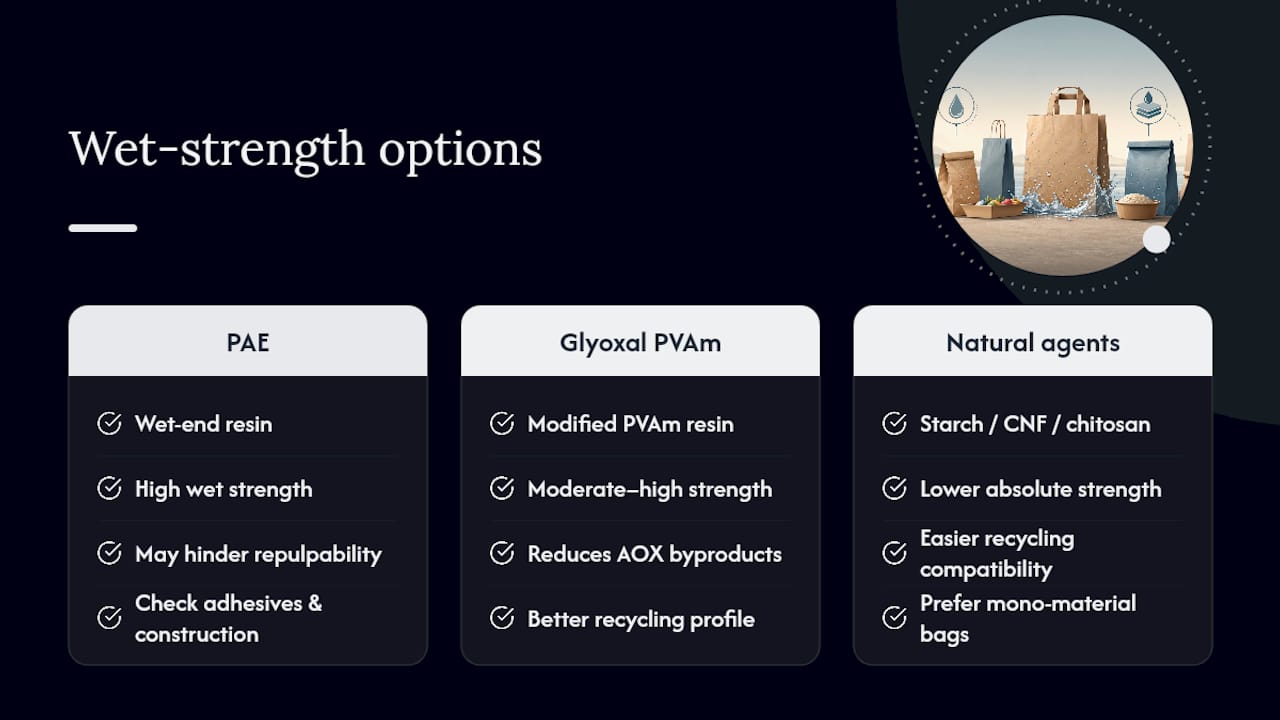
Wet-end resins, primarily polyamide-amine epoxide (PAE), get added during papermaking and bond into the fiber network itself, which is what gives structural wet tensile strength. Surface treatments and PE or PLA linings work differently. They create a physical barrier against liquid, but they don’t necessarily strengthen the fiber bonds the way a wet-end resin does. If your product is genuinely wet, you likely need both a resin for handling strength and a liner for containment.
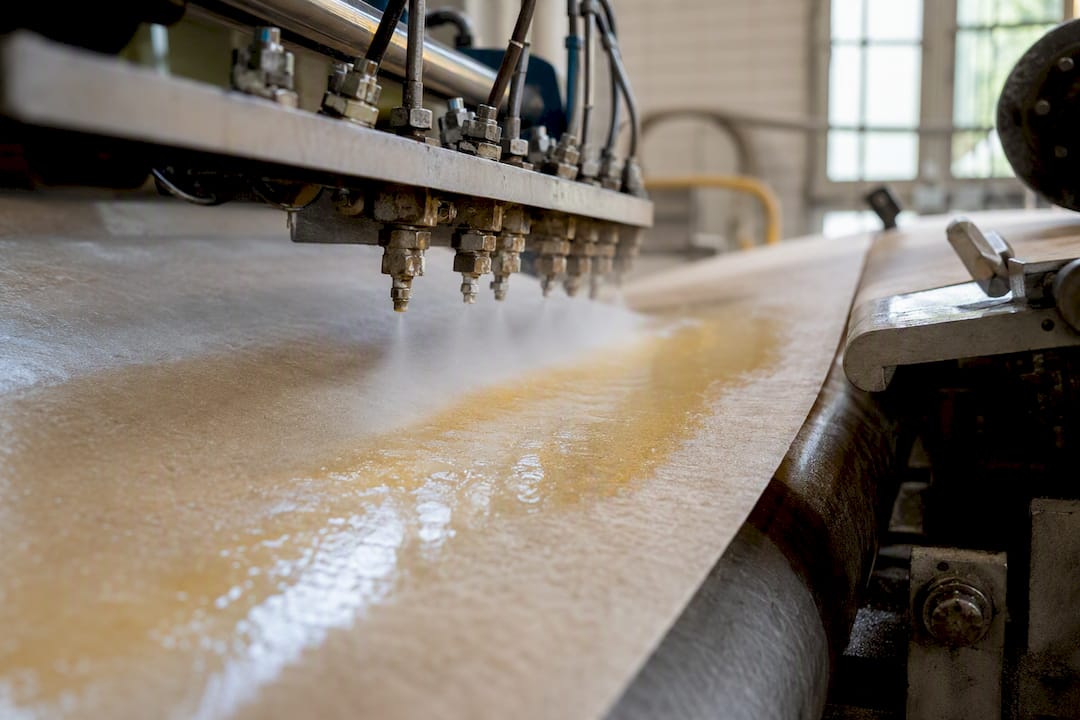
Newer chemistries are shifting the environmental math. Glyoxalated polyvinylamide and UHMW GPVM alternatives to PAE reduce AOX byproducts, and natural agents like starch, cellulose nanofibrils (CNF), and chitosan offer wet strength with a lighter chemical footprint, though often at lower absolute performance.
Repulpability is the trade-off buyers overlook most often. Some resin chemistries interfere with recycling streams, so ask directly whether a bag is designed for repulpability and whether the adhesives used are water-based rather than solvent-based. Mono-material construction, meaning no mixed plastic laminate fused to the kraft sheet, keeps recycling simpler. Groups like Expleco’s sustainable packaging work cover this exact tension between performance chemistry and end-of-life recovery.
How Do You Choose the Right Wet-Strength Bag for Your Products?
Run this as a checklist, in order, before you commit to a supplier or a purchase order.
- Define the load and environment first. Frozen fish is a different problem than damp lettuce or a hot takeout order. Write down the weight, moisture level, and handling time before you spec anything.
- Request ISO 3781 wet tensile results, including which direction (MD or CD) was tested.
- Request TEA and burst/tear values alongside the wet tensile number, since tensile alone won’t predict handle failure or drop resistance.
- Confirm coating or liner type and food-contact compliance if the bag will touch food directly, especially for produce or takeout use.
- Check handle design and reinforcement. Bottom gussets, reinforced handle patches, and stitching or taping all affect real-world load capacity more than most buyers expect. Our guide on durable bag construction breaks down what to look for.
- Ask about lead times and sample policy before you’re locked into a production schedule you can’t verify.
Acceptable evidence looks like a lab report citing the method name, sample conditioning, and a dated signature, not a marketing sheet with a green leaf icon and no numbers attached.
Pro Tip: Treat “eco-friendly” as a question, not an answer. Ask which specific certification (FSC, recycled content percentage, or a named resin chemistry) backs the claim before you accept it.
Reject any supplier who won’t name their resin chemistry, uses solvent-based adhesives without disclosing it, has no test data at all, or can’t answer a direct question about repulpability.
How Gatherpackaging Handles Wet-Strength Paper Bag Production
Gatherpackaging manufactures eco-friendly paper shopping bags domestically in Toronto, which means QA checks happen close to production instead of somewhere across an ocean with a six-week feedback loop. That proximity matters most when you’re troubleshooting a wet-strength spec that didn’t land right on the first sample run.
A supplier who can hand you a wet tensile report and a repulpability answer in the same conversation has already done the homework most buyers have to chase down themselves.
We provide test results on request, including ISO 3781 wet tensile data, TEA, and burst/tear figures, alongside FSC-certified material options for buyers who need documented sourcing. Our team can also walk through resin chemistry choices and recyclability trade-offs before you commit to a production run, rather than after.
Prototyping and sample testing happen in-house, and our 8-color flexo printing keeps branding sharp on kraft stock without compromising the wet-strength treatment underneath. If you’re speccing bags for produce, farm market, or wet-goods use, start by requesting a sample with your required test data attached. Browse available bag styles and materials to see what’s already in production.
How Should You Store and Inspect Wet-Strength Paper Bags?
Storage conditions affect performance as much as the resin chemistry does. Keep bags in a dry, ventilated space, off damp floors, and rotate stock so older inventory ships first.
On arrival, run three quick checks:
- Visual inspection for warping, discoloration, or uneven print that might signal moisture exposure in transit.
- Handle pull test on a handful of bags from different pallet positions to catch inconsistent reinforcement.
- Cut-and-wet sample test, soaking a cut sample and comparing its behavior against the supplier’s stated wet tensile data.
If a sample fails, request a lab retest and specify the method (ISO 3781) and sample conditioning explicitly, rather than sending a vague complaint about “flimsy bags.”
Why Procurement Teams Keep Getting This Wrong
Most buyers treat “wet-strength” as a marketing adjective instead of a measurable spec, and that’s the single biggest gap between what gets promised and what actually survives a delivery route. A bag described as “durable” with no ISO 3781 number attached is a bag nobody has actually tested.
The conventional advice, buy thicker paper or heavier GSM, misses the point. Weight alone doesn’t determine wet performance; resin chemistry and construction do. A heavier untreated sheet can still collapse to single-digit percentages of its dry strength once saturated, while a lighter, properly treated sheet holds together fine.
If I had to tell a procurement team one thing to prioritize, it’s this: stop accepting sample bags without a dated test report attached. Ask for the wet tensile percentage, the test direction, and the resin chemistry in writing before the purchase order goes out. The buyers who get burned aren’t the ones who chose the wrong material category. They’re the ones who never asked the supplier to prove the number on the label.
— Taylor
Ready to Spec Wet-Strength Bags That Actually Perform?
Gatherpackaging builds wet-strength paper bags to order, with domestic manufacturing in Toronto that keeps lead times shorter and QA conversations direct instead of routed through a broker overseas. You get test data on request, FSC-certified material options, and a team that will talk resin chemistry with you instead of handing you a glossy spec sheet.
If your product line includes produce, wet or frozen goods, or farm market items, this is the exact category we build for. Our Canadian-made kraft bag production covers everything from turn top to tamper-resistant styles, all customizable with 8-color flexo printing. Explore our sustainability and material options if recyclability or recycled content is part of your spec, then contact Gatherpackaging to request a sample and a test quote built around your exact load and moisture requirements.
Share:
Grease Resistant Paper Bags: A Procurement Buying Guide
What Perforations in Paper Bags Actually Do (And When to Use Them)