
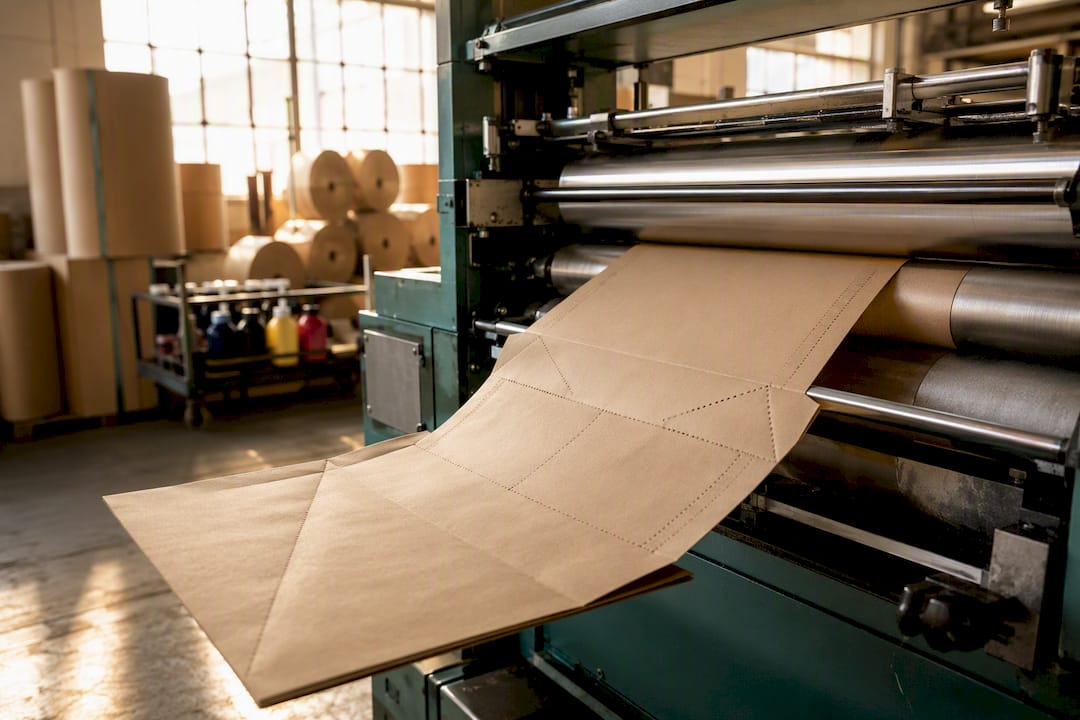
Perforations in paper bags create controlled airflow, let moisture or steam escape, and build in an easy-open path for the end user. That’s the whole function in one sentence. The decision rule is simple: specify perforations when your product needs to breathe, release heat, or open without a knife or tear notch, and when the bag’s structure can absorb some localized strength loss without failing in transit.
If your product doesn’t respire, doesn’t generate steam, and doesn’t need a consumer-friendly opening feature, skip perforations entirely. They add a manufacturing step and a structural compromise you don’t need. But for the right applications, they solve real problems that solid paper can’t.
Common use cases where perforations earn their place:
- Produce bags — controlling humidity and slowing spoilage through gas exchange
- Bakery bags — releasing steam from warm bread and pastries to prevent sogginess
- Valve bags — letting trapped air escape during high-speed automated filling
- Retail easy-open bags — giving customers a tear line instead of relying on adhesive or a fold
Key Takeaways
Perforations succeed when their hole size, pattern, and placement are matched to a specific functional need and validated with fixture-based mechanical testing rather than assumption.
| Point | Details |
|---|---|
| Function drives spec | Decide whether you need airflow, steam release, air displacement, or easy-open before choosing a pattern. |
| Method depends on volume and precision | Laser suits programmable micro-perforation; pin and punch suit standard production runs. |
| Placement protects strength | Keep perforation away from seams, gussets, and handle zones to avoid pre-openings. |
| Fixture testing beats hand tests | Mechanical tests simulating real opening motion give repeatable acceptance data. |
| Gather Packaging prototypes on your substrate | Domestic Toronto manufacturing lets you test tear performance before committing to a full production order. |
Table of Contents
- Perforations in Paper Bags: Functions and Where They’re Used
- Perforation Technologies: Mechanical Pins, Laser, Thermal, and Punch Methods
- Design Parameters: Hole Size, Pattern, Density, and Material Fit
- From Dieline to Production Line: How Converters Add Perforations
- Testing Perforated Bags: Why Human Hand Tests Fall Short
- Balancing Ventilation Against Bag Strength
- Gather Packaging’s Approach to Perforation Briefs
- Perforation Spec Checklist for Your Next RFQ
- Sustainability Considerations for Perforated Paper Bags
- Safety and Regulatory Standards for Perforated Bags
- What I’ve Learned From Perforation Briefs That Actually Worked
- Get a Perforation Prototype Made in Toronto
- Sources
Perforations in Paper Bags: Functions and Where They’re Used
Every perforation pattern exists to solve one of four problems: airflow, steam release, air displacement during filling, or user-friendly opening. Getting the function right matters more than the perforation itself, because the wrong pattern for the wrong job either fails to do its job or weakens the bag in a place you can’t afford.
-
Ventilation and moisture control. Produce and bakery items generate moisture. Trapped humidity accelerates decay in vegetables and turns crusty bread soft within hours. A grid of small holes lets that moisture escape gradually instead of pooling against the paper, which is one reason micro-perforated packaging can slow respiration in fresh produce rather than sealing it in.
-
Steam escape for hot items. Bread straight from the oven, pastries, and other warm bakery goods release steam for a period after packaging. Perforations near the top or sides of the bag give that steam somewhere to go, which keeps crust texture intact instead of letting condensation turn it chewy.
-
Valve bag air displacement. In automated filling lines, air trapped inside a bag during high-speed filling can cause overflow, seam blowouts, or inconsistent fill weights. A perforated valve section lets air escape as the product settles, without letting the product itself spill.
-
Easy-open consumer features. A perforated tear strip on a retail bag or a scored opening on a takeout bag gives customers a clean, tool-free way to access the contents. This matters most on foodservice takeout bags, where a fumbled opening at a delivery doorstep is bad optics for the brand on the bag.
-
When perforations don’t belong. If your bag needs to be a moisture or oxygen barrier, or if it’s serving a tamper-resistance function, perforations undermine the exact property you’re paying for. A tamper-evident seal and a row of holes are contradictory design goals. In those cases, skip perforation and look at closure and seal integrity instead.
Perforation Technologies: Mechanical Pins, Laser, Thermal, and Punch Methods
Converters have several ways to put holes in paper, and each method trades off speed, hole quality, and setup cost differently. Available perforating technologies include hot pin, cold pin, slit/razor, punch, rotary punch, laser perforating, thermal perforating, and vacuum perforating, and matching the right one to your application is a conversation worth having with your converter before you finalize a spec.
- Cold pin perforation pierces the paper mechanically without heat, producing clean holes at high speed. It’s a workhorse method for standard produce and retail applications.
- Hot pin (thermal) perforation uses a heated needle to melt or singe through the material, which can seal the hole edge slightly and reduce fraying on coated stocks.
- Rotary punch systems cut precise, round holes continuously as the web moves, offering high throughput but requiring a system to manage the punched-out paper discs, known as chad, before they jam the line.
- Vertical die punch methods produce very clean, uniform holes but tend to run slower than rotary systems and need the same chad-handling infrastructure.
- Slit or razor perforation creates linear cuts rather than round holes, which is the method behind most consumer tear strips and easy-open lines.
- Laser micro-perforation burns programmable patterns of tiny holes with no physical tooling contact, which makes it the go-to choice when you need fine control over respiration rates for fresh produce.
Laser systems stand apart because they’re programmable. You can adjust hole size and density for a specific product’s breathing rate without swapping tooling, which is difficult or impossible with pin or punch systems that require physical retooling for a pattern change.
Integration also varies. Some converters run perforation inline as part of the bag-forming process, others use attachable add-on modules on an existing line, and some outsource it entirely to an offline finishing step. Each option changes lead time and minimum order quantity, so confirming inline versus offline capability with your converter early avoids surprises on your first production run.
Pro Tip: Ask your converter for a sample run with the actual pattern and hole size you’re specifying, not just a generic perforation swatch. Cold pin holes on kraft paper look nothing like the same spec on a coated or laminated stock, and you want to see that difference before you commit to a production quantity.
Design Parameters: Hole Size, Pattern, Density, and Material Fit
Perforation performance comes down to geometry and where you place it, and both need to show up as explicit numbers on your technical spec, not vague descriptions like “some ventilation holes.”
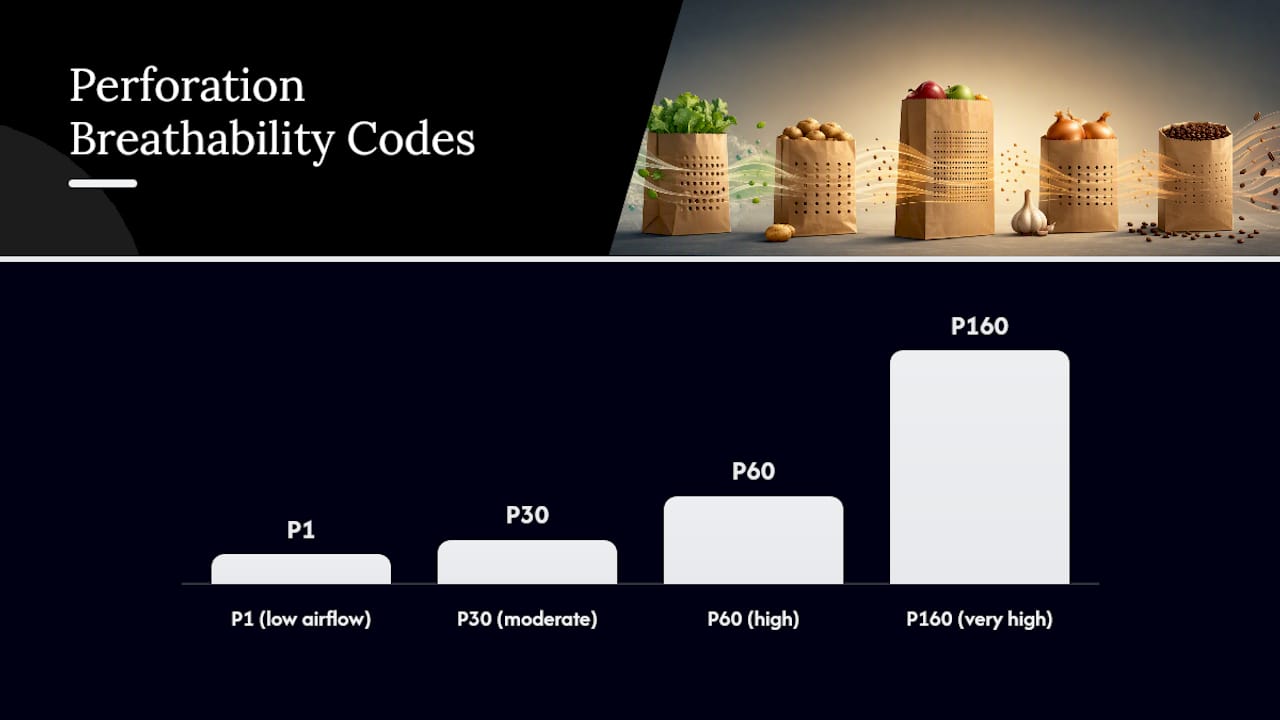
Hole size and density control airflow. The packaging industry often expresses breathability using holes-per-area or standardized codes like P1, P30, P60, and P160, which let converters match a perforation pattern to a specific product’s respiration rate rather than guessing. More holes per square inch means more airflow and faster moisture transmission, which is good for high-respiration produce and bad for anything that needs to stay dry.
Pattern choice changes the functional outcome. A linear row of slits creates a tear line for easy opening. A distributed field of micro-holes creates even ventilation across a panel. A windowed zone of denser perforation in one area lets you localize airflow, like a vented section behind a produce bag’s label, without perforating the whole bag.
Material interaction matters as much as the pattern itself. Kraft paper perforates cleanly and predictably. Coated or laminated stocks behave differently: coatings can resist clean hole formation, cause fraying at the edges, or interfere with tear propagation along a slit line. If you’re specifying a coated bag with easy-open perforation, ask your converter to test tear consistency on that exact substrate before approving the design.
Placement rules protect structural zones. Perforation removes material, and removed material means reduced strength exactly where the holes are. Research on perforated packaging materials confirms that perforations reduce local load-bearing capacity, which means density and pattern have to be optimized around the zones that carry load. Avoid seams, gusset folds, and handle attachment points. Favor flat, low-stress panel areas for tear lines and ventilation fields.
A useful supplier technical sheet should specify:
- Hole or slot dimensions (diameter or length/width)
- Holes-per-square-inch or the applicable perforation code
- Pattern file or PDF with exact placement coordinates relative to the dieline
- Substrate type and any coating or lamination
- Distance tolerances from seams, folds, and handle zones
From Dieline to Production Line: How Converters Add Perforations
Getting a perforation spec from paper to finished bag involves a series of production decisions your converter has to confirm before the first run starts.
-
Decide inline versus offline early. Inline perforation happens as part of the bag-forming process on the same equipment that cuts, folds, and glues the bag. Offline perforation is a separate finishing step, run either on a dedicated perforating machine or outsourced to a specialist. Inline tends to be more cost-effective at volume; offline gives more flexibility for short runs or unusual patterns.
-
Confirm chad management upfront. Punch and rotary methods generate chad, the small discs or strips of paper removed by the hole. Lines need vacuum extraction or ejection systems to keep that debris from jamming tooling or contaminating product-contact surfaces. Ask specifically how your converter handles chad removal on the equipment they’ll use for your order.
-
Ask about retrofit modules for short runs. Some converters use attachable perforation units bolted onto existing converting lines rather than dedicated inline tooling. These modules are useful for smaller or trial orders but often come with lower maximum speeds and tighter tolerance requirements than purpose-built inline systems.
-
Understand changeover time and its effect on cost. Switching between perforation patterns, or between perforated and non-perforated runs, takes setup time. That changeover time affects your minimum order quantity and per-unit cost, so confirming MOQ and changeover expectations before ordering prevents an unpleasant quote surprise.
-
Build in QA checkpoints during the run, not just after. Spot-checking perforation consistency at intervals during production catches tooling drift before an entire lot ships with inconsistent hole quality or pre-openings. This connects directly to the printing and converting workflow, where production consistency depends on tightly controlled line settings from start to finish.
Testing Perforated Bags: Why Human Hand Tests Fall Short
Asking someone on your team to “try opening a few bags” is not a QA test. It’s a gut check, and gut checks vary wildly from person to person based on hand strength, grip angle, and how much force feels normal. That inconsistency is exactly why fixture-based mechanical testing exists.
Research into perforation QA methods found that a test fixture simulating real opening motion, combining horizontal and vertical force, produces far more repeatable results than manual hand testing. A machine applies the same force the same way, every time, which means your acceptance criteria actually mean something from lot to lot.
The core insight from perforation testing research is straightforward: perforation design has to satisfy two opposing requirements at once, easy enough for a consumer to open by hand, strong enough to survive filling, handling, and shipping without opening on its own. A fixture that reproduces both stress types gives you one repeatable number instead of a dozen inconsistent opinions.
What a solid QA program for perforated bags should include:
- Tear initiation force testing, measuring how much force starts the tear
- Tear propagation testing, measuring whether the tear follows the intended line
- Tensile testing under a fixture that mimics two-axis handling motion
- A defined sampling frequency per production lot, not just a first-piece check
- Documented acceptance thresholds written directly into your purchase order
Ask your converter for traceability records tied to each production lot. If a QA issue surfaces after delivery, lot-level documentation is the difference between a quick root-cause fix and a guessing game. A structured QA checklist built specifically for paper bags gives procurement teams a starting template for these purchase order clauses.
Balancing Ventilation Against Bag Strength
Every perforation is a small, deliberate weak point. That’s not a flaw, it’s the design intent, but it means the location and pattern of that weak point has to be chosen with the bag’s structural demands in mind. Perforated zones carry less load-bearing capacity than solid paper, and the areas most likely to fail under stress are seams, gusset folds, and handle attachment points, exactly where a bag experiences the most force during carrying and filling.
A few mitigation tactics keep ventilation or easy-open features from becoming a liability:
- Backing strips reinforce a perforated tear line from behind without blocking the tear itself.
- Partial perforation cuts through only part of the paper thickness, preserving more strength while still creating a guided tear path.
- Staggered hole patterns distribute material loss more evenly than a dense straight line, reducing stress concentration at any single point.
- Localized doubling adds an extra layer of paper only in the perforated zone, common on high-traffic tear strips.
Micro-perforation for respiration control and macro-perforation for user tear lines are different tools solving different problems, and mixing up which one you need for which application is one of the more common specification mistakes procurement teams make.
Gather Packaging’s Approach to Perforation Briefs
When a perforation request comes in, the first question is always function: airflow, steam release, or easy-open. That answer shapes everything downstream, from hole size to placement to which converting process fits the order volume.
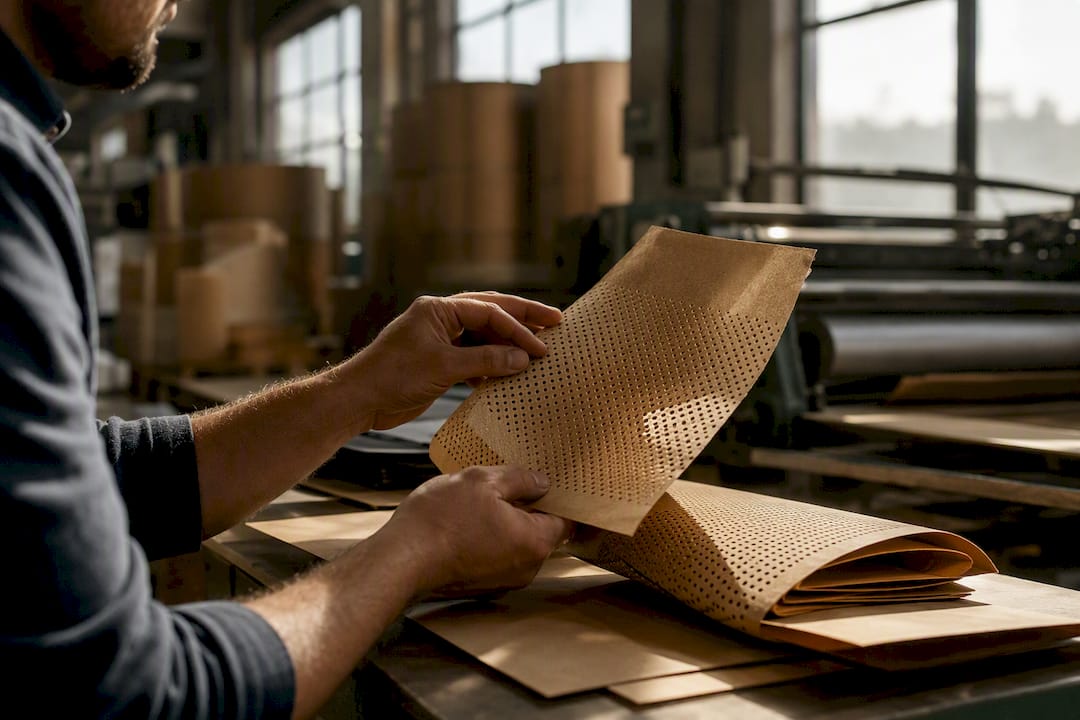
Gatherpackaging works through prototyping before committing to a full production run, checking tear consistency on the actual substrate a client has chosen, whether that’s FSC-certified kraft or a coated stock, and confirming the pattern holds up under handling before it ever reaches flexo printing. Converting integration, QA checkpoints, and printing all get planned together rather than as separate afterthoughts.
Pro Tip: Request a physical prototype, not just a rendered mockup, before approving a perforation pattern for production. A digital file can’t show you how a tear line actually behaves on your chosen paper weight.
Perforation Spec Checklist for Your Next RFQ
Handing a converter a vague request like “add some ventilation holes” invites weeks of back-and-forth. A tighter spec gets you an accurate quote on the first pass.
- Substrate and dimensions. Specify paper grade, weight, hole or slot dimensions, and holes-per-area or the applicable perforation code.
- Placement file. Provide a pattern PDF with coordinates relative to the dieline, clearly marked away from seams and gussets.
- Production method. Confirm whether the converter runs perforation inline or offline, along with minimum order quantity and expected changeover time.
- Chad handling. Ask how the equipment manages punched-out material so it doesn’t contaminate the run.
- QA requirements. Request fixture-based tear and tensile test results, not just a visual inspection, along with defined acceptance thresholds.
- Handling instructions. Specify transport and stacking guidance to avoid pressure on perforated zones that could cause pre-openings before the bag reaches the shelf.
| Point | Details |
|---|---|
| Match technology to function | Laser suits programmable micro-perforation for produce; punch and pin suit standard tear lines. |
| Specify holes-per-area | Use a defined density or code rather than a vague “ventilated” description. |
| Avoid structural zones | Keep perforation off seams, gussets, and handle attachment points. |
| Require fixture-based QA | Mechanical tests beat manual hand checks for repeatable acceptance criteria. |
Sustainability Considerations for Perforated Paper Bags
Perforated paper bags often support sustainability goals rather than working against them. A well-placed ventilation pattern extends produce shelf life, which reduces food waste before it ever leaves the store shelf. That’s a meaningful environmental win that doesn’t show up in a bag’s material composition at all.
Perforation can also reduce the need for multi-layer laminate structures. Some packaging that once relied on a plastic film layer for breathability can shift to a mono-material paper design with laser micro-perforation instead, which improves recyclability since a single-material bag is far easier to recycle than a laminate combining paper and plastic film. That shift toward mono-material design is one of the more overlooked sustainability benefits of laser perforation technology.
None of this changes the base material equation, though. A perforated bag made from FSC-certified stock with water-based inks carries the same sustainability credentials as its non-perforated counterpart, since perforation is a converting step, not a material substitution. If recyclability or compostability is a requirement for your program, confirm that any coatings or reinforcement used around perforated zones don’t compromise that certification. A backing strip made from an incompatible material, for instance, could undercut an otherwise recyclable bag.
Working with a partner focused on sustainable packaging materials alongside your converter can help identify where perforation and sustainability goals reinforce each other rather than conflict.
Safety and Regulatory Standards for Perforated Bags
Regulatory requirements for perforated paper bags mostly track back to the product they hold rather than the perforation itself. For food contact applications, whether that’s produce, bakery goods, or takeout delivery bags, the paper, inks, and any coatings need to meet applicable food-contact safety standards for the region you’re distributing into. Perforation itself doesn’t introduce a new category of food-safety risk, but it does create more exposed paper edge, which means ink and coating migration testing should account for that additional surface area near the holes.
Structural safety standards matter more directly. If a bag is rated to carry a certain weight, whether that’s a grocery sack or a retail shopping bag, perforation placement has to be validated against that load rating rather than assumed safe by default. This is where the fixture-based tensile testing discussed earlier in the QA section does double duty: it validates both consumer usability and the load capacity your packaging claims to support.
There’s no single universal perforation standard the way there is for, say, food-contact material approval. Instead, perforation design gets validated against the same structural and safety requirements that already apply to the bag category, produce packaging, retail carriers, or foodservice takeout bags, with perforation treated as one more design variable that has to pass those existing tests rather than a separate regulatory category of its own.
What I’ve Learned From Perforation Briefs That Actually Worked
The best perforation briefs I’ve seen start with a clear functional requirement, not a hole pattern. A produce client once asked for “more airflow” and got a bag that pre-opened during palletizing, because nobody had defined the actual respiration target first. The fix was simple once we backed up: define the product’s need, then size the perforation to it.
The recurring pitfall is placement, not pattern. Teams fixate on hole size and skip checking proximity to seams. Run your placement past your converter early, and bring us your brief when you’re ready to prototype.
— Taylor
Get a Perforation Prototype Made in Toronto
Gatherpackaging manufactures paper shopping bags domestically in Toronto, which means a perforation prototype doesn’t sit in a shipping queue behind an overseas production schedule. You get a physical sample on your actual substrate, tested for tear performance, faster than working with an importer.
Our converting lines handle perforation integration alongside 8-color flexo printing and FSC-certified paper options, so ventilation or easy-open features get built into your design from the prototype stage rather than bolted on as an afterthought. Whether you’re specifying a produce bag, a bakery bag that needs steam release, or a retail bag with an easy-open tear line, we walk through substrate, hole pattern, and placement with you before committing to a production run.
If domestic lead times and quality assurance testing matter to your program, request a sample from Gather Packaging and bring your perforation spec, or lack of one, to the conversation. We’ll help you build it from function down to hole size.
Sources
- HOW TO: Identify What Perforation Method is Right for Your Application - Paper, Film & Foil Converter
- Qualification of Test Method for Package Perforation Evaluation - RIT thesis
- Materials (MDPI) — study on perforation effects on structure
- Laser microperforated packaging prevents fresh produce waste - FreshPlaza
Share:
Wet Strength Paper Bags: What Buyers Should Know Before Ordering
FSC Chain of Custody: What Packaging Buyers Need to Know