
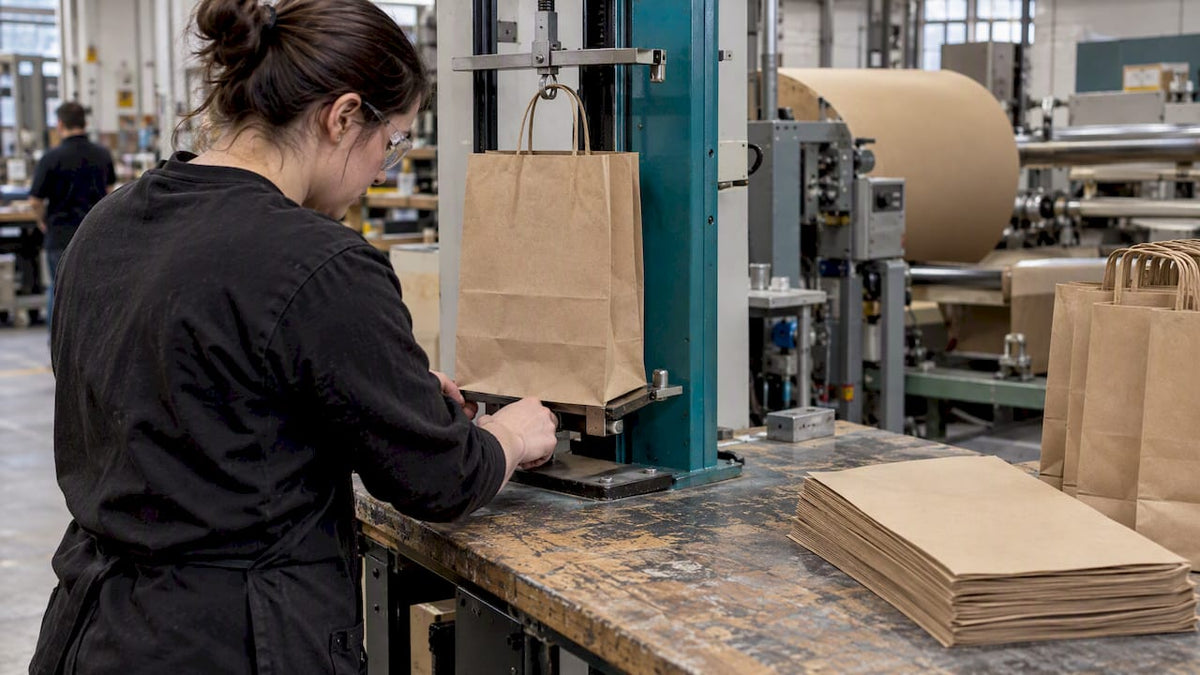
A recycled paper bag is a paper bag whose fibre comes, in whole or in part, from paper that was already used. That sounds simple, but a purchase order that says only “recycled” leaves out most of what you need: how much recycled fibre, whether it is pre-consumer or post-consumer, what proof the mill will provide, and whether the bag still carries the load you bought it for. This guide is written for packaging buyers, procurement teams and retail operations teams who are writing that specification for shopping bags or takeout bags in Canada.
TL;DR
- “Recycled” is not a spec. Ask for the recycled percentage, the split between post-consumer and pre-consumer fibre, and mill documentation that backs it.
- Kraft paper made in Canada already leans heavily on recycled fibre, so the question is rarely whether a bag has any, but how much and how well it is documented.
- Strength comes from paper weight, handle reinforcement and adhesive, not from recycled content alone. Test the finished bag, not the claim.
- Coatings, film liners and heavy adhesives can undo the benefit at end of life, because contamination is what gets bales rejected.
- We manufacture paper shopping bags in Toronto and can talk through recycled-content options, prototypes and lead times with your team.
Table of Contents
- What “recycled” actually means on a paper bag
- How much recycled fibre is normal in Canadian kraft
- Why the environmental case depends on recycled content and location
- Does recycled content weaken the bag?
- How to verify a recycled content claim
- Recycled content, recyclability and contamination
- Supply risk: what to plan for with recycled paper
- What to put in your RFQ
- Choosing a recycled paper bag supplier
- Our perspective: recycled content is a documented spec, not a label
- Talk to us about your recycled paper bags
- FAQ
- Sources
What “recycled” actually means on a paper bag
Three terms get blended together in quotes and catalogues, and they are not interchangeable.
Recycled content is the share of the bag’s fibre that came from recovered paper rather than freshly pulped wood. It is the claim most buyers care about.
Post-consumer recycled (PCR) content is the part of that recovered fibre that was used by a person or business, collected, and returned to a mill. It is different from offcuts and trim that never left the paper industry’s own process, which is usually called pre-consumer or pre-industrial material. If your brand wants to say “post-consumer” anywhere, your supplier needs to be able to show that specific portion, not only a total.
Recyclable describes what happens after the bag is used. A bag can be made from 100% virgin fibre and still be recyclable, and a bag can contain recycled fibre and still be unrecyclable if it is laminated with plastic. These are two separate questions, and a good specification answers both.
A fourth term, FSC®-certified, is about forest management and chain of custody. It is not the same as recycled, though FSC labels can include recycled categories. Keep the two lines separate in your RFQ so each claim can be checked against its own paperwork.

How much recycled fibre is normal in Canadian kraft
If you are comparing quotes, it helps to know the baseline. According to the Paper and Paperboard Packaging Environmental Council (PPEC), most paper packaging grades made in Canada, including the kraft paper used for bags, are made from recycled content. The council puts the share across the three major grades at roughly 82% of domestic shipments.
Two practical points follow from that.
First, that figure covers three grades together, including corrugated and boxboard. It is an industry-wide average, not a promise about any one bag. Kraft used for shopping bags is often chosen for strength, which can pull the other way, so the number on your particular paper has to come from the mill that made it.
Second, recycled fibre is not a one-way downgrade. PPEC describes the system as circular, with fibres recycled on average five to seven times before they need a boost from fresh, sustainably managed fibre. That is why virgin fibre still has a place even in a bag with strong recycled credentials: it keeps the loop strong.
Why the environmental case depends on recycled content and location
RECYC-QUÉBEC’s technical notice on shopping bags found that the environmental performance of a paper bag is closely tied to its recycled content. It also noted that paper bags on the Québec market are mainly made locally from sawmill by-products and recycled paper and cardboard. Local manufacturing and return to the municipal recycling stream are what make the footprint smaller.
For a buyer, that translates into three specification lines: how much recycled fibre, where the bag is converted, and what happens to it afterward. We cover the manufacturing side on our Canadian-made paper shopping bags page.
Does recycled content weaken the bag?
This is the objection every operations team raises, and it deserves a straight answer: recycled fibre is shorter on average than virgin fibre, so paper made entirely from it can be weaker for a given weight. That does not make it unusable. It means strength has to be engineered and then tested.
Industry guidelines from the European kraft producers’ association give a useful frame. They note that a high-quality paper carrier bag for supermarket use should carry at least 6 kg and survive up to five reuses, with strength depending on paper weight, handle reinforcement and the adhesive used in converting. The guidelines reference the EN13590 test standard. They are European, so treat them as a reference point for your own testing, not a Canadian requirement.
What that means in practice:
| Factor | What to ask the supplier | Why it matters |
|---|---|---|
| Paper basis weight | Grammage of the actual sheet used | Heavier sheet compensates for shorter fibre |
| Handle type and patch | How the handle is anchored and reinforced | Handles are where loaded bags usually fail |
| Adhesive | Type and application on seams and handle patches | Affects both strength and recyclability |
| Bottom construction | Fold style and gluing | A weak base drops the load, regardless of the paper |
| Intended load | The heaviest realistic item in the bag | Sets the test target |
We have written two buyer-oriented guides that go deeper on this: weight capacity for paper shopping bags and why volume is not load capacity. If you need contract language, our handle strength testing specs are written for procurement.
How to verify a recycled content claim
A catalogue line is not evidence. Before you approve artwork that says “recycled” or “made with recycled paper,” ask for the following.
- The exact claim and its basis. Is it a percentage of the total fibre, of the paper only, or of the whole bag including handles and adhesives?
- Mill documentation for the paper roll or batch. The paper maker, not the bag converter, is the primary source of recycled-content data. Our guide on requiring mill run data for recycled content claims lays out what that paperwork should include.
- The PCR versus pre-consumer split, if you intend to use the phrase “post-consumer” anywhere.
- A named methodology or standard. Under Canada’s updated environmental-claims rules, buyers are being advised to require third-party test reports, specific figures and methodology details from suppliers for any environmental claim. We summarize what to add to RFQs there.
- Chain-of-custody codes if you also claim FSC certification, so that claim can be checked separately.
- Traceability by lot. If the paper changes between reorders, the documentation should change with it.
A supplier who answers these quickly and in writing is usually one with control of its supply. One who answers with a general sustainability brochure is telling you something too.
Recycled content, recyclability and contamination
A bag with high recycled content that cannot be recycled again has only done half the job. The weak point is contamination. Recycle BC points out that non-paper material is a major threat to the recycling loop, and that even a small amount of non-paper content in a bale can lead to the whole shipment being rejected.
For bag specifications, that suggests:
- Avoid plastic film liners and laminations on bags you plan to label as recyclable.
- Keep adhesives to what the construction needs. Heavy glue use adds contamination risk.
- Think about the handle. Paper twist handles and flat paper handles are simpler to recycle than mixed-material cords, though you should confirm the material of any handle with your supplier.
- Be careful with food bags. Heavy food residue and wax coatings are the usual reasons a used bag cannot go in the paper stream. For takeout bags, this is where a plain kraft sheet earns its keep.
- Print with water-based inks where your design allows, and ask your supplier to confirm the ink system on the quote.
On access, PPEC reports that 96% of Canadians have access to recycling for paper bags, according to a study it commissioned. That is an industry-commissioned figure, but it supports a simple end-of-life message printed on the bag. Local rules vary by province and municipality, so keep that message general unless you have checked your markets.
Supply risk: what to plan for with recycled paper
Recycled paper supply is tied to mill capacity, the price of recovered fibre and the specific grade of kraft you need. We will not quote numbers we cannot source, but the planning logic is straightforward.
- Specify an acceptable range, not a single mill’s sheet. If your spec names one proprietary paper, any disruption stops your production. A performance-based spec (basis weight, tensile and burst targets, recycled-content minimum) lets a manufacturer qualify an equivalent.
- Ask where the paper is sourced and where the bag is converted. A shorter chain means fewer places for delays to happen. Domestic conversion also shortens the time between a change request and a sample in your hands.
- Approve a prototype before the production run. Colour and strength can shift with a different paper lot, especially on recycled kraft, which has natural tone variation.
- Set a reorder cadence early. Standing agreements with forecast volumes give a manufacturer room to buy paper ahead of your needs.
- Keep a documented alternate. One approved fallback spec, tested in advance, is cheaper than an emergency re-qualification.
If timing matters to your launch, read our guide on locking compliant paper bags in 16 weeks after Canada’s plastic ban.
What to put in your RFQ
A short, usable template for recycled paper shopping bags:
- Bag style and dimensions: turn top, serrated top or tamper-resistant serrated top for takeout, with width, gusset and height.
- Paper: kraft type, basis weight, minimum recycled content, and the PCR share if you will use that phrase.
- Documentation: mill run data or equivalent for each paper lot, plus chain-of-custody codes for any FSC claim.
- Strength: target load, test method, and sample count per lot.
- Print: number of colours, ink system, and proof requirements.
- End of life: no film liner or plastic lamination, and adhesive type disclosed.
- Logistics: delivery location, packing format and warehousing needs.
- Claim review: a requirement that the supplier confirms in writing any environmental wording before artwork is approved.
Our supplier non-negotiables guide goes through the points we think every Canadian buyer should insist on.
Choosing a recycled paper bag supplier
Suppliers fall into a few types, and each has trade-offs.
| Supplier type | Typical strength | Typical limit for a brand buyer |
|---|---|---|
| Stock-bag distributors | Fast access to standard sizes, small quantities | Limited customization, thin documentation on the paper |
| Overseas custom converters | Wide style range, often low unit cost | Long transit, harder to audit, slower to correct problems |
| Domestic custom manufacturers | Shorter lead times, easier sampling and audits | Minimum order quantities for custom work |
The right choice depends on your volume and how much your brand’s reputation rests on the bag. A boutique with a few hundred bags a month and a multi-store retailer with seasonal campaigns need different suppliers. What does not change is the questions: what is the paper, who made it, how was the bag tested, and how fast can a problem be fixed?
Our perspective: recycled content is a documented spec, not a label
We make paper shopping bags in Toronto, and we see the same pattern in buyer conversations. The word “recycled” arrives early in the brief, and the detail arrives late, if at all. By then, artwork is drafted and a claim is already printed on a mock-up.
Our view is that the order should run the other way. Decide the load the bag must carry. Choose a paper and a construction that can carry it, with the recycled content your brand can document. Then write the claim, once the paperwork exists to support it. A recycled bag that tears at the handle is worse for the environment than a sturdier bag, because it gets replaced or doubled up.
We also think domestic production helps buyers verify what they are buying. When the converter is a few hours’ drive away, a sample can be reviewed, a test can be repeated and a correction can be made without waiting on a container. That is the reason we built our service around design, prototyping, quality assurance and logistics under one roof.
Our materials work includes FSC®-certified stock, recycled content and water-based inks. The right mix differs by use, and we would rather talk through it with you than push one formula.
— Taylor
Talk to us about your recycled paper bags
We manufacture custom paper shopping bags in Canada, in turn top, serrated top and tamper-resistant serrated top styles, printed in up to eight colours with flexo. Our team can help with die-line preparation, graphic design and layout, pre-press proofing and prototyping, and we offer warehouse and logistics services. To discuss recycled content, strength targets, lead times or a quote, contact Gather Packaging with your bag style, quantity and intended load. You can also see our custom kraft paper bag page.
FAQ
Are recycled paper bags as strong as virgin paper bags?
Not automatically, because recycled fibre can be shorter, but strength depends on the whole construction. Paper weight, handle reinforcement and adhesive all matter, according to industry guidelines for paper carrier bags. Ask for a test on the finished bag at your real load.
Can I say my bag is made with post-consumer recycled paper?
Only if your supplier can document that specific portion. Total recycled content and post-consumer content are different figures, and mill records are where the split should appear. Get it in writing before artwork is approved.
Are paper bags recyclable in Canada?
Plain paper bags generally are, and PPEC reports that 96% of Canadians have access to paper bag recycling. Bags with plastic liners, wax coatings or heavy food residue are the exception. Local programs differ, so check yours.
Do recycled paper bags cost more?
That depends on the paper grade, the quantity and the construction, so we cannot give a single answer here. Request quotes against the same written spec so the prices compare fairly. We will quote your specific bag on request.
Share:
Circular Economy Packaging: Put Mill Guidance in Paper Bag Specs
Block Bottom Paper Bags: A Canadian Buyer's Guide