
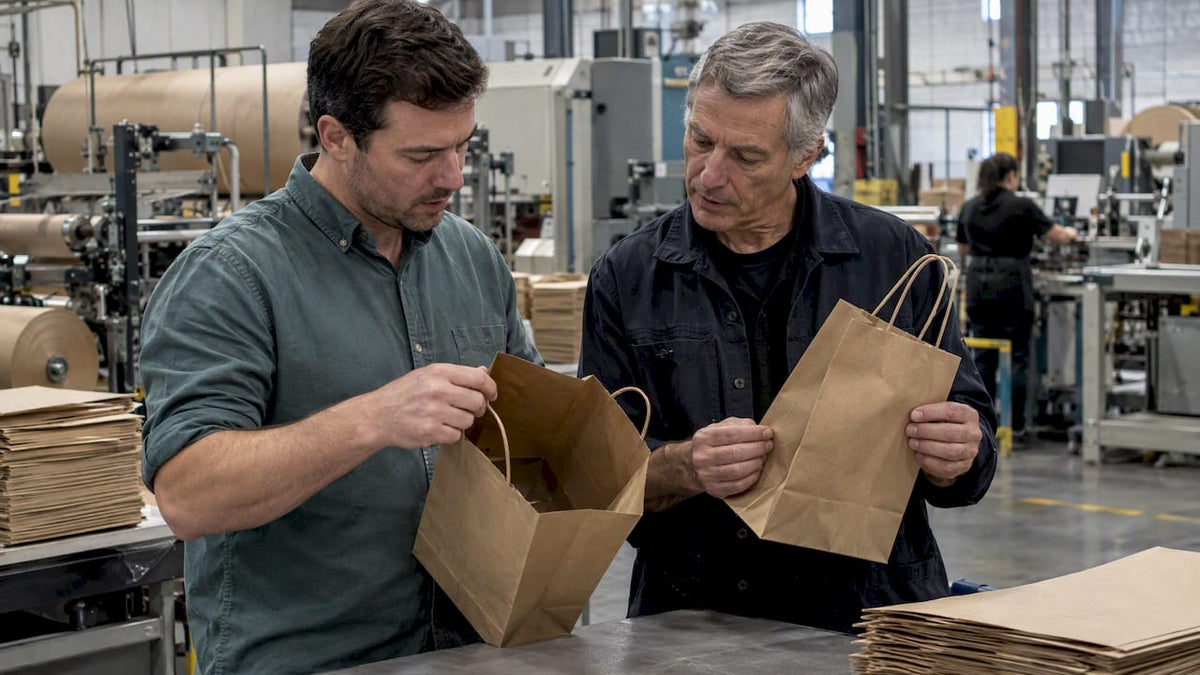
Circular economy packaging keeps materials in use through reduction, reuse, recyclability and recycled content, and your first move is to design for recyclability and specify fiber-based formats where they fit. AF&PA design guidance tells you what paper mills can actually process. Government of Canada funding shows policy is moving the same way.
TL;DR:
- AF&PA guidance sets a more than 95% primary material threshold, but local mills determine whether inks, adhesives, coatings, and labels can be processed.
- Specify fiber compatible inks and adhesives, minimize coatings and labels, and make bags easy to empty because residue and mixed materials can trigger mill rejection.
- For reuse, state the bag’s required load and cycle count, reinforce handles, then test samples against a named strength standard before running a customer pilot.
- Check with local haulers or mills before making recyclability claims; composting is suitable only where facilities accept clean, uncoated paper packaging.
- Request a life cycle assessment for the exact bag specification, and compare options using the same boundaries, use case, and number of trips.
Table of Contents
- What circular economy packaging means in practice
- Core design principles for circular packaging
- Design for recyclability: what your packaging brief should require
- Reuse systems and reusable packaging approaches
- Collection, sorting and contamination: where circularity breaks
- Practical implementation checklist: specify, prototype, test, pilot, scale
- How we help brands adopt circular paper packaging
- Measuring environmental impact for paper bags
- Getting customers to reuse and dispose of packaging properly
- Examples of circular packaging in retail and foodservice
- End-of-life options beyond recycling and reuse
- Supply chain: recycled content and domestic manufacturing
- Our perspective: design first, pilot before you scale
- Talk to us about circular paper bags
- FAQ
- Sources
What circular economy packaging means in practice
A linear model takes raw material, makes a package, and throws it away after one trip. A circular model asks a different question at the design stage: where will this material go next? The package is built so that its fiber, or the whole package, stays in use as long as possible, and so that whatever is left at the end can be recovered at a real facility, not just in theory.
The Government of Canada frames its approach around product design and high-rate reuse, repair, refurbishment and recycling, so that materials stay in the economy. Its guidance for selecting alternatives to single-use plastics is a core pillar of that strategy. In October 2025 it announced more than $3.4 million in investments in domestic projects, including work on recycling flexible packaging and on reusable packaging systems for foodware, personal care and cleaning products.
For a brand, four levers do most of the work:
- Reduce: cut the weight, layers and components you do not need, so there is less to collect and less to contaminate.
- Reuse: specify a bag or package built to make more than one trip, with a target number of cycles you can state in a brief.
- Design for recyclability: choose papers, inks, adhesives and coatings that a paper mill can handle without trouble.
- Increase recycled content: put recovered fiber back into new packaging so the loop closes on the buying side too.
These levers interact. A heavier, reusable bag uses more fiber per unit but may replace several lighter single-use ones. A barrier coating may protect a product but make the bag harder to recycle. The point of the circular approach is to make those trade-offs on purpose, with the end of life in mind, rather than discovering them after the first production run.
Most of what follows is about paper shopping bags and the packaging that surrounds them, because that is where we work every day. The same logic applies to any fiber-based format. Start with the lever you control best, which for most buyers is the design brief.
Core design principles for circular packaging
Good circular design is mostly subtraction. Before you debate exotic materials, ask what can come out of the package without hurting performance.
Start with the right material
Paper and fiber are the natural starting point when the package will be recovered through curbside or store collection, because paper mills are an established destination for fiber. Mixed materials are warranted only when the product genuinely demands them, such as a moisture or grease barrier that plain paper cannot provide. When you do need a barrier, treat it as a decision to justify, not a default.
Cut layers and non-fiber parts
Every added layer is a possible contaminant. Handles, windows, laminated patches, metallic foils and plastic closures each make a bag harder to sort and repulp. Prefer a single-material construction where the handle, body and glue are all compatible with fiber recovery. Where a bag is used for takeout delivery, think carefully about how much barrier it truly needs.
Make emptying easy
Product residue is a leading cause of rejected fiber. According to AF&PA, food, grease and liquids are significant contaminants for paper packaging, and design has to consider how easily an end user can empty and de-dust the package. A bag with a smooth interior and no pockets that trap product is easier to empty than one with deep seams and folds.

Design for the reuse cycles you intend
If you want a bag to be reused, say how many times and under what load. European industry guidelines for high-quality paper carrier bags set performance targets for carrying shopping and repeated use, and they stress paper grade, glue, handle and construction choices. Use that kind of explicit target in your own brief. “Durable” is not a specification; a load and a cycle count are.
- Name the paper grade and basis weight, and the load the bag must carry.
- Specify handle attachment and reinforcement, since handles are usually the first failure point.
- Choose strong water-based glue where the guidance recommends it.
- State whether the bag is meant to be reused, recycled, or both, and design for the dominant case.
Pro Tip: Write the reuse target into the brief, including the load and expected cycles. Suppliers can only prototype and test against a target they can read.
For more on balancing structure and branding, see our notes on packaging design tips for sustainable branding and paper bag design tips.
Design for recyclability: what your packaging brief should require
Mills do not care about your marketing claims. They care about whether the material pulps cleanly. Translating that into procurement language means writing specific requirements into every brief.
The 95% primary material idea
A package is generally treated as recyclable only if its primary material makes up more than 95% of its total weight, according to AF&PA’s design guidance. Auxiliary parts such as labels, liners and closures must be vetted so they do not disrupt recycling in specialized mills.

Why contaminants matter
Contaminants such as non-compatible labels, adhesives and product residues are often the main reason otherwise-recyclable packaging cannot be recycled at scale, the same guidance notes. AF&PA’s more recent guidance identifies the common non-fiber elements, namely adhesives, barriers, coatings, inks, tapes and labels, and explains that they may present recycling challenges depending on mill capabilities. That last phrase matters: compatibility is not universal, so the mills your material is likely to reach set the real rules.
| Element | Lower-risk choice | Common problem |
|---|---|---|
| Inks | Water-based inks, moderate coverage | Heavy, full-surface coverage can affect finished pulp quality |
| Adhesives | Water-based, fiber-compatible glues | Adhesives that do not break down can leave residue in the pulp |
| Coatings and barriers | Minimal or no coating where the product allows | Full-surface barriers and laminations can hurt repulpability |
| Labels and tapes | Paper-based, applied sparingly | Non-compatible labels can disrupt the recycling process |
Lamination, barriers and print coverage
Barriers, coatings and laminations are where recyclability most often breaks down. CEPI Eurokraft and EUROSAC note that coatings, laminations and adhesives can affect repulpability and that design choices need early coordination with mills. That is advice worth borrowing for paper bags. Heavy print coverage is a related concern, so a design with large flooded areas deserves a conversation about ink choice before it goes to press.
Industry fact: the paper industry’s stated goal, per AF&PA, is to raise the use of secondary materials such as recycled paper in new paper products to 50% by 2030.
Frameworks and testing
For system-level checks, The Recycling Partnership’s Pathway to Circularity framework offers a step-by-step assessment of whether a package is recyclable at scale. It stresses design, access and system-level adoption, and uses pass/fail building blocks. When a package fails, it recommends actions such as redesign or stakeholder coalitions. Treat it as a gut check on your own specification.
For performance, standards such as EN13590 are mentioned in the carrier bag guidelines as a testing reference. Pair strength testing with recyclability review, because a bag that is easy to recycle but tears at the handle will not be reused.
What to require in the contract
- A written statement of the paper grade, ink system, adhesive type and any coating.
- Confirmation that non-fiber components are kept to a minimum, with a weight breakdown.
- Samples for review before production release.
- A named test standard for strength, and a stated recyclability reference such as AF&PA guidance.
- Notice before any change to inks, glues or coatings.
Pro Tip: Ask your supplier to flag every non-fiber element in writing, even small ones like a handle patch or a label. Small parts are where recyclability problems hide.
Reuse systems and reusable packaging approaches
Reuse is the most intuitive circular strategy and the easiest to get wrong. The question is not whether reuse is good in principle but whether your specific system will deliver enough trips to pay back what it costs.
The life-cycle logic
Reusable packaging uses more energy and material up front, and its impact per use may fall as reuse cycles accumulate. Reuse is also cost-dependent and operationally specific, so the result varies by product, route and customer. In practice that means a reusable bag only makes sense if it is built tougher and actually gets used again. A sturdy bag that is thrown away after one trip is the worst of both worlds.
What a reuse system needs
Reuse is a system, not a product. Before committing, check that you can answer these:
- Collection: how does the package come back, and who handles it?
- Cleaning: does it need to be cleaned, and is that practical for a paper format?
- Standardization: can sizes and formats be kept consistent enough to handle efficiently?
- Consumer behavior: will customers actually bring it back or use it again?
- Durability: is the construction rated for the number of cycles you plan?
For paper bags, the practical reuse model is often not return-and-clean but simply a stronger bag that customers keep and carry again. That is why handle construction and load rating matter so much, and why a stated cycle target is useful.
Canadian pilots and funding
Reuse is getting public support. The Government of Canada’s Phase 2 plastics innovation challenge recipients include projects on reusable sleeves for pallet wrap, Borrow a Cup and Borrow a Bag programs, and refillable packaging pilots. Separately, $1.8 million in funding supported 13 projects focused on reuse, textiles and single-use plastics, and earlier programs since 2018 supported 55 projects. These are early proof points that reuse works when the logistics are designed in.
If you are weighing a reuse program, a small pilot with a defined customer group will teach you more than a spreadsheet. Our guide to reusable paper packaging walks through the business case in more detail. For the return and fulfillment side, logistics specialists such as Envio 3PL handle returns processing and warehousing for consumer brands, which is useful context when you plan a collection loop.
Collection, sorting and contamination: where circularity breaks
A package can be perfectly designed and still fail if it never reaches the right mill. The gap between “recyclable in theory” and “recycled in practice” is where most circular claims quietly fall apart.
How fiber moves through the system
Paper packaging is generally collected, sorted at a materials recovery facility, baled, and sent to a paper mill, where it is pulped and turned into new fiber products. Each step is a chance for contamination to enter or for the package to be misrouted. A bag that is covered in residue, bonded to a non-fiber label, or mixed with film can be downgraded or rejected at any of them.
The common culprits
- Product residue: food, grease and liquids are significant contaminants that can inhibit recycling or reduce recovered pulp quality, per AF&PA.
- Non-compatible labels and adhesives: as noted, these are often the main reason otherwise-recyclable packaging cannot be recycled at scale.
- Mixed materials: a fiber bag with a plastic window or heavy laminate may be diverted away from the paper stream entirely.
Why flexible packaging is harder
Flexible packaging and film are harder to circularize than rigid fiber. This is part of why the Government of Canada has put money into improving the recycling of flexible packaging. For brands choosing between a film pouch and a paper bag, the end-of-life path for fiber is usually more established, which supports the case for fiber where performance allows.
What brands can do
Engage the people who actually handle your packaging. Talk to your waste haulers and, where possible, the facilities that sort and process your materials. Ask what they accept and what they reject. Then reflect that in your design and in your on-pack instructions.
- Ask your waste manager which formats, coatings and labels are accepted locally.
- Print clear disposal instructions on the bag so people know where it goes.
- Keep labels and tapes minimal and fiber-compatible.
- Review rejected or problem loads, if your haulers report them, and adjust the design.
Pro Tip: Call the facility your packaging is most likely to reach and ask what causes rejects. A conversation with a mill or hauler can be more useful than a stack of generic guidelines.
Our guide to packaging waste management for businesses covers how to build those conversations into your process.
Practical implementation checklist: specify, prototype, test, pilot, scale
Good intentions become good packaging through a sequence. Skipping a step usually means paying for it later in rework or rejected product.
- Write the brief. State the use case, load and size, and who will handle the package at end of life.
- Lock the material spec. Name the paper grade, recycled content target and any FSC certification you need.
- Set print and glue rules. List acceptable inks and adhesives, and call for water-based options where appropriate.
- Request pre-press proofs. Check artwork, die-line and print coverage before anything is produced.
- Order samples or a prototype. Evaluate the physical bag in your own hands and on your own products.
- Test against standards. Review strength and construction against a stated reference such as EN13590.
- Run a pilot. Release a limited quantity into real use and gather feedback.
- Scale. Move to full production only after the pilot confirms performance and recyclability.
What belongs in the design brief
- Material grade and basis weight.
- Acceptable inks, adhesives and coatings, plus anything prohibited.
- Recycled content target.
- Repulpability requirement and the reference you will use to judge it.
- Intended reuse cycles and load.
Prototyping and testing
Pre-press proofs catch layout and color problems before plates are made. Sample runs show you how the bag actually folds, carries and feels. For test requirements, the European carrier bag guidelines point to EN13590, and for compatibility questions between packaging and contents, resources like this packaging compatibility testing guide explain what R&D and QA teams should check. If you plan to print on recycled kraft, our walkthrough on prototyping with 8-color flexo on recycled kraft shows how proofs and samples work in practice.
QA, pilot and lead times
Set acceptance criteria before samples arrive, not after. Decide what counts as a pass for strength, print quality, glue integrity and appearance. Then plan the pilot around real lead times. Domestic manufacturing shortens the loop between sample, feedback and revision, which matters when you are iterating on a design. Our Canadian manufacturing supports proofing, sampling and production, so changes do not wait on overseas shipping.
- Define pass/fail criteria for samples in writing.
- Confirm lead times for prototype, pilot and full production separately.
- Coordinate logistics and storage early, so a good pilot is not delayed at the dock.
- Record what changed between samples so improvements carry into production.
How we help brands adopt circular paper packaging
We manufacture paper shopping bags in Toronto, and we work with retail, foodservice and specialty buyers who want packaging that holds up in use and fits fiber recovery at the end. Here is what you can ask us for.
- Packaging consultation and quotation: a starting conversation about your product, volumes and goals.
- Die-line preparation: accurate templates so artwork fits the structure.
- Graphic design and layout: help turning a brand into print-ready artwork.
- Pre-press proofing: a check before anything runs on press.
- Prototyping: physical samples, including pre-production prototyping.
- Quality assurance testing: review at each stage of the process.
- Warehouse and logistics: support getting finished bags where they need to go.
On the material and print side, we work with FSC-certified paper and recycled-content options, use water-based inks, and print with 8-color flexo. Those choices line up with the specification items covered earlier: fiber-compatible inks and recyclable substrates. We offer turn top, serrated top and tamper-resistant serrated top styles, customizable in size and design.
What to include in your first enquiry
- Sample requirements: the size, style and finish you want to see.
- Target reuse cycles and the load the bag must carry.
- Expected order quantities.
- Your timeline, including any launch date.
- Any recycled content or certification requirements.
Pro Tip: Send your artwork and your end-of-life goals together. Print coverage and ink choices affect recyclability, so it helps us to know both from the start.
Measuring environmental impact for paper bags
Impact claims need metrics, and two are most useful for paper bags: carbon footprint and water use. Both are best understood across the full life cycle, from fiber sourcing and manufacturing through transport, use and end of life, not at a single stage.
Here is why that matters. A single-use bag is judged on one trip. A reusable bag spreads its production impact over every trip it makes, so its per-use footprint drops as reuse cycles accumulate. That is the same life-cycle logic described in the reuse section: more up front, less per use once the bag has been carried enough times. Recycled content and shorter transport distances can also lower the figure, which is one reason domestic production matters.
We do not publish bag-level carbon or water figures here, because those numbers depend on paper grade, weight, mill and route, and a made-up average would mislead you. If you need them for reporting, ask your supplier for a life-cycle assessment on the exact specification, and check that it states its boundaries and assumptions. Compare options on the same basis, with the same use case and the same number of trips, or the comparison means nothing.
Getting customers to reuse and dispose of packaging properly
Even a well-designed bag depends on what happens after the customer leaves the store. Behavior is the last mile of circularity, and it is often the weakest.
A few practical tactics work without gimmicks:
- Say what to do on the bag. A short, clear line about reuse or where to recycle removes guesswork.
- Make reuse feel normal. A sturdy, good-looking bag is one people keep. If it looks disposable, it will be treated that way.
- Reward the behavior you want. Programs where customers bring a bag back, such as the Borrow a Bag pilots funded in Canada, show that simple prompts can work.
- Keep instructions consistent. Use the same wording in store, online and on the package, so the message is not diluted.
- Train staff. Employees who can explain how to reuse or recycle the bag make the message credible.
Be honest in your messaging. Only claim recyclability you can back up with your specification and your local collection reality, and avoid vague green language. Customers and regulators are both quicker to notice a claim that outruns the facts.
Examples of circular packaging in retail and foodservice
Real examples teach more than principles, and the best publicly documented ones come from funded pilots. We stick to what the sources actually describe.
In retail, the Borrow a Bag and Borrow a Cup reuse programs supported through the Canadian Plastics Innovation Challenges show a borrow-and-return model in practice, alongside reusable sleeves for pallet wrap and refillable packaging pilots. The lesson is that reuse succeeds when return is easy and built into the customer routine.
The Government of Canada’s funding recipients cover 13 projects focused on reuse, textiles and single-use plastics, and its broader circular economy initiatives span design, collection, processing and secondary markets.
For foodservice, the relevant use is takeout delivery bags. There the practical circular questions are grease and residue, which as noted are significant contaminants for paper recovery, and how much barrier the bag truly needs. Choosing a bag that carries the order without a heavy lamination keeps it closer to a clean fiber stream. We do not claim a named brand case study here, because we would rather give you a verified pattern than an invented success story.
End-of-life options beyond recycling and reuse
Recycling and reuse come first in the hierarchy, but they are not the only endings. Paper is a natural fiber, so composting and biodegradation are real possibilities, with some honest caveats.
A clean, uncoated paper bag may be suitable for organics collection where a local program accepts it. The caveats are the same non-fiber elements discussed earlier. Plastic coatings, laminations and some inks can slow breakdown or leave unwanted residue, and not every composting facility accepts every kind of paper packaging.
So treat compostability as a local question, not a universal label. Before making a compostable or biodegradable claim, confirm what your local collection and processing facilities actually accept, and avoid implying more than your evidence supports. For most paper bags, recycling through the fiber stream remains the better-established path, with compostability as a sensible fallback for clean, uncoated material where a program exists. Clear on-pack wording keeps customers from guessing.
Supply chain: recycled content and domestic manufacturing
Circularity does not stop at the bag. It runs through where your fiber comes from and how far your packaging travels.
Recycled content is the buying-side half of the loop. The paper industry has stated an aim of raising secondary material use in new paper products, and AF&PA has invested in projects to increase recycled-paper use and capture more paper from the waste stream. When you specify recycled content, be clear about the target and ask your supplier to document it, since availability and grade can vary.
Domestic manufacturing helps in practical ways. Shorter distances mean less transport and quicker feedback during sampling and revision. They also mean more predictable lead times and easier coordination when you change a specification. Because we produce in Toronto, a design tweak does not have to wait on an overseas shipment. If you are weighing policy implications for packaging in Canada, our note on packaging EPR and kraft bags is a useful companion.
Dependable supply also means planning. Confirm paper availability, lead times and order minimums early, so a pilot does not stall for lack of material.
Our perspective: design first, pilot before you scale
Most circular packaging problems are decided on the drawing board. By the time a bag is printed, the inks, glue and coatings that determine its fate are already locked in. So the most valuable hour you can spend is on the brief, not on a sustainability claim after the fact.
My advice is simple. Prioritize recyclability in the design, because it is the lever that works for every customer whether or not they reuse the bag. Prototype before you commit, because a sample in your hands tells you what a spec sheet cannot. Then run a short pilot with real customers before full production. A small pilot is cheap insurance against a large batch that does not perform.
Be wary of anything that sounds circular but cannot name its end-of-life path. A claim you cannot trace to a mill, a collection program or a tested reuse target is marketing, not design. Keep your goals specific and measurable, and let the evidence, not the label, decide.
If you want a partner to work through the specifics, we are glad to help.
— Taylor
Talk to us about circular paper bags
If you are ready to move from principles to a sample, we can take you from first conversation to finished bags. We make turn top, serrated top and tamper-resistant serrated top paper bags in Toronto, with FSC-certified and recycled-content paper options, water-based inks and 8-color flexo printing. Our team handles consultation, die-line preparation, design, pre-press proofing, prototyping, quality assurance and logistics.
Before you reach out, it helps to have a few things ready:
- Your expected order sizes and how often you reorder.
- A spec sheet or brief, even a rough one, covering size, style, load and finish.
- Your timeline, including target launch or pilot dates.
- Any recycled content, certification or reuse goals.
From there, the next steps are straightforward: request a consultation, then a sample or prototype, then a pilot run. Browse our paper bag styles, see our custom kraft paper bags, or contact us to discuss your paper shopping bag or retail packaging needs.
FAQ
What is circular economy packaging in simple terms?
It is packaging designed so its materials stay in use instead of becoming waste. That means reducing what you use, reusing it where possible, making it easy to recycle, and using recycled content. For paper bags, the priority is designing for fiber recovery.
Is a paper bag automatically circular?
No. A paper bag is easier to recover than many alternatives, but heavy coatings, laminations, non-compatible adhesives or residue can undermine it. AF&PA guidance treats a package as recyclable only when its primary material is more than 95% of its weight.
How do I make paper packaging easier to recycle?
Keep the construction mostly fiber, use compatible inks and adhesives, and avoid unnecessary barriers or labels. Confirm choices against mill-informed guidance such as AF&PA’s design guidance, and ask your supplier to document every non-fiber element.
When does reusable packaging make sense?
Reuse pays off when the package makes enough trips to offset its higher up-front material and energy. It works best with a stated load and cycle target, plus a realistic way for customers to bring it back or use it again.
How should I test a paper bag before ordering in volume?
Start with pre-press proofs and a sample run, then check strength and construction against a stated reference such as EN13590. Follow with a small pilot in real use before scaling to full production.
Share:
Spot Color vs Process for Paper Bags: What Eight Color Flexo Changes
Recycled Paper Bags: What Canadian Buyers Should Specify