

TL;DR:
- Businesses must manage packaging waste through compliance, precise data, and design improvements to reduce costs and environmental impact.
- Regulatory laws vary by state, requiring accurate reporting and material choices that favor recyclability to avoid penalties.
Packaging waste management is the systematic process businesses use to control, reduce, and comply with regulations covering the packaging materials they put into the market. The industry term for this discipline is “packaging waste management,” and it encompasses three distinct layers: regulatory compliance under frameworks like Extended Producer Responsibility (EPR), operational practices such as material tracking and reporting, and design strategies that reduce packaging at the source. For retail brands and procurement teams, getting this right in 2026 means understanding Producer Responsibility Organizations (PROs), eco-modulated fee structures, and how material choices affect both your compliance costs and your environmental footprint.
What is packaging waste management, and why does it matter now?
Packaging waste management is defined as the coordinated set of processes a business uses to track, reduce, report, and responsibly dispose of the packaging it places on the market. The scope goes well beyond recycling bins. It includes how you design packaging, which materials you select, how you register with regulatory bodies, and how accurately you report volumes across multiple jurisdictions.

The regulatory pressure driving this discipline is real and growing. Seven U.S. states, including California and Minnesota, have enacted comprehensive EPR packaging laws. These laws require businesses to register with state-designated PROs, report detailed packaging volumes by material type, and pay fees calculated on recyclability and environmental impact. Non-compliance carries penalties up to $100,000 per day. That figure puts packaging waste management squarely in the category of legal and financial risk, not just environmental preference.
The importance of packaging waste management also shows up in cost control. Packaging redesign that reduces material weight by just 8% could eliminate 1.6 million tons of material annually worldwide, generating savings exceeding $3 billion per year. That is not a marginal efficiency gain. It is a structural cost reduction available to any business willing to treat packaging design as a financial decision.
What are the key regulations shaping packaging waste compliance?
EPR laws place the financial and operational responsibility for end-of-life packaging on the businesses that first introduce packaging into a state’s market. The definition of “producer” varies significantly by state. A business may trigger compliance obligations in California but not in another state, depending on who is considered the producer in each transaction type. Importers, brand owners, and retailers can all qualify as producers depending on the state’s specific statutory language.
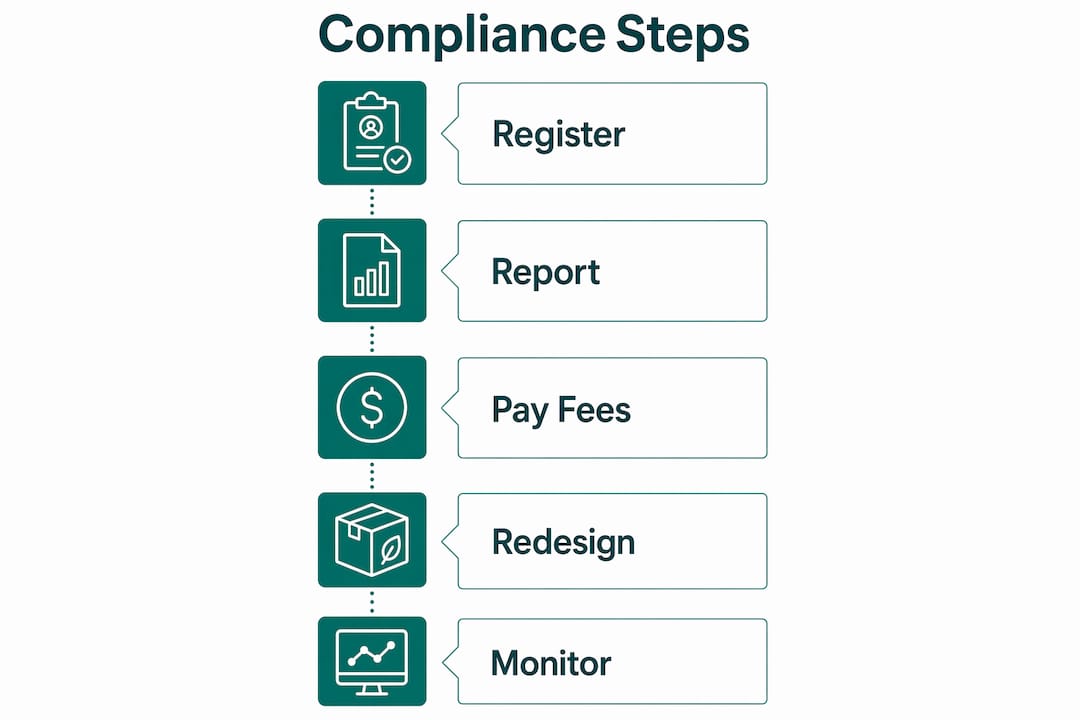
Compliance under these laws follows a structured sequence:
- Register with the state-designated PRO before the applicable deadline. Each state sets its own registration window, and missing it triggers penalties.
- Report packaging volumes broken down by material type, weight, and the state where packaging is sold or distributed. Accuracy is non-negotiable.
- Pay eco-modulated fees calculated based on how recyclable and how easily sorted your materials are within local waste management infrastructure.
- Monitor annual updates to state rules, because fee schedules and reporting formats change as programs mature.
- Audit your supply chain before reporting, because procurement teams that rely on estimates rather than verified data face the highest penalty risk.
The fragmented state-by-state structure of U.S. packaging laws increases administrative cost and complexity for multi-state businesses. A company selling in California, Colorado, Oregon, and Minnesota faces four different registration systems, four reporting formats, and four fee schedules. There is no federal standard to simplify this.
Pro Tip: Assign a dedicated compliance owner inside your organization before your first PRO registration deadline. Businesses that treat EPR compliance as a shared responsibility across departments consistently miss deadlines and underreport volumes.
Packaging compliance is also covered in depth in Gatherpackaging’s guide on staying legal in sustainability, which walks through how state regulations affect retail packaging buyers specifically.
How can businesses reduce packaging waste through design?
Packaging redesign is the most direct lever businesses have for reducing both material costs and compliance fees. An 8% reduction in packaging weight through redesign could eliminate approximately 1.6 million tons of material annually worldwide, with savings exceeding $3 billion per year. That scale is achievable through changes most brands can make without compromising product protection or consumer experience.
The table below shows how common design decisions affect both sustainability outcomes and compliance fee exposure:
| Design decision | Sustainability impact | Fee implication |
|---|---|---|
| Switch to FSC®-certified paper | Reduces deforestation pressure | Lower eco-modulated fees in most states |
| Eliminate mixed-material laminates | Improves recyclability | Significant fee reduction |
| Reduce bag weight by 8% | Cuts material use at scale | Lower reported tonnage, lower fees |
| Use water-based inks | Reduces chemical contamination | Neutral to positive fee impact |
| Optimize bag dimensions | Reduces shipping and storage volume | Indirect cost savings |
Eco-modulated fees penalize materials that are harder to recycle locally despite broad recyclability claims. A bag labeled “recyclable” may still attract high fees if local sorting infrastructure cannot process it efficiently. This means material selection requires more than a recyclability claim. It requires understanding how your packaging performs inside the specific waste management systems of each state where you sell.
Packaging optimization that improves shape and material use also reduces storage and shipping needs. Flatter, lighter bags take up less warehouse space and reduce freight emissions. These gains compound across a supply chain.
Pro Tip: When evaluating paper bag suppliers, ask specifically for FSC®-certified material documentation and water-based ink confirmation. These two attributes directly affect your eco-modulated fee calculation in most EPR states.
Gatherpackaging’s resource on cutting waste through design covers practical redesign steps for retail packaging buyers looking to reduce material use without sacrificing print quality or bag strength.
What are the operational steps for compliance and reporting?
Operational compliance requires precise internal data, not estimates. Companies must mature their internal data systems to track packaging volume accurately across states. Guessing or estimating volumes creates direct penalty risk under EPR laws that impose fines up to $100,000 per day.
The compliance workflow breaks down into five sequential steps:
- Audit your packaging inventory. Catalog every packaging format you sell or distribute by state, including material type, weight per unit, and annual volume. This audit forms the foundation of every downstream reporting obligation.
- Identify your producer status in each state. Work with legal counsel to confirm whether your business qualifies as a producer under each state’s statutory definition. The answer differs by state and by transaction type.
- Register with the relevant PRO. Each EPR state designates one or more PROs to administer the program. Registration deadlines vary, and late registration triggers penalties independent of fee payment.
- Prepare and submit annual reports. Reports must detail packaging volumes by exact material type. Accurate and detailed volume reporting by material is critical. Procurement and purchasing teams must audit supply chains thoroughly before submitting any figures.
- Calculate and pay eco-modulated fees. Fees reflect both the volume of packaging you place on the market and the recyclability of each material. Materials that are difficult to sort or process locally attract higher fees regardless of general recyclability claims.
The multi-step compliance process of registering, reporting, and paying eco-modulated fees is not a one-time event. It repeats annually, and fee schedules update as state programs evolve. Businesses that build compliance into their annual planning cycle avoid the scramble that leads to errors and penalties.
What are the main challenges in building a packaging waste management system?
The biggest operational challenge is regulatory fragmentation. State-by-state packaging laws in the U.S. create inconsistent requirements that increase administrative cost and disadvantage businesses that delay adopting sustainable procurement practices. A business selling nationally faces a patchwork of deadlines, definitions, and fee structures with no single compliance framework covering all of them.
Beyond fragmentation, businesses face several recurring challenges:
- Data immaturity. Most procurement teams do not track packaging volumes by material and state with the granularity EPR laws require. Building that data infrastructure takes time and cross-department coordination.
- Supply constraints on recycled materials. Secondary markets for recycled paper and other materials remain immature in many regions. Sourcing recycled content at scale and at consistent quality is harder than sourcing virgin material.
- Compliance versus sustainability confusion. Legal compliance does not equal a circular economy strategy. Businesses that meet their reporting obligations but continue using hard-to-recycle materials are compliant but not sustainable. True packaging waste reduction requires treating packaging as a recoverable resource, not a disposal problem.
- Cost pressure. Eco-modulated fees add to packaging costs. Businesses that have not redesigned their packaging to favor recyclable, locally sortable materials pay more in fees than those that have.
The solution to most of these challenges starts with a mindset shift. Packaging waste management is a resource management discipline, not a disposal task. Businesses that adopt that framing invest earlier in design, data, and supplier relationships. For small businesses navigating this complexity, a practical packaging guide can help clarify where to start without getting lost in regulatory detail.
Key Takeaways
Effective packaging waste management requires businesses to combine regulatory compliance, precise internal data, and material design decisions that reduce both environmental impact and fee exposure.
| Point | Details |
|---|---|
| EPR compliance is mandatory in seven U.S. states | Register with PROs, report volumes by material, and pay eco-modulated fees to avoid penalties up to $100,000 per day. |
| Packaging redesign delivers financial returns | An 8% weight reduction in packaging could eliminate 1.6 million tons of material annually and save over $3 billion globally. |
| Eco-modulated fees reward recyclable materials | Materials that sort easily in local infrastructure attract lower fees, making design choices a direct cost lever. |
| Internal data accuracy is non-negotiable | Estimating packaging volumes instead of tracking them precisely creates direct penalty risk under EPR laws. |
| Compliance alone is not sustainability | Businesses must treat packaging as a recoverable resource, not just meet reporting deadlines, to achieve genuine waste reduction. |
The compliance mindset gap most businesses still have not closed
I have worked with enough procurement and retail operations teams to recognize a pattern. When EPR laws first hit a state, businesses scramble to register and file. They treat it as a one-time legal task. Then the second reporting cycle arrives, and they realize their data is incomplete, their material classifications are inconsistent, and their fee calculations were wrong the first time.
The businesses that handle this well are not the ones with the biggest compliance budgets. They are the ones that connected their sustainability team, their procurement team, and their packaging supplier before the first deadline. They audited their packaging inventory before they needed to report it. They asked their suppliers for FSC® certification and material documentation as a standard part of vendor qualification, not as an afterthought.
The regulatory environment will keep tightening. More states will enact EPR laws, and existing programs will raise their standards. Businesses that wait for federal uniformity before building internal data systems will keep paying the penalty. The brands I see getting ahead of this are the ones treating packaging redesign as a financial and operational priority, not just an environmental gesture. That shift in framing changes everything about how you engage with suppliers, how you spec materials, and how you measure success.
— Taylor
Gatherpackaging’s eco-friendly paper bags for compliant retail brands
Packaging buyers who need to reduce their environmental footprint without sacrificing bag quality or print performance have a direct path forward with Gatherpackaging.
Gatherpackaging manufactures eco-friendly paper bags using FSC®-certified materials, recycled content, water-based inks, and biodegradable options from its Toronto facility. Every bag is available with custom sizing and 8-color flexo printing, with quality assurance built into domestic production for reliable lead times. For retail brands managing EPR compliance, sourcing from a supplier that documents material certifications and recycled content is not optional. It is part of your reporting obligation. Contact Gatherpackaging to discuss your paper shopping bag requirements and get material documentation that supports your compliance reporting.
FAQ
What is packaging waste management?
Packaging waste management is the systematic process businesses use to track, reduce, report, and comply with regulations covering the packaging they place on the market. It includes EPR compliance, material selection, and operational reporting to Producer Responsibility Organizations.
Which U.S. states have EPR packaging laws in 2026?
Seven U.S. states, including California and Minnesota, have enacted comprehensive EPR packaging laws requiring registration, reporting, and fee payment to designated PROs. Each state sets its own deadlines, definitions, and fee structures.
How are eco-modulated fees calculated?
Eco-modulated fees are based on how recyclable and how easily sorted your packaging materials are within local waste management infrastructure. Materials that are difficult to process locally attract higher fees, even if they carry general recyclability claims.
How does packaging redesign reduce compliance costs?
Packaging redesign that reduces material weight lowers the total volume you report to PROs, which directly reduces fee obligations. Switching to materials that sort easily in local recycling systems also lowers eco-modulated fee rates.
What is the difference between EPR compliance and packaging sustainability?
EPR compliance means meeting registration, reporting, and fee payment obligations under state law. Packaging sustainability means treating packaging as a recoverable resource and actively reducing material use, which goes beyond legal compliance requirements.
Share:
Top 6 ampersand.ca Alternatives in 2026
Biodegradable Inks in Food Packaging: What You Need to Know