

TL;DR:
- Biodegradable inks made from bio-renewable sources help food packaging meet environmental and regulatory standards. They enable cleaner recycling and composting processes, reducing VOC emissions and contamination risks. Proper integration and testing are essential for successful, sustainable food packaging implementations.
Biodegradable inks are printing materials derived from bio-renewable sources that break down naturally at end of life, enabling food packaging to meet both environmental and regulatory standards. The question of why biodegradable inks in food packaging matter comes down to three converging pressures: food safety compliance under frameworks like FDA 21 CFR and Health Canada regulations, growing retailer demand for circular packaging, and the practical reality that ink is a functional component of any compostable or recyclable substrate. Soy-based and water-based inks have moved from niche alternatives to production-ready solutions, and packaging professionals who ignore them risk falling behind on both compliance and sustainability commitments.
What are biodegradable inks and how do they differ from traditional inks?
Biodegradable inks use bio-renewable raw materials, such as soybean oil or plant-derived resins, as carriers instead of petroleum distillates. That substitution changes the ink’s entire environmental profile, from how it cures on press to how it behaves at end of life.
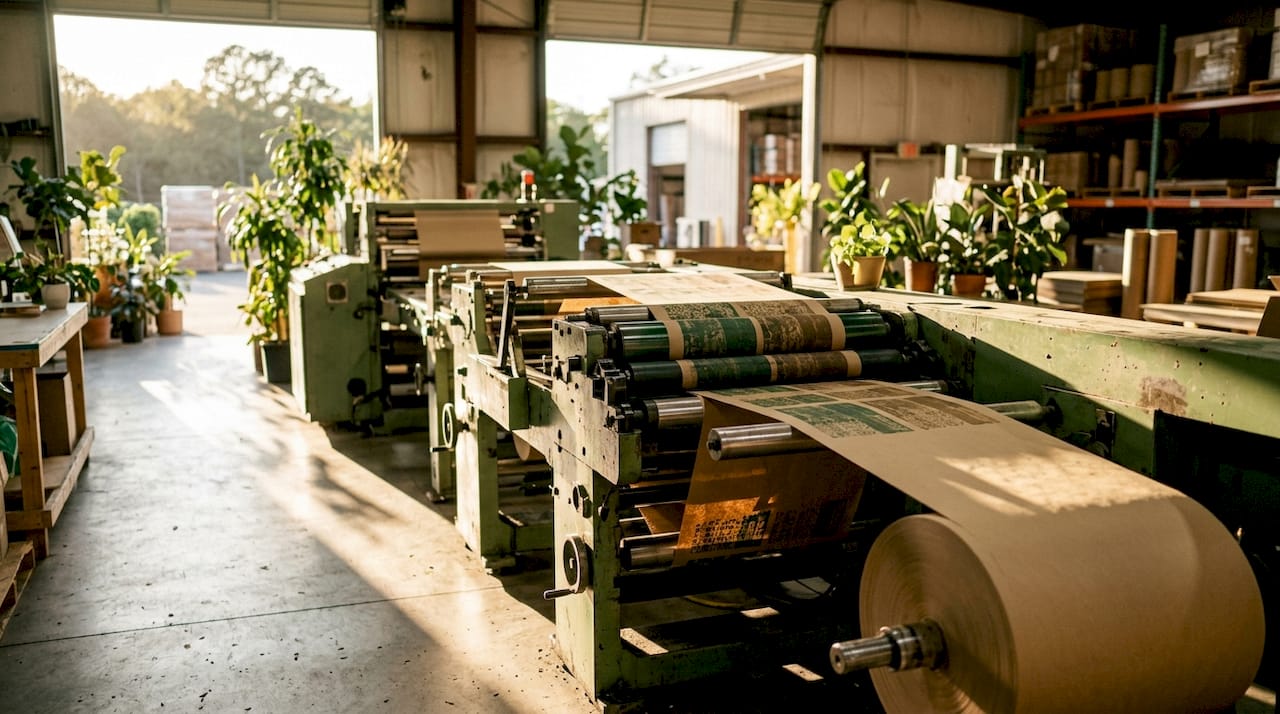
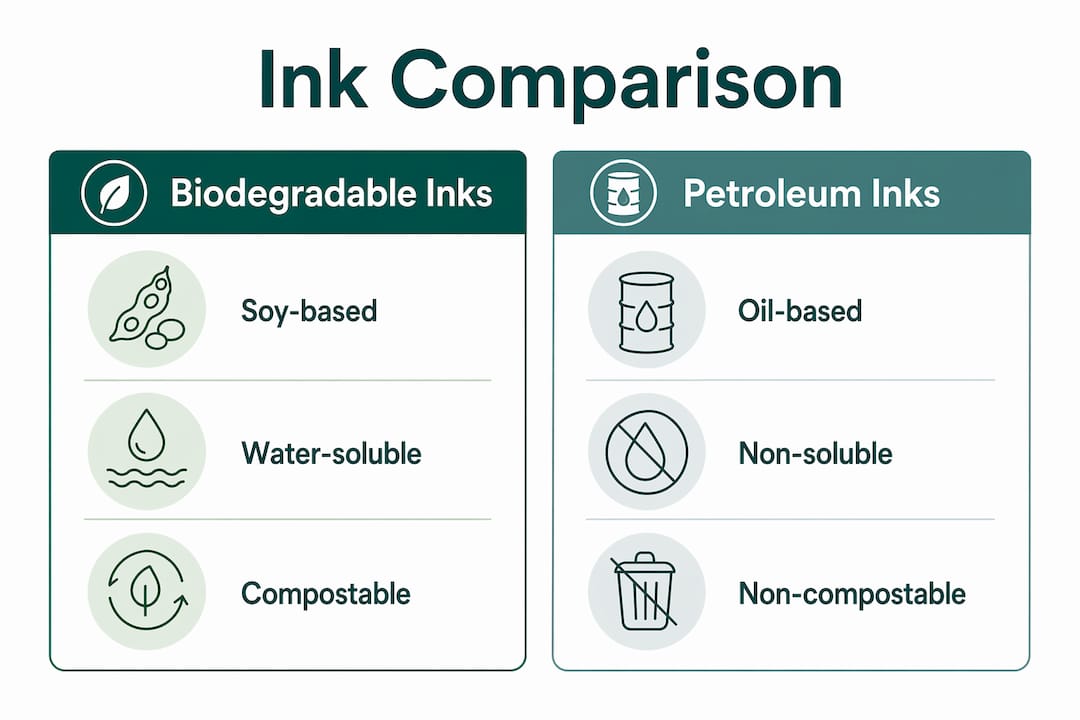
Soy-based inks are water-soluble and detach more easily during flotation de-inking processes, producing cleaner recycled pulp. That matters directly to paper bag manufacturers, because cleaner pulp means higher-quality recycled fiber and fewer contaminants in the recycling stream. Water-based inks go further by replacing solvent carriers with water, which sharply reduces volatile organic compound (VOC) emissions during printing. Soy inks emit less than 1% VOCs, compared to approximately 4.6% for petroleum-based inks. Lower VOC output protects press operators and reduces the facility’s air quality compliance burden.
The table below compares the two ink categories on the parameters that matter most to packaging professionals.
| Parameter | Biodegradable inks (soy/water-based) | Petroleum-based inks |
|---|---|---|
| Raw material source | Bio-renewable (soybean oil, plant resins) | Petroleum distillates |
| VOC emissions | Less than 1% | Approximately 4.6% |
| De-inking performance | Easier flotation de-inking, cleaner pulp | Harder to remove, more chemical waste |
| Biodegradability | Breaks down in composting conditions | Persists as contaminant |
| Recyclability impact | Supports paper recycling stream | Can contaminate recycled pulp |
Pro Tip: Pair soy-based inks with porous substrates like kraft paper or recycled corrugated. Absorption-based drying reduces the need for energy-intensive curing and improves your lifecycle sustainability profile.
Why use biodegradable inks specifically in food packaging?
Food packaging carries a unique set of requirements that standard commercial printing does not. Ink components can migrate through packaging walls and contact food directly, which is why the regulatory stakes are higher here than in retail or apparel packaging.
The FDA regulates individual ink components rather than finished packaging. Finished packaging compliance relies on supplier Letters of Guarantee confirming that each component meets 21 CFR standards. That means your ink supplier, not a government agency, carries the documentation burden. Biodegradable and water-based inks are formulated specifically to meet these migration and leaching thresholds, making compliance documentation more straightforward than with petroleum-based alternatives.
Beyond compliance, there are several reasons why biodegradable inks are the right choice for food-contact paper packaging:
- Microplastic avoidance. Petroleum-based inks can leave plastic residues when packaging enters composting or recycling streams. Water-based inks disintegrate during composting, avoiding intact contaminants and microplastics entirely.
- Compostable substrate compatibility. A compostable bag printed with a non-compostable ink fails certification. The ink must be a compatible, functional component of the whole system, not an afterthought.
- Consumer demand for clean-label packaging. Retail brands and foodservice operators face growing pressure from buyers who read ingredient and material claims. Biodegradable inks support clean-label positioning without requiring a separate sustainability story.
- High-temperature food packaging. Bio-based inks like Sun Chemical’s AquaHeat contain up to 60% bio-renewable content and sustain temperatures up to 220°C while meeting migration regulations. That performance profile opens biodegradable ink use to hot-fill and oven-safe food packaging formats.
- Alignment with FSC® and recycled content programs. Paper bags made with FSC®-certified fiber and recycled content deliver a stronger sustainability claim when the ink system matches the substrate’s environmental credentials.
The practical takeaway is direct: biodegradable inks are not a premium add-on for food packaging. They are the technically correct choice when the substrate is paper-based, compostable, or destined for the recycling stream.
What are the challenges of biodegradable inks in food packaging production?
Biodegradable inks carry real production trade-offs that packaging professionals need to plan for. Ignoring them leads to quality failures and cost overruns that undermine the sustainability case entirely.
- Slower curing and scuff risk. Soy-based inks cure more slowly than petroleum inks, especially on non-porous surfaces. Bags that move through finishing equipment before the ink fully cures are vulnerable to scuffing, which affects print quality and brand presentation.
- Substrate compatibility limits. Water-based and soy-based inks perform best on porous substrates like kraft paper. Plastic films and coated surfaces resist absorption, creating adhesion problems and requiring reformulation or primer coats.
- Energy consumption in curing. UV curing can increase carbon footprint beyond traditional methods if not managed carefully. Choosing absorption-based drying on paper substrates avoids this problem entirely, which is one reason paper bags are a natural fit for biodegradable ink systems.
- Regulatory testing and certification costs. Compliance testing adds 15–25% to ink formulation costs, creating a meaningful barrier for smaller suppliers. That cost favors established manufacturers with documented regulatory support and existing supplier relationships.
- Supply chain constraints. Bio-based ink supply chains are less mature than petroleum-based ones. Lead times can be longer, and not every ink supplier carries the full color range needed for 8-color flexo printing.
Pro Tip: Review your sustainable printing practices before switching ink systems. Energy use in curing is the most commonly overlooked variable in biodegradable ink lifecycle assessments.
How to implement biodegradable inks in sustainable food packaging workflows
Switching to biodegradable inks is not a drop-in replacement. It requires treating ink and substrate as an integrated system, not two separate purchasing decisions.
Industry experts stress holistic testing rather than separate evaluation of ink or substrate. A compostable paper bag that passes substrate certification but fails ink compatibility testing cannot carry a compostable claim. Test the full system together before committing to production volumes.
The following practices define a reliable implementation workflow:
- Verify compliance documentation first. Request Letters of Guarantee from your ink supplier confirming 21 CFR and, where applicable, EU packaging regulation compliance. Do not rely on general marketing claims.
- Match ink type to substrate porosity. Kraft paper and recycled paper boards absorb water-based and soy-based inks efficiently. Review your print substrate choices before finalizing ink selection.
- Run a quality assurance protocol on the combined system. Test for scuff resistance, color consistency across print runs, and ink adhesion after folding and handling. Gatherpackaging’s packaging quality assurance checklist provides a structured framework for this process.
- Confirm recyclability and compostability claims. If the bag carries a recyclable or compostable claim, the ink must support that claim. Document the test results and keep them on file for retailer audits.
- Work with domestic manufacturers who carry regulatory documentation. Shorter supply chains reduce lead times and make it easier to verify compliance at each production stage.
The table below outlines the key decision points in a biodegradable ink implementation workflow.
| Decision point | What to verify |
|---|---|
| Ink supplier compliance | Letter of Guarantee for 21 CFR and relevant EU standards |
| Substrate compatibility | Porosity, absorption rate, and compostability certification |
| Curing method | Absorption vs. UV curing and energy impact on lifecycle |
| Print quality testing | Scuff resistance, color consistency, and adhesion after handling |
| End-of-life claim | Recyclability or compostability certification for the full system |
Building a sustainable packaging workflow around these checkpoints gives you a defensible sustainability claim and reduces the risk of certification failures at the retailer level.
Key Takeaways
Biodegradable inks are the technically correct choice for food packaging when the substrate is paper-based, compostable, or recyclable, and compliance requires treating ink and substrate as one integrated system.
| Point | Details |
|---|---|
| Regulatory compliance | FDA 21 CFR compliance relies on supplier Letters of Guarantee, not government approval of finished packaging. |
| VOC reduction | Soy-based inks emit less than 1% VOCs versus approximately 4.6% for petroleum inks, improving press safety. |
| System-level testing | Test ink and substrate together; separate testing risks compostability certification failures. |
| Energy and curing | UV curing can negate biodegradable ink benefits; absorption drying on kraft paper avoids this problem. |
| Cost of compliance | Regulatory testing adds 15–25% to ink formulation costs, favoring suppliers with established documentation. |
The sustainability paradox most packaging teams miss
The conversation around biodegradable inks tends to focus on raw material origin, and that focus is too narrow. I have seen packaging programs that switched to soy-based inks, celebrated the move as a sustainability win, and then ran those inks through UV curing systems that consumed more energy per unit than the petroleum-based process they replaced. The bio-based content percentage looked good on a spec sheet. The lifecycle carbon footprint did not.
The real measure of a biodegradable ink’s value is what happens to the package after it leaves the consumer’s hands. An ink that enables clean de-inking in a paper recycling facility, or that fully disintegrates in a commercial composting system, delivers a concrete environmental outcome. An ink that is technically bio-based but contaminates the recycling stream or requires energy-intensive curing delivers a marketing claim, not a result.
My advice to packaging professionals is to start with the end-of-life scenario and work backward. If your bag goes into a paper recycling stream, prioritize de-inking performance. If it goes into a compost bin, verify the full system certification. The substrate and ink choice follow from that decision, not the other way around. Gatherpackaging’s approach to biodegradable bag production reflects this thinking, and it is the right framework for any team serious about making sustainability claims that hold up under scrutiny.
— Taylor
Gatherpackaging’s eco-friendly paper bags and print solutions
Gatherpackaging manufactures eco-friendly paper bags in Toronto, Canada, using FSC®-certified materials, recycled content, and water-based inks that meet food packaging compliance requirements. The company’s 8-color flexo printing capabilities support vibrant, print-quality results on kraft paper substrates that are fully compatible with biodegradable ink systems.
For foodservice operators and retail brands that need compliant, customizable paper bags with documented sustainability credentials, Gatherpackaging offers design assistance, prototyping, and quality assurance from a domestic manufacturer. Domestic production means shorter lead times, easier compliance verification, and direct access to the team managing your custom kraft paper bags. Contact Gatherpackaging to discuss your food packaging requirements and get a quote tailored to your production volume and sustainability goals.
FAQ
What makes an ink biodegradable?
Biodegradable inks use bio-renewable carriers like soybean oil or plant-based resins instead of petroleum distillates, allowing them to break down naturally in composting or recycling conditions without leaving harmful residues.
Are biodegradable inks FDA compliant for food packaging?
The FDA regulates individual ink components under 21 CFR, not finished packaging. Compliance requires a Letter of Guarantee from your ink supplier confirming that each component meets the applicable standards.
Can biodegradable inks handle high-temperature food packaging?
Yes. Bio-based inks formulated for heat resistance, such as Sun Chemical’s AquaHeat, contain up to 60% bio-renewable content and sustain temperatures up to 220°C while meeting food safety migration standards.
Do biodegradable inks affect paper bag recyclability?
Soy-based inks improve recyclability. They are water-soluble and detach more easily during flotation de-inking, producing cleaner recycled pulp compared to petroleum-based inks.
What is the biggest production risk when switching to biodegradable inks?
Slower curing times and substrate incompatibility are the most common issues. Testing ink and substrate together as a combined system before full production runs prevents certification failures and print quality problems.
Share:
Packaging Waste Management for Businesses: 2026 Guide
Top 3 torontoselfstorage.com.au Alternatives 2026