
TL;DR:
- Many brands face challenges with compostable bags due to local facility acceptance and certification limitations. Proper material selection, equipment, and certification compliance are essential to produce truly biodegradable bags that meet industry standards. Building relationships with composters and communicating transparently about certification and system limitations improve end-of-life success and customer trust.
Brands that want to go green with their packaging often run into an immediate wall: customers ask for “compostable” bags, composting facilities reject what gets dropped off, and the difference between biodegradable and compostable feels like a moving target. If you’ve sourced a bag that checks every certification box, only to discover your local composter won’t accept it, you already know how frustrating this can get. This guide walks through the full production process for biodegradable bags, from raw material selection to quality checks, so you can make better decisions, avoid costly mistakes, and back your sustainability claims with real substance.
Table of Contents
- What you need before producing biodegradable bags
- Step-by-step: How biodegradable bags are made
- Critical standards and real-world compostability challenges
- Common mistakes and troubleshooting tips
- Why “compostable” isn’t always enough: Our industry insight
- Work with bag production experts for your next sustainable launch
- Frequently asked questions
Key Takeaways
| Point | Details |
|---|---|
| Preparation matters | Lining up the right materials, equipment, and certifications is essential for successful biodegradable bag production. |
| Extrusion techniques are key | Extrusion and co-extrusion methods allow manufacturers to create strong, sealable, compostable bags from modern polymer blends. |
| Compostability is complex | Bags can pass lab standards but still be rejected by real-world composting facilities based on contamination and performance. |
| Avoid common pitfalls | Typical mistakes stem from mismatched materials, poor documentation, or not understanding end-use requirements. |
| Go beyond certification | Building relationships with composters and transparent communication are crucial for true sustainability success. |
What you need before producing biodegradable bags
Let’s start by making sure you have everything needed before beginning the actual production process.
Producing biodegradable bags is not as simple as swapping conventional polyethylene for a greener resin. The material choices, equipment configuration, and compliance requirements form a tightly connected system. A gap in any one area can result in bags that fail performance tests, get rejected at composting facilities, or cost far more than planned.
Materials
The most common base materials for biodegradable flexible bags include:
- PLA (polylactic acid): Derived from corn starch or sugarcane; rigid and clear, but brittle on its own
- PHA (polyhydroxyalkanoates): Produced by microbial fermentation; more flexible and marine-degradable than PLA
- PBAT (polybutylene adipate terephthalate): A soft, flexible petroleum-derived but biodegradable polymer often blended with PLA to improve toughness
- Blends: PLA/PBAT is the most commercially practical combination for shopping bags; ratios shift depending on targeted stiffness, clarity, and seal strength
According to Sulzer’s compostable bag research, PLA-based flexible bags can be processed via extrusion and film-forming techniques, often relying on multi-layer constructions to balance competing properties like stiffness, clarity, and moisture resistance.
Equipment
| Equipment type | Role in production |
|---|---|
| Single-screw extruder | Melts and homogenizes resin for flat or tubular film |
| Co-extrusion line | Combines multiple resin layers in one continuous run |
| Blown film unit | Forms tubular film for side-seal or bottom-seal bags |
| Die cutter | Shapes and perforates film into bag blanks |
| Heat sealer | Seals bag edges and handles |
Compliance and certifications
In North America, the two most relevant standards are ASTM D6400 (for plastic products that must biodegrade in industrial composting) and ASTM D6868 (for products with coatings or laminates on paper or other substrates). Both require laboratory testing showing specific disintegration and biodegradation rates within a set timeframe. Certification bodies like BPI (Biodegradable Products Institute) verify compliance.
Facility prerequisites matter too. Production zones must be kept free of conventional plastic contamination, because even trace amounts of regular polyethylene can invalidate a compostability claim for an entire production run.
Pro Tip: Before committing to a material blend, request small-batch trial runs and send samples to your target composting facility for informal feedback. It’s far cheaper to adjust a blend ratio at the trial stage than after a full production run. If you’re just beginning your journey into eco-friendly formats, reviewing choosing right paper bags and sustainable bag design tips will help you calibrate expectations across different product categories.
Step-by-step: How biodegradable bags are made
Once you’ve gathered your materials and prepared the facility, it’s time to start production.
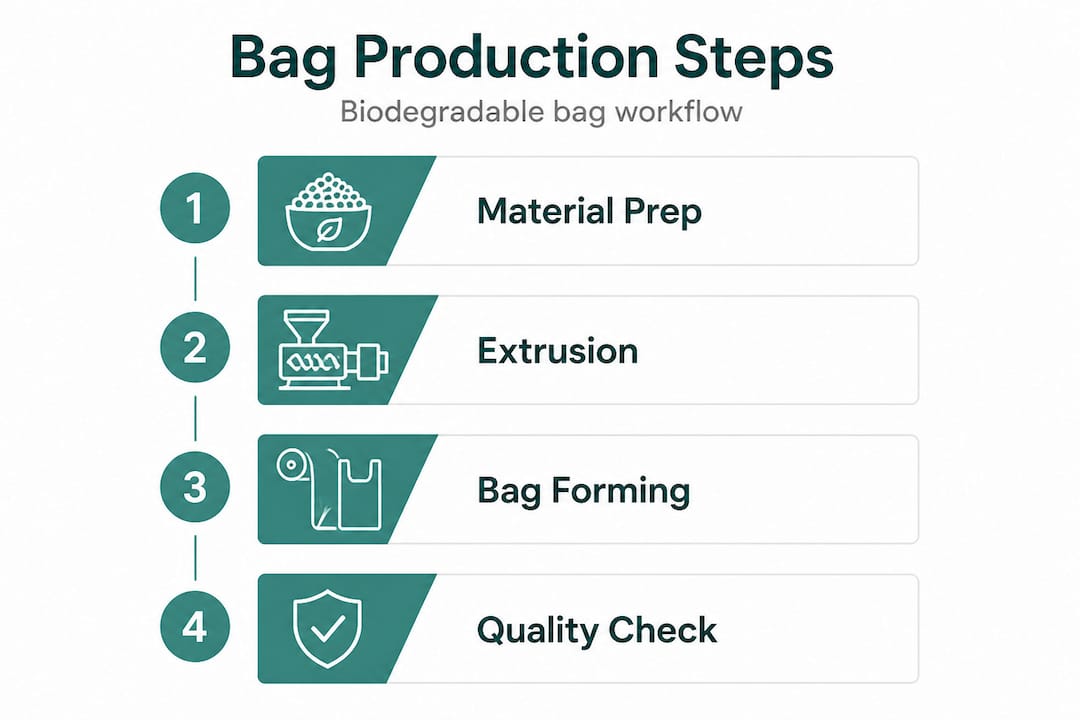
Manufacturing biodegradable bags follows a logical sequence, but each step has variables that affect the final product’s performance, compostability, and appearance. Here’s how the process unfolds in practice.
1. Material selection and preparation
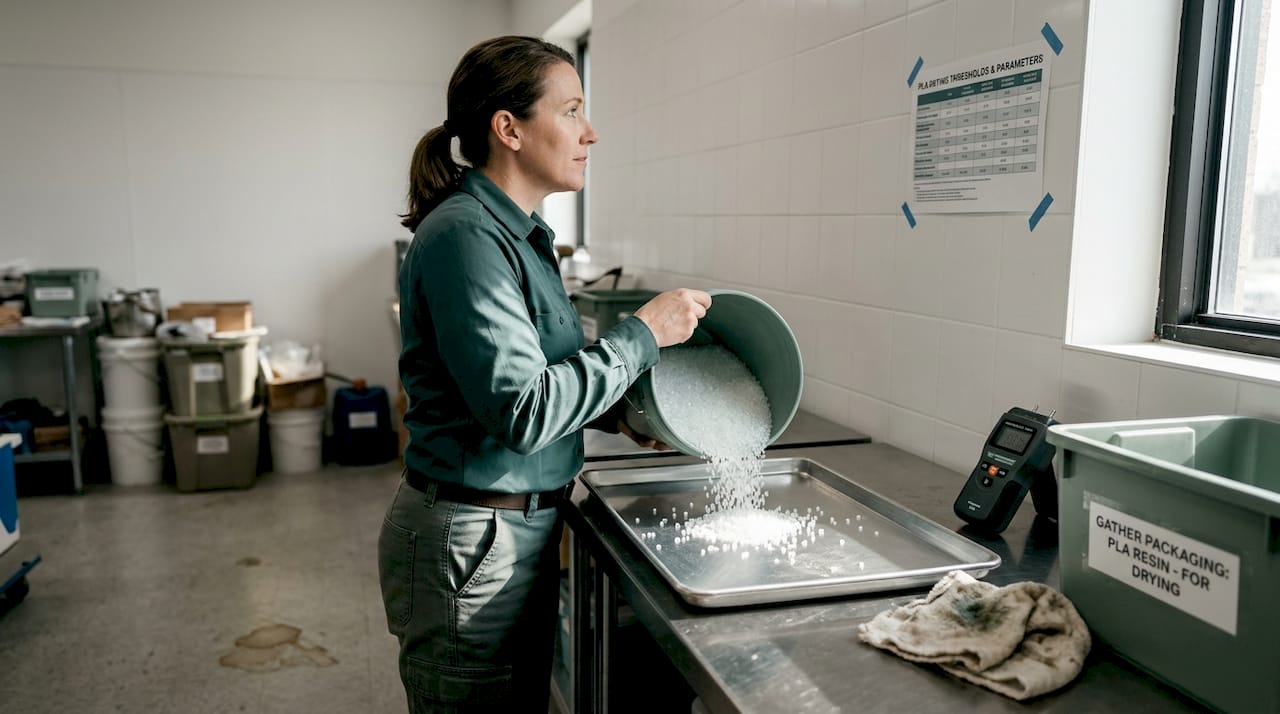
Resins arrive as pellets or granules. Before processing, they must be dried to specific moisture thresholds. PLA in particular is highly hygroscopic, meaning it absorbs moisture from the air readily. Even small amounts of residual moisture cause hydrolytic degradation during extrusion, which weakens the finished film. Drying time varies by resin type, typically between two and four hours at controlled temperatures.
2. Extrusion or co-extrusion
This is the core of the process. The resin is fed into an extruder where it melts under heat and pressure, then pushed through a die to form a continuous film. Blown film extrusion is the most common method for bag film: air inflates the molten tube to a specific diameter and wall thickness before it cools.
| Method | Layers possible | Best for | Tradeoff |
|---|---|---|---|
| Single-layer extrusion | 1 | Simple, low-cost bags | Limited strength or barrier |
| Co-extrusion | 2 to 7 | Bags with tailored properties | Higher equipment cost |
| Tandem lamination | 2 or more (post-process) | Adding paper or foil layers | Compostability risk if adhesive is not certified |
Co-extrusion allows manufacturers to combine a rigid PLA outer layer with a more flexible PBAT inner layer in one pass, creating a bag that is both printable and durable. As noted in Sulzer’s flexible packaging work, multi-layer constructions are a standard approach to resolving the single-material property limitations common with compostable polymers.
3. Bag forming, cutting, and sealing
After the film is extruded and wound onto rolls, it moves to a bag-making machine. Here, the film is cut to length, edge-sealed using heat bars or ultrasonic welding, and shaped into the chosen bag format (flat, gusseted, patch-handle, or loop-handle styles). Handle attachment for biodegradable bags requires extra attention: the adhesive, tape, or heat bond must also meet compostability standards or the whole bag fails certification.
4. Quality assurance and printing
Finished bags go through thickness and tensile strength checks, puncture resistance tests, and seal integrity reviews. For printing, water-based inks are the standard choice for bags targeting compostability certification. Solvent-based inks introduce chemical residues incompatible with most certifiers’ requirements.
Automated bag manufacturing lines can integrate inline print inspection and real-time thickness monitoring, which reduces waste and improves batch consistency. For a detailed guide on visual design and layout decisions, step-by-step bag design walks through the creative side of the process. And if you’re still deciding which bag format suits your retail or foodservice operation, reviewing types of shopping bags is a practical starting point.
Pro Tip: Co-extrusion equipment costs more upfront, but the per-unit efficiency on runs exceeding 100,000 bags makes it significantly more cost-effective than post-process lamination. If your brand plans to scale, build co-extrusion capacity into your early supplier conversations rather than treating it as a future upgrade.
Critical standards and real-world compostability challenges
Building bags to standard isn’t enough. Real-world field effectiveness is critical for credibility with customers and composters.
What certifications actually cover
ASTM D6400 and ASTM D6868 test for three things: disintegration (the bag must fragment into small pieces within a set period under controlled composting conditions), biodegradation (microbes must consume a minimum percentage of the carbon content), and ecotoxicity (the resulting compost must support plant growth at normal levels). These tests happen in a laboratory under optimal conditions: consistent temperature, humidity, and microbial populations.
The facility acceptance gap
Field reality is different. According to EPR Group Consulting’s analysis, facility acceptance differs meaningfully from laboratory results because composting operations vary in temperature management, throughput speed, and contamination tolerance.
| Factor | Lab standard (ASTM D6400) | Field acceptance reality |
|---|---|---|
| Temperature control | Strictly maintained at 58°C | Varies from 40°C to 65°C depending on pile management |
| Processing time | 180 days maximum | Many facilities run 60 to 90 day cycles |
| Contamination tolerance | Controlled environment | Zero tolerance for lookalike conventional plastics |
| Biodegradation threshold | 90% of carbon converted | Varies by facility policy |
The bottom line: A certified compostable bag can still be turned away at the gate if a composter’s staff cannot visually distinguish it from conventional plastic, or if your logo or label includes materials outside the certification scope.
Key operational challenges include:
- Lookalike confusion: Compostable and conventional bags can look identical. Clear labeling (color coding, logos, printed text like “compostable”) significantly improves acceptance rates.
- Contamination from mixed streams: If bags are collected in a mixed bin, food residue or conventional plastics can trigger rejection of the entire batch.
- Incomplete label certification: Printed labels, adhesive handles, or laminated panels that aren’t independently certified can disqualify an otherwise compliant bag.
If your product involves any laminated components, the decisions around materials and process affect both performance and compostability credibility. Lamination and sustainability breaks down the specific tradeoffs to weigh.
Common mistakes and troubleshooting tips
Understanding typical challenges can help you produce bags that perform reliably in the market.
Even well-intentioned brands make avoidable errors during the development and sourcing of biodegradable bags. Most of these mistakes come down to misaligned expectations between what a material can do in a lab and what happens when it enters a real supply chain.
Frequent mistakes to avoid
- Mismatched material and end use: PLA alone may work for lightweight produce bags but will perform poorly as a heavy-duty grocery carry bag. Match your blend to the actual use case before finalizing a specification.
- Skipping contamination testing: Conventional plastic contamination at even very low levels (often less than 1%) can compromise the entire batch during compostability verification. Run contamination audits on incoming feedstock.
- Incomplete documentation: Certification bodies require a full material declaration including every component: base film, handles, adhesives, inks, and coatings. Missing one component is enough to delay or invalidate certification.
- Sealing failures from moisture: PLA films that weren’t properly dried before extrusion often produce brittle seals that crack under load. Check incoming moisture content and drying parameters at every production run.
- Assuming certification equals acceptance: As EPR Group’s analysis notes, standards provide comparability but they do not guarantee that every composter in your distribution area will accept the product.
Troubleshooting common production issues
If seals are failing, check heat bar temperature calibration first, then examine moisture levels in the film. If printing adhesion is poor, verify that the film surface energy (measured in dynes) meets the ink manufacturer’s minimum specification. Corona treatment during extrusion typically solves surface energy issues.
Pro Tip: Build a living document that tracks every material change, including supplier shifts and resin lot numbers, alongside corresponding QA results. Certification audits often require batch-level traceability, and having organized records dramatically speeds up the process. Stay current with evolving standards by bookmarking resources like EPA guidelines and the BPI standards updates page. Compostability requirements are shifting as regulations around extended producer responsibility tighten across U.S. and Canadian markets. If you’re designing bags for a foodservice context, designing eco-friendly foodservice bags covers the specific design and material decisions relevant to that sector.
Why “compostable” isn’t always enough: Our industry insight
Reflecting on these challenges and solutions, here’s what we think most brands overlook about going biodegradable.
Getting a bag certified to ASTM D6400 feels like crossing the finish line. In reality, it’s closer to the starting gun. We see brands invest real resources in sourcing certified compostable bags and then discover, months into a launch, that none of their local composting partners accept them. The certification was real. The operational gap was also real.
The deeper issue is that the composting infrastructure in North America is still developing. Fewer than 20% of U.S. households have access to food waste collection programs that accept certified compostables, which means the end-of-life pathway your brand is communicating to customers may not exist for most of them. That’s not a reason to abandon compostable packaging, but it’s a reason to communicate honestly and plan strategically.
What we’ve seen work consistently is brands that treat composter relationships the same way they treat supplier relationships: with proactive outreach, ongoing dialogue, and shared problem-solving. Calling your regional composters before you launch, sharing your certification documentation, and asking what labeling or color coding makes their sorting easier all create goodwill and increase acceptance rates in practice. These conversations also give you early warning if your bags need any modification.
The brands that build the most credibility with their customers are also the ones that are honest about the system’s limitations. Saying “this bag is certified compostable and accepted at these specific facilities” is far stronger than a generic green claim that customers can’t verify. Transparency about the process, including materials choices and lamination strategies for bags, builds the kind of trust that survives regulatory scrutiny and customer questions.
Compostable bags are worth doing well. But doing them well means owning the entire lifecycle, not just the manufacturing step.
Work with bag production experts for your next sustainable launch
Ready to take your biodegradable packaging from concept to certified production? Navigating material blends, certification requirements, and composter acceptance is much more manageable when you work with a manufacturer that’s done it before across multiple retail and foodservice contexts.
At Gather Packaging, we specialize in custom eco-friendly bags that combine real sustainability credentials with the print quality and durability your brand needs on the floor. Our eco-friendly bag solutions are built around FSC-certified materials, water-based inks, and recycled content, with options that meet the certification standards retailers and foodservice operators actually need. Whether you’re sourcing in volume or exploring a new sustainable format, our team can guide you through material selection, prototyping, and QA. Take a look at our kraft paper bags in Canada for a practical starting point, or reach out to talk through your specific requirements.
Frequently asked questions
What materials are commonly used to make biodegradable bags?
PLA, PHA, and PBAT are the most common materials, often combined in blends to balance flexibility, strength, and certified compostability for shopping bag applications.
Are all certified compostable bags accepted by composting facilities?
No. As field conditions show, certified bags can still be rejected based on individual facility policies, processing cycle length, or visual similarity to conventional plastics.
What is the main production method for biodegradable bags?
Extrusion and co-extrusion are the primary methods, and multi-layer constructions are standard in commercial bag manufacturing to combine the properties of different compostable polymers in a single film.
What certifications should I look for in biodegradable bags?
In North America, look for ASTM D6400 for fully plastic bags or ASTM D6868 for bags with coated or laminated substrates. Both standards ensure comparability across industrial composting scenarios, though field acceptance still varies by facility.
Share:
Top 4 Colemancontainers.com Alternatives 2026
How packaging logistics shapes brand value and sustainability